Showing posts with label Fantastic Four. Show all posts

Thursday, March 31, 2011

Comics! The passing of the Torch


Marvel's two flagship comics continue to deal with the aftershocks of the death of Johnny Storm, the Human Torch, a couple of issues ago in "The Fantastic Four." Nobody this side of Aunt Petunia believes the Torch is really, permanently dead (since a revived and all-growed-up Bucky Barnes is now on the Avengers as Captain America, my old ironclad Marvel Comics rule "Nobody dies but Bucky" has now been amended to "Nobody dies, period"), but these long-arc storylines where a major character seems to be dead allows writers at Marvel and DC to pretend it was all true and put all the related characters through all the Kubler-Ross stages of grieving, kind of like Tom and Huck getting to watch their own funeral.

Such a gambit can be flubbed, of course - DC dropped the ball big-time twenty years ago with its "Death of Superman" arc, and then, not to be outdone, they dropped the ball again last year when Batman allegedly died. But Marvel tends to do it right, as was seen in their recent headline-grabbing "Death of Captain America" story. And the approach they're taking this time is low-key and entirely believable.

The stress is on family, and Dan Slott's writing captures something of the tone of that quite nicely. The current issue of "Spider-Man" (lamentably titled "Torch Song") features nothing more than Spider-Man going to the Baxter Building late at night to share the company of the remaining members of the Fantastic Four (we're treated to a neat little homage to Spidey's first visit to the team, when he's accidentally caught in a pneumatic intruder-tube). It's all very quiet and sad and real-seeming, just four old friends talking about a loved one who's died. Gruff Ben Grimm matter-of-factly tells Peter Parker that he's a member of the family, and Sue Richards seconds it. They're sitting in the kitchen talking - no super-villains erupt through the walls, no surprises explode in splash panels.

The timing is off a bit in terms of titles shipping to stores - readers already know Spider-Man will join the team - but that doesn't dull the enjoyment of the last bit, where Reed Richards reveals that Johnny left one last holographic video message for Peter Parker:
Pete? If you're hearing this, I'm sorry, pal. Sorry that I'm gone, 'cause ... well, I know how you feel when it comes to losing family. And that's what you are to me. Family. So ... if you're thinking of this as my last will and all ... I'm not leaving you my sports cars or stuff like that ... I'm leaving you the best thing I ever had ... my spot on this team. A place in this family. The best sister, two brothers, niece, and nephew a guy could ask for.

Slott hits all the right notes in these scenes (including the hokey-but-effective signature FF hand-pile), but for my money, the single best evocation of what this whole story means is Marcos Martin's wonderful, understated, incredibly sad cover illustration. The combination of elements - the Empire State Building, the old-style water tower, the '4' signal-flare that will never now mean what it once did, and a small-looking Spider-Man looking up at it - makes this the best Marvel cover I've seen this year.

Tuesday, November 02, 2010

Comics: Last week!

Last week's comics were all over the place in terms of quality, but certain images stand out. Let's pick two for Marvel and two for DC and see what we get, shall we?

Marvel's worst image of the week would have to be the cover of the latest issue of the Avengers' most recent re-launch:


although I'll give this monstrosity its due: it perfectly reflects the disaster this opening run of the book's first storyline has been from the start. It's hyperactive, confused, and incredibly misleading (nothing even closely resembling that scene happens in the issue, needless to say). 'Old' Hulk is grabbing Thor's tunic; but Thor is smacking him across the face with his hammer; but Thor's helmet is falling off, for some reason; but there's some weird-looking young woman jumping over the two of them like it was a dance contest; but the Avengers logo is shattering, for some reason … etc. Actually reading the issue isn't any less painful or distracting – just more prolonged.

DC's worst image isn't actually bad – but it also serves as perfect visual shorthand for the whole issue's contents. Smack dab in the middle of the latest issue of the Teen Titans, we get this:


That's sensitive young Connor Kent – i.e. Superboy – getting all sympathetic with Wonder Girl (because this is the 21st century, the scene takes place after they've done some heavy kissing and caressing), pausing in the middle of a make-out session to hear about all the things that are bothering her this week. It's plodding, TV melodrama-type stuff, and that's been a besetting problem with the Titans for about 900 issues now: no writer has come along in quite some time who seems willing to just ignore the impossibly complicated back-stories of every single character on the team and just make the book exciting again. Instead, we get scene after scene like this one (although usually not so prettily drawn), in which meaning and melodrama are hashed out endlessly in place of anything actually happening. It's possible the writer and artist felt they needed to get this stuff out of the way first – the set-up for next issue looks very promising, at last – but we'll see.

Luckily, it's not all bad news! DC also furnished one of the best issues of the week, in which Lex Luthor, thinking he's dead, has an issue-long angry discussion with Death herself – the teenaged girl-waif Death from Neil Gaiman's interminably pretentious “Sandman” run. At one point, Lex (who here proves again and again the truth of the old theater axiom that villains get to be ten times more interesting psychologically than heroes), trying to figure out what's going on, makes a ranting mention of DC's biggest, most-hyped crossover event of the summer, saying all of this must be connected somehow to the Black Lanterns and Darkest Night. To which Death has an answer that's hilariously blasé:


And even that panel can't hold a candle to the best visual of the week. Over at Marvel, Ben Grimm has been given the ability to temporarily revert to his human form, and he and Johnny Storm decide to make the most of it by filling the day with a host of long-postponed 'normal' activities that Ben could never quite do in his monstrous Thing persona. And one of those activities is a pure gift to us long-time fans:


Impossible to beat that, this time around. But who knows what the next batch of comics will hold?

Friday, June 27, 2008

comics in july!

Five different comics this time around, and the thrilling breath of rejuvenation running through each one of them! And the incredible thing is, four out of five of those comics were published by Marvel, a company whose recent creative decisions have been, shall we say, questionable (fascism rules? check! Spider-Man off in la-la land? check! Captain America effing dead? check!). We here at Stevereads once thought that, given the state of affairs at Marvel, the only way they could field a rejuvenatingly good issue would be to very consciously set it outside the pig's breakfast that is the company's current continuity. Put Spider-Man in some sort of mystical backwater where you can turn back the clock; put the Hulk on an alien world and follow his adventures there; put Thor (and Asgard) out in the American badlands as a declared neutral, etc.


So imagine our surprise to find that two out of these four Marvel titles take place smack-dab in the middle of the current muddled continuity! One of these is Marvel's flagship title, The Fantastic Four, now under the creative control of writer Mark Millar and artist Bryan Hitch; issue #558 is the start of a new storyline (not, curiously, the one trumpeted on the cover, "Starting This Issue: The Death of the Invisible Woman" - no hint of which is present in the issue itself), one which sees the villainous Doctor Doom falling prey to a group of mercenaries called the New Defenders (who, in the tiresome Millar fashion, are made to seem bad-ass by easily defeating our heroes in the initial set-to), forcing the FF to come to his defense. Hitch's pencils still seem a little rough (Andrew Currie is not his ideal inker), but Millar's got a good grasp of the non-stop action and underlying humanity that are the hallmarks of this particular team. We predict that if Millar stays with the title, this Doctor Doom storyline will turn out to be really, really good, and the eventual Galactus storyline will be epic. We shall see.


The other of these two issues is the latest She-Hulk, written by fanboy-favorite hack Peter David and drawn with interesting linear simplicity by Val Semeiks. The plot is fairly simple stuff - a giant on a rampage in a city, She-Hulk and guest star Hercules teaming up to beat the giant and save the day, etc. The rejuvenation here is something happening in more than one place in the Marvel universe these days: the revived and fantastic use of Hercules as a character. He's got his own comic, and he's appearing everywhere else, and this is a very welcome development - in Marvel comics, Hercules has always stood in the shadow of Thor, but in many ways he's more interesting and logical character to moonlight as a super-hero: after all, he's part human, whereas Thor is not. When you think about it, it's an inherently silly idea that a god of thunder would spend time having adventures alongside the Wasp and Hawkeye. But Hercules has a history of adventuring alongside superpowered mortals, so it's refreshing to see him showing up i so many places lately.

One of which, in this issue of She-Hulk, is her bed! After their adventure together, these two heroes decide to make merry in her RV, and one thing leads to another. Oddly, when it's time for him to write the inevitable morning-after scene, David doesn't screw it up. As she looks at the sleeping Hercules, She-Hulk thinks, "When all is said and done, he was one of the few who stood beside Bruce when it all went down. That meant a lot to me. He meant a lot to me. And well ... he's immortal. For all I've got going for me, that's something I'll never be. Except ... I was, for one brief moment in time, the lover of Hercules. So maybe that's a little bit of immortality for me. There's dumber reasons to have sex with a guy. I should know: I've used them all."


Far more typical is the aforementioned manuever of setting your story outside of the current Marvel continuity, which is what our next two Marvel issues do. Matt Fraction's new issue of his ongoing Thor mini-series is firmly mythological in its setting; here there is no hint of Thor the super-hero, just high epic fantasy - for which Fraction shows a surprisingly adept hand. The dialog of his gods, demons, and monsters bears no similarity to the 'thee's and 'thou's of Stan Lee's era, but it's extremely distinctive just the same.

The issue features two parts, the first drawn by Khari Evans in a competent enough manner reminiscent of Ron Frenz, and the second drawn to bring the walls down by Patrick Zircher. The first segment is entertaining enough - again, a loose adaptation of a story out of Norse mythology - but the second story! Hoo-boy! Here is everything a real Thor story should be (except that Thor, true to Norse mythology if not to Marvel continuity, is still a bit of a jerk): it's sweeping, epic, and full of fantastic stuff. The best part of it happens when the poor mortals of Earth, beset by legions of the undead, create the husk of a "blood colossus" to combat their enemies. They pray and pray to summon Thor, hoping his lightning will bring their blood colossus to life: "Mortals prayed and prepared as best they could. Shattered by the unending cruelty of an unjust punishment, they began to look toward the miraculous. Until finally the miraculous began to look back." Thor shows up, animates the colossus, and saves the day, but this all feels much more like some alternate title Marvel would have published in the mid-'70s.

Our plea here at Stevereads: Marvel should create a new title, call it "Tales of Asgard," and make Patrick Zircher illustrate it until Ragnarok, if not longer.


The other offset Marvel issue this time around takes a much surer path: a retold origin story. In this case, it's an installment in the ongoing, spottily-executed 'Mythos' title aimed at revisiting the origins of Marvel's characters. In this case, touchingly, it's Captain America's turn, here getting a splendid, moving treatment by writer Paul Jenkins and artist/painter Paolo Rivera. This is an origin story that's been told many times - skinny WWII army reject Steve Rogers is chosen to undergo experimental procedures and become America's "super-soldier," Captain America. The one difference in this retelling (inspired, no doubt, by the "Ultimate" version of Captain America featured in "The Ultimates") is that we're specifically told that the experiments give Captain America super-human abilities. But that's beside the point of the story, which is a wonderful story of a man out of time. That, plus the issue having the greatest cover of any Marvel comic published in 2008, makes this issue a large-lunged call to bring back their signature character, for Pete's sake.


And then there's the ongoing rejuvenation of The Legion of Super-Heroes over at DC Comics, all thanks to legendary writer Jim Shooter, who has kept his new run on this, his old stomping-grounds, positively sizzling with activity on many fronts, all the while packing in a disarming amount of characterization. Bit by bit, piece by piece, he's editing out the ridiculousness of the current Legion incarnation and weaving back in his own sure-footed grounding in character and action. His Legion is beset on all sides - physically by monsters continually adapting to their powers, politically from a suspicious United Planets eager to control the Legion. Each issue happens at breakneck speed, which is great (and something not one writer in ten can manage successfully), and we here at Stevereads confidently expect that the upcoming issues will feature some of the Legion basics Shooter hasn't got to yet - a possible Brainiac 5 meltdown, for instance, or the arrival on the scene of a genuine villain or two (the monsters in these issues are a good start, since there's got to be somebody pulling their strings). In the meantime, this is great stuff, especially for Legion fans.

All of the issue this time around were great stuff - something we doubt we'd be saying if we'd allowed the clerk at the Android's Dungeon to talk us into the latest issue of Trinity, or Final Crisis, or some such. A fate narrowly avoided, and as it is, we put aside our batch of comics smiling a contented smile.

Tuesday, June 12, 2007

Essential Fantastic Four, volume 6


Our book today is the sixth volume of Marvel Comics’ ongoing reprint series, ‘Essential Fantastic Four #6,’ collecting issues 111 through 137 of the Fantastic Four’s monthly comic book from the ‘60s and ‘70s.

The sheer number of you we lost just now with that little description is a sorry reflection on the cultural snobberies of our age, but we shall persevere, not only in the hopes of changing that status quo, but also because Kevin, Elmo, and all the other scattered faithful will appreciate the effort to level the playing field.

So: the Fantastic Four. For those of you languishing in ignorance (you know who you are, and you’ll need to be up to speed if you’re to take in the religious event known as ‘Fantastic Four - the Rise of the Silver Surfer’ in theaters as we speak), that means Reed Richards, the world’s smartest man, Sue Richards, his fiery and compassionate wife, Ben Grimm, his crusty old-school best friend, and heartthrob Johnny Storm, Sue’s younger brother. They go up into space in a stolen spacecraft, accidentally get exposed to cosmic rays, and get transformed into the Fantastic Four: Mister Fantastic, who can stretch his body like silly putty, the Invisible Woman, who can fade from sight and generate equally-invisible force fields, the Thing, rocklike monstrosity of enormous physical strength, and the Human Torch, a living firebrand capable of hurling flame.

They were Marvel’s flagship title, a super-group that was first and foremost a family, with squabblings and interpersonal dynamics that were, in the early ‘60s, virtually unheard of in comic books. Their identities are known to the public - indeed, they’re celebrities, and Stan Lee is a fine, funny chronicler of the ups and downs of that status. Far from a Fortress of Solitude or a Batcave (and we should remember that the Justice League originally hung out in a cave), our heroes make a Manhattan skyscraper their headquarters.

The list of Stan Lee’s innovations on this one title alone virtually defy tabulation, and they get taken for granted by today’s over-pampered comics-reading set, who think all the gritty givens that form the basis of every comic out there were somehow ALWAYS there. They weren’t. Stan Lee and Jack Kirby invented them.

This presents problems in an of itself, namely: what do you do when the creating ur-titans get older and want to retire, or seek out new pastures? How do you pass the torch on something so newly minted?

In the case of Marvel comics, the answer is: pretty bloody awkwardly. Stan Lee insisted on being credited as writer long after he’d lost interest in the title and ceded actual scripting chores (writing and re-writing dialogue, checking continuity, etc) to three of the greatest wunderkins ever to grace a comic book company: Gerry Conway, Archie Goodwin, and Roy Thomas. DC Comics, during their own transitionary period, could only have dreamt of caretakers so conscientious (well, OK, they had one - Julie Schwartz - but he was unique).

But first, we have to get through the dwindling of the old order, and in the case of the Fantastic Four, that was a long, protracted, severely depressing trough of truly terrible issues (the sack of crap collected in Essential Fantastic Four #5 is a thing you wouldn’t drop on the head of your worst enemy).

Luckily, thanks to the growing influence of the trio named above, by volume #6 some light is breaking through the clouds. Stan Lee is credited with writing a great number of the early issues collected here, but he didn’t; Thomas and especially Goodwin were generating every word of dialogue, altough often enough under Lee’s heavy influence.

It must be admitted right up front that this volume’s worst misstep is also a really, really big misstep: the second coming of Galactus is botched so badly we here at Stevereads challenge any of you to tell us how that particular story ends, or even what-all happens in it.

Galactus this time around is heralded by Gabriel, perhaps his lamest-assed herald (Terrax was bad, but perhaps not quite so bad) Galactus has had so far. Gabriel walks on air like an angel and signals the end of the world - i.e. the world’s being gulped down whole by planet-chomping Galactus - by blowing on his horn. Get it?

He fights the FF almost to a standstill, despite the fact that he ends up being a friggin robot who they should have trashed in about four panels of trying. But that’s not the worst of it: when Galactus shows up, he displays his awesome presence and power by ... well, by talking a lot of trash and hanging out a lot at Coney Island. Suddenly, Galactus is Vinnie Pastoranza, the bad boy of Our Lady of Perptual Grace in Brooklyn. The story is so bad that we don’t even care a) when the Silver Surfer shows up, b) why he shows up, or c) what the hell he does once he’s there.

No ultimate sacrifice this time around. No Ultimate Nullifier. Galactus wears shortpants and plays around with the Cyclone for a weirdly unseemly amount of time, and all through it, you get the impression that this whole thing went wrong for the exact same reason so many Hollywood blockbusters go wrong: too many cooks, too much creative interference, or, as my somewhat disturbed old friend Franco always said, too many hands down the boy scout’s pants. (in case you’re wondering, it was at that exact moment that this review got Beepy’s attention)

You’d think nothing could save a collection that manages to feature a bad Galactus storyline, but you’d be wrong: there’s some strong stuff here, beginning with the volume’s first story-arc, featuring a big, fat baddie named the Over-Mind and a wonderful, protracted Thing/Hulk battle that displays some of John Buscema’s finest penciling on the title (the crisp inking by Joe Sinnott works perfectly here, where it would have been disastrous on, for instance, Kirby’s pencils). In the course of that battle, and in the course of the Over-Mind battle that follows, the FF inflict a great deal of property damage on Manhattan - for which they’re threatened with eviction by their landlord, and for which they’re actually arrested by the police (Reed Richards writes out a check for their $20,000 bail) - today’s readers will be forgiven for seeing seeds of Marvel’s recent wretched ‘Civil War’ storyline, and yesterday’s readers will be forgiven for wistfully wondering what glories could have been wrung from that premise by writers like Thomas or Goodwin.

It’s in this series of issues that Johnny Storm loses his sometime-girlfriend, Crystal of the Inhumans, to none other than Quicksilver, who’s just mutie-bastid enough to rub Johnny’s face in it. This is also the period in which Medusa of the Inhumans joins the team, and re-reading these issues gave us a fresh appreciation for how she’s portrayed: mature, capable, with just a hint of the disdain that might come naturally to royalty (this volume also features a great little sequence where heartsick Johnny looks up his old sweetheart Dorrie Evans - and finds her to be a cheery, plump house-frau mother of two... at a time in American history when even the squarest melvin could get some groovin, Johnny can’t catch a break)

The highlight of this volume, though, is also one of the single-issue highlights of the Fantastic Four’s entire history. It’s a story called “Three Stood Together,” in which the Black Panther, traveling incognito to the white supremacist African nation of (somewhat disappointingly) Rudyarda, is thrown in jail for being black, and the Thing and the Human Torch go there to break him out (and stop the bad guy, of course)(who’s Klaw, of course). From the start, the two heroes are disgusted by the country’s separate but equal doorways labeled ‘Europeans’ and ‘Coloreds,’ but the story raises a broad spectrum of racial issues (like, for instance, when the Thing questions why T’Challa is temporarily calling himself ‘The Black Leopard’ and T’Challa answers: “I contemplate a return to your country, Ben Grimm where the latter term [Black Panther] has ... political connotations. I neither condemn nor condone those who have taken up the name - but T’Challa is a law unto himself”).

At the end of the issue, after the bad guy has been beaten and all set right with the authorities, our heroes encounter once again a stone wall inset with separate doorways for ‘Europeans’ and ‘Coloreds,’ and the Thing, steaming over the whole concept, abruptly tears down the whole wall, and the three walk out over the shattered labels. It’s a little hokey, but when you consider how many times apartheid or black power movements had been mentioned in comics prior to that (i.e. never), you recall the power the issue had when you first read it.

The next volume of Essential Fantastic Four will contain, by our reckoning, five real high points in the history of the title. But this volume has its share of nifty bits and is by no means despicable. Despite some notable missteps (cosmic bikers? a big furry creature with a WWII land mine for a head?), this volume is well worth your handful of fivers.

Thursday, January 25, 2007

Comics! The highs and lows of Pepito!


Plenty of highs and lows in our most recent batch of comics, certainly enough UNcertainty to justify the periodic swearing-off that even die-hard comics fans have been known to do. There's a handful of really good titles being published every month, but they're surrounded every week by such vibrating piles of poop that even the faithful find themselves doubting.

It's always been so, of course. Here at Stevreads we have a rather sadly OLD intern - he's an oddity at whom the others point and sneer - who remembers a time DECADES ago when the only good monthly titles being published were John Buscema's run on Conan and Mike Golden's run on Micronauts. But knowing ahead of time the tedious features of the landscape doesn't make it any easier to pass them on the road.

Part of the problem, as you're all guessing by now, is my archnemesis Pepito. When he's not seeding the globe with robotic duplicates of himself (unfortunately they're EXACT duplicates, meaning they don't get up until 2 in the afternoon and they're constantly forgetting where they left their keys, so the whole world-domination thing is likely still a ways off), he's out there routinely buying equal weights crap and good stuff.

For crap, take the latest issue of Wolverine. Actually, take the whole IDEA of a Wolverine comic, but this issue certainly isn't helping any. It features some very spiffy art by Simone Bianchi and a howlingly (no pun intended) ridiculous plot by Jeph Loeb.

The plot involves yet another re-imagining of the relationship between Wolverine and Sabertooth, this one looking to feature, disasterously, some pre-historic tribe of wolf-people called the Lupine (no need to follow up on it, since we won't be dumb enough to read the next issue).

But as if that weren't bad enough, the issue starts with Wolverine using one of his claws to pick his way into Professor Xavier's mansion (no explanation of WHY he does this, since presumably he has a key or pass-card, but hey). Rogue is standing there when he walks in (she points out the key business too, but hey), and our hero right off tells her: "This is between me and him, Rogue. You wanna make it about you and me, pick a different night."

Then Rogue says, "Well gosh, sugah, it sure looks to me like you came here to coldly, premeditatedly kill one of my teammates, so I'm gonna hafta use my super-strength, super-speed, and life-absorbing powers to slap you down like a daddy-longlegs." There follows a thirty-second battle, and afterwards, when Wolverine wakes up, she and him spend the rest of the issue debating the pros and cons of vigilante justice.
Oooops. That's how the issue went in its first draft, before Loeb hoovered up a saucerful of coke. In the issue before us, Rogue says "You could've knocked" and frickin WALKS AWAY, after which Wolverine tries his hardest to cold-bloodedly murder her teammate.

Yech.

Luckily, for every sweaty-adolescent power-fantasy in the batch, we've got a comic written for actual thinkng adults, like for instance the penultimate installment of 'Doctor Strange - The Oath,' which is hands-down the best Marvel book currently being published. If there were any justice in the comics world, this mature, intelligent, funny version of Stephen Strange would become the new definitive version and run for 50 issues - when this storyline is collected in a graphic novel, it will be that rarest of rarities: a book you can hand to anybody, confident they'll like it. Our sources tell us that this mini-series isn't selling out every month - which means it should be possible for you-all to toddle on down to the Android's Dungeon and catch up on all four extant issues. Hint hint.

Alas, our little pile of comics doesn't stop there. Up next is the first issue of another Marvel mini-series, "Silent War," written by David Hine and drawn by Frazer Irving.

We're all in favor of the concept of the mini-series, here at Stevereads. Open-ended comic titles are almost always deficient in plot; their soap-opera nature prevents them from delivering the climax and payoff that close-ended short-runs can (this applies even to mini-series that are gargantuan in their scope, like 'Cerebus' or 'Bone,' since they were - at least according to their creators - plotted out ahead of time).

Yep, we like mini-series. Except when they suck. Which brings us to 'Silent War.'

First, a little background: the Inhumans are a reclusive super-race who gain their powers by entering a chamber full of genetic-code-altering Terrigan Mists. Inhumans go through the Mists as a cultural event, and no two end up with the same powers. In a recent storyline, the US government came into possession of the Terrigan Mists, and when the country refused to return them, Black Bolt, the king of the Inhumans, declared war on the United States.

So far so good, mainly because so far 'Silent War' hasn't started yet.

Once it does, major and minor annoyances start piling up pretty quick. What is the plan of the Inhumans, you wonder? Looks like it's this: they send four of their number (Gorgon, whose hoof-stamps trigger mini-earthquakes, Jolen, who controls all plant-life, Kurani, who can cast lifelike illusions, and Nahrees, who seems to have electrical powers) to America, where they commandeer the stage during a black-tie Shakespeare performance and issue a declaration of war on live TV.

Problem #1: as we covered at the beginning of class, Black Bolt has already declared war. Problem #2: Manhattan is, like, CRAWLING with super-heroes.

Then the plan goes awry: instead of merely restraining the audience (as Gorgon tells us repeatedly their king ordered him to do), Jolen decides to have his plants start KILLING them. Gorgon puts a quick stop to this, but not before dozens have been killed.

The four of them leave the theater and return to their hotel, where they're confronted by the Fantastic Four (meaning, I guess, that this mini-series falls into the very, very narrow gap between the events of 'House of M' and 'Civil War'). When Gorgon asks how they were detected, Ben Grimm supplies this answer: "Four visitors from Eastern Europe fly halfway around the world to sit in a crummy hotel room for a week. First time they go out, there's a terrorist attack on a theater half dozen blocks away."

Okaaaay. Problem #3: Why did the Inhumans reserve a hotel room at all, when they could have had any one of their people's teleporters wisk them in and out? Problem #4: Even assuming they take a hotel room, why not have their cover-illusion be that of a wholesome American family (or, Hell, one person and three pieces of luggage)? Problem #5: why wait a week, increasing the likelihood of detection? Why not strike some venue right away? And Problem #6: we're told a hotel clerk called Homeland Security AFTER the attack, having become suspicious beforehand. But Gorgon and crew walk straight from the theater to their hotel ... where the Fantastic Four are already waiting. That kind of split-second timing just begs to be laughed at.

Except that it's nothing compared to what follows. The next few pages are take up with one of the all-time suckiest comic-book battles we here at Stevereads have ever seen. Despite the fact that the powers of each Inhuman are formidable in their own right (and despite the fact that Gorgon himself has fought the team better all by his lonesome), the Fantastic Four wins without breaking a sweat. And depite the fact that one of the Inhumans present is an illusion-caster, and despite the fact that Black Bolt's evil brother is a mind-controller, and despite the fact that the Fantastic Four and the Inhumans have been friends and allies and practically family forever, the Fantastic Four then hand them over to face-masked rifle-toting government agents without hesitation.

What follows reads like a cheap knock-off of 'Civil War' (which, as Elmo has pointed out, itself reads like a cheap knock-off): Gorgon is stripped (eww), interrogated, declared an 'enemy combatant' with no right whatsoever, and then EXPERIMENTED upon, all in the space of seven quick and easy pages. Not by Maximus the Mad or by Kang the Conqueror or by Doctor Doom, but by the U.S. government, which, in the current grossly cynical Marvel universe, has apparently replaced the Nazis as the go-to villain for sadistic torture-sequences. Yeesh.

Ironic, then, that our final highlight from this batch of comics also features the Fantastic Four. In the latest issue of their own book (writer Dwayne McDuffie's first), one of the things that's bugged us most about the whole
'Civil War' storyline is finally addressed: why the hell would Reed Richards support the Registration Act?

The issue begins with Reed agreeing to meet Johnny Storm in a coffee shop so Johnny can pose that very question to him. Reed prevaricates in all the ways we've seen before - that it's the law, that it's a good law, etc. - and when Johnny asks him if he's sure he's right about that, Reed tells him 'to a mathematical certainty.'

And then, for the first time, we see him doubt that certainty.

He does what any super-genius would do: he enlists another super-genius to check his math. The super-genius in question is the Mad Thinker, here wonderfully characterized. Reed takes him back to the Baxter Building, where construction teams are assessing the costs of repairing the damage Sue Richards did last issue (there's a delicious bit of political commentary here, when the head of damage control thanks Reed for his patronage, noting that Halliburton's been getting all the work lately. Reed's response? "But they always go substantially over estimate" Hee ... that would have been grimly funny even before they went some 20,000 'over estimate' ...).

Reed shows him the equations he's been using, the equations that have prompted him to believe supporting the Registration Act is the only way to stave off unspecified future disasters. The Mad Thinker examines the work with nicely understated envy ("No wonder I never beat you. I was a caveman, bragging about fire, and you were splitting the atom") and then reveals that Sue has been with them all along, invisible and listening. Once she hears the real explanation for Reed's actions, she storms off.

The issue is wonderfully done, but hey - it wouldn't be a Stevereads write-up without a few bricks being hurled, now would it?

For instance, when - and more importantly why - did Sue contact the Mad Thinker? Was she with him as they entered the Baxter Building, where presumably there'd be security sensors to detect her? And what, Reed can predict 'societal trends' to a high degree of accuracy, but he can't anticipate the actions of his own wife? (actually, those of you out there who are married might give him a pass on that, come to think of it)

And most of all: why is everybody in the issue so fat? I mean, it's the Fantastic Four: I expect the Thing to be fat, and certainly the Red Ghost looks like he's had a few too many blinis. But for some reason artist Mike McKone is drawing EVERYBODY as shapeless and doughy. What, our heroes haven't ever heard of 'You on a Diet' or 'The JuiceMan Cometh'?

Either way, a singularly uneven batch of comics this time around - but hey, what can you expect, when dealing with megalomaniacal euro-trash such as Pepito? Maybe we'll have better luck next time ...

Friday, December 15, 2006

Comics! 52, FF, and more!


Four comics this week, all quite good (proof positive that they must have come from Elmo, since there's not an issue of gay-murderer Nightwing or Super-Linebacker, not a piece of crap in the batch ... hence, Pepito's hand is not seen) - and each yields a fervent PLEA to the funny book powers that be.

The current issue of '52' maintains that title's increasingly incredible run of great issues (those of you who a while ago gave up on this book should pick it back up forthwith ... not as some sort of 'prequel' to the current continuity, but because you'll scarcely read better DC stories anywhere on the new release shelves)(that last urging was aimed pretty much squarely at you, Kevin, ya snobby slug-a-bed!). It can't last, this run - next issue promises more of the idiotic new untrained lesbian Batwoman, and that CAN'T be made good.

But we can savor it while it lasts! This issue's hugely winning highlight is the whining, hapless Ralph Dibny's discovery of the hidden mountaintop city of Nanda Parbat.

I expected to be bored. I expected, in fact, to be FRUSTRATED and bored, since the Nanda Parbat stories I WANT to be reading star one of the greatest DC superheroes of them all, sharing all the elegant simplicity of the Hal Jordan Green Lantern, or the Barry Allen Flash - or indeed Superman and Batman: of course I refer to Deadman. And not whatever stupid-ass relaunch might be out there, but good old Boston Brand, wisecracking circus performer/ghost, who can slip his ghostly form into living bodies and take control of them. THAT character should be on issue #300 of his own title right now, but that's not the plea associated with this issue (well, it IS - I mean, it's always been a plea of Stevereads that Deadman be given the treatment he's due ... and yet, apart from that marvellous mini-series two years ago with its stellar artwork by Jose Garcia-Lopez, he hasn't received it).

No, our plea arises from this issue's amazing portrayal of one member of '52's Chinese super-team, the Great Ten of the Peoples Republic.

When we first encountered the team, we groaned at all the stereotypes herded together in one narrow space. Perhaps unlike the rest of you, we here at Stevereads number among our closest friends a native of China who would cringe equally at all the one-note caricatures it contained.

So imagine our pleasure when, in this issue, we learn that at least one member of the team, the lamentably-named Accomplished Pefect Physician, is revealed to have an actual personality, an individual back-story in which he's NOT just a mindless Communist party drone.

So our plea is this: more, please! Let's have a Great Ten mini-series, with equal complexity doled out to each member. With sufficient googling on the part of our writers, it could prove an educational experience for all the comic readers out there whose knowledge of China starts and stops with the Yellow Claw.

Up next is the third issue of Alan Davis' everything-but-the-kitchen-sink 'imaginary' Fantastic Four story, 'The End.' This is the third issue of six, so there's way too much going on to summarize here. Suffice it to say Davis is continuing to haul in as many characters from the FF (especially the Lee/Kirby era) continuity as he possibly can - Galactus, the Watcher, Ronan the Accuser, Black Panther, and the Sentry this time around. And as with the previous two issues, there's the distinct feeling that he's sending out invites before he counts his chairs, if you get my meaning.

Still, this issue has high points - Davis' artwork is stellar, and John Kalisz contintues to outdo himself with his coloring. And there's an intriguing attempt to explain something that's always confused me - why so many of the Inhumans wear masks (Davis comes up with the ingenious idea that it's done as a sign of public contrition, for still looking human even after exposure to the Terrigan Mists).

(There are low points as well, most notably the 'cliffhanger' ending ... our heroes are attacked by a Sentry! Now let's see ... the original Sentry was defeated by the Fantastic Four; THIS one is facing the Human Torch, the Thing, the entire Inhuman royal family, and oh yeah - the friggin Silver Surfer. Geez - I'm on the edge of my seat over here!)

And the issue features a great action sequence involving Sue Storm and the Sub-Mariner, which leads us to our PLEA for this issue: could we please have a Namor ongoing series again? It's been years since the last one flared out in a burst of incoherent Jae Lee nonsense - surely it's time for one of Marvel's flagship characters to have his own title again? (and while we're at it, could somebody really popular propose renovating the continuity of the original Human Torch? So that he's alive, fully powered, and starring in his own title too? Thanx)

The Justice League shows up twice in this batch - first in the fourth issue of Brad Meltzer's ongoing relaunch. As you-all have gathered, I'm growing a bit impatient with this title - Meltzer clearly mapped out in his head the big storyline he wanted to tell, but it turns out he payed virtually no attention to breaking that story down into individual issues that are compelling in themselves.

The result has been four issues that feel, each one of them, like prologues. This is very annoying - bad enough we all know this run is going to be graphic novelled before the ink is dry on the last issue, but it sucks to have that fact rubbed in our faces.

This issue is a typical mess. There's Starro. There's a new Amazo. There's the issue's big reveal, Solomon Grundy - only dressed in a suit, so you know he's REALLY dangerous this time (where do these size-145 large super-villains get their suits?). But none of it gels at all, and you're left at the end of the issue same as at the end of all the other issues: wondering when the story's going to start.

So our plea? Start the story, already! So far, it looks like the new League membership will consist of Superman, Wonder Woman, Batman, Black Lightning, Vixen (just as soon as she gets her friggin jewelry back), Green Lantern, Black Canary, Red Tornado, Hawkgirl, and Roy Harper, rather disasterously renamed Red Arrow (it's the color-league!) - but it still feels like we're light-years away from actually seeing them all together.

(the issue also features a little mystery: on the bottom of page 11, the panel where Black Canary is hunched menacingly over Professor Ivor is clearly drawn by Adam Kubert, not Ed Benes ... but he's not credited. What the eff?)

Our last comic this time around is Justice League Unlimited, and there our plea is pretty simple: everybody should read this title! Month after month, it's the happy little antithesis of the 'adult' team books: a jam-packed story, great art, and the whole thing wraps up neatly at the end of every issue. Speaking for those of us who remember when ALL comics were like that, it can be pretty darn refreshing.

And what would a comic entry be without a Kevinator quiz? Let's try two this time around, and see who steps up:

1) The Sub-Mariner and Deadman share, by my counting, three major things in common as characters ... anybody care to guess what they are?

2) Davis' idea about why some Inhumans wear masks is good, but three things in Marvel continuity contradict it ... anybody?

Tuesday, November 28, 2006

Comics! 52 and Action!


After waiting patiently for my archnemesis Pepito to fall asleep (which he eventually did, clutching his ragged Ricky Martin plush doll close to his heart, as always), I crept into his lean-to and snatched up a small selection of the latest comics to read and tell you all about.

(the sequel, the somehow getting them back into Pepito's lean-to without arousing suspiciion, is a trickier matter, but we'll manage it somehow)

The item on the top of the pile aroused some considerable misgivings - it was the second issue of 'Fantastic Four - The End,' and the misgivings came from our awareness that our freakish young friend Elmo seemed to LIKE the first issue.

So we read the second issue with more care, attenae attuned for the WORTH of the thing.

The first worth leaps off the page: this is some of Alan Davis' greatest artwork almost impossibly rich in detail and compositional excellence.

Beyond that, well ... there's always been a certain charm in 'imaginary' stories - plots set outside the normal continuity, where readers get to conjure on might-have-beens.

This present story is set in the future, on an Earth that's become a paradise since all the mutie-scum were eliminated (or not all ... you just KNOW how this thing is going to climax ... and if you don't, let me give you a hint: his code-name starts with 'W'), and it's got lots of interesting stuff in it. It doesn't yet exercise our passion here at Stevereads, but there are four issues left. We shall see ...

A 'we shall see' response is also provoked by the third issue of the new Wonder Woman relaunch, which is the first issue of the run that has the distinct feeling of groping.

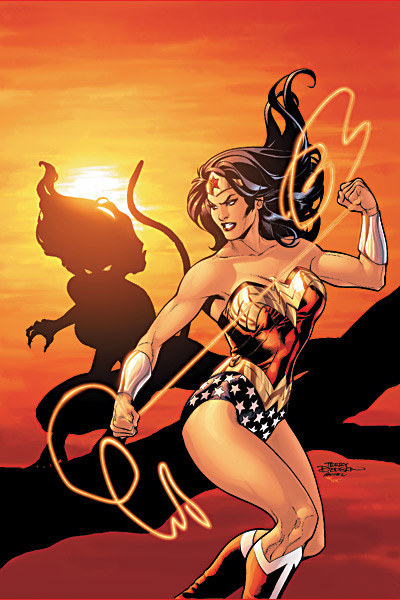
We won't nickpick that this feeling starts with the cover itself (as you can see from the accompanying picture, the background - Cheetah and her feline servants hunched menacingly - was added after the fact, and lamentably so, since climbing trees is not among the many talents cheetahs possess) - instead, we'll concentrate on the issue itself, which is frantically nonstop in terms of plot and virtually featherweight in terms of sense or momentum.

In the progress towards the extremely un-surprising climax (the sorceress Circe deprives Agent Prince of ... her powers! Why, THAT plot-device hasn't been used since the early 90s, and before that the mid-'80s, and before that the late-'70s, and before that the mid-'60s ... if we do it often enough, the readers will always remember that FEMALE superheroes don't really DESERVE their powers and must constantly have them taken away and re-earned), we learn one thing above all: writer Allan Heinberg hasn't bothered to sit down at his coffee table and actually PLOT OUT what he wants to do with this title. We'll have to see what comes of it all ...

Luckily, no element of 'we shall see' attends the new Geoff Johns/Adam Kubert relaunch of Action Comics! This is epic stuff, despite its colossal flaws. Kubert's artwork is amazing, and Johns' writing walks the fine line between humanity and iconography.

The flaws creep in around the basic premise of the plot - a boy from Krypton, found by Superman and sought by the rest of the world (including a Bizarro-manipulating Lex Luthor), eventually taken in by Lois Lane and Clark Kent as their 'foster son' ... as Lois herself points out, everybody in the whole feckin world is going to NOTICE the coincidence. Somebody needs to tell Johns that pointing out this fact isn't the same thing as CONSIDERING it, as a writer should.

Still, the issue has one great exchange. When Clark and Lois are hanging around the Kent family farm debating what to do with the little super-boy, Johns gives this neat little bit of dialogue to Lois:

"Clark, people like Ma and Pa Kent were put on this earth to be good parents. We weren't. You're here to save it. And I'm here to find the truth in it." Great stuff, even if the issue's sentimental climax turns things around.

But the pearl of the pickings this time around was the latest issue of '52' - starting with the fantastic cover, certainly the best cover '52' will field this year (and it gets my nomination for best DC cover of year period).

The plot - half of it, anyway - revolves around how the trio of DC's oldest super-heroes, the original Green Lantern, the original Flash, and Wildcat, react to the new wave of Lex Luthor-sponsored young super-heroes. The tone is controlledly bittersweet, and the best part of it is, it's offset by the issue's other plotline, featuring a group of mad scientists. This other plotline is openly and joyously feckin hilarious.

My young friend Elmo (you'll know him by the errant Owl-like tufts of hair emanating at random hours and angles from the top of his head) speculated the other day that this new format - a weekly comic actually done well - might be the future of the genre. If so - and if the quality remains this good - that might be a very interesting future. We shall see.

Thursday, October 19, 2006

comics! 52and counting!


My extremely young friend Elmo spends a great deal of his time with alien species. He betakes his sylphlike form to the nearest open parkland and slowly, by ineluctable stages, he VANISHES from the human-view of all the living things around him. Those living things then proceed to pay Elmo the highest compliment they can: they completely ignore him.

They cavort in front of him, they scamper all over him, and they let him into their own perceptions of the living world. Elmo loves to play games with his own perceptions in this way - it's his particular drug. It's a drug-habit he shares with, among many other people (including innumerable anonymous British bird-watchers throughout the ages), David Attenborough - and a habit entirely unknown to various crocodile hunters of recent vintage. Buff, married, obviously gay nature-jumper Jeff Corwin has spent innumerably more hours around innumerably more species than Elmo ever will, but he's a pathetic, complete stranger to the interest, the joy, and especially the exhilaration Elmo can find in a walk in the park.

So when it's Elmo supplying me with a batch of current comics, instead of his roommate, my nemesis Pepito (theirs is a marriage of convenience, I assure you), I know to pay attention.

Five issues this time around, an uneven batch. Starting thing off are the Wildstorm relaunch of Wildcats and the Authority.

This is ominous stuff, this sudden reappearance of Wildstorm titles like pesky super-villains you were sure were dead and buried. Wildcats has always been a crappy concept, and we all know the Authority was only ever a two-arc wonder.

So imagine my surprised happiness when both these debut relaunches turned out to be really, really good.

PSYCH!

No, they stink, both of them, a whole lot. Wildcats is the worse by far, despite Jim Lee's technicaly adept pencils. The main point of this first issue is that cool people smoke. They smoke cigarettes when they're down on their luck, they smoke cigars when they're kicking ass, but in either case, they're NEVER loser enough NOT to smoke. Geez.

The Authority #1 had a little more complexity to its crapitude. It's unbearably slow-paced and clogged with cliches, but Gene Ha's artwork is genuinely interesting. I'll never look at another issue of this turgid piece of poop, but that artwork was interesting.

Luckily, the rest of the batch didn't suck. The latest issue of X-Men had fantastic artwork by Yanick Paquette and a fairly snappy story besides, although can I just say I HATE this big blue kitty-cat Beast? The movies were a success - can't we dial back this 'secondary mutation' crapola to the classic Kelsey Grammar look?

The latest Ultimate Fantastic Four continues the God War story arc, and it's incredible - Mike Carey's writing is better than the vast majority of sci-fi short stories that appear in Asimov's and Analog, and Pasqual Ferry's artwork is the best of his career. The only irritating thing about this whole story arc is that it IS a story arc. I'd be happy to buy the grapic novel it was obviously designed to be NOW, instead of waiting for the whole process to run its course.

Wrapping up batch in question is the title by now guaranteed to get a totally ambiguous reaction from the crack staff at Stevereads: 52.

Every issue, there's stuff I really like and stuff that really irritates me, and this issue is certainly no exception. So let's go through it categorically, shall we?

Like:

Well, of course a comics veteran such as myself not only likes but LOVES the whimsical gesture of having Elliot Maggin as Oliver Queen's campaign manager.

*In the days before comics grew up, Elliot Maggin provided readers with an endless stream of good stuff, wiry, witty issue after issue. I don't know that he or any of his colleagues in those simpler days could write a comic today - and I'm not sure they'd want to. But this little invocation was a nice squirt of nostalgia.

*the look of Super-Chief - great size, great buffalo-mask.

*Judging from the memorial sculpture carved by the Martian Manhunter in this issue, it seems that Maxima is finally dead. And so our long national nightmare is over.

*the continued fascinating and well-done characterization of Black Adam - now accompanied by Isis and this new character Osiris.

*the hilarious way Ambush Bug infiltrates the 'next issue' banner at the end of the issue.

Irriates:

*Um, week 24? At the end of Infinite Crisis, Oliver Queen was a pin cushion, two arrows through his lungs and a convicted killer standing over him. Not only does this opening sequence not jibe with the story being told in flashbacks over in Green Arrow (I predict this is going to happen a lot), but it doesn't make sense on its own.

*the unholy resurrection of Keith Giffen's weird, apparently unappeasable fetish for loser-supergroups. Note to Keith: they weren't funny then, and they aren't funny now.

*Osiris? Did I miss an issue? Where did this kid (however entertainingly written) come from? Did I miss an issue? Wait ... Elmo, Pepito, you izquierda ... DID I miss an issue?

*Uh, the DEATH of Super-Chief? After one friggin issue? Geez.

*My usual complaint about 52 in general: the basic concept of this whole series - in addition to showing us the events that took place in the 'missing' year after Infinite Crisis - is to show us what the super-hero (and super-villain) world would be like without Batman, Wonder Woman, and Superman in the picture. And this opportunity - it's unlikely there'll be another - is being hugely wasted.

Put simply, we shouldn't be reading stories about a bunch of losers (and Super-Chief, sniff) trying to be the Jutice League.

Wonder Woman was not only the most powerful woman in the world but an ambassador and de facto friendly face on the superhero community. Superman, despite his extensive rogues gallery, spent most of his time averting natural disasters. And Batman kept the most viral assortment of stone-cold psychopaths under constant control.

In addition to figuring out everything that happened in that missing year, this series should be about what happens to the world when none of those things is true anymore. What happens when the only person between UN sanctions and the superhero world is, for instance, Black Canary? How does Catman handle a Richter 7 earthquake in northern China?

How the hell does Captain Marvel handle the Joker?

Alas, we'll never see that storyline. 52 seems intent on a more soap-opera theme instead. Guess we'll have to take the good with the bad of that, and I'll just have to silently (well, metaphorically, you undertand) regret the path not taken.