 Our foray today into the he-manly latest issues of GQ and Esquire begins deep in the bi-valved heart of amiguity (or DOES it?), which is troublesome to those of us trained to think of ambiguity as the Eigth Deadly Sin.
Virtually every interesting article in the latest GQ (it's the 'Men of the Year' issue, with variant covers featuring a happy-looking Will Ferrell, a freakishly young-looking Leonardo DiCaprio, and a dour young man rather oddly named Jay-Z) is fraught with ambiguity - if not in its conception then certainly in its re-ception.
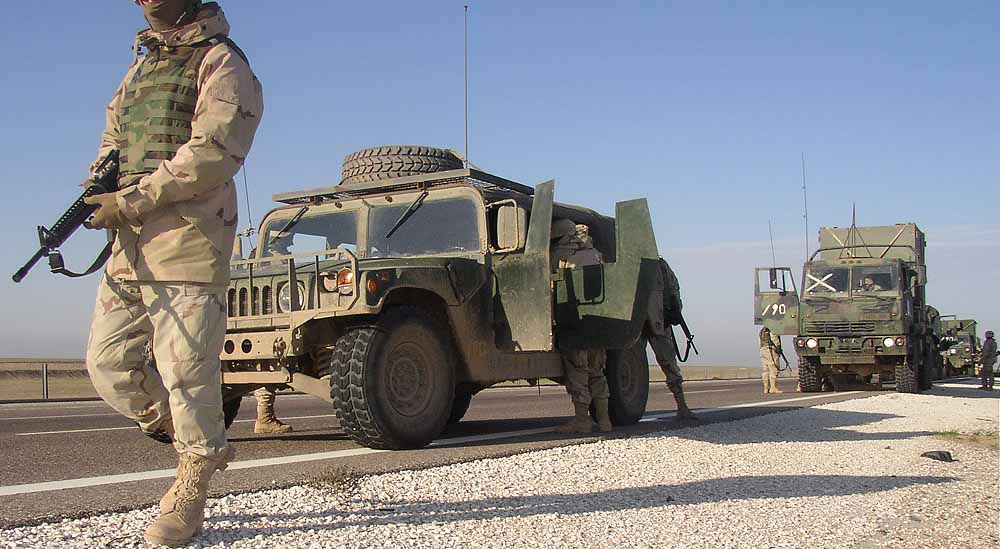
Take, for instance, Kevin Conley's article "A Few Good Medals," about some of the various high-valor decorations given to some of the men who served (or are still serving) in Iraq.
The strongest thing about Conley's piece is its descriptions of the various battles during which these men earned their commendations - you feel like you're there, in the dust and confusion.
And stories! The things these men not only lived through surmounted - well, even in these jaded times, it's the stuff of pure heroism.
Or is it? Take the story of Staff Sargeant Jerry Wolford, who earned a Silver Star in the Shiite town of Samawah. In 2003 Wolford was leading a platoon toward a bridge over the Euphrates when they spotted Iraqi Regulars on the other side. Wolford and his men opened fire, killing the men. So far, no ambiguity - in war, it's kill or be killed when you confront the enemy in plain sight.
Then comes this part:
"Everything happened quickly after that. Iraqi Regulars hidden in houses along the river started firing back, surprising a team of engineers who'd gotten ahead of the battalion. Wolford ran over to the spot were they'd hunkered down."
The article goes on to describe the fighting and heroism by which Wolford won his decoration, but we here at Stevereads stopped at that bit about Iraqi Regulars popping out of every house in the neighborhood. Regulars hidden with the knowledge and the help of the locals - in other words, an organized, locally-supported militia fighting well-armed and well-financed invaders sent by the world's foremost superpower.
We've debated the pros and cons of American military adventurism here in the past (well, Sam and I have - the rest of you being either too timid or too ill-informed to step up and join us ... or too lazy, let's not leave THAT one out) - and I'm sure we will again - but nevertheless: there's a deep current of ambiguity running underneath awarding a guy a medal for being the ruthless invader of a country that never did America the nation any harm. Nothing negates the valor of the specific battle - but there's a whole LOT of ambiguity informing whether or not that battle should ever have taken place.
(In case any of you are reading this in connection with my previous screed on properly-run military occupations, I'll share with you the results of a Google-search this morning: the town of Samawah still exists. It still has houses, roads, and inhabitants. The inhabitants are still considered to have rights, under the American occupation. If you're wondering how any of that differs from how a real military occupation would react to armed soldiers pouring out of civlian homes, just add a 'not' before each of those particulars)
Even when we move from international to domestic, the ambiguity remains. Take, for example, Lisa DePaulo's short, stupid interview with Al Gore (the short-form idiocy of the format is a stinging critique of what the powers that be at GQ consider the attention-span of their target audience).
Even through the haze of DiPaulo's (probably mandated) stupid questions, there blazes forth that curious 2006 phenomenon of The Other Al Gore.
I'm sure you're all familiar with the phenomenon. In conjunction with the gratifying success of 'An Inconvenient Truth' (the book and the movie), we've all seen him: The Other Al Gore, the smart, articulate guy who's not worried about clowning around in interviews, who's not only brainiac-style well-informed on a huge variety of subjects but who's openly passionate about a lot of them, who wants to teach about them, to change minds about them.
You know, the guy you'd have voted for in a heartbeat if he'd run for president in 2000. But instead, Al Gore ran, and The Other Al Gore stayed at home, and we got a president who speaks proudly about the fact that he doesn't even read the newspaper.
The Other Al Gore is exclamation-point excited about reprising his role as a disembodied head (even more likeable: he's actually unself-consciously dorky enough to USE the phrase 'reprising my role' when talking about a feckin disembodied head) on 'Futurama. He effortlessly mentions that Janis Joplin's great song 'Me and Bobby McGee' is in fact Kris Kristofferson's great song. He quotes from the Onion and makes iTunes mixes for the wife he's obviously still goo-gah in love with. He's sarcastic about President Bush but still respectful of the office.
So where, you ask, does the ambiguity come in?
Gore says it best himself, when commenting on the different perception people have of the Two Gores - the 'Inconvenient Truth' guy v.s. the campaign guy:
"I think one part of it is that in a campaign, there is an adversarial context. Your opposition is constantly painting negative caricatures."
Yes, they are. That's big-stakes politics, alas (although a bright young intern here at Stevereads points out that Massachusetts just elected its very first Black governor, who ran a landslide campaign WITHOUT resorting to slash-and-burn negative ads ... apparently, he even went so far as to tell his vicious Republican rival that she was better than the campaign she ran, which sounds almost Jed Bartlett in its high-mindedness ... ah, Boston! Someday, we'll get there!). And that's the ambiguous part!
Enough already with the 'I'm absolutely positively NOT running ... unless I run' line-dancing! Just in this one-page softball interview, Gore dances around the question twice, saying "Well, I don't plan to run. I don't plan to run. And I don't expect to run." But when asked if he's not ruling it out says "Uh ... no."
Think about what Karl Rove will do with this kind of Cinderella-to-the-ball coquettery. What possible reason can there be for this kind of theatrical hesitation, unless it's the very LAST thing the American voting public wants to hear: that Gore is AFRAID to declare until he's more sure of how the political winds will blow? This isn't a seminar on how distasteful he finds the mechanisms of presidential elections (although if the news from Boston is correct, there's already a successful blueprint in place for changing those mechanisms in the minds and hearts of the voters), it's a question of whether or not Gore feel CALLED ON. This epic-level hesitation hurts him whichever way the coin lands - either it's genuine and it's hugely distracting to his party, or it's poll-driven and, when characterized (or worse, revealed) as such, will hugely hurt his run.
The country's midterm elections already demonstrated that the living are trying to take back the government from the undead. Al Gore - especially The Other Al Gore - needs to either carry the standard or get out of the way. Until then, ambiguity reigns!
And then there's Devin Friedman's profile of Richard Ford, where the ambiguity arises mainly out of the fact that we here at Stevereads didn't particularly care for Ford's new book, "The Lay of the Land" but we kinda LIKE the guy who emerges from Friedman's beautifully-written piece. You have to like somebody who can say the quote that starts this off:
"'An airplane is forty tons of aluminum culvert, pressure-packed with highly volatile and unstable accelerants, entering a sky chock-full of other similar contraptions, piloted by guys with C averages from Purdue ... so it's stupid not to think it will seek its rightful home on earth at the first opportunity. Therefore today must be a good day to die.' If that's happiness, I guess you'd call it an ADULT happiness. And lots of people never have a go at it and wouldn't want to, because to them it doesn't look like happiness at all."
I like the quote (and needless to say, I agree with the concept of ADULT happiness - it's much rarer than the pabulum most people accept, but oh, it's so much sweeter), but I didn't like the book .... hence, more ambiguity...
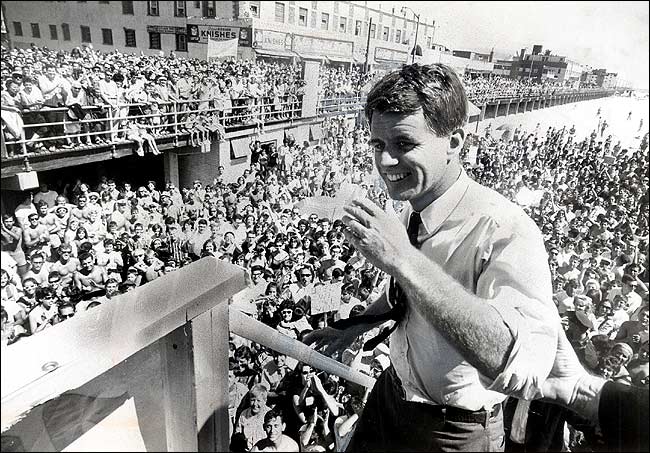
But hands down, the NADIR of this issue's ambiguity centers on Tom Carson's review of Emilio Estevez' movie 'Bobby.' I've read the piece six times now, and I have NO IDEA WHATSOEVER whether or not Carson LIKED the movie. And it's not just me, I'll bet: my friend Locke is as smart, funny, and shrewd movie reviewer as ever strapped on a bag of Cool Ranch Doritos, and I defy even HIM to make sense of this hyperventilating ARIA of fence-sitting.
"Even though Estevez's labor of love isn't a good movie by any stretch of the imagination, I can think of worse tributes to Robert Kennedy."
"The script is a ring-around-the-rosary of cliches; there isn't one observation that seems to have grown out of lived experience."
"So sue me if I came out thinking naivete as ardent as Estevez's has its appeal. Sure, Oliver Stone can run rings around Estevez as a filmmaker, but give him fifty years and he wouldn't come up with a concept this purely touching."
"The movie is so oblivious to its own absurdities that watching all this schlock get wheeled out in good faith is kind of bewitching."
"Only a clod could dish it up with this kind of conviction, so let's give Estevez's ingenuous zeal its due. If his movie were any better, it wouldn't be nearly as expressive, and I'm not trying to be insulting."
Whew! Glad to know he's not trying to be insulting! Wish to Gawd I knew what he WAS trying to be, but I guess we'll just have to see the movie to tell!
(On a far more satisfying note, Carson is marvellously non-ambiguous in his sideline review of the UK-made 'Death of a President.' He calls it a 'repulsive piece of drivel' and makes a telling point: 'but then, these lucky Brits have no idea of what living through a real political assassination is like. Our history is a little different. You can't help wondering whether it's ever occurred to D.O.A.P.'s director, one Gabriel Range, that if American critics ended their reviews by urging the public to beat the shit out of him on sight, he wouldn't have a leg to stand on.')
Fortunately, there's no a scrap of ambiguity about the latest Esquire, because the entire issue is in this case merely the delivery device for one piece, one amazing, absolutely flooring piece.
Of course I'm referring to John Ridley's ground-scorching essay "The Manifesto of Ascendancy for the Modern American Nigger."
No amount of quoting will relieve any of you of your responsibility - you have to read this essay. It's smart, guardedly optimistic, and above all incandescently angry. It's easily the best essay I've read this year, and I'd be exceedingly interested in knowing what-all the rest of you make of it.

