Showing posts with label david foster wallace. Show all posts

Tuesday, April 19, 2011

Hay Fever in the Penny Press


Sometimes, the Penny Press is just plain depressing. This season that feeling is occasioned by the requisite avalanche of hipster posing and screeching lies accompanying the publication of a posthumous novel-fragment by David Foster Wallace. I knew months ago that this fragment was coming, and its approach has all this time felt like the dread of hay fever. There were the first faint trickles in Vanity Fair and Men's Journal ("Could it be ... the greatest unfinished novel of all time? I don't know, dude ... I just don't know"), then shooting buds all over the place in literary journals that ought to know better, and now it's reached full bloom, with Tom McCarthy's 150,000 word review in the New York Times Book Review.

By far the most depressing thing about all this - more depressing than its sadness (the author killed himself, after all), more depressing than its fraud (it's a fragment of a novel - it doesn't warrant reviewing at all), and more depressing than its misdirection (its author was never, even at his most productively controlled, all that talented) - is its lumbering inevitability, like a Zeffirelli production at the Met. I've seen it happen many times before; I watched it with Hemingway, I saw the talentless Sylvia Plath become venerated, I cringed as the execrable Kurt Vonnegut got the process started himself. It's always unpleasant, and I always hope it's only the craze of a single season (Henry Green, for instance, and, I sure as Hell hope, Elizabeth Bishop), not the zeitgeist taking hold.

I read Wallace's posthumous novel-fragment, The Pale King, months ago. There was no way for me to either like or dislike it, since it's a fragment rather than a completed whole. All I could do was notice things about it, and I did - negative things, such as the continuation of the author's apparently endless willingness to masturbate intellectually in public, but also positive things, the slow accretion of the habits of craft, the possibility - now heartbreaking - that this writer might very slowly be learning the disciplines he should have had in place before he started his career. I doubt there was ever any danger of him returning to his old vomit ala Scott Turow or Bret Easton Ellis, but in this fragment there were hints that he was dreaming of finally leaving the narrow estuary of himself and venturing out into the wider world (not many hints, I grant you - there are something like six characters in this fragment who have the author's name and are loving reflections of him - but some). I would have applauded that, because I never doubted his intelligence.

That's never going to happen, of course - David Foster Wallace committed suicide in 2008, thereby both preventing The Pale King from getting finished and virtually guaranteeing this hay fever season. In his New Yorker piece last week, Jonathan Franzen hinted that perhaps Wallace was on some level planning that glut of posthumous reactions, maybe even relishing the thought of it. I'm hoping not, but in either case, I'm also hoping the NYTimes Book Review Haggadah represents the worst of it. Because it's pretty damn bad.

Tom McCarthy himself has some talent as a novelist, but that just makes it worse. He's as self-indulgent as Wallace was and very nearly as self-infatuated, which has the distasteful effect of making his "review" read like a Gospel According To. Reading his name at the top of a "review" doesn't bode well for any kind of impartiality in the passages that follow.

And it isn't there. McCarthy writes his 900,000 words under the shadow of two completely immovable assumptions: that Wallace was a great writer, and that The Pale King is not only a book but a great book. So we're told things like "The Pale King is pervaded by an air of melancholia, an acute sense of loss" even though it's a manuscript-fragment and so can't be pervaded by anything. Treating a badly unfinished manuscript as though it were a completed novel - or worse, far worse, acting like the difference is immaterial - is the hallmark of this hay fever.

To his credit, McCarthy senses this on some level. But just when that hint might force him to, you know, write about something else, he takes his Gospel act to the next level in order to stay on-topic:
Which brings me to the second way of understanding the whole document: as a much rawer and more fragmented reflection on the act of writing itself, the excruciating difficulty of carrying the practice forward - in an age of data saturation.


But it's not the age's data saturation that's the point - it's the parallel saturation in Wallace's fiction, including in this novel-fragment. And that saturation is not only there by choice, it's also the most visible and most annoying of Wallace's flaws as a writer. That cutesy-poo over-bombardment of the manuscript with 200-page digressions, rafts of footnotes, endlessly tail-chasing syntax, all of it geared to make the writing of that manuscript - and by accidental side-effect the reading of it - as close to the simulation of a video game as possible. The fullest manifestation of this insane cowardice is Wallace's dark gift to literature: that you have to concentrate on the fizzy thrills of weird typography in order to, like, enjoy a book - because otherwise, God help us all, you'd have to, you know, concentrate - otherwise, boring old things like plot and character development would have to matter ... and if they mattered, somebody calling himself a writer would have to work at them, in order to do them well. Wallace wrote a 1000-page novel in part in the smug assumption that such an act would protect him from any accusation of laziness - and yet he was the laziest American author since Sydney Sheldon. In writing as in life, laziness isn't defined by how little you do - it's defined by how much you're willing to do to avoid work. Wallace buried his editors and publishers with hundreds of pages of 'notes' and 'clarifications,' buried his books in hundreds and hundreds of pages of pointless verbiage, but he didn't do any of that for the reasons he helped the literary world to craft. There was never any of the 'tortured artist with so much to say' involved in all that over-production ... it, all of it, every page of it, was produced in order to avoid doing the actual work of writing, the shaping of plot and character and action, the whittling and revising and precision that are supposed to separate the novelist from the tyro. That's epic, Biblical laziness.

And it prompts laziness in turn. McCarthy at one point is practically asleep at the keyboard when he writes, "The issues of emotion and agency remain central, but are incorporated into a larger argument about the possibility or otherwise of these things within contemporary fiction." I'm not at all sure what any of that means, but I'd hazard a guess that "issues of emotion and agency" are central to pretty much every novel ever written. These are the kinds of things reviewers write when the grip of a celebrity season is upon them, and even Wallace deserves better.

He almost gets it in this same Book Review, when Jennifer Schuessler turns in a very good Essay on some of the ways the I.R.S. has featured in American life and literature. She almost takes Wallace to task for shoddy plotting - she doesn't quite do it, but she almost does. Even a partial hint at any of the dead author's defects is yards and yards more than the literary world has been doing in response to this novel-fragment, but if Schuessler disliked The Pale King, she buries it under talk about tax codes, tax code novelists, and that bad old literary tax-dodger, Edmund Wilson. It's a good piece, but at one point she writes, "One wonders what Wilson would have made of 'The Pale King' ..."

I, for one, don't wonder.

Sunday, April 17, 2011

Agreeing to Disagree in the Penny Press!


The linear procession that is my weekly plow through the latest furrow of the Penny Press couldn't have started off worse this time around - not even with a 'short' story by Alice Munro: The New Yorker featured a long piece by Jonathan Franzen that was just about as appalling an exercise in narcissism as anything I've seen from somebody who doesn't run a book-blog. Franzen, of course, is the author of Freedom, the big gaseous novel that's going to win the Nobel, Pulitzer, and Zee-Magnee Prizes for Greatest Thing Ever Created By Anybody, Including When God Created the Universe. He's also one of the ground-zero survivors of the suicide of his friend and fellow author David Foster Wallace, and I understand and accept where that confluence leads. It's probably inevitable that some writing would result from it - after all, in such circumstances, even the least literary person in the world might be moved to put pen to paper. Franzen is not the least literary person in the world - he himself has commented many times on his apparently uncontrollable urge to, as he puts it, "narratize" himself - so something like this essay was probably going to happen at some point.

But I find myself asking the same question about this piece - a clumsy half-cloning of a literary appreciation of Robinson Crusoe (for which an expedition to Selkirk Island was enacted, of course - nobody reads at home anymore, silly!) and a reminiscence of a lost and troubled friend - that I ask about so much of Franzen's work: did it have to be so bad? Did it have to show so little thought, or rather, so much completely misdirected thought? I know Franzen would probably say it's his arch and awkward impulses that make him worth our time as a writer, but there's a difference between adopting an arch and awkward kitten and working full-time at the animal shelter.

Franzen's been writing things - fiction, nonfiction, and the pure self-absorption he and Wallace perfected for a whole new generation - for years; how could he not have seen how maladroit this piece would end up being, if he insisted on keeping the mechanical framework of the Defoe device? It's maddening to watch him churn out the requisite travel-essay paragraphs (it's so windy there!), the requisite lies (tobacco addicts always, always, always claim their vacations from the busy world were also vacations from tobacco, when if that's how addiction worked, nobody would be addicted), and the requisite posturing (litt'rary authorities are startled awake and hauled on stage, as though Franzen felt compelled to say, "hey, don't forget - I'm an incredible intellectual heavyweight, in addition to being this shy and sensitive guy") - especially maddening because behind all that stuff, he's actually got something to write about this time. I would have read a Daniel Defoe essay from him with interest, but yoking it so stubbornly like this to a very, very different kind of essay - more interesting, yes, but also more shameful to actually publish - is a beginner's mistake, or else the mistake of somebody who no longer has those 'first readers' every writer needs so badly.

So our author goes to Selkirk Island to read Robinson Crusoe - but also because he has to do something in the wake of his friend's suicide. As a result, neither the trivia nor the trauma is well-served, but the trauma is at least arresting ... and interestingly conflicted. I was surprised - and I shouldn't have been - by the sharpness of the anger in Franzen's writing about what Wallace did. And of course I was fascinated, who wouldn't be, by the new personal details Franzen reveals about Wallace's final year and downward spiral, the idea Franzen has that Wallace considered his suicide to be, in drug addict terms, "one last score" and an act of vengeance against both himself and his closest friends. But just because such details are fascinating doesn't mean I should have been reading them - the personal, wounded parts of this weird piece are the best writing Franzen's ever done, but they should have remained in his journal where they belong. I wish I could get this point through the Yaddo-addled brains of all our most lionized young writers: the reading public doesn't, in fact, need you to "narratize" every aspect of your lives - exercising more restraint and more narrative control would actually make you better writers.

Fortunately, that first course didn't ruin the meal. I moved on to the new Harper's, and once there I did what I now happily always do: I turned straight to the "New Books" column and settled in to read Zadie Smith. I don't know Smith, and I have no idea what she thinks of her new gig as Harper's fiction critic, but sometimes even Irish Catholics know when not to question a good thing, so I just sit back and enjoy the show. I've rhapsodized here before about Smith as a literary critic, and here that rhapsody is put to the worst test the love of any book critic can face: what do you do when a great critic writes about a book you just don't care about?

In this case, Smith writes about Edouard Levy's Suicide and Peter Stamm's Seven Years, and I couldn't care less about either book, which made the going tough. But even so, the wonderful, winning tone, the voice Smith is creating in these columns won me over (finding the right voice being, of course, essential to the long-term business of writing anything) - won me over to her column, that is, not to the pretentious pieces of poop she reviews in it this time around. Here's hoping next month she gorges herself on murder mysteries, or else takes in Black Lamb and Gray Falcon and tells us all about it. And in the meantime, this particular issue of Harper's has one other thing that's enormously worth your attention - no, not that laughably hideous cover illustration, which struck me as a bizarre practical joke until I remembered what century I live in ... no, Nicholson Baker's scintillating essay "Why I'm a Pacifist" is the non-Smith highlight of this issue, a refreshingly meaty essay where I'd expected to find yet more Franzen-style narcissism. It was so good it almost convinced me that some of its daffiest contentions just might be true.

But, much to my surprise, the real saving grace of my Penny Press trawling this time around came from a source I'd almost completely discounted: the good old Atlantic, whose slide into just another Beltway glossy has been decried here and elsewhere. Much to my dismay, I've come to associate the Atlantic with reading disappointment, and certainly a glance at this issue seemed to confirm that: a 'genius' issue without one true genius on display, a 'culture' issue as though that were a special, distant place (Selkirk Island, perhaps?) for which we should designate an isolated visit once in a while ... and that Editor's Note! Has 2011 yet seen so vertiginous a combination of arrogance and cringing? The Editors intend, I think, to offer some kind of justification for their decision to include to short stories in their 'culture' issue even though they've long since banished fiction from their ordinary (non-culture?) issues. Airy words are aired about the special qualities shared by the two stories in question, one by Stephen King, the other by Mary Morris, but I knew better than to get my hopes up, and I was right: the stories have a lot in common, beginning with the proudly-declared triviality of their origins and ending, I suppose, in how boring and awful they both are, but when the Editors describe them as "entertaining, interesting, and gloriously open," they're adding a whole lot of sawdust to the bread.

No, it wasn't the special 'cultural' offerings on hand that made the issue for me: it was the workhorse rear-end (...) of the thing that did the trick, as always. Once all the 'geniuses' are done being interviewed about how incredible they are, the real power-hitters come out, and we get three fantastic essays in a row. Ta-Nehisi Coates writes the impossible: an essay about Malcolm X that I actually found interesting. Christopher Hitchens reassures me that his medical treatments must be going well, because he turns in a long and utterly beguiling essay on yet another subject that doesn't usually interest me at all: the poet Larkin and his various smutty doings. And best of all, towering over this week's Penny Press offerings, there's the mighty Benjamin Schwarz, writing about James M. Cain's novel Mildred Pierce - and in the process writing about yet another subject that doesn't interest me at all: Los Angeles. Only a whole lot of money could ever possibly induce me to visit Los Angeles again, and nothing on Earth could make me re-read Mildred Pierce - and yet there I was, eagerly lapping up every word Schwarz wrote about both, solely on the basis of how wonderful those words are:
Moreover, in Mildred Pierce, Cain wrote the greatest work of American fiction about small business. He made compelling the intricacies of real-estate deals and cash flow, of business planning and bank loans, and of relations with suppliers and customers ("She had a talent for quiet flirtation," as Cain explained of Mildred's technique, "but found that it didn't pay. Serving a man food, apparently, was in itself an ancient intimacy; going beyond it made him uncomfortable, and sounded a trivial note in what was essentially a solemn relationship.") He rendered the plodding method and the fundamental gamble of small-time commerce - the foundation of Los Angeles's service-oriented economy - not just absorbing but romantic.

As usual with this critic, I could go on quoting (Hitchens on Larkin is equally quotable), and reading this piece by him and that piece by Zadie Smith (and knowing that Sam Sacks is there, every week, over in the Wall Street Journal) reminded me yet again that the current state of heavyweight American book-criticism is in good hands. Even if they all occasionally write about books I wouldn't cross the street to read.

Monday, February 15, 2010

Travel the World with The Lifted Brow!


The latest installment of Australia’s great literary journal The Lifted Brow is now out – and sold out! Ronnie Scott, the journal’s weirdly youthful proprietor and mastermind, is currently working on a limited second run, so do your best to get on that list (or desperately Craigslist anybody you know in Australia, begging them to find you a copy).

There are two reasons why this issue sold like hotcakes: first, the days when The Lifted Brow may have been the best-kept secret on the international literary stage appear to be over. And second, this issue is so damn much fun – and when was the last time you could say that about The New Republic?

It’s a travel-themed little behemoth of an issue this time around. Travel, as the old saw goes, can broaden the mind. Unfortunately, in this day and age, it can also get you blown up, dysenteried, dengued, taken hostage, flight delayed, flayed, beheaded, or at the very least pauperized. In recognition of these dismaying facts (and in the spirit of the aforementioned fun), this issue brings the world to you: dozens of writers, including Justin Rice, Clancy Martin, Andrew Holder, the insufferable Reif Larsen, Douglas Coupland, Benjamin Kunkel, the moderately sufferable Adam Golaski, the late David Foster Wallace (and yours truly), each hones in on a different corner of the world and tries to convey something of its flavor, its culture, its commonality, or its strenuous irrelevance. The issue also features two CDs of vaguely world-themed music by lots of people I’ve never heard of (but it sure filled my room with strange and ultimately alluring sounds when I popped it into my computer!) – all in the service of The Lifted Brow’s obvious (though unstated, because that would be so stuffy) message, that literature should be collaborative, multi-genre, and invigorating, while we’re all young. To keep us all young. To make us all young.

So it’s an odd position I find myself in here: I’m unabashedly plugging a great literary production that’s almost completely unavailable specifically because of how great it is. Nevertheless, do your best. Go to the website, spring for a subscription (so this doesn’t happen to you again!), look around, sign up for yet another  reprint of this issue. It’s got lots of art, lots of good words, and lots of good music – it’s worth the bother.

Tuesday, October 28, 2008

A Sad Little Story in the Penny Press!


There's an achingly sad little story in the latest issue of the successfully-redesigned Rolling Stone (gone is the whole pothead oversized-paper-zine format - it's now shaped like an ordinary magazine)(for an unsuccessful magazine redesign, you can turn this month to the Atlantic), an article by David Lipsky on the life, career, and suicide of David Foster Wallace. Wallace's widow and such friends as fellow author Jonathan Franzen go on the record with Lipsky, who crafts a wonderfully told and ultimately heartbreaking story of how one young guy felt his life slip out of his control.

The basic theme is helplessness, and of course that doesn't sit well with me. It's the problem I've always had when confronted with what at one point in the piece is called clinical depression; despite ample evidence to the contrary that I've seen over the past twenty years, I still sometimes reflexively think of it as a more or less elective illness. These people expect to be happy all the time, this thinking goes, and when they're not, they start taking pills.


Reading this Rolling Stone article would cure a more stubborn person than I am of such thoughts. Here is a scrupulously honest, entirely agonizing portrait of a talented young man whose own thoughts and feelings took turns of such wanton strength and wayward direction that he was as stunned and embarrassed by them as anybody. This was clearly not a person just wanting attention or pity - nor, wrenchingly, was it a person who wanted to die. The pattern manifests itself early, when Wallace abruptly tells his college roommate he's leaving school. "He wasn't able to talk about it," the roommate says. "He was crying, he was mortified. Panicky. He couldn't control his thoughts. It was mental incontinence, the equivalent of wetting his pants."

Wallace went to the University of Arizona for his MFA (what is it with that place? Who would voluntarily go someplace where it's 100 degrees every single day?) and sold novels and short stories, and he told that same college roommate that the act of writing brought him some relief: "He once said to me that he wanted to write to shut up the babble in his head. He said when you're writing well, you establish a voice in your head, and it shuts up the other voices. The ones that are saying, 'You're not good enough, you're a fraud.'"

But he was also taking a prescription drug regularly, and when he stopped for a time and then tried to re-start, the drug was no longer effective in calming or regulating his thoughts, his fears, his panics. He's described as "terrified" and "suffering," and by the time you reach the end of the article, you wholly believe it. The piece ends like this:

At the end of August, Franzen called. All summer long he had been telling David that as bad as things were, they were going to be better, and then he'd be better than he'd ever been. "David would say, "Keep talking like that - it's helping." But this time it wasn't helping. "He was far away," Franzen says.

A few weeks later, Karen [Wallace's wife] left David alone with the dogs for a few hours. When she came home that night, he had hanged himself.

"I can't get the image out of my head," his sister says. "David and his dogs, and it's dark. I'm sure he kissed them on the mouth, and told them he was sorry."

Dogs, writing, and supportive loved ones - and it still wasn't enough to save him, because medication (and electro-shock treatment) couldn't restore balance to his brain's chemistry. The article leaves you feeling the exact same kind of pointless, resolutionless sorrow that a sudden, unexpected death often evokes ... except it's also cathartic, because you're actually alive and able to read it all and appreciate how well-done it all is. So Rolling Stone kicks off its first redesigned issue with a stunning piece of nonfiction, and I find myself wishing David Foster Wallace were still alive and irritating me. Suddenly, I miss him.

So good job, Lipsky.


Tuesday, February 06, 2007

Penny Press! A Compartmentalized TLS!


A place for everything, and everything in its place in last week's TLS. The issue had all the requsite features every issue does, in this case doled out one at a time to several authors.

Michael Brett, for instance, gets the Best Quip. In his review of "Islam and the Abolition of Slavery," he points out that for a book to cover such an enormous subject in only 293 pages requires the author to dash all over the place, lingering nowhere. Brett's quip:

"'Islam and the Abolition of Slavery' is a tour de force, but one with a distinct resemblance to the Tour de France."

Hee.

The Spirited Objection comes from the always-reliable Raymond Tallis, whose review of Neil Gorsuch's "The Future of Assisted Suicide and Euthanasia" rises gradually to an exalted pitch:

"The recklessness of the Roman Catholic Church with the lives of millions of believers, by vetoing condoms and in some cases actually lying about their effectiveness, thus sacrificing human life on the altar of doctrinal purity, is about as grotesque an example of instrumentalism as one could imagine."

We here at Stevereads are entirely in favor of physician-assisted suicide for terminally ill patients with no hope of improvement. So naturally we agree with Tallis' ringing final lines:

"To oppose assisted dying is to make an active decision to impose suffering. I hope when I am being marched to imminent death by my disintegrating, pain-racked body, my doctor will not risk a fourteen-year prison sentence for refusing to abandon me in my hour of greatest need."

To Jamie McKendrick falls the Thoughtful Appreciation. He turns in a very thoughtful essay on Giorgio Bassani's fantastic novel "The Garden of the Finzi-Continis" (soon to be given a new translation by Penguin, joyous news).

Bassani's book is a wonderful story of young love, set in the golden town of Ferrara against the backdrop of pre-World War II darkness spreading across Italy.

We here at Stevereads have very fond memories of Ferrara (and of her greaest adopted son, Ariosto), and "The Garden of the Finzi-Continis" wonderfully evokes the nature of the place.

We can't speak for the quality of the new translation (no copy has yet made its way to our door), but we can enthusiastically recommend the book (and all of Bassani's work, particularly "Behind the Door"). If memory serves, there are at least two English translations in existence - albeit not, alas, in print. Time for yet another trip to Alibris!

And an issue of the TLS wouldn't be complete without the Outrage-Inducer piece. This issue's comes from Stephen Burns - it's a long, adulatory review of David Foster Wallace's "Infinite Jest" (on the occasion of that book's now being ten years old).

Burns starts up his blather right from the starting-gate, hauling in Italo Calvino and Norman Cohn to set up a discussion of 'millennial fiction' - then he lets the reader have it, right in the solar plexus of good taste:

"One of the most artistically significant of these millennial novels is David Foster Wallace's encyclopedic masterpiece 'Infinite Jest' ..."

When any kind of 'masterpiece' is attributed to David Foster Wallace, you just know James Joyce can't be far off, and sure enough, "Ulysses" gets a mention in the next paragraph, where it and "Infinite Jest" are put on the same shelf as 'Hamlet.'

All the giants are mentioned in due course: Jonathan Franzen, Dave Eggers, Jonathan Safran Foer, Zadie Smith (Burn oddly also mentions George Saunders and Lawrence Norfolk, both of whom actually have literary talent; we presume they were included by mistake) ... all good in their way, but none comparing to the Master:

"The desire to adapt (rather than explicitly reject) the legacy of post-modernism and move toward a fiction that humanly engages is probably 'Infinite Jest's most palpable contribution to contemporary fiction."

Such passages illustrate the transformation of criticism into outright lying, and the article is full of them. There are possible explanations for this kind of sunshine-pumping sycophancy (massive drug use? a burgeoning homoerotic affair between author and reviewer?), but they are resolutely extra-literary. Writing like this makes us want to rush to the loo and make a 'palpable contribution' of our own.

Wallace's book is an enormous, spoiled mess, an epic failure, a gigantically extended demonstration of hubris - hubris being the defining and linking flaw of all the navel-gazing giants listed above. Of the novel's 1,079 pages, perhaps four are any good.

But the thing sure is LONG, ain't it? And Eggers' "A Heartbreaking Work of Staggering Genius" is manically detailed. And Foer's "Extremely Loud and Incredibly Close" has BLANK PAGES! Surely there must be SOMETHING going on here!

Alas, it's not difficult to write a 1,079-page book if do it the Wallace way. You can do it yourself! The steps are easy:

1. Come up with the thinnest possible scrap of an actual plot (Burn admits that the various plot-strands in "Infinite Jest" are left hanging, but of course he views that as a GOOD thing, the poor wretch)

2. Start typing.

3. (this one's crucial, so pay attention) Don't STOP typing.

Here at Stevereads we're blessed with readers who are also writers, and it's that third step that will give them the most trouble. Because if you follow the Wallace way, you'll JUST KEEP TYPING - no agonizing over word-choice (or even word-repitition), no pausing to refresh, no questioning whether or not something you're writing actually BELONGS in your book, and most of all no revising.

If you can turn off your writerly urges to do all of those things, if you JUST KEEP TYPING, you'll have 1,079 pages by Armistice Day, no problem. They'll be a big, egotistical mess, but they'll BE there.

The reader isn't a dozen pages into "Infinite Jest" before he's painfully aware that this is exactly how Wallace wrote it. Well, any reader except Burn, who incredibly blames the book's endless roster of flaws on anybody BUT its author.

He says that "from the very beginning, the novel has been dogged by textual errors. When the proofs were delivered to Wallace, he claims he discovered 'about 712,000 typos,' and some of these evidently made their way into the first edition."

Apparently impervious to irony, Burn proceeds to list some of these 'textual errors':

"Another character has his head frozen to a window on November 18 and appears to stay there until November 20, although he takes part in a conditioning run in between those two days."

You'd think such 'textual errors' might pile up enough to make even Burn see the light, but you'd be wrong: they just make him protective of his author:

"These problems (and others like them) are minor issues in such a long, complex work but it is disappointing that after ten years, the publisher who has reissued this important and influential book has not corrected such errors."

If Burn were reading this blog, we'd ask him one simple question: exactly HOW is the publisher supposed to correct such 'textual errors'? By re-writing them? Then what's become of the book's importance and influence?

The more pertinent question might be what's become of the author's JOB, if his sloppy plotting and lack of revision bloat his book to 1,079 pages and riddle it with 'textual errors'?

Tuesday, August 15, 2006

books, books, books!


It's been slim pickings on the new book front this week.

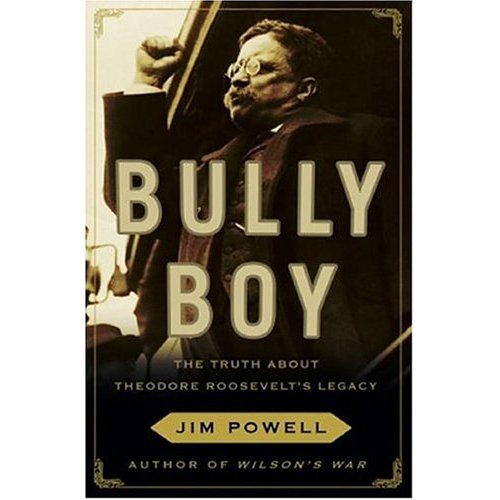
I read Jim Powell's book Bully Boy, which purports to be about Theodore Roosevelt. The author purports to be writing a kind of expose on how the 'real' Roosevelt was a darker, more ruinous figure for his own time and ours than the popular presidential mythos would have us believe.

I confess, it took me two whole chapters to see this book for what it is: a political TRACT, not history. Something sweaty and slightly crazed. Instead of being sold in bookstores, it should be handed out on subway platforms by sandalled young people whose parents think they're at the library.

It shouldn't have taken me that long (what can I say? It's been hot) - Hell, the chapter titles alone give the game away, consisting as they do of what lawyer-folk like to call leading questions.

Why did Roosevelt want to enter other people's wars?

Why did Roosevelt brag about 'trust busting' that harmed the American consumer?

Why were Roosevelt's 'conservation' policies wasteful and destructive?

When did Roosevelt stop beating his wife?

OK, that last one was mine, but you see what I'm getting at. If that sort of sophomoric nonsense were being spoken aloud, Jack McCoy would long since have lept to his feet and barked out "Your Honor!"

The book is riddled with ... well, I hesitate to call them errors, since that implies a black-and-white thing that can be fixed should there ever be, Gawd help us, a second printing. The book has plenty of those too, mind you, but the main thing it's choked with is a fog of partisan zeal - like when you're talking with a young Republican on your dorm floor and you suddenly get that sickening feeling that no ACTUAL discussion is happening at all - that the beads of cold sweat on their upper lip aren't there because they're fully engaged in the debate, they're there because your young friend hugely, overwhelmingly wants to send you to a death camp RIGHT NOW for what you're saying.

The book is a screed, and like all screeds political or otherwise, it DOESN'T CARE if its own underpinnings are distorted, unjust, or plain old false.

There's something like that on every page. The author went into his book with the theory that Theodore Roosevelt was an evil president, a war-monger, an enemy to the working classes, and the architect of all that's wrong with American society today. Basically, Powell's blaming Teddy Roosevelt for Vietnam. Yeesh.

If enough of you loyal readers raise the cry for me to page-by-page demolish this piece of crap, I'll do it. Your humble scribe is at your disposal, of course. But absent that acclaim, I just don't think it's worth it - the book isn't nearly GOOD enough to warrant dismantling.

Alas, the same can be said for Michael Cox's forthcoming novel The Meaning of Night. Well, not exactly the same - it's not a piece of crap, by a long shot. It's a big Victorian historical thriller, complete with Latin chapter headings and a liberal sprinkling of footnotes (a cutesy-poo literary fadlet given wide parlance by David Foster Wallace and recent cachet by the otherwise-delightful Jonathan Strange & Mr. Norrell - let's pray this book is its death-gasp), and its publishers are clearly holding their breath until the first reviewer uses the term "sumptuous."

But for all that it's not a bad book, although far overlong and full of itself, and with dialogue that's often tin-eared. If it ever comes out in a mass market-sized paperback, it'll be easy to recommend it to all of you as a slightly lighter-weight alternative to a very similar and hugely better book, Ian Pears' An Instance of the Fingerpost. But until then, you won't be missing much if you stick to re-reading Sherlock Holmes.

There WAS a good experience among the disappointments, however, and it came as a surprise to me. I read Mark Helprin's Freddy and Fredericka and really liked it, despite the fact that I haven't liked Helprin's last few books at all. I almost passed on this one completely, but a friend lent me the trade paperback, and I read - at first warily, and then gulping down the pages.

The book is a long piece of satire on the state of modern royalty, and I was expecting the operative word would be 'long' - but I didn't find it so. Instead, I found an endlessly energetic, very, very smart and almost consistently hilarious book. Helprin spares his titular royals no embarrassment, no imbecility, no fiasco .. but still, after very few pages, you get the distinct feeling that he LIKES them, certainly in spite of themselves.

And the dialogue (Helprin's age-old weakness) sparkles for long stretches, I thought. The royal couple go incognito to America, and at one point they're posing as dentists, of a sort:

"We're dentists," Fredericka blurted out. After all, that was what it said in the capsules.
Knowing this could lead to trouble, Freddy clarified Fredericka's answer. "Not for people, though," he said, holding up his right index finger.
"Not for people? For what then?" A long silence followed.
"Crocodiles," Freddy finally said. He seemed to think about it in awe.
"Crocodiles?"
"It's mainly periodontics."
"Is that true?" D. Popcorn's hands fell at his sides.
"There are tens of thousands of crocodiles in the South, where we come from. They have a lot of problems with their teeth, and they have a lot of teeth - a lot of teeth."
"But there are no crocodiles in America."
"There aren't?" Freddy asked.
"No, just alligators."
"Oh," said Freddy. And then, turning to Fredericka, "You mean all that time, all those years, we've been working on alligators, and we thought they were crocodiles?"
"What's the difference?" Fredericka asked.
"I have no idea," Freddy answered.
"Whatever they are, they make nice bags and belts," Fredericka continued. "Did you know that Bunny, the middle daughter of the Duchess of Trent, has a speedboat with crocodile upholstery? Or alligator, I don't know."
"How do you get them to the point where you can safely work on them?" Dr. Popcorn asked. "I can't even do that with a lot of my own patients."
"I guess you shoot them," Freddy said nonchalantly.
"To anaesthetise them."
"To kill them."
"You do periodontics on dead alligators?"
"Alligators or crocodiles, whichever they are."
"What for?"
Freddy was hard-pressed to think of an answer. "We're animal lovers."
"But you shoot them."
"We have to. They're terribly vicious. They can swallow a Corgi in the blink of an eye."


Not everybody's cup of tea, I know (especially 500 pages of it), but I found this stuff delightful, and I very much liked all the subtle strands of sadness and sentiment Helprin works into what is mostly a rollicking good farce. I can't for the life of me think of who I would recommend this book to - it will appeal neither to fans of modern fiction nor, strictly speaking, to fans of historical fiction. But I'll keep it in the back of my mind in case I meet a true reading omnivore like myself (it's possible my friend Beepy would like it, but since she only reads about a page every three days, it would represent five years of effort for her, so I probably won't mention it).

I felt like shopping for books today, but for some unknown reason, I didn't feel like HIKING to do so. So I put on my togs and went up West Broadway to the Goodwill (got panhandled along the way, but a perfectly healthy young woman with a big meal currently digesting in her belly - she said "sir, can you spare some change so I can pay for my prescription?" I almost laughed in her face. I almost said, "Missy, I was raised in a mean-spirited, incredibly manipulative Irish Catholic family; you're gonna have to do a LOT better than that to get any guilt out of me").

On West Broadway, we've got a good book selection at the Goodwill. The only worker there who spoke English told me they get around 150 books a week, but most of their customers are there to buy clothes, so the book section has a healthy amount of titles.

There's something oddly satisfying about buying books at a Goodwill. Maybe it's the total randomness of the selection, far more hit-or-miss even than a used bookstore. Or maybe it's the welcoming atmosphere of the West Broadway branch, where all the families and old ladies seem to know each other, where the jokes are sassy and rapid-fire, and where the parents for once don't have to worry about affording all the stuff their little kids pick out.

Or maybe it's the fact that this is unquestionably the last stop on the spin cycle for these books. This is where they end up when NOBODY else wants them, and there's nothing theoretical about their fate should they not be bought: the Dumpster is RIGHT THERE, in plain sight of the bookshelves. Every time you buy books there, you're making your own little Schindler's list.

Every time I go there, I start off browsing in silence. But gradually the books become aware of me, and they sense that being bought by me is one of the very best things that can happen to a book - I'll either loving read, annotate, and care for the book myself, or I'll find it a carefully-vetted home. So they start clamoring, and it's heartbreaking to hear. "Pick me, pick me - don't leave me here, you're my only chance!"

I heard that from many books today, none louder than an old Mentor paperback called The Essential Erasmus - still in excellent condition, no underlining or highlighting, 75 cents. But I left it behind, because a) I, of course, already have a copy (Erasmus being one of my favorites) and b) I couldn't in a million years find anybody who'd be even slightly interested in receiving i as a gift.

I left a lot behind, for variations on those reasons, and it struck me as it always does: you could stock a very good bookcase for $15. All of Sherlock Holmes. The Proud Tower by Barbara Tuchman. The Persian Boy by Mary Renault. Michael Shaara's The Killer Angels and Larry McMurtry's Lonesome Dove. All of Jane Austen. Cervantes. Ibsen. Greek tragedies. Nature books like the great Watchers at the Pond. Dictionaries, dictionaries of quotations, The Lord of the Rings and Plato.

Today I bought a fat trade paperback of Hedrick Smith's wide-ranging extremely companionable The Power Game, about how politics in Washington DC used to be done (before the present administration's new rules, of course) - one of the few political books I can stomach, mainly owing to its author's puckish writing ability. I also bought a sturdy trade paperback of Konrad Lorenz' King Solomon's Ring, mainly for two reasons: 1) I wasn't absolutely sure I owned a copy, and 2) even if I did, for 75 cents I'd get to read his wonderful, near-perfect essay about men and dogs, "The Covenant," before I passed it on to somebody else. And lastly I bought a mass market copy of an edition of Shakespeare's sonnets from 1969 that made me smile because the doubleted and ruffed young man and woman on the cover illustration look like they stepped out of an off-broadway production of "Hair."

Three worthy books, plucked from oblivion, for 2 bucks and change.

So give your local Goodwill a try! I'm not saying they're all as good as this one (strong in the memory is an ill-fated trip Sebastian and I once took to the big Salvation Army store on Route 1 North - a dank and horrid place where even the books had bad body odor), but you never know until you go look.