You know, the main enemies of science fiction aren't the genre-snobs who think it starts and stops with Philip K. Dick (or that Margaret Atwood has ever written a word of it).
The real enemies of science fiction are the writers of it who've bought into the mainstream idea that genre readers are a little dim.
If there's one thing I can't stand, it's dumb genre writing. As if genre fiction doesn't have enough handicaps to getting any respect in the literary world.
Mainstream fiction is another matter altogether. It's already accepted, so it doesn't need to prove itself. James Patterson's novels are pitched - intentionally or otherwise - at about a seventh grade level of literacy, and they sell millions of copies each, regular as clockwork. Every single one of Earth's 10.3 billion inhabitants has read
The DaVinci Code, and it was so dumb the movie version was an IMPROVEMENT.
Mainstream fiction is so complacent in its stupidity that writers who are at best mediocre are lauded as its literary lions (I'm guessing most of you could append my usual list here). Margaret Drabble's latest indescribably dull novel goes on the best-seller list. Gilbert Sorrentino barely merits a one-paragraph obituary in the Dogwood Dispatch.
Science fiction has the potential to be the most relevant, the most challenging of all the genres. Exotic, killer diseases, staggering sights beamed to Earth from far-voyaging probes, the unlocking of the genome, the miniaturization and saturation of computers ... these developments aren't coming once every fifty or hundred years, like with Darwin and Mendel. Science fiction is happening in every morning's newscast (and not just in the technologically developed West - the meanest sub-Saharan village will be cast into turmoil right alongside London and Cairo by the destruction of the environment or the spread of mutated super-diseases).
So it's all the more frustrating that I recently read two stupid science fiction novels.
Not just stupid novels - although they were, good Gawd they were - but novels that ASSUMED stupidity on the part of their readers.
That assumption might help to sell more books, but it's certainly NOT something science fiction should learn from James Patterson.
This isn't to say that dumb science fiction can't be enjoyable (dumb pretty much anything can be enjoyable, although some things - like newscasts or commentary 'discussion' shows - nonetheless should never, ever be dumb).
No, the problem is that the two science fiction books I read recently have two distinct but equally compelling reasons NOT to be stupid, and yet stupid they are, stupid, stupid, stupid. Which is frustrating.
The first of the two books is titled ... well, I have no idea WHAT it's titled. The front cover (which, traditionally, gives the reader a clue or two as to the title of what they're reading) has two possible candidates, but I see no instinctive way to pick between them: either
Crucible: McCoy or
Provenance of Shadows. (I'm hoping it's the former, since the latter sucks like hard vacuum)
I can HEAR you rolling your eyes from here! Let me quote you: "A STAR TREK novel? Well OF COURSE that's going to be dumb! What did you expect?" Close enough?
That's this book's compelling reason NOT to be stupid. Because even genre fiction has its ghettos, and although 'Star Trek' ranks higher than 'Star Wars' (which ranks higher than 'Dragonquest,' which ranks higher than 'Warhammer'), it definitely constitutes a ghetto.
I stand for the ghetto. The entire 'Star Trek' phenomenon has attracted a tribble-trove of howling nutjobs over its forty year existence, it's true. But it's also attracted a whole lot of really smart, really passionate people, and: it's produced some really good books.
David George's "Crucible McCoy Provenance of Shadows" sure as Hell ain't one of them.
Good novels, really. It's a shame so many of you will never believe that, but it's understandable. For every
Federation or
Ship of the Line or
Strangers from the Sky, there'll be books like this one, confirming every prejudice you have.
That doesn't mean I don't hate each such book with undimmed energy, as they come down the pike.
George takes as the fulcrum of his storyline ('plot' would be WAY too complimentary) the great 'classic' Trek episode "City on the Edge of Forever," in which, as many of you will not need reminding, a drug-addled McCoy goes back in time to 1930s Earth and Kirk & Spock go after him.
McCoy alters the timeline by saving the life of Edith Keeler, and Kirk & Spock restore it by preventing him from doing that.
Only NOT! Turns out the timeline in which McCoy saves Edith Keeler and changes Earth history happened after all, spooling out in mind-numbingly tedious daily detail in which McCoy is never rescued by his friends and never returns to the 23rd Century.
The separate timeline - in which Kirk & Spock rescue McCoy - turns out not to have erased the other one at all. They go on right next to each other, and the saved McCoy feels connected somehow to the unsaved one throughout his life.
That's really it. The saved McCoy doesn't somehow save the unsaved McCoy. And the unsaved McCoy doesn't somehow save the future. Nope. They both just live out their lives.
As was, I imagine, his goal, George takes us through most of the McCoy 'highlights' on the original series, the movies, and the character's brief cameo in the premiere of 'The Next Generation.'
Balancing this, we also get the life & times of the unsaved McCoy, who finds himself in the 20th Century with no ID and no background.
I guess I should point out, in case any of you missed it, that this premise a) makes no friggin sense whatsoever and b) could have made an absolutely RIVETING parallel-lives novel anyway, in the hand of a good writer.
The A part is obvious to anybody who's actually SEEN 'City on the Edge of Forever.' For those of you who might need your memory's refreshed (or who'll CLAIM you do - stand up and take a bow, Harlan!), allow me to walk you down memory lane:
Kirk & Spock follow their ailing comrade into the past. They meet Edith Keeler (there's that sublime scene in the basement, where she needs only a second to intuit that where Spock belongs is "at your side, like he always has been and always will be"), and Kirk falls in love with her.
(Decades of fan fiction have asserted that Edith Keeler is the great love of Kirk's life - something George seems to agree with, and maybe something that will salvage his upcoming Kirk novel)
Kirk is escorting Edith to the movies when she makes incidental mention of McCoy, that he's living back in the Mission they've just left. Kirk, electrified by the news, turns immediately to go back and find his friend. He sternly tells Edith to stay right where she is (Shatner's very good, showing a Kirk a little desperate to hold on to everything, old and new).
Just as Kirk is reaching the Mission's front doors, McCoy comes out - the friends have found each other! The rescue is a success!
Edith, seeing this joyful reunion, naturally walks toward it, intrigued. She doesn't notice the truck bearing down on her until it's too late. McCoy tries to save her, but Kirk, mindful of restoring the timeline, stops him. Edith is struck and killed.
In other words, McCoy CAN'T FAIL to save her unless he's ALREADY BEEN saved himself. The one follows the other. So there can't be any alternate timeline in which he grows old in the past. Either he grows old in the future, or he grows old in the past WITH Kirk and Spock (assuming here that the restoration of the timeline is what prompts the Guardian of Forever to return them to their present ... the story is a little vague on that point, with all due respect to its author!).
Still, I would have been willing to swallow a plot inconsistency of that size if the storytelling had been up to the task. Even Homer makes plot gaffes (a free book to the first of you loyal readers to give me an example! And again, don't send it to me privately! Share it with your legion of fellow Stevereads acolytes!)
But the storytelling is dumb. George is a leaden, endlessly repetitive writer who fundamentally distrusts his readers to pay attention for more than a page or two. PARAGRAPHS of exposition are repeated with only minimal variation EVERY SINGLE TIME their object is mentioned. It becomes mind-deadeningly dull.
And he's so self-conscious of writing intentionally 'canonical' Star Trek novels that you can virtually HEAR him flipping pages in the 'Star Trek Encyclopedia' every time he even so much as mentions a character.
The most ludicrous example of this? At one point, while he's performing the minor miracle of making a Federation/Klingon starship battle DULL, he contorts the action into balloon-animal shapes because of one tiny little line of dialogue. One of the Klingon ships the Enterprise is facing is commanded by Captain Koloth, and damn if George doesn't feel BEHOLDEN to Jadzia Dax's comment (a free book to the first person to tell me where!) that Koloth never faced Kirk in battle! Guess being AT the same battle on opposite sides but never actually exchanging phaser-fire honors that restriction!
This is EXACTLY the kind of crap that causes even science fiction fans to roll their eyes at 'Star Trek' novels. Continuity over drama. Fanboys over readers.
And it doesn't help any that his characterizations are unfailingly wooden. One excrutiating example should suffice. Spock suggests to McCoy that Kirk is hiding from his grief over Edith Keeler. And McCoy replies:
"I wasn't aware of what transpired between Jim and Edith Keeler. But do you really think his refusal to really deal with his loss is impacting the captain's ability to command?"To paraphrase a wonderful bit of snark, that's prose written on a computer BY a computer. It would sound stupidly formal and verbose even put in a Vulcan's mouth - does any 'Star Trek' reader (aside, I guess, from George) for a moment picture McCoy sounding like that?
I'm sure all this venting is mostly wasted effort. Most of you wouldn't read a 'Star Trek' novel with a phaser pointed at your head (although I know at least three of you, like myself, have lots of fond memories of earlier ones that were actually good).
My frustration comes from the fact that stupid novels like this - where distrust of the audience's intelligence is the bedrock starting point - not only betray the intelligences that created 'Star Trek' in the first place but also make it that much harder for ANYBODY to take these novels seriously.
The exact same state of affairs pertains to the 'new' "Dune" novel,
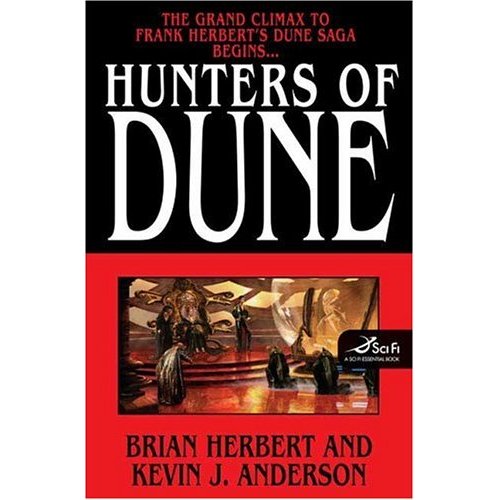
Hunters of Dune by Brian Herbert and Kevin Anderson. The same state of affairs: stupid writing, pitched to coddle stupid readers.
Frank Herbert's
Dune is one of the five greatest science fiction novels of all time. It's a crowning example of how smart, sharp, and moving the genre's fiction can be. It's a magnificent reading experience, and I'm of the opinion (not shared by all of you, I know) that all of Herbert's subsequent "Dune" novels are almost equally great (
God Emperor is my personal favorite).
One of the fundamental REASONS they're great is because Herbert always assumes his readers are as intelligent as he is (since his intellect was up in Elmo's slightly-creepy range, this isn't always the case, and some of most delicious sensations in
Dune come from the reader scrambling to KEEP UP).
Herbert's son, who for some reason seems to think his filial devotion is best demonstrated by exhuming his father's literary corpse every year and sodomizing it for all the world to see, holds just the opposite view. He assumes his readers are video-addled pre-adolescent boys, and he writes accordingly.
How many travesties has it been? Five? Six? But bad as they've been, they haven't been as bad as they COULD be. One thing prevented it: none of them were explicitly SEQUELS.
Brian's writing a thick, laborious version of the Butlerian Jihad? Well, that's appalling of course, but hey - Frank never wrote about it. Brian's free to envision it any way he likes, I guess. And I'm free not to pay that much attention. Even with the "House Atriedes" trilogy of prequels, it was just barely possible to convince yourself that it didn't 'really' concern
Dune at all.
Hunters of Dune takes that all away. Its plot - and its HUGE marketing campaign - entirely DEPEND on it being the sequel to Frank Herbert's final
Dune novel,
Chapterhouse: Dune. It picks up exactly where that book ends.
The marketing campaign - and Brian's self-serving preface - assert repeatedly that the ending of
Chapterhouse is a cliff-hanger that's gone unresolved for twenty years. Brian hauls out that oldest of fraud-chestnuts - the lost manuscript locked in a bottom desk drawer (how many such drawers has Hemingway had so far? Four?), and tries to cloak his 'sequel' in legitimacy by claiming it's just the fulfillment of a book Frank meant to write.
I read and loved
Chapterhouse back in 1985, and I've re-read it several times since (Herbert's books REALLY repay re-reading, in a way even those of his smart contemporaries often don't). At no point did I feel I was reading a cliff-hangingly incomplete novel. Nor do I believe Herbert thought he was writing one (writing a book that was not an aesthetic whole would have been anathema to him, as his son should bloody well know).
The scene at the close of
Chapterhouse is tense and precarious, yes, but by no means incomplete. The savage Honored Matres - in the person of their Bene Gesserit-trained new leader Murbella - have reached a fragile, suspicious accord with the Sisterhood. True, some dissenters have stolen a spaceship and disappeared out into the Scattering beyond the Empire, but Murbella is still holding her tentative alliance together, and there's a note of hope for the future.
The book ends on this note, followed, as all readers of the book know, by a heart-breaking tribute from Herbert to his late wife. This personal coda actually informs the novel, which is populated with one of the richest and most varied cast of female characters in all of fiction, let alone science fiction.
It's spare and unapolgetically intelligent: in life, there are no pat and simple conclusions - we adapt as best we can and move forward with what tools we have, always true to our larger purpose (it's obvious from his tribute that Herbert's wife both embodied this philosophy and served as its inspiration)(in other words, what the fuck is
wrong with a son who thinks it's a good idea to screw with that kind of end-note?)
Herbert's novel, like George's, is lumpy and endlessly repetitive - as one reader pointed out, just how many frickin times do we need to be told what 'the spice melange' is?
At every turn, characters are re-introduced and their comments carefully explained. The action - such as it is - is done so poorly it sometimes takes you a couple of pages to realize that anything has happened at all. On every page, Frank Herbert's literary legacy is despoiled, by the only person on Earth with the legal ability to do so.
It's extremely depressing to think this is just going to keep happening (as that same reader lamented, "Can't we just PAY him to stop writing?"), but the book's opening clarion call, "the saga of Dune is far from over!" makes it pretty clear the son is going to go right on doing this to his father's creation.
My solution, and my recommendation to all of you? Go back and read the real "Dune" books again. You'll find gems buried in them you missed before, no matter how many times you've read them.
And of course if you HAVEN'T read them, you should ignore
Hunters of Dune and do so at once. They'll amply show you what SMART science fiction can be like.