Showing posts with label justice league. Show all posts

Thursday, August 25, 2011

Comics! Heaven's Ladder!

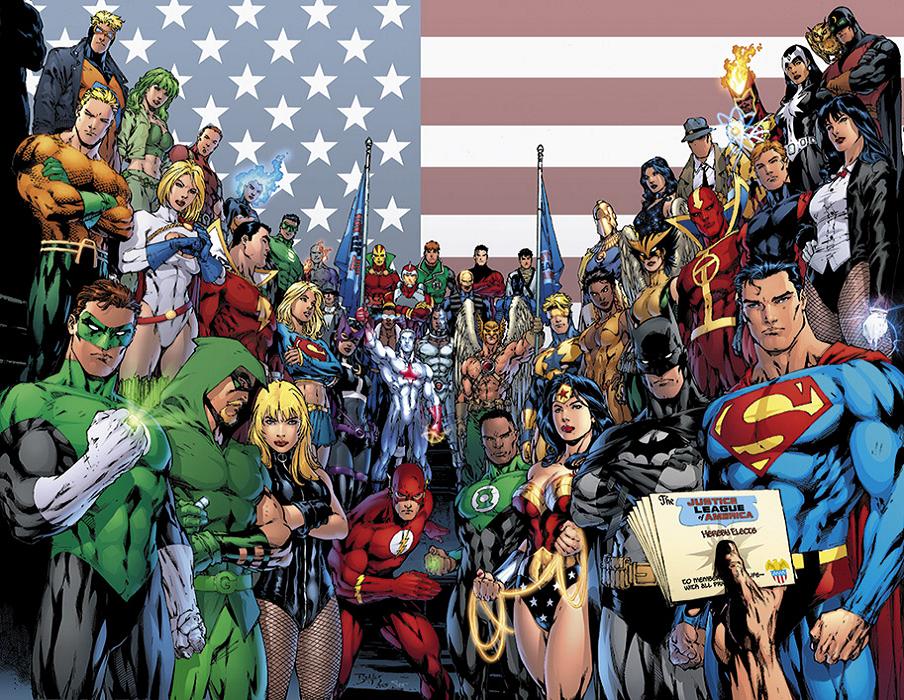
Since DC Comics' new iteration of  "DC Comics Presents" is specifically designed to reprint high point stories and artwork from the company's many decades, I'm presuming it'll be cancelled soon so all that glorious past continuity doesn't muddy up the "new 52" onslaught that begins hitting comics shops next week. Can't be regularly reminding your readers of how things used to be if you're trying to sell them a brand new set-up, now can you? Especially the part of that brand new set-up that touches on the Justice League, since the legendary super-group of all DC's iconic characters is undergoing a radical revamping in only a week, from a super-powerful team honored and respected by the world to, it seems, a spatting and hunted group distrusted by the world. I'll be trying that new Justice League (and a dozen other "new 52" titles), and I'll be keeping an open mind to its potential. But nevertheless, I'll always have a special place in my comics-reading heart for the real Justice League, especially for the rare instances when the title is done perfectly.

That's murderously difficult to do, of course. The League has taken on many incarnations over the decades (some interesting, some just plain ridiculous), but it's always at its best when its roster is at its strongest, crammed full of names even the most dilatory comics fans will recognize: Superman, Wonder Woman, Batman, the Flash, Green Lantern, Aquaman (nobody at all recognizes the Martian Manhunter, alas, but he's been with the team from the beginning, so creators always feel obliged to use him, even though the far more natural candidate would be either Supergirl, Plastic Man, or Captain Marvel) ... and with a roster like that, it's well-nigh impossible to come up with challenging things for them to do. DC heroes (at least, until next week) typically don't bicker and squabble among themselves the way Marvel heroes do, so Justice League writers can't get much out of the kind of interpersonal dynamic that would animate a Marvel book like "The Avengers." But actual adversaries capable of giving this 'big seven' roster a serious challenge are almost non-existent.

My own solution to this problem, if I controlled DC Comics, would be fairly simple: "Justice League" would be an annual comic, not a monthly one. Once every year, DC's best writer and artist would give us a staggering, epic adventure of the League, pulling out all the narrative and visual stops, and the rest of the time, we'd just read about the separate characters having their separate adventures.

(Of course, if I controlled DC Comics, none of these characters would be radically re-invented in only a week. And Adam Strange would have his own monthly comic.)


Since there's franchise money to be made, DC will never officially adopt that strategy - but for decades now, they've more or less unofficially adopted it, periodically bringing out special one-shot Justice League issues that stand alone in continuity and offer self-contained and fittingly epic stories. These are almost always far more satisfying than any monthly League title happening at the same time, and virtually every one of them has become a classic of the team's history.

So it's kind of fitting, in a bittersweet way, that one week before the debut of an all-new, all-different Justice League, "DC Comics Presents" would re-issue one of the greatest of those stand-alone Justice League events, "Heaven's Ladder." This book was originally issued back in 2000 in an oversized format designed to better highlight Bryan Hitch's stunningly detailed visuals, and I was very pleased to learn that it would be reprinted in a normal comic-book size and thereby perhaps reach a much wider audience.


The story is epic in its simplicity: the oldest race of beings in the universe is dying, and they abduct a string of planets (including Earth) in order to form a DNA-like helix that will allow them to transcend death into an afterlife of their own creation. The League (here comprised of 'the big seven' plus Steel, Plastic Man, and the Atom) naturally want their planet back, but they quickly become altruistically involved in the quest of their abductors to find peace. And along the way, they share their own beliefs of what the afterlife might be like, from Aquaman's oceanic view:
 In death we become one with the inky depths of the ocean. Below the knowledge of light, we float forever wide and weightless, silent witnesses to the dark above a sea-soaked sandscape older than time. Every creature of the sea, from the mighty whale to the merman to the turtle to the glistening mussels shed of their shells, becomes the very salt that buoys the teeming life beyond them.

To Wonder Woman's more warlike credo:
The ancient Greeks bequeathed us the lesson that death is but a dismal state. All men and women, from the greatest to the most ignoble, are eventually reclaimed by the soil of mother earth. The only way to deny death, then, is to live each day to its absolute fullest - by constantly striving to carve an immortal legend which will serve as your eternal legacy. By making the extraordinary ... look easy.

And naturally, for us Superman fans, this is a fraught topic - after all, our hero died (I still have the armband DC issued to prove it). The Atom remembers this at one point in Heaven's Ladder and asks Superman what Heaven was like, leading to a classic, simple exchange:
"What makes you think I went to Heaven?"

"Because if you didn't, the rest of us have no hope. Seriously, what do you remember? Anything?"

"A sensation that at long last, whatever I had to do next ... it could wait."

Waid's writing is snappy and in-character the whole time (Batman is the typical stumbling block for writers doing this kind of epic thing, since he's a guy with no superpowers who wears a bat suit - Waid handles it perfectly), and Hitch's artwork is magnificent - in my opinion, the best stuff he's ever done. Great chunks of DC continuity are worked into the story, and there are some hum-dinger fight scenes, and the scope of events is so big even this powerhouse version of the League is beaten and tattered and brought right to the edge of what they can do. It's thrilling stuff, and it feels all the more precious being presented to us now, when the foreseeable future might not have stories like this.

So I say "long live the good old days" - not the last time I'll be thinking that about DC comics in 2011 and beyond, I'd guess.


Tuesday, December 09, 2008

JLA/Avengers!


Our book today is JLA/Avengers, the graphic novel collection of the epic four-issue collaboration between comic book giants Marvel and DC in 2003 and 2004, now finally out in a trade paperback in a bookstore near you.

For many comics fans (myself certainly included), this story line is a kind of dream come true: an elaborate and highly detailed team-up/fight between the greatest super-hero team of the Marvel universe, the Avengers, and the most iconic super-hero team of the DC universe, the Justice League - here written by a comics fan who manages to 'get' just about every one of the many characters he's writing, and drawn by a comics legend and fan favorite. The comic-reading public had been promised some variation of this collaboration at every fan convention and trade show for the last thirty years (artist George Perez slips in funny visual references to all of them in the course of this story), and here popular writer Kurt Busiek is finally given permission not only to have the core members of both teams meet, but to have them fight - with a couple of actual winners and losers (non-comic fans have to realize how very, very rare that is in the comics world).

Now that all four issues have been collected, first in a deluxe slipcased hardcover and now in a handy trade paperback, it's easier to assess the strengths and weaknesses of the story - it has plenty of both. In any mega-thingamabob like this, the organizing plot device will be a Maguffin of massive proportions, and in that JLA/Avengers doesn't disappoint: a cosmic super-baddie from the DC universe, Krona, wants to know what came before the Big Bang. He wanders through one alternate universe after another (destroying most of them in the process, as cosmic super-baddies tend to do) in search of the answer, until he gets to the Marvel universe, where the cosmic chess-player The Grandmaster tells him he knows of a being who pre-dates the Big Bang - he offers to make introductions, IF Krona can best him in a game of cosmic chess, using the super-heroes from two alternate universes as living chess pieces. Instead of immediately eviscerating The Grandmaster, Krona agrees - and so the Justice League and the Avengers are pitted against each other!


This presents Busiek with his first major problem, because he's enough of a comics aficionado to want to use only the quintessential members of both teams as his key players. For the Justice League this is comparatively easy: it's the roster even most non-comics fans will know by name - Superman, Wonder Woman, Batman, Green Lantern, the Flash, Aquaman (to which add that perennial unknown, the Martian Manhunter, and Busiek's quite appropriate addition of Plastic Man). For the Avengers it's much trickier - you want a roster that has a good deal of physical power but that also represents the team at its best. Busiek picks a great central core: Captain America, Iron Man, Thor, Hank Pym, the Wasp, the Vision, the Scarlet Witch, Hawkeye, and Quicksilver.

Comics fans can spot the problem right away, at least in terms of having the two teams of chess-pieces initially square off against each other: the Justice League would mop the floor with the Avengers. The Justice League roster includes three characters with world-class super-strength, four characters who can move at super-speed, four characters who can emit energy-beams of some kind or other, five characters who possess (or can summon) some form of invulnerability ... etc. By contrast, the Avengers contingent has two characters who are entirely dependent on technology (and one who is a piece of technology), two characters with no super-powers at all, only two characters with any degree of invulnerability, and only three characters with any degree of super-strength (and only one of those, Thor, has it in comparable degree to that possessed by half the Justice League team) ... etc.

If this thing were being handicapped by Las Vegas bookies instead of written and drawn by comics fans for comics fans, the resulting fight between these two teams would take about five minutes. After those five minutes, Thor would be the only Marvel character still standing - and he'd be facing Superman, Wonder Woman, Green Lantern, and the Martian Manhunter, so he wouldn't be standing for long.

But that's never how things happen in the world of comics, and Busiek knows it (you can tell he knows it by the two absolutely priceless scenes in JLA/Avengers where he bucks against it - once by having Batman 'spend fifteen minutes beating up some loon in kevlar' offstage - i.e. the allegedly badass Punisher, and once by having Captain America handily demolish the allegedly badass Prometheus ... while uttering my single favorite line from the book, "Try fighting the Wehrmacht, mister - it teaches you FOCUS!" Hee). So the battles between the two teams in his book are more prolonged and even-sided affairs.


Of course long-time comics fans will have dreamt of some of those battles, and they'll disagree with some of Busiek's outcomes. Some of the fights he orchestrates are iconic in their own right: Batman and Captain America, for instance, are each respective company's most popular and well-known non-superpowered character, one a grim nighttime avenger of wrong, and the other a flag-wearing champion of right. How on Earth can you call a winner in such a fight? On his side, Captain America has not only the super-soldier formula coursing through his body (and making him, at least according to The Official Handbook of the Marvel Universe, virtually incapable of getting tired) but has years of experience fighting all kinds of opponents. And on the other hand, you have ... Batman, the least beatable of all super-heroes, powered or otherwise.

Busiek solves this particular problem cannily (he makes them so experienced they don't need to fight - they become the ones who realize both teams are being used as pawns in a bigger game), but that still leaves him with lots of others. DC's Flash is just plain and simple faster than Marvel's Quicksilver. DC's Green Lantern has access to technology (his ring) that just plain and simple outclasses the technology of Iron Man's armor. DC's dark-eyed emotionally-controlled team 'outsider' Martian Manhunter has all the powers of his Marvel equivalent, the Vision, and lots more besides. And who on the Avengers even approaches the balance for a character like Wonder Woman - as powerful as Superman and with five hundred times his fighting experience?

It's to Busiek's credit that in addition to side-stepping some of these problems by getting the two teams co-operating on the double, he also shifts his focus onto the differences in the two teams - and by extension the two universes and the two companies. At one point Aquaman comments to Superman that the heroes of the Marvel universe seem generally less powerful than those of the DC universe ("and," Aquaman points out, "their world is stacked against them"), and although this doesn't cut any mustard with Superman (he's portrayed throughout as interestingly disdainful of the Marvel heroes' inability to inspire the populace), it's a great motif running throughout the book. We're told that the Marvel Earth is smaller than the DC version, and louder, and less healthy (Superman's senses note harsher sunlight and higher blood pressure) - and this perfectly reflects the more hardscrabble, more human kind of superhero that Stan Lee, Jack Kirby, and Steve Ditko wanted to create forty years ago, specifically as a comment on DC's larger-than-life icons.

At one point when the Avengers' expert marksman Hawkeye rejoins his comrades, the Wasp warmly welcomes him with a friendly peck on the cheek, and it's a winning, natural moment - and unthinkable in DC's more Olympian cast. Busiek puts little moments like that everywhere in his sprawling cosmic epic, and they all work.


The whole book largely works, and by far the most moving moment comes when our combined heroes are faced with a choice: go on living in the fantasy-world caused by the forcible combining of their two worlds, or fight to separate those worlds and restore both their realities. In order for them to make an informed decision, The Grandmaster shows them a kaleidoscope of key moments from their respective realities - a guided tour of the very worst things that comics readers have seen happen to these characters over the last twenty years. It's a surreal moment, as long-time readers realize all they've been through with these characters ... and when it's over, our heroes do just what heroes always do: they choose to suffer for the greater good.

Again, JLA/Avengers mostly works, and reading it again after a lapse of years allowed me to pick out not only more of the delectable little character moments Busiek includes but also more of the fantastic, fanatical, insanely detailed penciling work of George Perez, who manages, in the course of four issues (and all at once on the cover of the fourth), to draw just about every major and minor character in the entire history of both Marvel and DC. Virtuosity like that becomes almost scary, but in a good way.

And at the end, of course, the door is left open for other such epic adventures! To which I have an obvious suggestion but one nevertheless I'd love to see: the full cast of Golden Age characters from each company, fighting and then teaming up against Hitler, the Red Skull, Per Degaton, and whatever other baddies come to mind. JSA/Invaders! Who's with me?


Friday, December 15, 2006

Comics! 52, FF, and more!


Four comics this week, all quite good (proof positive that they must have come from Elmo, since there's not an issue of gay-murderer Nightwing or Super-Linebacker, not a piece of crap in the batch ... hence, Pepito's hand is not seen) - and each yields a fervent PLEA to the funny book powers that be.

The current issue of '52' maintains that title's increasingly incredible run of great issues (those of you who a while ago gave up on this book should pick it back up forthwith ... not as some sort of 'prequel' to the current continuity, but because you'll scarcely read better DC stories anywhere on the new release shelves)(that last urging was aimed pretty much squarely at you, Kevin, ya snobby slug-a-bed!). It can't last, this run - next issue promises more of the idiotic new untrained lesbian Batwoman, and that CAN'T be made good.

But we can savor it while it lasts! This issue's hugely winning highlight is the whining, hapless Ralph Dibny's discovery of the hidden mountaintop city of Nanda Parbat.

I expected to be bored. I expected, in fact, to be FRUSTRATED and bored, since the Nanda Parbat stories I WANT to be reading star one of the greatest DC superheroes of them all, sharing all the elegant simplicity of the Hal Jordan Green Lantern, or the Barry Allen Flash - or indeed Superman and Batman: of course I refer to Deadman. And not whatever stupid-ass relaunch might be out there, but good old Boston Brand, wisecracking circus performer/ghost, who can slip his ghostly form into living bodies and take control of them. THAT character should be on issue #300 of his own title right now, but that's not the plea associated with this issue (well, it IS - I mean, it's always been a plea of Stevereads that Deadman be given the treatment he's due ... and yet, apart from that marvellous mini-series two years ago with its stellar artwork by Jose Garcia-Lopez, he hasn't received it).

No, our plea arises from this issue's amazing portrayal of one member of '52's Chinese super-team, the Great Ten of the Peoples Republic.

When we first encountered the team, we groaned at all the stereotypes herded together in one narrow space. Perhaps unlike the rest of you, we here at Stevereads number among our closest friends a native of China who would cringe equally at all the one-note caricatures it contained.

So imagine our pleasure when, in this issue, we learn that at least one member of the team, the lamentably-named Accomplished Pefect Physician, is revealed to have an actual personality, an individual back-story in which he's NOT just a mindless Communist party drone.

So our plea is this: more, please! Let's have a Great Ten mini-series, with equal complexity doled out to each member. With sufficient googling on the part of our writers, it could prove an educational experience for all the comic readers out there whose knowledge of China starts and stops with the Yellow Claw.

Up next is the third issue of Alan Davis' everything-but-the-kitchen-sink 'imaginary' Fantastic Four story, 'The End.' This is the third issue of six, so there's way too much going on to summarize here. Suffice it to say Davis is continuing to haul in as many characters from the FF (especially the Lee/Kirby era) continuity as he possibly can - Galactus, the Watcher, Ronan the Accuser, Black Panther, and the Sentry this time around. And as with the previous two issues, there's the distinct feeling that he's sending out invites before he counts his chairs, if you get my meaning.

Still, this issue has high points - Davis' artwork is stellar, and John Kalisz contintues to outdo himself with his coloring. And there's an intriguing attempt to explain something that's always confused me - why so many of the Inhumans wear masks (Davis comes up with the ingenious idea that it's done as a sign of public contrition, for still looking human even after exposure to the Terrigan Mists).

(There are low points as well, most notably the 'cliffhanger' ending ... our heroes are attacked by a Sentry! Now let's see ... the original Sentry was defeated by the Fantastic Four; THIS one is facing the Human Torch, the Thing, the entire Inhuman royal family, and oh yeah - the friggin Silver Surfer. Geez - I'm on the edge of my seat over here!)

And the issue features a great action sequence involving Sue Storm and the Sub-Mariner, which leads us to our PLEA for this issue: could we please have a Namor ongoing series again? It's been years since the last one flared out in a burst of incoherent Jae Lee nonsense - surely it's time for one of Marvel's flagship characters to have his own title again? (and while we're at it, could somebody really popular propose renovating the continuity of the original Human Torch? So that he's alive, fully powered, and starring in his own title too? Thanx)

The Justice League shows up twice in this batch - first in the fourth issue of Brad Meltzer's ongoing relaunch. As you-all have gathered, I'm growing a bit impatient with this title - Meltzer clearly mapped out in his head the big storyline he wanted to tell, but it turns out he payed virtually no attention to breaking that story down into individual issues that are compelling in themselves.

The result has been four issues that feel, each one of them, like prologues. This is very annoying - bad enough we all know this run is going to be graphic novelled before the ink is dry on the last issue, but it sucks to have that fact rubbed in our faces.

This issue is a typical mess. There's Starro. There's a new Amazo. There's the issue's big reveal, Solomon Grundy - only dressed in a suit, so you know he's REALLY dangerous this time (where do these size-145 large super-villains get their suits?). But none of it gels at all, and you're left at the end of the issue same as at the end of all the other issues: wondering when the story's going to start.

So our plea? Start the story, already! So far, it looks like the new League membership will consist of Superman, Wonder Woman, Batman, Black Lightning, Vixen (just as soon as she gets her friggin jewelry back), Green Lantern, Black Canary, Red Tornado, Hawkgirl, and Roy Harper, rather disasterously renamed Red Arrow (it's the color-league!) - but it still feels like we're light-years away from actually seeing them all together.

(the issue also features a little mystery: on the bottom of page 11, the panel where Black Canary is hunched menacingly over Professor Ivor is clearly drawn by Adam Kubert, not Ed Benes ... but he's not credited. What the eff?)

Our last comic this time around is Justice League Unlimited, and there our plea is pretty simple: everybody should read this title! Month after month, it's the happy little antithesis of the 'adult' team books: a jam-packed story, great art, and the whole thing wraps up neatly at the end of every issue. Speaking for those of us who remember when ALL comics were like that, it can be pretty darn refreshing.

And what would a comic entry be without a Kevinator quiz? Let's try two this time around, and see who steps up:

1) The Sub-Mariner and Deadman share, by my counting, three major things in common as characters ... anybody care to guess what they are?

2) Davis' idea about why some Inhumans wear masks is good, but three things in Marvel continuity contradict it ... anybody?

Friday, August 25, 2006

comics! wolverine and JLA!


Only two comics this week, although my nemesis Pepito just recently returned from an exclusive tour of Europe and the subcontinent, so I'll doubtless be rooting through a pile of poop sometime soon.

In the meantime, I bought Justice League of America #1 and the latest issue of Wolverine. Both were meticulously well-done (fantastic artwork in both cases), and both irritated the piss out of me.

Wolverine #45, written by Marc Guggenheim and drawn by Humberto Ramos, is a Civil War tie-in, and I confess I bought it because the cover showed Wolverine duking it out with the Sub-Mariner, and Namor fascinates me these days. Not only does he LOOK like DC's Black Adam, but nowadays, with Namor having no ongoing title of his own, he's being WRITTEN like Black Adam - not a super-villain, but something much rarer in the comics world: a powerful badass who just doesn't happen to AGREE with the normal way super-heroes act.

Never bought an issue of Wolverine in my life. As many of you might already know, the character as he's always written torques me off no end. The pinnacle of that torsion had to be that John Romita Jr.-illustrated storyline a few years back where the writer (the perp's name escapes me at the moment) had a mind-controlled Wolverine take on - and BEAT - the frickin Fantastic Four.

This issue isn't as bad as that. But almost.

Guggenheim is a really good writer, and Ramos is a great artist, better all the time. And that keeps the issue interesting, well worth the offensive $3 price tag. I was brought up to speed quick: Nitro, the super-villain whose explosion killed Namorita and started the whole Civil War, has been hunted down by Namor's operatives. But Wolverine wants to know who was supplying Nitro with the drugs he was high on when he detonated, so he's in the odd position of needing to defend the guy against the Atlanteans. As this issue opens, that pits him against Namor himself, and that's where I started to get irritated.

I want you to picture something along with me. Picture yourself pitted in combat against a little toddler, a toddler who just a month ago learned to walk. This toddler, despite his outward appearance, has years of combat experience - and to top it all off, he's got super-tough bones and two hands full of razor sharp knives.

In this scenario, you're a fully-grown male Navy SEAL.

Yep, you anticipate me. There is one, and I goddam mean only ONE way such a fight progresses. You are ONE HUNDRED TIMES stronger and faster than the toddler in question. There is NO CHANCE WHATSOEVER that the toddler will WIN the fight. There won't BE a fight.

Now guess what happens in issue #45?

On page 2, Wolverine a) takes a direct punch to the head and b) IN THE NEXT PANEL kicks the Sub-Mariner's feet out from under him.

That's just on Page 2. Not only would Namor's punch have blown Wolverine's eyeballs out of his head (bet they're a bitch to grow back, huh?), but Wolverine shouldn't be able to kick Namor's legs out from underneath him under any circumstances, even with a backhoe to help him out.

I mean, what's the POINT of having these characters in the first place, of endowing them with a rich continuous history, if you'll disregard it to make the little toddler look cool?

But I'm not sure the issue's ending doesn't bother me even more. Wolverine borrows a suit of armor from Iron Man to track Nitro to Atlantis (no attempt is made to explain why Iron Man doesn't just go himself, except that if he did, it would fuck this issue's storyline up the wazoo), where he fights Namor again and - surrealistically absurdly - comes even closer to being his equal. And then Wolverine has a change of heart and LEAVES Nitro to the Atlanteans. Knowing full well that they're going to torture him for a very, very long time before they kill him. Having been told of these methods by Iron Man.

So they both know about it. Iron Man and Wolverine know they're handing Nitro over to a society that'll TORTURE HIM TO DEATH.

That's my growing problem with the whole Civil War storyline: it's making half of all Marvel's super-heroes into SUPER-VILLAINS. The appeal Wolverine used to have was that he might kill people, but he had a code of ethics - that deep down, he was a super-hero. And Iron Man? OUR Iron Man, leaving a super-villain in the hands of people who he knows will torture him to death?
I find I don't mind the idea that Civil War might radically change everything in the Marvel universe forever. I find I can live with the idea that half our erstwhile heroes are now ... well, if not super-villains maybe then certainly something more complex than they were before.

Oddly enough, the thing that bothers me is that the 'bad' guys include not only Spider-Man but ... worst of all ... the Fantastic Four.

So we move across the aisle to DC for a much bigger event: Justice League of America #1! Written by fourth-rate hack novelist Brad Meltzer and drawn by the great, the mighty Ed Benes.

There's a lot going on in this issue, and a lot of it is wonderful. Meltzer gives us a very mature multi-layer narrative, the hands-down best part of which is the strand where we see Batman, Superman, and Wonder Woman standing around in the Batcave discussing who they should invite to join the new League. Oh, how I wish we'd been given EVER so much more of that! It's wonderfully done - Batman obsessing about security issues, Superman exuding hope and inspiration, and Wonder Woman balancing it all out with tactical considerations.

From their deliberations, I'm gathering the new League's lineup will include at least Hal Jordan (a boring but predictable choice), Power Girl (an INSPIRED choice, if only for the interplay possible between her and Wonder Woman), Arsenal (mystifying, plain and simple - over in Outsiders, hasn't Arsenal been beaten up, tied up, throat-slit, chest-shot and just generally bitched-up by every single enemy they've faced?), Black Lightning (a welcome choice, not only a character with a rich history but also the very rare black super-hero who's not a pale imitation of some earlier white character) (but let's have his electrical powers substantially AMPED, shall we?), Vixen (a character with great potential, but still a fewkin lightweight), and Red Tornado (but a very altered version of the same, potentially not the same old boring android-striving-to-be-human yutz of old).

Alas, the rest of the issue ain't s'good.

There's Black Lightning's plotline, in which we learn that the old Flash villain is now an addict, addicted to Psycho-Pirate making him feel ecstatic. This bothers me because it links uncomfortabtly with Nitro over in Wolverine - so what, super-villains are now going to be drug addicts? But no HERO drug addicts (except maybe poor old Rex Tyler)?

And then there's Vixen's plotline. Urrgh, where to start? Actually, I'll start where the plotline starts - with Vixen, responding to a hand-written note, showing up at a bar for a BOOTY CALL. For some quickie-sex with the Question. Yeesh. So her code-name is Vixen, and she's Latina, and on top of that ... she's a drooling nympho. What's next, in the parade of stereotypes? She's got a brother upstate?

Then there's Arsenal's plotline, which is good in its own right but raises one HUGE question that Meltzer of course doesn't even acknowledge, let alone answer: why would you WANT Arsenal if, as the issue makes abundantly clear, Green Frickin Arrow is available? I mean, I'm all for new blood (Power Girl would be an inspired choice, as would Black Lightning), but why aren't we talking about re-assembling such core members as Green Arrow, Zatanna, SOME Flash, Martian Manhunter, etc?

And then there's Red Tornado's plotline, wherein the character's soul - ushered by Deadman (ALWAYS a pleasure to see, and a much brighter writer would have explored means of having HIM on the new team ... wouldn't THAT have been fun? DC's best character in 30 years ... why not at least try?) - eventually enters a genuine flesh-and-blood human body, although he gets to keep his powers. This bugged me less than other storylines - Red Tornado has needed re-defining for some time now, and this seems as good a start as any.

So, a hit-or-miss issue for me, but it might have worked OK, since it IS intelligently done and DOES leave the reader wanting a whole Hell of a lot MORE ... but no, I finished it with the pulpy feel of vomit in my mouth, and can you guess WHY?

YEP! The pages and pages of The Book of Fate, Meltzer's forthcoming novel ... pages that are tacked on at the end of the issue like a Cleveland whore's early-morning slurred demand of payment for service rendered.

So what are we supposed to think? That Meltzer demanded the pages appear, or he wouldn't write for the title? Or that the DC powers that be voluntarily appeased him, to woo his compliance? Either way, it's disgusting, and not just for the rank feeling of being manipulated.

No, the main reason it's disgusting is one not many comic fans will stomach easily, and that's the acknowledgement that they are children of a lesser god.

Comic book writers sometimes forget this and make inevitably disastrous forays into actual book-writing. They forget that nine-tenths of their comic book work is shouldered by the artists with whom they work - sequential art aimed at the eye does SO much of the work of words aimed at the brain. And so E.S! Maggin or Chris Claremont write novels fogged over with hyperbolic prose and phantom-limb longings for pictures that aren't there.

This is kin to the same thing. The only reason Meltzer writes a (very) decent Justice League issue is because he can't HACK it in any bigger leagues. He stoops to conquer, but in so doing (i.e. following up the issue with a frickin novel-excerpt), he gives ample sighting of his wide fat bum.

Don't get me wrong - comics these days are producing some mighty fine writers. What bugs me here are the one or two who have stupid, condescending ulterior motives for writing comics ... so my question is: is Meltzer in or out? I wouldn't have asked before this issue's noxious excerpt-inclusion, but I'm asking now.

Still, no matter how any of that works out, I was pleased to see the new JLA launched with such multi-layered intelligence. Let's hope DC's other, even more venerable flagship team title, Justice Society, is launched with equal care.