Showing posts with label mark helprin. Show all posts

Thursday, February 18, 2010

Winter's Tale!


Our book today is Mark Helprin’s luminous 1983 novel Winter’s Tale, certainly the author’s masterpiece and one of the only sustained examples of so-called ‘magical realism’ that didn’t strike me as lazy, condescending, or both. As most of you will already know (I’ve seldom met a well-read person who hasn’t read – and loved – this book), the skein of the story concerns innocent young barbarian Peter Lake, who leaves home to come to a towering, imposing New York City of a bygone era. There he finds/is found by an immense magical white horse named Athansor, and the two have adventures, but the cast of characters here is almost limitless, and in many ways the most memorable one is the city itself:
Manhattan, a high narrow kingdom as hopeful as any that ever was, burst upon him full force, a great and imperfect steel-tressed palace of a hundred million chambers, many-tiered gardens, pools, passages, and ramparts above its rivers. Built upon an island from which bridges stretched to other islands and to the mainland, the palace of a thousand tall towers was undefended. It took in nearly all who wished to enter, being so much larger than anything else that it could not ever be conquered but only visited by force. Newcomers, invaders, and the inhabitants themselves were so confused by its multiplicity, variety, vanity, size, brutality, and grace, that they lost sight of what it was. It was, for sure, one simple structure, busily divided, lovely and pleasing, an extraordinary hive of the imagination, the greatest house ever built.

For this reason, it occurred to me just the other day that Winter’s Tale would make a very satisfying re-read during a long-planned bus-ride to Manhattan. Bus and train are really the only ways to approach NYC; driving your own car, you’re too concerned about not getting killed to appreciate the experience, and flying is by its very nature anti-climactic. But when you approach slowly, over the course of four hours, you can watch the scenery gradually flatten out, as though in preparation for the immensity to come. You roll past the vast, faceless industries (reclamation plants, storage facilities for things and people) that exist only to support the daily workings of the thing you’re soon to encounter, and then, like a clockwork miracle, it appears: a city so huge it feels like a provocation just to approach it. In an unbeatable visual irony, you pass miles-wide and carefully-maintained cemeteries as you draw nearer, and your eyes can effortlessly shift from landscape that is quiet and determinedly horizontal to one that is intensely vertical and so raucous you can swear you hear it as you get nearer.

How nice, I thought, to re-read this quintessential hymn to New York City while driving into the heart of it. So I packed Winter’s Tale along with everything else.

Unfortunately, I also packed a monstrous pathogen, and after a mere 90 minutes of bus-ride (in the middle of a decidedly un-inspiring winterbound Connecticut landscape), my ears, nose, eyes, throat, and stomach erupted in a series of time-lapse geysers that left me trembling, weeping, sitting on the front step of the bus, begging the driver to let me off.

So my oh-so-neat English major’s idea of re-reading Winter’s Tale as I approached New York didn’t happen (looking back, I think the travel-gods were almost certainly punishing me specifically for being so insufferably artsy-fartsy), and, being of 100% Irish descent, I a) thoroughly destroyed that copy of the book and b) will never bring another copy  on a trip of any kind ever again, even at Mark Helprin’s specific behest. If innocent inanimate objects can’t be blamed for the misfortunes that befall us, say generations of Donoghues from Donegal, then what good are they?

Still, upon reflection (and after fifteen hours of sweated-through fever dreaming in which my fat basset hound did all the hippo’s dance routines from “Fantasia”), I see no reason to taint the book itself, nor to call for any of my loyal (and silent … sigh …) readers to shun it. “I have been to another world, and come back,” Winter’s Tale’s motto urges us, “Listen to me.” Readers have, and readers should. Not only is there wonder aplenty in this book, but there’s also a great deal of pitch-perfect humor (indeed, Helprin is so good at evoking the wonder that I think his humor is underestimated), as in the following little epiphany by the questionably sane Reverend Mootfowl, which ends with the perfect zinger:
“A bridge … is a very special thing. Haven’t you seen how delicate they are in relation to their size? They soar like birds; they extend and embody our finest efforts; and they utilize the curve of heaven. When a catenary of steel is hung over a river, believe me, God knows. Being a churchman, I would go so far as to say that that catenary, this marvelous graceful thing, this joy of physics, this perfect balance between rebellion and obedience, is God’s own signature on earth. I think it pleases Him to see them raised. I think that is why the city is so rich in events. The whole island, you see, is becoming a cathedral.”

“Does that leave out the Bronx?” someone asked.

“Yes,” Mootfowl replied.

Joyful little hoots pop up all through this book, and they fit so well with the solemnities that you can only stand in sheer awe of the work it must have required to write this book. In fact, Helprin could almost be writing about Winter’s Tale itself when he has a transformed and visionary Peter Lake proclaim:
“You see, it works. The balances are exact. The world is a perfect place, so perfect that even if there is nothing afterward, all this will have been enough.”

As we all know, ‘afterwards’ has included some less-than-stellar work and some gems (one of which, Freddy and Fredericka, I reviewed way, way back in 2006!) … but nothing shines quite as brightly as Winter’s Tale. If you’re one of the few who hasn’t read this book, hurry out today and do so. But mind the pathogens.

Tuesday, August 15, 2006

books, books, books!


It's been slim pickings on the new book front this week.

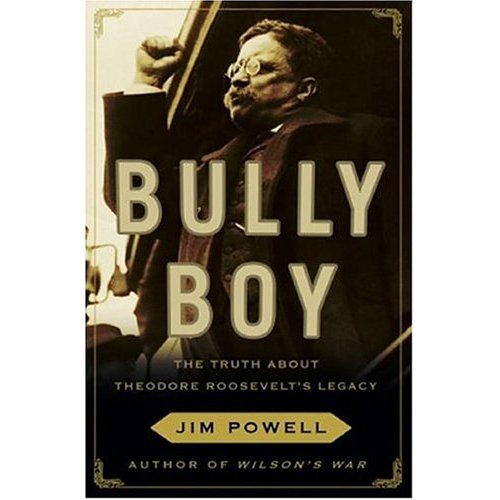
I read Jim Powell's book Bully Boy, which purports to be about Theodore Roosevelt. The author purports to be writing a kind of expose on how the 'real' Roosevelt was a darker, more ruinous figure for his own time and ours than the popular presidential mythos would have us believe.

I confess, it took me two whole chapters to see this book for what it is: a political TRACT, not history. Something sweaty and slightly crazed. Instead of being sold in bookstores, it should be handed out on subway platforms by sandalled young people whose parents think they're at the library.

It shouldn't have taken me that long (what can I say? It's been hot) - Hell, the chapter titles alone give the game away, consisting as they do of what lawyer-folk like to call leading questions.

Why did Roosevelt want to enter other people's wars?

Why did Roosevelt brag about 'trust busting' that harmed the American consumer?

Why were Roosevelt's 'conservation' policies wasteful and destructive?

When did Roosevelt stop beating his wife?

OK, that last one was mine, but you see what I'm getting at. If that sort of sophomoric nonsense were being spoken aloud, Jack McCoy would long since have lept to his feet and barked out "Your Honor!"

The book is riddled with ... well, I hesitate to call them errors, since that implies a black-and-white thing that can be fixed should there ever be, Gawd help us, a second printing. The book has plenty of those too, mind you, but the main thing it's choked with is a fog of partisan zeal - like when you're talking with a young Republican on your dorm floor and you suddenly get that sickening feeling that no ACTUAL discussion is happening at all - that the beads of cold sweat on their upper lip aren't there because they're fully engaged in the debate, they're there because your young friend hugely, overwhelmingly wants to send you to a death camp RIGHT NOW for what you're saying.

The book is a screed, and like all screeds political or otherwise, it DOESN'T CARE if its own underpinnings are distorted, unjust, or plain old false.

There's something like that on every page. The author went into his book with the theory that Theodore Roosevelt was an evil president, a war-monger, an enemy to the working classes, and the architect of all that's wrong with American society today. Basically, Powell's blaming Teddy Roosevelt for Vietnam. Yeesh.

If enough of you loyal readers raise the cry for me to page-by-page demolish this piece of crap, I'll do it. Your humble scribe is at your disposal, of course. But absent that acclaim, I just don't think it's worth it - the book isn't nearly GOOD enough to warrant dismantling.

Alas, the same can be said for Michael Cox's forthcoming novel The Meaning of Night. Well, not exactly the same - it's not a piece of crap, by a long shot. It's a big Victorian historical thriller, complete with Latin chapter headings and a liberal sprinkling of footnotes (a cutesy-poo literary fadlet given wide parlance by David Foster Wallace and recent cachet by the otherwise-delightful Jonathan Strange & Mr. Norrell - let's pray this book is its death-gasp), and its publishers are clearly holding their breath until the first reviewer uses the term "sumptuous."

But for all that it's not a bad book, although far overlong and full of itself, and with dialogue that's often tin-eared. If it ever comes out in a mass market-sized paperback, it'll be easy to recommend it to all of you as a slightly lighter-weight alternative to a very similar and hugely better book, Ian Pears' An Instance of the Fingerpost. But until then, you won't be missing much if you stick to re-reading Sherlock Holmes.

There WAS a good experience among the disappointments, however, and it came as a surprise to me. I read Mark Helprin's Freddy and Fredericka and really liked it, despite the fact that I haven't liked Helprin's last few books at all. I almost passed on this one completely, but a friend lent me the trade paperback, and I read - at first warily, and then gulping down the pages.

The book is a long piece of satire on the state of modern royalty, and I was expecting the operative word would be 'long' - but I didn't find it so. Instead, I found an endlessly energetic, very, very smart and almost consistently hilarious book. Helprin spares his titular royals no embarrassment, no imbecility, no fiasco .. but still, after very few pages, you get the distinct feeling that he LIKES them, certainly in spite of themselves.

And the dialogue (Helprin's age-old weakness) sparkles for long stretches, I thought. The royal couple go incognito to America, and at one point they're posing as dentists, of a sort:

"We're dentists," Fredericka blurted out. After all, that was what it said in the capsules.
Knowing this could lead to trouble, Freddy clarified Fredericka's answer. "Not for people, though," he said, holding up his right index finger.
"Not for people? For what then?" A long silence followed.
"Crocodiles," Freddy finally said. He seemed to think about it in awe.
"Crocodiles?"
"It's mainly periodontics."
"Is that true?" D. Popcorn's hands fell at his sides.
"There are tens of thousands of crocodiles in the South, where we come from. They have a lot of problems with their teeth, and they have a lot of teeth - a lot of teeth."
"But there are no crocodiles in America."
"There aren't?" Freddy asked.
"No, just alligators."
"Oh," said Freddy. And then, turning to Fredericka, "You mean all that time, all those years, we've been working on alligators, and we thought they were crocodiles?"
"What's the difference?" Fredericka asked.
"I have no idea," Freddy answered.
"Whatever they are, they make nice bags and belts," Fredericka continued. "Did you know that Bunny, the middle daughter of the Duchess of Trent, has a speedboat with crocodile upholstery? Or alligator, I don't know."
"How do you get them to the point where you can safely work on them?" Dr. Popcorn asked. "I can't even do that with a lot of my own patients."
"I guess you shoot them," Freddy said nonchalantly.
"To anaesthetise them."
"To kill them."
"You do periodontics on dead alligators?"
"Alligators or crocodiles, whichever they are."
"What for?"
Freddy was hard-pressed to think of an answer. "We're animal lovers."
"But you shoot them."
"We have to. They're terribly vicious. They can swallow a Corgi in the blink of an eye."


Not everybody's cup of tea, I know (especially 500 pages of it), but I found this stuff delightful, and I very much liked all the subtle strands of sadness and sentiment Helprin works into what is mostly a rollicking good farce. I can't for the life of me think of who I would recommend this book to - it will appeal neither to fans of modern fiction nor, strictly speaking, to fans of historical fiction. But I'll keep it in the back of my mind in case I meet a true reading omnivore like myself (it's possible my friend Beepy would like it, but since she only reads about a page every three days, it would represent five years of effort for her, so I probably won't mention it).

I felt like shopping for books today, but for some unknown reason, I didn't feel like HIKING to do so. So I put on my togs and went up West Broadway to the Goodwill (got panhandled along the way, but a perfectly healthy young woman with a big meal currently digesting in her belly - she said "sir, can you spare some change so I can pay for my prescription?" I almost laughed in her face. I almost said, "Missy, I was raised in a mean-spirited, incredibly manipulative Irish Catholic family; you're gonna have to do a LOT better than that to get any guilt out of me").

On West Broadway, we've got a good book selection at the Goodwill. The only worker there who spoke English told me they get around 150 books a week, but most of their customers are there to buy clothes, so the book section has a healthy amount of titles.

There's something oddly satisfying about buying books at a Goodwill. Maybe it's the total randomness of the selection, far more hit-or-miss even than a used bookstore. Or maybe it's the welcoming atmosphere of the West Broadway branch, where all the families and old ladies seem to know each other, where the jokes are sassy and rapid-fire, and where the parents for once don't have to worry about affording all the stuff their little kids pick out.

Or maybe it's the fact that this is unquestionably the last stop on the spin cycle for these books. This is where they end up when NOBODY else wants them, and there's nothing theoretical about their fate should they not be bought: the Dumpster is RIGHT THERE, in plain sight of the bookshelves. Every time you buy books there, you're making your own little Schindler's list.

Every time I go there, I start off browsing in silence. But gradually the books become aware of me, and they sense that being bought by me is one of the very best things that can happen to a book - I'll either loving read, annotate, and care for the book myself, or I'll find it a carefully-vetted home. So they start clamoring, and it's heartbreaking to hear. "Pick me, pick me - don't leave me here, you're my only chance!"

I heard that from many books today, none louder than an old Mentor paperback called The Essential Erasmus - still in excellent condition, no underlining or highlighting, 75 cents. But I left it behind, because a) I, of course, already have a copy (Erasmus being one of my favorites) and b) I couldn't in a million years find anybody who'd be even slightly interested in receiving i as a gift.

I left a lot behind, for variations on those reasons, and it struck me as it always does: you could stock a very good bookcase for $15. All of Sherlock Holmes. The Proud Tower by Barbara Tuchman. The Persian Boy by Mary Renault. Michael Shaara's The Killer Angels and Larry McMurtry's Lonesome Dove. All of Jane Austen. Cervantes. Ibsen. Greek tragedies. Nature books like the great Watchers at the Pond. Dictionaries, dictionaries of quotations, The Lord of the Rings and Plato.

Today I bought a fat trade paperback of Hedrick Smith's wide-ranging extremely companionable The Power Game, about how politics in Washington DC used to be done (before the present administration's new rules, of course) - one of the few political books I can stomach, mainly owing to its author's puckish writing ability. I also bought a sturdy trade paperback of Konrad Lorenz' King Solomon's Ring, mainly for two reasons: 1) I wasn't absolutely sure I owned a copy, and 2) even if I did, for 75 cents I'd get to read his wonderful, near-perfect essay about men and dogs, "The Covenant," before I passed it on to somebody else. And lastly I bought a mass market copy of an edition of Shakespeare's sonnets from 1969 that made me smile because the doubleted and ruffed young man and woman on the cover illustration look like they stepped out of an off-broadway production of "Hair."

Three worthy books, plucked from oblivion, for 2 bucks and change.

So give your local Goodwill a try! I'm not saying they're all as good as this one (strong in the memory is an ill-fated trip Sebastian and I once took to the big Salvation Army store on Route 1 North - a dank and horrid place where even the books had bad body odor), but you never know until you go look.