Showing posts with label oxford book of english verse. Show all posts

Saturday, April 30, 2011

Poetry Anthologies!


I could hardly let National Poetry Month come to a close without paying some kind of tribute to the main venue where most readers encounter poetry, now could I? Once, ages ago, that venue would have been the bard in the hall, the singer on the portico, but for most readers since Gutenberg, the main place where they encounter poetry is in books - and not just any books, but poetry anthologies. Poet jostling against poet, centuries eliding into centuries, styles and movements recklessly colliding with their polar opposites. Most readers out there first read poetry in just such heterogeneous company ... it was only later, as a mature-feeling act of adulthood, that some of them began buying entire books of poetry written by only one person.

Since the poetry anthology is perfectly adapted to pedagogy, they proliferate in schools, and this forces us to specify our terms. In terms of sheer numbers in print and sheer numbers of eyeballs that have scanned its pages, by far the most important poetry anthology of all time is the Norton Anthology of Poetry, the various incarnations of which have been mainstays in schools for three or four generations. But there are two kinds of poetry anthologies: the itemized tour and the personal statement. The Norton Anthologies are very much the former - they have to be, if they're going to work in classrooms. And while I don't discount the viral vitality of all literature (you can get infected regardless of the vector), I'm concentrating today on the other kind of poetry anthology, the personal statement. These are usually no less scholarly, and in their hearts they'd certainly like to be as impartially inclusive ... but they're not boardroom-generated, so they end up being as much reflections of their creators as they are reflections of the state of the art when they're made.

The ground-breakers in (more or less!) modern times were Palgrave's Golden Treasury and Quiller-Couch's Oxford Book of Verse ... and the main thing we notice about their original versions today is how narrow and parochial they seem, how limiting their personal statements are. We know there's a bigger verse-world out there than all those syrupy pastorals, but you certainly can't tell that from the neat and well-tended confines of the volumes themselves. I've got three very different - one can't help but think "better" volumes in mind.

The first is one that might actually compete with the Norton Anthology for academic sales: Hayden Carruth's hugely popular 1970 book The Voice That Is Great Within Us. There was a time when I could walk into the ramshackle apartment of any young poet and find a dog-eared copy of this book with its signature white cover. Carruth was a rotten poet himself, but with the overseeing of this particular volume, he hit a fascinating balance - like all the best 'personal statement' poetry anthologies, this one can be very pleasurably read from front to back like a novel, rather than picked and pecked through. Although I'll peck for you now, since I'd like to share one poem I love from each of the three anthologies mentioned here. From Carruth's book it's got to be Countee Cullen's quick ditty "Incident":
Once riding in old Baltimore,
Heart-filled, head-filled with glee;
I saw a Baltimorean
Keep looking straight at me.

Now I was eight and very small,
And he was no whit bigger,
And so I smiled, but he poked out
His tongue, and called me, "Nigger."

I saw the whole of Baltimore
From May until December;
Of all the things that happened there
That's all that I remember.

The most august of the three volumes I'm writing about today - indeed, quite possibly the most august poetry anthology in English - is Helen Gardner's mighty successor to the Quiller-Couch Oxford Book of English Verse. I prefer the Gardner even to its own successor, since that later version seems to me to be an Oxford Book that's finally more concerned with what it's not leaving out than with what it's including, if you follow the distinction. Any personal statement that even so much as acknowledges consensus is irredeemably craven, which is why I prefer the magisterial perfection of Gardner's version. Here are all the greatest names of English poetry, to an absolutely remarkable degree unmixed with baser matter, and here, unapologetically, are all the greatest poems by those great names, one after another in an astounding, uplifting fusillade. I'll again pick only one, well-known and well-loved by me: Tennyson's "Ulysses," which starts like this:
It little profits that an idle king,

By this still hearth, among these barren crags,

Matched with an aged wife, I mete and dole

Unequal laws unto a savage race,

That hoard, and sleep, and feed, and know not me.

And that ends, wonderfully, like this:
There lies the port; the vessel puffs her sail;

There gloom the dark broad seas. My mariners,

Souls that have toiled, and wrought, and thought with me -

That ever with a frolic welcome took

The thunder and the sunshine, and opposed

Free hearts, free foreheads - you and I are old;

Old age hath yet his honour and his toil;

Death closes all: but something ere the end,

Some work of noble note, may yet be done,

Not unbecoming men that strove with Gods.

The lights begin to twinkle from the rocks:

The long day wanes: the slow moon climbs: the deep

Moans round with many voices. Come, my friends,

'Tis not too late to seek a newer world.

Push off, and sitting well in order smite

The sounding furrows; for my purpose holds

To sail beyond the sunset, and the baths

Of all the western stars, until I die.

It may be that the gulfs will wash us down:

It may be we shall touch the Happy Isles,

And see the great Achilles, whom we knew.

Though much is taken, much abides; and though

We are not now that strength which in old days

Moved earth and heaven; that which we are, we are;

One equal temper of heroic hearts,

Made weak by time and fate, but strong in will

To strive, to seek, to find, and not to yield.

And naturally, in any post like this, we must come at last to simple personal favorites, and I have one: the magnificent 1998 soup-to-nuts update of Mark Van Doren's Anthology of World Poetry, this one edited by Katharine Washburn and John Major and full of 1300 pages of endless variety and wonder. Where the Gardner volume has one immortal standard after another, this volume is a steady stream of surprises, whole worlds of the unexpected on every page. It's broken down roughly chronologically and sprawls across the whole of recorded human history - African chants, Elizabethan madrigals, Chinese miniatures, Beat imponderables. This is my single favorite poetry anthology, the book I would hand to somebody if they stood next to me in the Poetry section of the Brattle and asked me "What one book should I get?" In part this is due to the elastic range of the contents, because more than anything poetry should be about not letting our aesthetics calcify - but mainly due to the sheer beauty of so much of what's in here. I could pick a dozen examples instantly, but I'll stick to just one: a very loose adaptation of Horace by J. D. McClatchy, a poem called "Late Night Ode" that I've loved for long enough so that some of its terms are already outdated (CNN, beepers...):
It's over, love. Look at me pushing fifty now,

Hair like grave-grass growing in both ears,

The piles and the boggy prostate, the crooked penis,

The sour taste of each day's first lie,

And that recurrent dream of years ago pulling

A swaying bead-chain of moonlight,

Of slipping between the cool sheets of dark

along a body like my own, but blameless.

What good's my cut-glass conversation now,

Now I'm so effortlessly vulgar and sad?

You get from life what you can shake from it?

for me, it's g and t's all day and CNN.

Try the blond boychick lawyer, entry level

At eighty grand, who pouts about the overtime,

Keeps Evian and a beeper in his locker at the gym,

And hash in tinfoil under the office fern.

There's your hound from heaven, with buccaneer

Curls and perfumed war-paint on his nipples.

His answering machine always has room for one more

Slurred, embarrassed call from you-know-who.

Some nights I've laughed so hard the tears

won't stop. Look at me now. Why now?

I long ago gave up pretending to believe

Anyone's memory will give as good as it gets.

So why these stubborn tears? and why do I dream

Almost every night of holding you again,

Or at least of diving after you, my long-gone,

Through the bruised unbalanced waves.

I can't recommend World Poetry eagerly enough - if you ever find a copy, snatch it up. And if you should have the option to spend a few warmly drunken nights exchanging favorite finds with a beautiful young poet, don't hesitate to do that too. It definitely adds to the experience.

Thursday, November 22, 2007

The Oxford Book of English Verse


Our book today is the venerable Oxford Book of English Verse in the second edition helmed by the mighty Helen Gardner.

In John Mortimer's short story "Rumpole and the Golden Thread," the main character Horace Rumpole opines that when time and tide have washed away all remnants of the England he knows, three things will still survive: the British Breakfast, the presumption of innocence, and ... the Oxford Book of English Verse. In this as in so many things (like never pleading guilty, or the salubrious qualities of Chateau Thames Embankment), we here at Stevereads find ourselves in complete agreement with that lovable Old Bailey hack.

Or rather, almost complete. Rumpole's allegiance is, after all, to the first edition of the Oxford Book produced in 1900 through the herculean efforts of Arthur Quiller-Couch. Here we must admit a small apostasy: good as the Quiller-Couch volume is, it's nevertheless a quaintly Victorian conception, more a response to Palgrave's Treasury than to anything alive in the world of poetry at the turn of the 20th century. Even Quiller-Couch's revision of his own seminal work is more grudging than great-hearted.

No, it's enough to say he planted the seed and guarded its first sapling growth. Helen Gardner it is who brings it to perfection. Her volume, in turn, can never be bettered - when the time comes, it will need to be broken apart and entirely remade.

Botanical metaphors seem inevitable in describing a work of this much beauty and variety. An old Arab saying has it that a book is a garden you can carry i your satchel. If this is so, then the Oxford Book of English Verse represents the opulent parks and walkways of Versailles. Four pillars hold aloft the grand edifice of English letters - the novels of Jane Austen, the plays of Shakespeare, the King James Bible, and this indispensable volume.

Like those other pillars, it's really many volumes, as many volumes as there are readers who find it. The lovestruck mooncalf will find heartfelt outpouring aplenty. The melancholy brooder will find his surfeit of sighs. And the jeering satirist will find knives to make him smile. Gardner's range is far greater than Quiller-Couch's, and she is much more willing than he was to cut chunks of great verse from longer works. There is everything here, and all an appreciative reader can really do is flip pages and share their favorites. We here at Stevereads are no different in this, and we will leave you today with a few selections.

The first is from Henry King (1592-1669), written in one dash of self-pity the morning after he learned one of the best-kept secrets in the world:

Sic Vita

Like to the falling of a star,
Or as the flights of eagles are,
Or like the fresh spring's gaudy hue,
Or silver drops of morning dew,
Or like a wind that chafes the flood,
Or bubbles which on water stood:
Ever such is man whose borrowed light
Is straight called in, and paid to night.

The wind blows out the bubble dies;
The spring entombed in autumn dies;
The dew dries up, the star is shot;
The flight is past: and man forgot.

And here's the great John Dryden, waxing at his most pithy, as he always did when his heart was hurting:

Farewell, Ungrateful Traitor

Farewell, ungrateful traitor,
Farewell, my perjured swain,
Let never injured creature
Believe a man again.
The pleasure of possessing
Surpasses all expressing,
But 'tis too short a blessing,
And love too long a pain.

'Tis easy to deceive us
In pity of your pain,
But when we love you leave us
To rail at you in vain.
Before we have descried it
There is no bliss beside it,
But she that once has tried it
Will never love again.

The passion you pretended
Was only to obtain,
But when the charm is ended
The charmer you disdain.
Your love by ours we measure
Till we have lost our treasure
But dying is a pleasure,
When living is a pain.

And we'll end on a hopeful note, one of the most hopeful notes ever struck by a poet and one of our most loved pieces of verse (even though we don't believe a word of what it promises), by Christina Rossetti:

Uphill
Does the road wind uphill all the way?
Yes, to the very end.
Will the day's journey take the whole long day?
From morn to night, my friend.

But is there for the night a resting-place?
A roof for when the slow, dark hours begin.
May not the darkness hide it from my face?
You cannot miss that inn.

Shall I meet other wayfarers at night?
Those who have gone before.
Then must I knock, or call when just in sight?
They will not keep you standing at that door.

Shall I find comfort, travel-sore and weak?
Of labour you shall find the sum.
Will there be beds for me all who seek?
Yea, beds for all who come.

Wednesday, September 13, 2006

In the Penny Press! the TLS destroys!


It was a fairly bloody week over in the TLS, which might be horrendous news to a handful of writers out there ("Donoghue has not mastered his subject matter" ... hee...), but is very happy news to those of us with ringside seats to the veddy veddy British bloodletting.

First up, a trio of books on the biological and evolutionary origins of happiness in humans. The piece is fairly neutral on Richard Schoch's The Secrets of Happiness, very much likes Darrin McMahon's The Pursuit of Happiness and ... well, Danilel Gilbert's Stumbling on Happiness doesn't fare so well:

At the beginning of his book, Schoch inveighs against the current fad for measuring happiness and experimenting with control groups. In fact, the blurb of his book describes it as a 'kick up the rear' to such activities. Daniel Gilbert is not in Richard Schoch's bibiography under 'the new science of happiness', but that is where Gilbert's book Stumbling on Happiness belongs. The author is a distinguished Harvard psychologist with interests in the 'systematic mistakes we make when we try to imagine our personal future' and in the brain's limited ability (hence the book's title) to 'predict which of those futures it will most enjoy'. Unfortunately he writes in a style of such irritating condescension and infantile humour (with references to poo, cream-pie, popcorn, and puking one's guts out) that I was only able to read him with great difficulty, a few pages at a time. Gilbert seeks to surprise and amuse us with such scientific pronouncements as: 'Research shows that Californians are actually no happier than anyone else - so why does everyone (including Californians) seem to believe they are?'. This book, written as if human identity were premissed on Middle American taste (and that it's funny to describe Westerner's disgust at certain Chinese delicacies) is a model of how not to present psychological research to the general reader. I hope Daniel Gilbert's editor, who says he has a beautiful ear, reads this review.


Hee.

Up next? Robert Harris' new novel Imperium. This caused me a flutter of sympathy, I must admit, for two reasons: 1) I very much liked Harris' last book Pompeii and 2) I myself have written Roman historical novels, and the specter of being served on a spike hangs over the endeavor. After all, nobody would like reading this:

It is hard to see for whom this book is intended. Those who know the period well will find it anaemic; others may well be baffled. In spite of some absurdities and vulgarities - maybe in part because of them - the recent HBO television series Rome gives a much richer and more informed sense of Rome in the first century BC than does Imperium - and for that matter, more intelligent portraits of Caesar, Pompey, and indeed Cicero himself. Imperium is not vulgar or absurd, but it is curiously pointless.

Ouch.

Much as it's heresy to say so, I'm not entirely convinced by this review. The TLS is never wrong about scholarly works, but sometimes, very, very rarely, it misses the point of fiction. Pompeii had a wonderful undemostrative intelligence behind its every word-choice, and its characterizations were better and truer in 200 pages than Colleen McCullogh managed in 80,000. I'm holding out hope for Imperium.

But the butcher-belt keeps rolling! Naturally the ever-reliable J.C. gets in on the fun in the NB column, reviewing a new book of poetry by Matthew Cooperman:

A new book of poetry and prose arrives on our desk: Daze by Matthew Cooperman, published by Salt of Cambridge. It's tough stuff to understand. A piece of prose called 'Reasons for the Novel' offers twenty-seven 'reasons', the first of which is 'The novel of it, an unaccountable number of effects, whereby verisimilitude does or doesn't render ensemplastically skin, bicycles, meteors, savoir faires'. Reason No 8 is 'For Gods sake listen. Glottel horizon.'

There has always been 'difficult' literature, of course, and experts to make sense of it. With expectations therefore, we turned to the back cover of Daze to find D. A. Powell offering an exposition of Cooperman's work:

The ache of Berryman and the balls of Berrigan - a combination so striking in its language: sonorous, yes, but also snarky; lyrical and yet perky - dare I say perky? I do ... The poems do daze, they dazz, they does."

Hee. Oh, hee. The really bitter element of this comedy is that of course far worse, far deeper bullshit gets thrown around the poetry world every day, happily below J.C.'s radar. My young friend Sebastian travels voluntarily in such sewers, and he knows I've always been mystified as to how he can endure it. 'They does. They dazz' ... yeesh ...

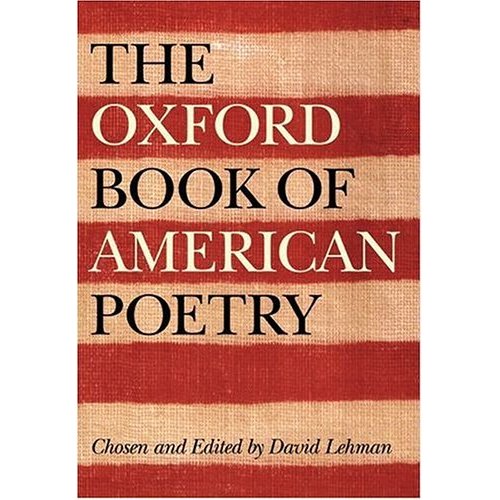
Unlike the vast horde of bullshit poetasters out there, it should be pointed out, Sebastian is genuinely talented. So of course I had him in mind when I read the MOTHER of all savageries in this TLS, Marjorie Perloff's magisterial, utterly damning review of David Lehman's Oxford Book of American Poetry.

I think I can guess what Lehman thinks, in whatever dark corner he's in after reading this piece. It's a systematic dismantling of Lehman's entire enterprise, culminating in this:

The myriad unaccountable inclusions and exclusions in the Oxford Book (why Joseph Ceravolo but no Amiri Baraka; Molly Peacock but no Majorie Welish?), suggest that Lehman's 'gold standard' is neither revisionary like Donald Allen's, nor encyclopedic like the Library of America's; neither avowedly multicultural like Nelson's, nor providing special focus on transnational and postcolonial poets like Ramazani's. No, the Oxford Book is merely tedious in a corporate way, what with its repeated nods to Lehman's contemporaries in high institutional places such as the President of the Guggenheim Foundation (Edward Hirsch), the director of the National Endowment for the Arts (Dana Gioia), and a bevy of recent laureates, of whom Donald Hall is the most recent.

Hee.

The really touching thing at the heart of Perloff's piece is its bedrock respect for the OFFICE of poet. Earlier in the piece this note is sounded more clearly:

And there's the rub: far from being apolitical, as Lehman claims, the standard of 'poems not poets' implies that clever, well-educated, well-connected people, working as academics or journalists or publishers, can often produce a lyric or two that deserves to be placed side by side with those who have made poetry their vocation. The poet as seer? as rebel? as serious thinker? as maker of the new? Not, evidently, in Lehman's lexicon.

See, I read the New York Times Book Review to learn what the chattering classes are actually chattering about. That's important, of course.

But the TLS, alone of all major publications (with the exception, perhaps, of Publishers Weekly, although gee, a whole LOT of ad money flows through their coffers ...), offers scrupulously intelligent, dispassionately fierce evaluations of everything worth considering literarily.

I love it dearly, though I doubt the above-named authors do.

Sunday, September 03, 2006

they also serve


For those of us who not only read but USE our books (writing, editorializing, translating, researching ... the verb-parts of reading), there's an unsung group of heroes on our shelves.

They're not first editions. They're not autographed. They don't come in attractive sets with calfskin bindings. They're not even the books we go to for pleasure, in most cases.

But they're essential, and it's high time they were given some of the praise that's their due.

Of course I'm talking about our reference books. That extremely well-thumbed and heavily bookmarked half-shelf to whole-shelf of books we keep not attractively displayed but RIGHT THERE, at arm's length from where we do our writing.

We THINK about all our other books far more often than we do these old workhorses. We move all the others around, change their order for aesthetic reasons. We handle them lovingly and are inwardly proud when our guests do likewise.

The reference shelf is different. Those books seldom get SEEN by guests, much less shown to them. But what they lack in glamor they make up in an intimacy for which all our other books envy them: we handle them virtually every day. I have a very attractive two-volume slipcased "Man Without Qualities" on my living room shelf. I haven't touched it in six years.

I've used my battered American Heritage Dictionary (4th edition) three times in this entry alone.

I'm not proposing calfskin and better lighting for these volumes - far from it! They need to be within arm's reach and well-used, because we need them to get our brains fully dressed before we show our stuff to anybody else. That shelf, alone among our books, can't support any peacocks.

What I AM proposing is that we all pause for a moment and THANK these books, these essential props who've taught (and continue to teach) us so much.

So go over to your shelf, if you have one - that particular place (probably near where you work), and jot down the titles, and share them with me and everybody here! Then we can all go back to our Folio Society volumes and our first editions.

Here's mine:

The American Heritage Dictionary, 4th edition
The Oxford Companion to English Literature, 4th edtion, edited by Margaret Drabble
The Oxford Book of English Verse - the Helen Gardner edition
Biblical Literacy by Rabbi Joseph Telushkin
The Ocean Almanac by Robert Hendrickson
Tudor England by John Guy
History of the World by J.M. Roberts
Animal by DK and the Smithsonian
The King James Bible
The mighty Oxford Classical Dictionary
The Chambers Biographical Dictionary, both the current edition and the previous one
The Riverside Shakespeare
and the National Geographic World Atlas

These old friends I thank one and all. Now let's hear yours!