Showing posts with label science fiction. Show all posts

Wednesday, February 02, 2011

Under the Covers with Paul Marron, Army Drone!

When last we left our chisel-cheeked pert-buttocked hero, he was the semi-willing thrall of a seductive vampire queen, and he was industriously fulfilling the job's two requirements: driving just the right kind of stake into her, um, heart whenever she demanded it, and acclimating himself to lots and lots of bondage-on-demand. And at the skilled hands of writer Joey Hill, that particular job was becoming steamy hot - including a later volume in the series in which Paul is caressing his vampire queen while several duplicate Paul's caress her (and perhaps each other?) also.  A person could become understandably flustered.

And if our Pauly did become flustered, he certainly reacted the way we all have at one time or another in our lives: he up and joined the space militia.

His first choice was the 26th century United Authority Marines in Steven Kent's rip-snortingly good series of Clone Republic novels - The Clone Republic, Rogue Clone, The Clone Alliance, and The Clone Elite. In these books, Paul goes by the nom de guerre of Wayson Harris, who's a clone with a lemon twist - he's got a mind of his own, and so he's got a price on his head.

The books follow Wayson through a nonstop series of adventures facing off both against human extremists and nasty alien invaders, and through it all, Steven Kent gives us lively dialogue and some fantastic action-sequences. The niche of military science fiction is one I've yet to explore here, at least not to an extent that would mirror the sheer enjoyment I've derived from that niche since David Drake was a hippie and Gordie Dickson would do readings for beer. I'll get to it one of these days, but in the meantime, those of you who like military sci-fi could do a lot worse than to seek out this author's books, where tense exchanges like this one are the order of the day:
"If General Glade thinks you're something special, that's his problem, asshole!" Moffat continued. "You got that? You may have friends in high places, but I have friends of my own, asshole. Do you hear me? You try to make yourself a hero again, and I will flatten you into a specking statistic. I will turn you into K.I.A. roadkill so fast you won't have time to wet yourself." As he said this, he placed a hand on my shoulder.

He should not have put his hand on me. Now I found myself angered to the point that I began to have a Liberator combat reflex. The hormone was beginning to flow through my blood, soothing me and pushing me to attack at the same time. Struggling to keep my temper in check, I brushed Moffat's hand from my sleeve. "I'll keep that in mind," I growled, still hoping to keep my growing need for violence in check.

When the fending off of other men's advances became too much for Paul - when he could no longer keep his needs in check - he left the U. A. Marines and shipped out with the Macht, a mysterious, mountain-bred race of warriors on the world of Kuf, in Paul Kearney's gripping, fantastic novel The Ten Thousand (gotta love a classical reference, especially made by somebody smart enough to realize that Xenophon is, in fact, the father of military science fiction). Here we call him Phiron, the commander of a unit of Macht hired by Prince Arkamenes of the Asurian Empire to make war on Arkamenes' brother the Great King and take his kingdom from him. Arkamenes is that staple of military science fiction - the courtly fop who doesn't at first understand the sublime coolness of the men he hires. He has all the low opinions of the Macht that you'd expect from such a figure:

"Well, Phiron, what plan is this you've hatched for me now?"
Phiron stepped out of the brisk-marching column. He wore his cuirass and carried a spear. Like all the Macht, he stored his shield and helm in the wagons while on the march. He was growing a beard; Arkamenes thought it did not suit him, but then no Kefren noble grew hair on his face. What an ugly race, he thought. So stubborn and steadfast, so small in mind, unprepossessing. They might be brothers to the Juthan, were it not for their colouring. And yet, these hairy, ugly little creatures were the stuff of Asurian legend. Deep down, Arkamenes knew full well that no Kefren army, not even the Great King's Honai, could have come out of that river and broken the enemy line as these things had. There was an implacability about them that had to be seen to be believed. His money had been well spent.

Readers of this sort of thing will catch echoes of everything from the Sardaukar of Dune to the Dorsai of Gordon Dickson, but then, science fiction done well is a homage-heavy genre. The point is, Kearney's stuff is done well, so the echoes honor their sources.

Well, that's one point. Another - and surely more important - point is that when some effete nobleman can call our Paul an "ugly little creature," it's clear that our hero has strayed very far from his natural habitats. It's fairly clear he was seeking out anonymity by joining the ranks of the space cadets, but what anonymity can there be for one so shapely? It bespeaks a fundamental confusion when a lodestar of so many female (and perhaps a few male? Can such things be?) fantasies should attempt to cross the road and find solace in science fiction. And to his credit, Paul eventually realizes this. When next we meet him, he'll be on far more natural terrain.

Monday, January 03, 2011

Dhalgren!

Our book today is Samuel Delany's 1975 masterpiece Dhalgren, and I've chosen it in part because it's the longest really good science fiction novel ever written (L. Ron Hubbard's Battlefield Earth is even longer, but it's one of the worst science fiction novels ever written, so its length is no consolation), and I love good long books. I read very fast (not speed-reading – never learned how to do that or wanted to – just really, really fast reading); a book of average length usually takes me only a bit more than 90 minutes to finish. That's really, really useful when it comes to keeping abreast of lots of new stuff that's being written, and it definitely comes in handy for freelance reviewing assignments, so I'm not bemoaning it by any means. But there's one element of the reading experience that absolutely doesn't activate in only 90 minutes: the element of submersion. Oh, I can still intensely love reading a book in that time (or less time! I dearly love at least three-quarters of the novellas Ingrid Norton just finished touring at Open Letters), and I can just as intensely dislike one. But the added element of 'getting lost in a book' – an element I treasure as much as any other reader – just isn't possible when the pages turn at such a rate.

If the book is not only really good but really long, I get to luxuriate in it just like everybody else. It's an uncritical reason to like a text, but there it is. And I'll even admit that there are books I'm quite fond of primarily for their length, books I know perfectly well have precious little literary quality (the first one of you who can accurately guess any such book will get a free copy of it from yours truly!) … but that's not the case with Dhalgren, which is so over-brimming with quality that even after multiple re-readings, I'm still finding strata that completely eluded me before, reading and sub-readings that would no doubt come as surprises to the congenial author himself – but that's the way of labyrinthine texts, as he knows better than almost anybody.

Dhalgren is a dreamscape of a novel – post-apocalyptic only in the sense that its world is partially shaken, partially melted, only fragmentarily recognizable as having once been our own. The setting is the beleaguered city of Bellona, around which reality itself seems to have collapsed and draped like a deflated tent. Miasmic fog fills the streets, and people wander into and out of the crumbling brickworks of each other's fantasies, and all of it is evoked in prose that's by turns precise and sensual. Time itself blurs and blends into “the terrible and vivid ephemera of now,” and the narrative slows often to lyric pauses like this one:
Look for a shadow in this double-lit mist. A dark communion in the burning streets between the landscape and the smarting senses suggests more sterile agonies. Clouds out of control decoct anticipation. What use can any of us have for two moons? The miracle of order has run out and I am left in an unmiraculous city where anything may happen. I don't need more intimations of disorder. It has to be more than that! Search the smoke for the fire's base. Read from the coals neither success nor despair. This edge of boredom is as bright. I pass it, into the dark rim. There is the deceiving warmth that asks nothing. There are objects lost in the double-light.

(Those of you who might wonder if you have filthy minds can relax – you do indeed! In addition to a poetic meditation on the collapse of order, that passage is also serving up an only slightly disguised description of something quite deliciously raunchy – the entire book is like that: constantly trying to slip you a mickey)

Losing yourself in this book is a very hot-summer hallucinatory kind of experience as characters of both genders and all ages move from shelter to shelter, coupling sometimes at random and always in exquisitely described detail (I'm trying to remember if there were comparably graphic same-sex scenes in any mainstream sci-fi novel before this one, but none are coming to mind – although in this as in all things, Star Trek fan fiction blazed the, er, trail). There's a grimness that underlies virtually all of it - as in most even vaguely post-apocalyptic stories, nobody's happy that they're living in post-apocalyptic times – so I'm always struck by how much humor there is in Dhalgren, as when gruff old George is complaining that the neighborhood has gone straight to Hell:
“God damn, sometimes I think there ain't nobody in the city no more ain't a faggot but me.”

“Is that a standard male, heterosexual fantasy?” Lanya asked. “I mean, to be the only straight man around when all the others are gay?”

“I ain't got nothing against faggots,” George said. “You seen them pictures them boys made of me? Something, huh? Some of my best friends is -”

“George!” Lanya held up her hand, her face in mock pain. “Come on, don't say it!”

“Look -” George's gestures became sweepingly gallant - “I just like to make sure all my friends is taken care of. If you wasn't getting none, see, I was gonna volunteer to make an exception in my standard methods of procedure and fit you in my list. We got to watch out for our friends? Now, don't we?”

“That's sweet of you,” Lanya said. “But I'm royally taken care of in that department.”

And as with most epic and deliberately unconventional novels like this one (Gravity's Rainbow being the obvious example, although in this case I think The Recognitions is a closer parallel), the author indulges in his super-large canvas to take some stylistic and rhetorical chances that would sink a shorter, more pointed work. One of the most persistent of these is also one of the ones I find most enjoyable: characters – especially a rather sexy pedant called Newboy – very often step off into long, almost uninterrupted flights of quasi-academic lecturing, and as off-putting as that sounds, it's never less than fascinating:
“But let me pose you an example. You know of Wilfred Owen?” Newboy did not wait for Kid's nod. “Like many young men, he wrote his poems during the War; he seems to have hated that war, but he fought in it, and was machine-gunned to death while trying to get his company over the Sambre Canal when he was younger than you. He is generally considered, in English, the greatest war poet. But how is one to compare him to Auden or O'Hara, Coleridge or Campion, Riding or Roethke, Rod or Edward Taylor, Spicer, Ashbery, Done, Waldmen, Byron or Berrigan or Michael Dennis Browne? As war – the experience or the concept – stays a vital image, Owen will stay a vital poet. If war were to be both abolished and forgotten, then Owen would become a minor figure, interesting only as a purely philological point in the development of the language, as an influence on more germane figures.”

An almost equally lengthy digression on Golding's translation of Ovid follows, and it's all the more wonderful for being so disjointed from its setting. There's a quiet wonder in how surely Delany pulls it off.

Dhalgren is very much a product of its times, in some regards – this is very much a fever-dream about how large cities warp the reality of those who live in them. But what's impressed me the times I've read this after the '70s is how much more there is to it than that. It's one of the most urban sci-fi epics ever written, true (ironically, far more so than books like Perdido Street Station, even though such books are carefully, almost fetish-style obsessed by their imaginary streets and buildings), but its sprawl contains multitudes of other registers. And I can sauna myself in it for the whole length of a lazy afternoon, which is no small attraction.

I can't recommend it strongly enough; you should go to your nearest bookstore and buy a copy (the latest trade paperback is boring-red). And as usual, if you're broke I'm happy to send you a copy.

Saturday, November 27, 2010

Notes for a Star Trek Bibliography: The Dinner Bell!

After the reckless abandon of the fanzines, just after the first flush of professionally-published fan fiction, the world of Star Trek fiction reverberated with a sound previously unheard in connection with any other adult science fiction TV show: the sound of the dinner bell. This sound is typically heard when a gap opens up between demand and supply, and it's almost always gonged by executive types who don't care much about how they supply that demand. To those executives, a gap between demand and supply means money - either being made or being lost. There is a large and active class of human beings that is urgently concerned with the making and losing of money, and that class always busies itself with the gap between demand and supply, be it for cars, Coldplay CDs, or 'reality' TV shows. It's through the ceaseless activities of this class of people that crap first entered the world seven thousand years ago and continues to fill it. So it is with parking garages, Will Ferrell movies, and, alas, a vast number of books - including Star Trek books.

The reason for this is of course lack of passion, and the reason it becomes an issue is simple: when executive types concerned with filling the gap between demand and supply ring the dinner bell, the first people to respond are the hacks. Almost by definition, a hack writer is someone for whom a writing assignment is a matter of pages not passion, word count not wonder, deadlines not destiny. Hacks may not live to write but they certainly make their living from writing - the lounge like sharks through the empty seas and come to full, hurrying life the instant their always-searching senses detect the erratic twitchings of a job. The nature of the job is secondary to a whole host of things: is it possible in the time allotted? Can it be done or faked without undue effort? And above all, what does it pay? If these things all check out OK, the hack will take the job - and only then will inquire what it is.

In the late 1970s, after Paramount and Bantam woke up to the fact that if they printed a Star Trek novel at $2.95 a copy it would routinely sell 300,000 copies (often more, and always quickly), they rang the dinner bell. In a financial sense, they had to - all they had on tap to fill that suddenly-perceived gap were a few manuscripts lovingly crafted by fanatics show-followers, and loving craft is time-consuming. Books were needed right away, to fill the creaking metal spinner-racks that constituted the whole sci-fi section of most American bookstores at the time.

It wasn't only Star Trek, naturally. Tie-in novels were booming, and the waters were positively frenzied with hacks. The Hardy Boys, K.N.I.G.H.T. Rider, The Man from Atlantis, (pre-cool) Battlestar Galactica, The Partridge Family, C.H.I.P.S. - all were spawning books in which familiar character-names were moved around in new "adventures" for an audience who wanted more than they'd received through the medium of TV. Every one of those books had to be written, and since it was too much to expect anybody to want to write them (it was only enough for the studios to expect people to want to read them), hacks were needed - and they answered the call, adopted pseudonyms, churned out prose, and so made their rent payments, bought their swimming pools, gave money to friends, and paid their beagles' medical bills. It's true that the field of literature was not elevated by their endeavors - but nobody got hurt, and the publishers' checks didn't bounce.

So it was with Star Trek novels in the late '70s. The dinner bell was sounded, and the books came pouring off the presses. Perhaps it's helpful to clarify here that I'm not always and only using the term 'hack' in a pejorative sense. I'm especially not using it to connote shoddy writing. When it comes to the actual mechanics of fluency, hacks are almost always not only competent but proficient - their sentences are smooth, their constructions hold up, and their dialogue is usually snappy. They are the prose professionals; while other, more heartfelt souls are torturing their sentences into brilliance over months or even Gold help us years, hacks are producing reams of writing that isn't brilliant but isn't bad. But a thing need not be technically bad to be crap - all that's really necessary to produce crap is to lack any passion for what you're doing. Andy Warhol, Sidney Lumet, Jonathan Franzen - the list of people who aren't technically bad yet produce crap is almost endless. The sad fact is, consumption doesn't usually wait on craft, or the world would have far less of practically everything man-made, and all of it would be much better.

In any case, none of this can be blamed on the hacks. They swarm in and take the writing jobs because those jobs pay, not for any other reason. In the late 1970s, there were suddenly paying jobs writing Star Trek novels (a state of affairs that would have seemed a madcap dream only a few years previous), and the work was fairly easy. The studio had a readily available 'book' on the factual scaffolding of the show (Dr. McCoy has an ex-wife, not a wife; Lieutenant Sulu is Japanese, not Chinese, etc.), and besides, by then almost everybody had seen the re-runs. What fans wanted seemed simple: more Star Trek adventures. Hacks set to work.

The resulting novels are the earliest canon of genuinely professional Star Trek novels, but they aren't the heart of that canon. In books such as Stephen Goldin's Trek to Madworld, Gordon Eklund's Devil's World and The Starless World, Jack Haldeman's Perry's Planet, or Joe Haldeman's Planet of Judgment and World Without End - this list is about a dozen books long - the general rout of readers got what it seemed to want: more adventures of the crew of the U.S.S. Enterprise ("No bloody A, B, C, or D"). Hack writers took fifteen minutes to come up with a tentpole gimmick - what if stars were sentient? what if the Enterprise encountered magic? what if Spock were trapped on a hostile world with a woman who hates Vulcans? - and plugged in cufflink characterizations (Kirk = heroic, McCoy = dour, Spock = exposition, etc.), shook vigorously, and rapped out the requisite 50,000 words. Trust me when I tell you: if you switch off the part of your brain that believes in its subject, the work isn't difficult. 5 solid pages a day gets it done in a little more than a month, and the publisher's check goes a long way.

The problem was that Star Trek was built on passion. Not just a drive to broadcast a show every week (even the producers of B.J. and the Bear had that), but passion about what the show stood for, what it dreamed. It would be impossible to tell the difference between a good Space:1999 novel and a bad one, for the simple reason that such a higher passion had never touched the show at any point - either in the broadcasting or in the knock-off novels - and without that passion, kitsch is indistinguishable from craft. But for some fans, it most certainly was possible to tell the difference between a good Star Trek novel and a bad one. The key was passion, and the give-away was how that passion animated the characters at the heart of the show. The Voight-Kampff test of Star Trek fiction has always been, ironically enough, whether or not the characters seem real.

This is an intangible test, and so hacks were doomed to fail it. A few minutes cogitation can give you a gimmick you can run through the whole of a quick book - Hey, past a certain point technology looks like sorcery, doesn't it? or Hey, what if gravity just stopped working? - but as The Velveteen Rabbit taught us many years ago, you have to believe in something to make it real. In every one of these dozen or so early novels (all of which we fans eagerly devoured and re-read, all of which sold far, far in excess of all other sci-fi novels published in the same months), there are familiar character names but no characterization, dialogue tics but no real exchanges, lots of stuff happening but no drama. In virtually every one of these books, you could extract the Star Trek elements and substitute Space Cruiser Yamato elements without disturbing things at all - stars would still be sentient, gravity would still be wonky, etc. They were consumed because their recipients were starving, and for that same reason many of them were fondly remembered even once those recipients had all the sustenance they could want (when you've been hiking for two weeks on one bitter apple and a few swallows of water a day, you remember forever the first big meal you had when it was over, no matter how terrible that meal was).

Very often, once hacks swarm in and blanket an area, they blight it or nearly do. The real question at this point in the course of Star Trek fiction was: now that the studio and the word-churners were involved, would there be no more genuine, passionate Star Trek fiction? As befits this particular show, the answer turned out to be surprisingly hopeful - as we'll see next time!

Tuesday, January 12, 2010

Votaries and Sharecroppers in the Penny Press!


You have to do a little patient skull-duggery to get to the good stuff in this month’s Atlantic. The James Fallows cover article on what America needs to do in order to ‘bounce back’ against the onslaught of underdog India and world-dominating China starts off strong, makes lots of good points, then in the third act veers off into weird we-need-a-new-form-of-government territory (if I had a dime for every time Jefferson’s boneheaded and offhand remark about how the country “needs a little rebellion now and then” was misused, I could buy a subscription to the Atlantic). Amanda Ripley’s piece on what makes a great teacher spends a great deal of time and verbiage arriving at the conclusion that the really great teachers are the ones who work really hard at it and think about it a lot. Timothy Lavin’s profile of a loony-tune late-night radio host went, I’m afraid, right over my head. And Michael Kinsley starts a piece by willfully misunderstanding the difference between a news story and a news bulletin and then flogging an entire article out of that misunderstanding (the article announces that he’ll be heading up a new website created by the Atlantic’s parent company – making me wonder if the dumbitdown.org domain name is already taken).

But once you get to the rear of the issue, some fun stuff can be found. Not, alas, Benjamin Schwarz (he appears to have the issue off, and I’m betting he’s at home reading), but two other stalwarts of the Atlantic, Caitlin Flanagan and Christopher Hitchens.

Flanagan, in full snarky-mad fettle, takes on the school-garden craze that’s sweeping her state of California – a craze that’s new to me, in which schoolchildren are assigned time during regular school hours, as schoolwork, to tend to the school’s garden, concoct recipes involving the school’s garden’s produce, harvest that produce, etc. Flanagan’s ire over this movement prompts her to a most excellent high dudgeon, right from the opening salvo:
Imagine that as a young and desperately poor Mexican man, you had made the dangerous and illegal journey to California to work in the fields with other migrants. There, you performed stoop labor, picking lettuce and bell peppers and table grapes; what made such an existence bearable was the dream of a better life. You met a woman and had a child with her, and because that child was born in the U.S., he was made a citizen of this great country. He will lead a life entirely different from yours; he will be educated. Now that child is about to begin middle school in the American city whose name is synonymous with higher learning, as it is the home of one of the greatest universities in the world: Berkeley. On the first day of sixth grade, the boy walks through the imposing double doors of his new school, stows his backpack, and then heads out to the field, where he stoops under a hot sun and begins to pick lettuce.

It’s rare for an immigrant experience to go the whole 360 in a single generation – one imagines the novel of assimilation, The White Man Calls It Romaine.

Hee.


Apparently, the mastermind behind school gardens is a woman named Alice Waters, whose restaurant, Chez Panisse, is renowned among foodies as the height of the gourmand experience. Flanagan is not amused:
… an eatery where the right-on, ‘yes we can,’ ACORN-loving, public-option-supporting man or woman of the people can tuck into a nice table d’hote menu of scallops, guinea hen, and tarte tatin for a modest 95 clams – wine, tax, and oppressively sanctimonious and relentlessly conversation-busting service not included (I’ve had major surgeries in which I was less scrupulously informed about what was about to happen to me, what was happening to me, and what had just happened to me than I’ve been during dinner there).

But her anger over school gardens isn’t born of anti-snobbery (well, mostly) – it’s purely practical:
I have spent many hours pouring over the endless research on the positive effects of garden curricula, and in all that time, I have yet to find a single study that suggests classroom gardens help students meet state standards for English or math. Our kids are working in these gardens with the promise of a better chance at getting an education and a high school diploma but without one bit of proof that their hard work will result in either.

The lack of those results, and the inevitable consequence of that lack, leads her to a ringing finale:
The state, which failed those students as children and adolescents, will have to shoulder them in adulthood, for it will have created not a generation of gentlemen farmers but one of intellectual sharecroppers, whose fortunes depend on the largesse or political whim of their educated peers.

What can I say? Writing that packs that kind of punch is to be welcomed whenever it shows up. Flanagan almost never disappoints, but this is heady stuff, even for her.

Would I could say the same thing about the other interesting piece at the rear of this issue, Christopher Hitchens’ review of W.W. Norton’s The Complete Stories of J.G. Ballard!


It’s not a knee-jerk reaction, either. Long-time watchers here at Stevereads will know that I’ve taken issue with Hitchens once or twice before (including once in the letters page of the Atlantic itself), but it’s always at least as much the product of frustration as anything else. The man can be brilliant, after all, whereas the most I myself am ever able to pull off is indefatigable (a word I wanted to work into the title of our favorite literary journal, calling it Indefatigable Letters Monthly – but John Cotter slammed his ale tankard on the table and bellowed “Avast with that talk, Donoghue!”)(actually, he swished his martini glass counter-clockwise and said, “Wellllll, that’s one way we could go – and here’s another” … and “Open” Letters was born). But when he’s insufferable, he’s A-grade insufferable … and he’s A-grade in this piece.

The main problem is that it’s fashionable among New York bookstore workers who read no science fiction to say that Ballard and writers like him (Margaret Atwood’s name invariably comes up in this context) actually wrote it. This particular version of eating your cake and having it too has always bugged me; it’s snobbery trying to disguise itself as open mindedness. “See?” it says, “I read science fiction! I thought The Road was stunning!” If you’re not willing to get down and dirty with the actual tropes of a genre, you’re nothing but a hoity-toit parvenu.

Cue Hitchens:
As one who has always disliked and distrusted so-called science fiction (the votaries of this cult disagreeing pointlessly about whether to refer to it as “SF” or “sci-fi”), I was prepared to be unimpressed even after Kingsley Amis praised Ballard as “the most imaginative of H.G. Wells’s successors.” The natural universe is far too complex and frightening and impressive on its own to require the puerile add-ons of space aliens and super-weapons …

Hitchens just barrels on from here (without seeming to realize that his rationale, if followed past its cramped use in this instance, would annihilate the legitimacy of all fiction – indeed, all representative art except real-time documentary film footage), high-handedly informing us that although he’s always thought this about the “cult” of science fiction (does he apply the word to Impressionist paintings? Romantic poetry? Even murder mysteries? I bet not), this Ballard fellow is alright – then he spends five paragraphs talking about Ballard’s straight-up historical novel Empire of the Sun.

As is perhaps inevitable in a piece with such a rocky start, further frustrations await, including this rather amazing comment:
Ballard wrote his heart out, especially after the random death of his beloved wife left him to raise three children, so I don’t especially like to say that he wrote too much. (This book has almost 1200 pages). But some of the stories are in want of polish and finish.

The hypocrisy of Christopher Hitchens bemoaning the fact that another writer churned out too much prose is so pronounced as to be almost surreal, but the thing that irked me most about this piece was the unprepossessing sight of a talented writer parading the fact that his mind has always been closed on a certain subject, is currently closed, and will likely remain closed forever. That’s hardly how you want to wind up an issue of the Atlantic.

Ah, but then, that’s NOT how we wind up this issue! No, that honor goes to Jeffrey Goldberg’s asinine “What’s Your Problem?” mock-advice column, which still occupies the magazine’s entire back page, even though its appearance every month for this long must surely have convinced even a blind man that the whole thing is a criminal waste of some of the most valuable magazine real estate in the world. If the goal here is to mimic Harper’s almost equally inane “Findings” end-page, the result is failure – “Findings,” although also a disgrace to the reputation of a legendary magazine, still manages to be bizarrely interesting about once every half-year, for a line or two. There’s no danger of that happening with “What’s Your Problem?” The Atlantic Powers That Be should yank this embarrassment – and if they’re looking for a smart, funny, invigorating one-page ‘literary life’ column to take its place, I’d be happy to see if any of my sharp young colleagues at Indefatigable Letters Monthly wants the gig.

Monday, December 14, 2009

Killer!


Our book today is the slam-bang sci-fi novel Killer by David Drake and Karl Edward Wagner. The book (an entirely successful outgrowth of an equally successful but substantially different short story by the same title) is set during the reign of the emperor Domitian and features the stoically heroic big game hunter Lycon, who has provided many an exotic beasts for the slaughter of the Roman games. Lycon has developed many contacts over the years, and the story opens when one of them shows him a weird animal found by some natives in Numidia in the rubble after a mountaintop exploded. The creature in question is man-shaped, with tough scaly blue skin and razor-sharp claws, and all the other animals in the caravan hate it instinctively.

Drake and Wagner are old hands at crafting expert sci-fi thrillers; they set to work immediately playing on the delicious narrative tension that arises from the fact that we understand right away that the creature is from another planet, whereas Lycon and his associates can't possibly think that and so spend the bulk of the novel simply to trying to comprehend how such an animal could exist in the world. The creature is cunning and at least human-smart, and it quickly escapes and begins to create havoc. Lycon pursues it with a pack of enormous dogs, and the results are sadly predictable:

Lycon was less than a hundred yards from the hedge, when the blue-scaled lizard-ape vaulted over the thorny barrier with an acrobat's grace. It writhed through the air, and one needle-clawed hand slashed out - tearing the throat from the nearest Molossian before the dog was fully aware of its presence. The lizard-ape bounced to the earth like a cat, as the last two snarling hounds sprang for it together. Spinning and slashing as it ducked under and away, the thing was literally a blur of motion. Deadly motion. Neither hound completed its leap, as lethal talons tore and gutted - slew with nightmarish precision.

Lycon skidded to a stop on the muddy field. He did not need to glance behind him to know he was alone with the beast. Its eyes glowed in the sunset as it turned from the butchered dogs and stared at its pursuer.


In the course of the pursuit that follows, Lycon gains the help of a mysterious "native" who conceals secrets just as otherworldly as those of the blue-skinned man-ape, and the hunt quickly goes from desperate to gruesome, as the hunters find an old associate hanging from the rafters of the creature's latest lair, his goo-encased body serving as an unwilling incubator:

Smiler's throat convulsed. Then his lips moved and spewed not words but blue-shimmering larvae the size of men's fingers - dozens of them, gouting up to flop onto the wood and writhe on vestigial legs toward the man who had just approached. Blood sprayed from Smiler's lips and throat together as the entire substance of his body seemed to convulse and give way to pass more of the things that had just hatched within his living flesh.

Killer takes the premises of Alien and Predator, shakes them vigorously, and transports them two thousand years into the past. The pace of the action never slows down for a moment, and the neat little trick the authors (both of whom are lifelong unapologetic advocates of the neat little trick) pull off at the very end will have you smiling for days. David Drake went on from Killer to overwrite severely - he's still a first-rate craftsman, but the best thing he could possibly do for that craft would be to summarily kill off every single character in all of his ongoing series, take a solid year off from all writing of any kind, then take a solid year to write - really write - one self-contained novel that will have no sequels. It would sweep the sci-fi awards if he did, you mark my words.

And if Killer prompts even a few of you to hunt around and explore the gritty, dark fictional worlds of Karl Edward Wagner, so much the better. A fat new collection of his work - with a fittingly badass new cover illustration - would be a fine thing indeed. Fortunately, in the meantime, we have this novel - in which both of them are clearly having a whale of a time.

Thursday, October 23, 2008

Dorsai!


Our books today are four of the late Gordon Dickson's "Dorsai" books, Dorsai!, Lost Dorsai, Spirit of Dorsai, and Soldier, Ask Not. These four titles are nowadays billed as 'segments' of something called 'The Childe Cycle,' but that need not overly worry you - Dickson was a chronic big-dreamer, and by the time of his death the over-arching structure of his 'Childe' books had taken on the doomed hyper-comprehensiveness of the unfulfillable - kind of like science fiction's answer to Mr. Casaubon's "The Key to All Mythologies."

Unfortunately, the "Dorsai" books ended up bloated, boring, and hopelessly convoluted; later tomes like The Final Encyclopedia, Young Bleys, and The Chantry Guild are joylessly impenetrable. And there are misfires early in the series too - notably Necromancer and Tactics of Mistake. But our four books today all crackle with energy and invention, each a perfect demonstration of how great Dickson's talent was before he forgot one-half of the Horatian dictum "to instruct and entertain."

The shared background of the books is Dickson's imagined future world of the so-called Splinter Cultures: in this future, groups of humans have left Old Earth and settled other worlds, allowing those worlds to sharpen their specialties and narrow their focuses - a kind of cultural natural selection. The planets Newton and Venus have devoted themselves to cutting-edge science, to the exclusion of all else; Harmony and Association are hotbeds of religious ecstasy (and fanaticism); Mara and Kultis are home to the Exotics (think of them as super-psychologists, with a little stage-magic thrown in); and central to these early books, there's the world of the Dorsai, whose natural resources are scanty enough so that the planet's chief export resource is its fighting men and women, the super-mercenaries known as the Dorsai.

Against this backdrop, Dickson again and again created fascinating stories, mainly centering around the Graeme family, specifically Donal and twin brothers Ian and Kensie. These three either star in the novels and short stories that comprise these four books or else crop up in them at key moments. The story of this family and the chaotic growth of the Splinter Cultures away from (and occasionally against) Old Earth had huge potential - Dickson only barely scratched its surface before he died. To an old hack sci-fi writer such as myself, the obvious grand clincher of a plotline would involve all these squabbling cultures banding together against a common enemy from outside, one intent of destroying them all. Deadwood-to-the-stars, as it were. But Dickson never got around to writing that story, as satisfying as it might have been.

Still, what we have today is satisfying enough! Dickson might eventually have intended his whole 'cycle' to be a parable of the totality of human existence, but before he went down that rabbit-hole, he wrote some great, thought-provoking sci-fi adventure stories set in a future world as fascinating as any on the market. Plus, it's pretty obvious from these four books how cool Dickson thinks his Dorsai are.


And they are - these men and women who are a little bigger, a lot faster, and who adhere to a military code that at times makes them seem utterly alien to the other Cultures, especially the hum-drum ordinary men of Old Earth. That contrast is at the heart of Soldier, Ask Not, which centers on the burning desire of one man of Old Earth, Tam Olyn, to plant his flag for the home world and have his revenge on the excesses of the Splinter Cultures. As he puts it:

... I am a man of Earth.

That does not impress you? Not in these days when the sons of the younger worlds are taller, stronger, more skilled and clever than we of the Old World? Then, how little you know of Earth, and the sons of Earth. Leave your younger worlds and come back to the Mother Planet, once, and touch her. She is still here and still the same. Her sun still shines on the waters of the Red Sea that parted before the Children of the Lord. The wind still blows in the pass of Thermopylae, where Leonidas and the Spartan Three Hundred held back the hosts of Xerxes, King of the Persians, and changed history....

...The men of the Dorsai may be warriors above imagining. The Exotics of Mara and Kultis may be robed magicians who can turn a man inside out and find answers outside philosophy. The researchers in hard science on Newton and Venus may have traveled so far beyond ordinary humans that they can talk to us only haltingly, nowadays. But we - we duller, shorter, simpler men of Old Earth still have something more than any of these. For we are still the whole being of man, the basic stock, of which they are only the refined parts - flashing, fine-honed, scintillant parts. But parts.

Responding to a tragedy in his life, Olyn seeks revenge on these worlds and their specialized beings, and eventually one of tools he's tempted to use to gain that revenge is a creation of Dickson's called The Final Encyclopedia - and it's positively goose-pimpling to read his descriptions of this vast storehouse of active, interlinked information ... information of all kinds, continuously fed and updated and multiplied until it takes on a kind of matrix or interconnectivity of its own ... a vast, centralized encyclopedia that puts all the combined knowledges and whims and artistic choices of every discipline at the fingertips of the most casual user ....

In Dickson's future world, such a Final Encyclopedia will take more than a century to build (since it's being accumulated, steadily) - and of course long before it's finished, it'll be too big to be housed on Earth's surface; it'll have to be launched into orbit around Earth. Dickson died in 2001 and hadn't been in the best of health for a time before that; I don't know if he ever really saw the real-world form his Final Encyclopedia ended up taking (he certainly couldn't even dream that some day an old snail-mail correspondent of his would have access to that amazing creation from the comfort of his bed on an autumn's evening, without need for special headset, jetpack, or inter-orbital shuttle).

Soldier, Ask Not is probably Dickson's most accomplished novel, although it drags in certain sections. Likewise the novel Dorsai! physically and opposite sides of the same coin emotionally, with Ian "all ice" and which centers on Donal Graeme as a kind of focal-point of planetary destiny. The book is fast-paced but feels anticlimactic, although it gives us some fine portraits - not only of Donal, who's strange and mystical in ways that puzzle his fellow Dorsai, but also of the towering identical twins Ian and Kensie Graeme, who are quintessential DorsaiKensie "all blood."


The brothers (and another pivotal Dorsai character, Amanda Morgan) feature prominently in Dickson's best-written Dorsai book, Lost Dorsai, a very intriguing story about what happens if a Dorsai were to embrace pacificism. There's plenty of action in this book, but the character-work is its highlight and some of Dickson's best work.


But for my money, the purest distillation of his Dorsai mythos comes in the short novella "Brothers" which forms half of Spirit of Dorsai. In that story, Kensie Graeme is leading a Dorsai Expeditionary Force putting down insurgents on the world of St. Marie, and his job is just about over - when a sniper guns him down in a city street. Kensie's allegedly emotionless brother Ian order the planet be put under martial law until his brother's killers are found, but he also orders his soldiers to wait until an investigation is made. The men are reluctant to obey, wrathful and mindful of an infamous incident in Dorsai past, the subject of a marching song:

It was the song of the young Colonel who had been put to death one hundred years before, when the Dorsai were just in their beginning. A New Earth city had employed a force of Dorsai with the secret intention of using them against an enemy force so superior as to surely destroy them utterly - so rendering payment for their services unnecessary while at the same time doing considerable damage to the enemy. Then the Dorsai had defeated the enemy, instead, and the city faced the necessity of paying, after all. To avoid this, the city authorities came up with the idea of charging the Dorsai commanding officer with dealing with the enemy, taking a bribe to claim victory for a battle never fought at all. It was the technique of the big lie; and it might even have worked if they had not made the mistake of arresting the commanding officer, to back up their story.

This incident from the Dorsai past hangs over the events of "Brothers" like an insistent threat, and the deadline the troops give their commanding officers (by overwhelming vote) before they attack the cities of St. Marie gets closer and closer as Ian and his allies search for the assassins. It's a tense, well-told tale of tragedy and revenge, and in addition to everything else, it treats its readers to Dickson's wonderfully Kiplingesque poetical talents! Because naturally, in addition to alluding to that old-story camp song, he sings it for us, and it goes like this:

... one fourth of Rochmont's fighting strength -
One battalion of Dorsai -
Were sent by Rochmont forth alone,
To bleed Helmuth, and die.

But look, look down from Rochmont's heights
Upon the Helmuth plain.
All of Helmuth's armored force
By Dorsai checked, or slain.

Look down, look down, on Rochmont's shame
To hide the wrong she'd done,
Made claim Helmuth had bribed Dorsais-
No battle had been won.

To prove that lie, the Rochmont lords
Arrested Jacques Chretien,
On charge he dealt with Helmuth's Chiefs
For payment to his men.

Commandant Arp Van Din sent word:
'You may not judge Dorsai,
Return our Colonel by the dawn,
Or Rochmont town will die.'

Strong-held behind her walls, Rochmont
Scorned to answer them,
Condemned, and at daybreak, hanged,
Young Colonel Jacques Chretien.

Bright, bright the sun that morning rose
Upon each weaponed wall.
But when the sun set in the west,
Those walls were leveled all.

Then soft and white the moon arose
On streets and roofs unstained,
But when that moon was down once more,
No street nor roof remained.

No more is there a Rochmont town
No more are Rochmont's men.
But stands a Dorsai monument
To Colonel Jacques Chretien.

So pass the word from world to world,
Alone still stands Dorsai.
But while she lives, no one of hers,
By foreign wrong shall die.

They little knew of brotherhood
- The faith of fighting men -
Who once to prove their lie was good
Hanged Colonel Jacques Chretien!

Of course in an overview like this one, only a fraction of the good stuff that awaits you in these four books can be sampled, so just take it on faith: if you like vigorous, down-to-earth (so to speak) science fiction, and especially military science fiction (if you know somebody currently serving in any branch of the military, find a copy of Spirit of Dorsai and mail it to them today), the early sagas of Gordon Dickson's "Dorsai" cycle won't let you down.

Sunday, November 04, 2007

Top 50 Science Fiction/Fantasy - 2007!


Nothing quite so restorative as a nice long list, and there’s been some demand, so we here at Stevereads unveil the latest version of our world-famous ‘Top 50 Science Fiction/Fantasy Novels of All Time.’ (a note to completists: this list supercedes all previous lists, by virtue of the fact that we here at Stevereads just keep getting smarter)

50. Norstrilia – Cordwainer Smith
49. The Pastel City – M. John Harrison
48. The Martian Chronicles – Ray Bradbury
47. Stranger in a Strange Land – Robert Heinlein
46. Ender’s Game – Orson Scott Card
45. Fire Upon the Deep – Vernor Vinge
44. Dying Inside – Robert Silverberg
43. The Demolished Man – Alfred Bester
42. Gormenghast – Merwyn Peake
41. The Invisible Man – H.G. Wells
40. The Lathe of Heaven – Ursula LeGuin
39. Up the Walls of the World – James Tiptree
38. 20,000 Leagues Under the Sea – Jules Verne
37. Dune - Frank Herbert
36. Dracula – Bram Stoker
35. Silverlock – John Myers Myers
34. The Last Unicorn – Peter S. Beagle
33. The King of Elfland’s Daughter – Lord Dunsany
32. Neuromancer – William Gibson
31. The Orphan – Robert Stallman
30. Them Bones – Howard Waldrop
29. War of the Worlds – H.G. Wells
28. Under the City of Angels – Jerry E. Brown
27. The Worm Ouroboros – E. R. Eddison
26. Tarzan of the Apes – Edgar Rice Burroughs
25. The Once and Future King – T. H. White
24. Elric of Melnibone – Michael Moorcock
23. Dhalgren – Samuel Delaney
22. Anno Dracula – Kim Newman
21. Perdido Street Station – China Mieville
20. The Lies of Locke Lamora – Scott Lynch
19. Frankenstein – Mary Shelley
18. The Mists of Avalon – Marion Zimmer Bradley
17. Dr. Jekyll and Mr. Hyde – Robert Louis Stevenson
16. Slan – A. E. Van Gogt
15. Soldier, Ask Not – Gordon Dickson
14. The Watchmen – Alan Moore and Dave Gibbons
13. Glory – Alfred Coppel
12. A Million Open Doors – John Barnes
11. Doorways in the Sand – Roger Zelazney
10. Where Late the Sweet Birds Sang – Kate Wilhelm
9. The Winter Queen – Joan Vinge
8. Farenheit 451 – Ray Bradbury
7. Hyperion – Robert Simmons
6. A Princess of Mars – Edgar Rice Burroughs
5. Trio for Lute – R.A. MacAvoy
4. The Dragon Waiting – Robert Ford
3. Canticle for Leibowitz – Walter Miller
2. The Book of Merlyn – T.H. White
1. The Lord of the Rings – J.R.R. Tolkien

As in previous versions of this list, there are some visible omissions. The journeyman work of such plodders as Asimov and Clarke continue to be absent, of course. Likewise we faced a problem with great writers – like Fritz Leiber, for instance – whose talents were almost always channeled into short stories (a top 50 short story list is in the offing). Another problem is of more recent vintage: fantasy authors don’t seem to write single, stand-alone novels anymore – most of the more talented writers are enmeshed in multi-volume open-ended mega-series that have no place on a list of this kind. So first-rate writers like Steve Erickson and R. Scott Baker find no mention here (a series list is another possibility).

But still! Even given unavoidable limitations, this list remains the single most definitive one in existence – which is surely what you’d expect here at Stevereads.

Thursday, December 07, 2006

New Genre!


Ordinarily, we here at stevereads regard with sad-eyed pity those wretched creatures who take it into their heads to create that most despised of our brethren, the literary journal.

We think always of the impossibly long odds, the frightful financial outlay, the obstinately recalcitrant contributors, the staggering unreliability of the talent (or lack thereof) pool. We shudder at pitiless odds of success.

Truly blessed are those literary journals that start off life with a dedicated cadre of talented content-providers. Of course the go-to fantasy template here is the New York Review of Books, or more recently the Believer.

Alternately, a good launch-sequence is a fiercely strong editorial vision, one that can potentially override any of the obstacles that hobble or eliminate lesser endeavors.

A loyal reader has brought before our attention here at Stevereads one such of the latter kind, an enterprising young literary journal called New Genre (oh very well! The reader was my young friend Sebastian, who flung the latest New Genre on his gold-inlaid teak coffee table and plaintively cried out 'Should I CARE about this? Because I have to tell you, between the new Clinique line and this Darfur business, I've only a certain amount of CARE left to go around!" Whereupon he flopped down on his Italian leather half-sofa and was served an early martini by the long-suffering Fulke).

Through a little industry on the part of our unpaid, unappreciated intern staff, we now have the first four issues of New Genre before us.

The first thing that should be pointed out is that the journal's title is a misnomer. Actual honest-to-gosh new genres are as rare as hen's teeth, and they arise from totally unforseen circumstances (science fiction from the rise of science, for instance, and chick lit from the faux-empowerment of the late 90s that allowed women to be as stupid and lazy as men). This is a science-fiction/horror journal. Not that there's anything wrong with that.

Nothing wrong, and nothing small-time: New Genre is a very attractive proposition, square-bound, clean-paged, with none of the idiotic, needy graphics that usually bedevil such organs. For your $8, you get a professionally put-together product without the smallest wiff of amateurism.

But surely that's not enough, you object? Like Sebastian (well, perhaps not EXACTLY like ... he weathers his frustrations at the family's private estate at the Isla de Malpelo, with its panoramic ocean views, whereas some of the rest of us have to muddle through on Main Street like plain folks), you must be wondering - what separates this from all the other like journals out there? The Alaska Quarterly (don't laugh - they pull their weight more often than not), Kenyon, Ohio, Story TriQuarterly, and (of course, given the givens) the Iowa Review ... they all offer relatively the same merits - professional packaging, modest pricetag (considering the, shall we say, elastic nature of their publishing scedules), clean, well-lit pages.

The selling-point as it were, lies at least partly in the intangibles. In editiorial vision, in aesthetic discrimination ... in short, in the editors' ability to PICK GOOD STORIES.

That's really it, isn't it? That's really it with ANY of these square-bound aspirants for our dollar and attention: do they provide the goods? Do they pick good stories?

Rest assured: the good folks at New Genre pick good stories. For the most part. And considering that one must GET good stories in order to pick them. Can't make bricks without straw, and all that.

The journal is edited jointly by Adam Golaski and Jeff Paris - the former holding sway over horror submissions and the latter over science fiction. They seem to enter very little on each other's domain - the science fiction stories all read very much of a piece, slangy and often stand-outishly good (whether this is a reflection of submission-quality or editorial sleight-of-hand is question only Mama Paris' little boy could answer accurately). The horror stories are very different - far more atmospheric, far heavier and more prolix (a distressing number of them seem to feel that dialogue is a frilly little option when it comes to writing real, he-manly prose).

The result is weird - and, it should immediately be added, extremely pleasing - dissonance in every issue. This is perhaps not what our editors would wish - at least judging from the title they chose for their enterprise, they might ideally hope to be closer to the same page, content-wise. But it benefits the reader, so our editors will just have to suffer in silence on the point.

Every issue has highlights, of course, and this four-issue run has standout items that will stick with the reader long after the more makeweight stories have filtered back into the background noise. This is the way with all literary journals, alas. The key, as far as the potential consumer is concerned, is a matter of ratio: is there enough good stuff to justify plunking for the cover price (in this case, New Genre starts at a reasonable $5 and then promptly jumps to a more daunting $8)(a note to our editors: ANY purchase that gives the buyer chump-change from a $10 bill is going to be considered major ... this reviewer, all innocent of overhead realities, but noticing that the journal offers only a handful of stories per issue, humbly suggests returning to the $5 level)?

The answer, at least when it comes to New Genre, is yes.

The standard of quality is refreshingly high across the board, and even what editorial lapses there are seldom detract from the reader's enjoyment. In some of the horror stories, mood is allowed to flourish at the expense of plot-sense, and in a few of the science fiction stories, gimmicky orthography is allowed to stand in place of narrative. In neither case are these lapses fatal: horror readers tend to LIKE mood, after all, and gimmicky orthography is the closest many science fiction readers will come to sex.

And in the meantime, every issue features not only a few pieces of good prose but at least one piece of really great prose. The first issue's highlight is Charlee Jacob's sweet, elegaic "The Pentacles of Their Hands." Issue #3's "Inside Everything is an Engine" by Thomas Dunford is strong and almost visionary in its clarity. In issue #4, Paul Glister's "Three Views from Deir el-Medina" is precisely one of those aforementioned stories that will stick with the reader long after the issue is read.

Issue #2 hits the high point of the run to date, with an absolutely fantastic story called "Wonderfreaks" by New Genre's most reliable star, Jan Wildt.

"Wonderfreaks" is the best thing so far found by New Genre, just as Wildt is the most promising writer in their stable. In fact, finding a writer as smart and talented as Wildt BEFORE the mainstream world does is one of the signal little joys of literary journals.

There are many such little joys - and a few big ones - in every issue of New Genre. Adam Golaski and Jeff Paris have concocted a (fairly) regularly realized literary journal of considerable worth to the general reader.

There's a caveat, one small one. Anyone familiar with literary journals will be able to guess what it is: yep, the proprietors. It's their party, and they almost always feel behooved to weigh in, to hold court for their readers before ushering them into the presence of their authors. It's an age-old rule: you have to tip a glass with the founders of the feast before you're allowed to talk with anybody interesting.

Editor essays are always quease-making little models of pompous sophisitry. It's distressing, but alas, it's the lay of the land. Somebody has to pay for the party, after all.

The amazing - and, oddly, pleasing - thing about New Genre's editor-prefaces is that just as the editors split the genre requirements right down the line, they also split the opening-comments requirements 50-50. Paris handles the sophistry, and Golaski handles the pomposity. And boy! Both are good at their roles! Paris aimlessly woolgathers during his essays, and Golaski's are so turgidly Olympian they could only have been written by a very young man (we've set an intern to Google Golaski's age, but the intern in question has a notorious drinking problem and has yet to supply the requested number).

But these introductions can be skipped - or else winkingly enjoyed! The real pleasures of New Genre lie well past the anteroom antics of its editors - the real pleasures of this neat little periodical arise from the fact that Paris and Golaski pretty consistently pick good stories. Even in our burgeoning literary scene, that's no inconsiderable thing.

So the answer to Sebastian's bleated plaint is yes. Yes, even in this crowded, shouting world, we should all care about New Genre. It and its sister publications are all that stand between us and a great deafening wave of corporate-sponsored least-common-denominator prose.

So hie thee hence to your local Barnes & Noble and ask them in a civil manner to take in New Genre! They ought to, and you ought to too.

Wednesday, August 30, 2006

Books! Stoopid Sci-Fi!


You know, the main enemies of science fiction aren't the genre-snobs who think it starts and stops with Philip K. Dick (or that Margaret Atwood has ever written a word of it).

The real enemies of science fiction are the writers of it who've bought into the mainstream idea that genre readers are a little dim.

If there's one thing I can't stand, it's dumb genre writing. As if genre fiction doesn't have enough handicaps to getting any respect in the literary world.

Mainstream fiction is another matter altogether. It's already accepted, so it doesn't need to prove itself. James Patterson's novels are pitched - intentionally or otherwise - at about a seventh grade level of literacy, and they sell millions of copies each, regular as clockwork. Every single one of Earth's 10.3 billion inhabitants has read The DaVinci Code, and it was so dumb the movie version was an IMPROVEMENT.

Mainstream fiction is so complacent in its stupidity that writers who are at best mediocre are lauded as its literary lions (I'm guessing most of you could append my usual list here). Margaret Drabble's latest indescribably dull novel goes on the best-seller list. Gilbert Sorrentino barely merits a one-paragraph obituary in the Dogwood Dispatch.

Science fiction has the potential to be the most relevant, the most challenging of all the genres. Exotic, killer diseases, staggering sights beamed to Earth from far-voyaging probes, the unlocking of the genome, the miniaturization and saturation of computers ... these developments aren't coming once every fifty or hundred years, like with Darwin and Mendel. Science fiction is happening in every morning's newscast (and not just in the technologically developed West - the meanest sub-Saharan village will be cast into turmoil right alongside London and Cairo by the destruction of the environment or the spread of mutated super-diseases).

So it's all the more frustrating that I recently read two stupid science fiction novels.

Not just stupid novels - although they were, good Gawd they were - but novels that ASSUMED stupidity on the part of their readers.

That assumption might help to sell more books, but it's certainly NOT something science fiction should learn from James Patterson.

This isn't to say that dumb science fiction can't be enjoyable (dumb pretty much anything can be enjoyable, although some things - like newscasts or commentary 'discussion' shows - nonetheless should never, ever be dumb).

No, the problem is that the two science fiction books I read recently have two distinct but equally compelling reasons NOT to be stupid, and yet stupid they are, stupid, stupid, stupid. Which is frustrating.

The first of the two books is titled ... well, I have no idea WHAT it's titled. The front cover (which, traditionally, gives the reader a clue or two as to the title of what they're reading) has two possible candidates, but I see no instinctive way to pick between them: either Crucible: McCoy or Provenance of Shadows. (I'm hoping it's the former, since the latter sucks like hard vacuum)

I can HEAR you rolling your eyes from here! Let me quote you: "A STAR TREK novel? Well OF COURSE that's going to be dumb! What did you expect?" Close enough?

That's this book's compelling reason NOT to be stupid. Because even genre fiction has its ghettos, and although 'Star Trek' ranks higher than 'Star Wars' (which ranks higher than 'Dragonquest,' which ranks higher than 'Warhammer'), it definitely constitutes a ghetto.

I stand for the ghetto. The entire 'Star Trek' phenomenon has attracted a tribble-trove of howling nutjobs over its forty year existence, it's true. But it's also attracted a whole lot of really smart, really passionate people, and: it's produced some really good books.

David George's "Crucible McCoy Provenance of Shadows" sure as Hell ain't one of them.

Good novels, really. It's a shame so many of you will never believe that, but it's understandable. For every Federation or Ship of the Line or Strangers from the Sky, there'll be books like this one, confirming every prejudice you have.

That doesn't mean I don't hate each such book with undimmed energy, as they come down the pike.

George takes as the fulcrum of his storyline ('plot' would be WAY too complimentary) the great 'classic' Trek episode "City on the Edge of Forever," in which, as many of you will not need reminding, a drug-addled McCoy goes back in time to 1930s Earth and Kirk & Spock go after him.

McCoy alters the timeline by saving the life of Edith Keeler, and Kirk & Spock restore it by preventing him from doing that.

Only NOT! Turns out the timeline in which McCoy saves Edith Keeler and changes Earth history happened after all, spooling out in mind-numbingly tedious daily detail in which McCoy is never rescued by his friends and never returns to the 23rd Century.

The separate timeline - in which Kirk & Spock rescue McCoy - turns out not to have erased the other one at all. They go on right next to each other, and the saved McCoy feels connected somehow to the unsaved one throughout his life.

That's really it. The saved McCoy doesn't somehow save the unsaved McCoy. And the unsaved McCoy doesn't somehow save the future. Nope. They both just live out their lives.

As was, I imagine, his goal, George takes us through most of the McCoy 'highlights' on the original series, the movies, and the character's brief cameo in the premiere of 'The Next Generation.'

Balancing this, we also get the life & times of the unsaved McCoy, who finds himself in the 20th Century with no ID and no background.

I guess I should point out, in case any of you missed it, that this premise a) makes no friggin sense whatsoever and b) could have made an absolutely RIVETING parallel-lives novel anyway, in the hand of a good writer.

The A part is obvious to anybody who's actually SEEN 'City on the Edge of Forever.' For those of you who might need your memory's refreshed (or who'll CLAIM you do - stand up and take a bow, Harlan!), allow me to walk you down memory lane:

Kirk & Spock follow their ailing comrade into the past. They meet Edith Keeler (there's that sublime scene in the basement, where she needs only a second to intuit that where Spock belongs is "at your side, like he always has been and always will be"), and Kirk falls in love with her.

(Decades of fan fiction have asserted that Edith Keeler is the great love of Kirk's life - something George seems to agree with, and maybe something that will salvage his upcoming Kirk novel)

Kirk is escorting Edith to the movies when she makes incidental mention of McCoy, that he's living back in the Mission they've just left. Kirk, electrified by the news, turns immediately to go back and find his friend. He sternly tells Edith to stay right where she is (Shatner's very good, showing a Kirk a little desperate to hold on to everything, old and new).

Just as Kirk is reaching the Mission's front doors, McCoy comes out - the friends have found each other! The rescue is a success!

Edith, seeing this joyful reunion, naturally walks toward it, intrigued. She doesn't notice the truck bearing down on her until it's too late. McCoy tries to save her, but Kirk, mindful of restoring the timeline, stops him. Edith is struck and killed.

In other words, McCoy CAN'T FAIL to save her unless he's ALREADY BEEN saved himself. The one follows the other. So there can't be any alternate timeline in which he grows old in the past. Either he grows old in the future, or he grows old in the past WITH Kirk and Spock (assuming here that the restoration of the timeline is what prompts the Guardian of Forever to return them to their present ... the story is a little vague on that point, with all due respect to its author!).

Still, I would have been willing to swallow a plot inconsistency of that size if the storytelling had been up to the task. Even Homer makes plot gaffes (a free book to the first of you loyal readers to give me an example! And again, don't send it to me privately! Share it with your legion of fellow Stevereads acolytes!)

But the storytelling is dumb. George is a leaden, endlessly repetitive writer who fundamentally distrusts his readers to pay attention for more than a page or two. PARAGRAPHS of exposition are repeated with only minimal variation EVERY SINGLE TIME their object is mentioned. It becomes mind-deadeningly dull.

And he's so self-conscious of writing intentionally 'canonical' Star Trek novels that you can virtually HEAR him flipping pages in the 'Star Trek Encyclopedia' every time he even so much as mentions a character.

The most ludicrous example of this? At one point, while he's performing the minor miracle of making a Federation/Klingon starship battle DULL, he contorts the action into balloon-animal shapes because of one tiny little line of dialogue. One of the Klingon ships the Enterprise is facing is commanded by Captain Koloth, and damn if George doesn't feel BEHOLDEN to Jadzia Dax's comment (a free book to the first person to tell me where!) that Koloth never faced Kirk in battle! Guess being AT the same battle on opposite sides but never actually exchanging phaser-fire honors that restriction!

This is EXACTLY the kind of crap that causes even science fiction fans to roll their eyes at 'Star Trek' novels. Continuity over drama. Fanboys over readers.

And it doesn't help any that his characterizations are unfailingly wooden. One excrutiating example should suffice. Spock suggests to McCoy that Kirk is hiding from his grief over Edith Keeler. And McCoy replies:

"I wasn't aware of what transpired between Jim and Edith Keeler. But do you really think his refusal to really deal with his loss is impacting the captain's ability to command?"

To paraphrase a wonderful bit of snark, that's prose written on a computer BY a computer. It would sound stupidly formal and verbose even put in a Vulcan's mouth - does any 'Star Trek' reader (aside, I guess, from George) for a moment picture McCoy sounding like that?

I'm sure all this venting is mostly wasted effort. Most of you wouldn't read a 'Star Trek' novel with a phaser pointed at your head (although I know at least three of you, like myself, have lots of fond memories of earlier ones that were actually good).

My frustration comes from the fact that stupid novels like this - where distrust of the audience's intelligence is the bedrock starting point - not only betray the intelligences that created 'Star Trek' in the first place but also make it that much harder for ANYBODY to take these novels seriously.

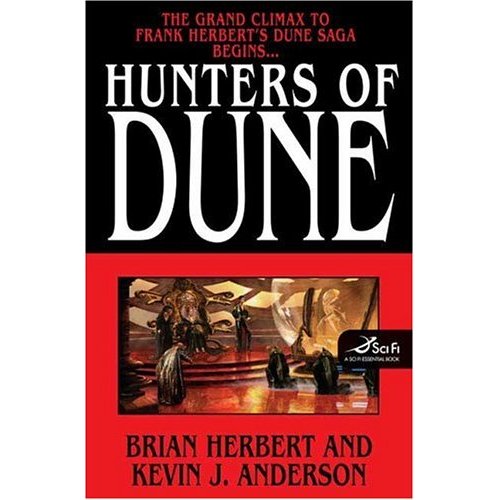
The exact same state of affairs pertains to the 'new' "Dune" novel, Hunters of Dune by Brian Herbert and Kevin Anderson. The same state of affairs: stupid writing, pitched to coddle stupid readers.

Frank Herbert's Dune is one of the five greatest science fiction novels of all time. It's a crowning example of how smart, sharp, and moving the genre's fiction can be. It's a magnificent reading experience, and I'm of the opinion (not shared by all of you, I know) that all of Herbert's subsequent "Dune" novels are almost equally great (God Emperor is my personal favorite).

One of the fundamental REASONS they're great is because Herbert always assumes his readers are as intelligent as he is (since his intellect was up in Elmo's slightly-creepy range, this isn't always the case, and some of most delicious sensations in Dune come from the reader scrambling to KEEP UP).

Herbert's son, who for some reason seems to think his filial devotion is best demonstrated by exhuming his father's literary corpse every year and sodomizing it for all the world to see, holds just the opposite view. He assumes his readers are video-addled pre-adolescent boys, and he writes accordingly.

How many travesties has it been? Five? Six? But bad as they've been, they haven't been as bad as they COULD be. One thing prevented it: none of them were explicitly SEQUELS.

Brian's writing a thick, laborious version of the Butlerian Jihad? Well, that's appalling of course, but hey - Frank never wrote about it. Brian's free to envision it any way he likes, I guess. And I'm free not to pay that much attention. Even with the "House Atriedes" trilogy of prequels, it was just barely possible to convince yourself that it didn't 'really' concern Dune at all.

Hunters of Dune takes that all away. Its plot - and its HUGE marketing campaign - entirely DEPEND on it being the sequel to Frank Herbert's final Dune novel, Chapterhouse: Dune. It picks up exactly where that book ends.

The marketing campaign - and Brian's self-serving preface - assert repeatedly that the ending of Chapterhouse is a cliff-hanger that's gone unresolved for twenty years. Brian hauls out that oldest of fraud-chestnuts - the lost manuscript locked in a bottom desk drawer (how many such drawers has Hemingway had so far? Four?), and tries to cloak his 'sequel' in legitimacy by claiming it's just the fulfillment of a book Frank meant to write.

I read and loved Chapterhouse back in 1985, and I've re-read it several times since (Herbert's books REALLY repay re-reading, in a way even those of his smart contemporaries often don't). At no point did I feel I was reading a cliff-hangingly incomplete novel. Nor do I believe Herbert thought he was writing one (writing a book that was not an aesthetic whole would have been anathema to him, as his son should bloody well know).

The scene at the close of Chapterhouse is tense and precarious, yes, but by no means incomplete. The savage Honored Matres - in the person of their Bene Gesserit-trained new leader Murbella - have reached a fragile, suspicious accord with the Sisterhood. True, some dissenters have stolen a spaceship and disappeared out into the Scattering beyond the Empire, but Murbella is still holding her tentative alliance together, and there's a note of hope for the future.

The book ends on this note, followed, as all readers of the book know, by a heart-breaking tribute from Herbert to his late wife. This personal coda actually informs the novel, which is populated with one of the richest and most varied cast of female characters in all of fiction, let alone science fiction.

It's spare and unapolgetically intelligent: in life, there are no pat and simple conclusions - we adapt as best we can and move forward with what tools we have, always true to our larger purpose (it's obvious from his tribute that Herbert's wife both embodied this philosophy and served as its inspiration)(in other words, what the fuck is wrong with a son who thinks it's a good idea to screw with that kind of end-note?)

Herbert's novel, like George's, is lumpy and endlessly repetitive - as one reader pointed out, just how many frickin times do we need to be told what 'the spice melange' is?

At every turn, characters are re-introduced and their comments carefully explained. The action - such as it is - is done so poorly it sometimes takes you a couple of pages to realize that anything has happened at all. On every page, Frank Herbert's literary legacy is despoiled, by the only person on Earth with the legal ability to do so.

It's extremely depressing to think this is just going to keep happening (as that same reader lamented, "Can't we just PAY him to stop writing?"), but the book's opening clarion call, "the saga of Dune is far from over!" makes it pretty clear the son is going to go right on doing this to his father's creation.

My solution, and my recommendation to all of you? Go back and read the real "Dune" books again. You'll find gems buried in them you missed before, no matter how many times you've read them.

And of course if you HAVEN'T read them, you should ignore Hunters of Dune and do so at once. They'll amply show you what SMART science fiction can be like.