
Monday, November 20, 2006

Penny Press! Chain stores and the Apocalypse!


Every issue of the Atlantic Monthly is a little like Christmas morning. You see the bounty spread before you in the table of contents, or blazoned on the cover, and the heart races. And like Christmas morning, what you end up unwrapping is almost always a mixed bag.

(ah, the glowing memory of the one and only Christmas where the bag WASN'T mixed ... that one and only time when everybody actually LISTENED to me and gave only gift certificates! Hardly any space under the tree, and I was in Heaven for months!)

Virginia Postrel turned in a very good piece "In Praise of Chain Stores," which of course had us here at Stevereads nodding in approval.

One of the experts Postrel quotes hits the nail on the head:

"[local anti-chain activists] want specialty retail that sells exactly what the chains sell - the same price the same fit, the same qualities, the same sizes, the same brands, even. You can show people pictures of a Pottery Barn with nothing but the name changed, and they'll love the store."

In other words, anti-chain store prejudice is born and kept alive by snobby Cantabrigians.

Chain stores plant themselves sometimes in the middle of feckin nowhere, offering a clean well-lighted space, shevles that are always well-stocked with a mind-staggering variety of items. They almost always attract to their staffs people who care about their particular specialization. Their size often allows them to offer discounts.

Listen carefully, boys and girls: ONLY in America could ANYBODY consider this a bad thing.

Don't get me wrong: we here at Stevereads are big fans of strong, knowing, well-stocked, idiosyncratic local shops. We're also big fans of Santa Claus and the Tooth Fairy.

OK, they're not quite urban legends. Everyplace has at least some places that 'you gotta see' - places that owe a large part of their 'gotta' status to the fact that you won't see them anywhere else.

That is a true fact. Here'a another: in the last twenty years, America has undergone a gigantic REAL ESTATE BOOM. This boom, ENTIRELY separate from what chain stores do or don't do, what they are or aren't, has driven property rates through the ceiling. Independent of ANYTHING chain stores do or don't do, these property rates have driven many small, idiosyncratic shops out of business. The ONLY thing chain stores did was take advantage of their more stable financial footing to PAY those hugely swollen rents. That's it. That's all. The only thing they did 'wrong' was exactly what all those little 'independent' shops would have done if they could have. The hypocrisy leaves salt-clogs in the mouth.

Alas, those clogs stay firmly in place during Mona Simpson's fawning piece about Alice Munro's recent elevation to the celestial ranks of Everyman's Library.

As some of you may know, Munro is one of our bete noires here at Stevereads. Not only is she completely talentless in exactly the same way a tape recorder is completely talentless, but she's never written a 30 page short story that didn't dress out about about 170 pages of turgid, mind-numbing blandness.

The subtitle of Simpson's puff-piece is 'the living writer most likely to be read in a hundred years,' and I realize Simpson might not have had a hand in that line, but still: what a bleak future it hints at, if they're still reading Alice Munro in a hundred years! (the story she wrote last February, about two Canadian sisters, Esther and Florence, arguing about the level of their shared car's brake fluid, is, as far as I know, still ongoing)

A hundred years from now? Surely no eco-apocalypse scenario floated by the most radical environmental fringe-group is worse than that? Surely your children's children deserve better than that? Munro has built her entire 110-year career on banking that the general reading public doesn't understand - or more properly doesn't care - that there's a world of difference between simple fluency in English and actual TALENT in writing. Can it be that the progeny of a hundred years hence won't be able to tell the difference? We here at Stevereads certainly hope not! We have young writer-friends who are counting on earning royalities round about then.

Fortunately, there's always Cristina Nehring, who can be relied upon to turn in a quick, smart, snarky review no matter what.

Here she reviews a book called 'Mating in Captivity - Reconciling the Erotic and the Domestic' by Esther Perel ... and she clearly revels in her intended prey:

"Perel practices couples therapy in New York, and her book's organizing principle emerge in a series of clinical vignette. A typical one might go like this: On spunky young couple has it all. The adore each other. They have wonderful times, wonderful families, spectacular careers. But they are 'in despair over what's happening to them.' "We are terrified," they confess. Why? Because their sex together is good, dear reader, but it it is not GREAT.
'Incalculable woe. Part of us wonders if Perel might best advise such couples to GET A LIFE - i.e., CARE ABOUT SOMETHING MORE IMPORTANT. Go help the homeless or the victims of war, and let your libido rebound on its own time. But the advice Perel profers her 'distressed' clients is not to help others; it is to destroy themselves. Do you, she asks them, express physical affection? 'Do you cuddle? .... Do you touch each other?' Yes, they say, in unison. Well, annouces the doctor, 'it's got to stop.' She gives them an assignment: Stop being nice to each other. Stop kissing. Stop hugging. It is sapping your sexual energy. Treat each other like trash, and you might notice a discrete rise in sexual tension.' Or just tension in general, one is tempted to add. 'About a month into it,' he says, 'I wanted nothing more to do with her.' Dr. Perel considers this plan a success. 'I knew I was onto something,' she intones."

This is odious stuff, and just when I thought I'd have to be the one to point this out, Nehring did it for me, in terms so clear and beautiful that I couldn't improve on them in any way. In fact, her words might stand as an motto for this entire blessed site. Just listen:

"It's easy to make fun of this sort of thing - and it's important to do so."

Let's hear that again, for the benefit of those out there who might be laboring under the impression that we here at Stevereads have always been ISOLATED gadflies:

"It's easy to make fun of this sort of thing - and it's important to do so."

Alas, there's plenty to make fun of in this issue, and nothing moreso than the centerpiece of the thing, the 100 most influential Americans 'They Made America' feature.

The thing was ripped from the pages of Cosmo - finding it in the Atlantic was both jarring and infuriating.

The one-sentence summaries of our worthies (an irritating number of whom aren't in fact American - allusions to the melting pot are all well and good, but what? There weren't one hundred people BORN here worthy of the list?) are puerile:

"Lewis and Clark - they went west to explore, and millions followed in their wake"

"Sam Walton - He promised us 'ever day low prices,' and we took him up on the offer"

"Elvis Presley - The king of rock and roll. Enough said."

Ugh.

In the Atlantic, of all places .... ugh.

Difficult to know what the purpose of this is, given how dumbed down it all is - the accompanying article about what exactly 'influential' is could go under a card-catalogue definition of useless, and the promo-blurb mini-summaries are better suited to Teen Beat than the country's best periodical ('Eli Whitney - his cotton gin harvested OUR HEARTS!!! OMG!!!)

As it is, the piece is two-parts hagiography and one-part misleading (you rock 'n' roll fans among my loyal followers, take a deep breath and ask yourself this: what INFLUENCE, in any way, has Elvis Presley had on ANYTHING, from the last twenty years of his career until now?), best forgotten entirely.

Unfortunately, this piece isn't the only deplorable thing in this issue, and one of those such things is very, very hard to swallow. As some of you know, we here at Stevereads consider the Atlantic's book critic Ben Schwartz to be the finest book critic currently working in English. So you can imagine how it pains us to point out that his 'Books of the Year' feature in this issue was hip-deep in sheep-dip.

He recommends these things:

Twilight of the Superheroes by Deborah Eisenberg

The Secret River by Kate Grenville

All Aunt Hagar's Children by Edward Jones

After This by Alice McDermott

The Accidental by Ali Smith

Framing the Early Middle Ages by Chris Wickham

We don't know exactly WHERE this crazy list comes from, but we feel certain it DIDN'T come from pure, clean thought. Perhaps payola was involved: we've all fallen behind on those lawnmower payments. Whatever the reasons, this list most certainly does NOT represent the best books of 2006. We here at Stevereads have read them all, and only the history, the last of them, is anything approaching GOOD, let alone great.

The rest are grasping, psuedo-intellectual hackwork, the type of prose most of my young friends currently writing would be embarrassed to see under their name even after a typical night's informal free-for-all. We can only hope Schwarz will give us all a longer, more discriminating list in the one issue he has left to do so before the year ends.

Our survey of the issue ends on a high note, however, albeit a grim one. Once again, William Langewiesche (Bill Lang) has turned in a piece of prose so well-written it's as thrilling as it is compelling.

The downside is that the piece is about how relatively easy it is to buy all the componants of a nuclear bomb in this topsy-turvy world. Wonderful prose or not, if you're not hiding under your desk by the time you finish reading this essay, you've got some kind of nuclear death-wish.

The ONLY conclusion anybody could possibly draw from all Lang's reportage is that it's a feckin MIRACLE some nutjob or 'rogue state' hasn't set off a nuclear bomb on American soil. The article is titled 'How to Get a Nuclear Bomb,' but it might just as well have been titled 'When, Not If.'

Which is depressing mainly because in a mutant-ravaged post-apocalyptic wasteland, there would be no Stevereads. Surely that's incentive enough to bring the wayward world to its senses?

Friday, November 17, 2006

books! yet another grab-bag of goodies!


Due to the vast power we wield here at stevereads, our palatial offices are inundated with advance copies of all manner of forthcoming books. Of course we wish to look kindly on all these humble supplicants, but it isn't possible. They are too many, and, let's be frank, most of them are crap on a stick, unworthy of anyone's time or attention.

Even the good titles are too numerous to read, much less recommend - amd there's also the undeniable fact that some of the un-worthy titles are still perforce note-worthy, for their reach, for their subject, even for their particular failure.

It's a huge burden, and the only thing that allows us to shoulder it is our own absolute infallibility. Without that, we scarcely know how we'd muddle through.

Nevertheless, we DO muddle through! It's akin to a sacred duty, blazing the trail and sending back reliable dispatches for those who read slower than I do (which is everybody).

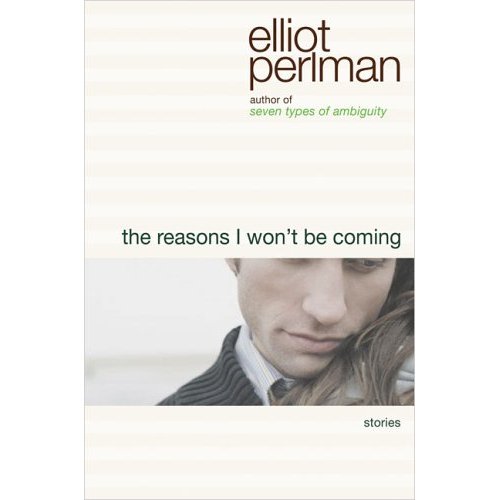
Of course, some of the noteworthy forthcomings are more problematic than others, even from a personal view. One such title is Elliot Perlman's "Reasons I Won't Be Coming," which comes out in paperback shortly.

Elliot was much-praised (and rightly so) for his novel "Seven Types of Ambiguity." This book is a collection of short stories, all of them strong, one or two of them nothing short of moving.

The conflict comes in around the edges because Elliot is currently mining the same white-suburband-privileged-youth market that three of my young friends are attempting to mine. So far, none of them has met with success in terms of a book contract (although all three have succeeded in terms of competency, and one of the three has achieved some scenes of genuine beauty), and that fact makes LIKING Elliot's books feel a trifle traitorous. Still, these are good stories, well worth your time.

Less worthwhile is Jeremy Black's new book "George III America's Last King" - Black is a ploddingly competent historian, but he knows nothing whatsoever about fluid storytelling and never has. King George III is a fascinating historical figure who ruled for a very long time and of course saw the parting of the American colonies from the British empire. His story has been undertaken many times, from many angles, but this particular undertaking fails on almost all counts. The writing is mediocre at best, and the research has large and curious gaps (almost like SOMEBODY lost a research assistant two-thirds of the way through).

There are good biographies of George III out there - although no great ones - but this isn't one of them. When a superb one eventually comes, you'll be sure to read about it here at stevereads. Until then, best to skim this volume on your local Barnes & Noble tables and move on. I absolve you of a guily conscience.

And speaking of guilty pleasures! There's a new book called 'Voyages of the Imagination,' in which editor Jeff Ayers presides over a staff who've devoted their time and energy to ... well, to the unthinkable.

They've read and summarized every single Star Trek novel ever written. Think about that last sentence. Every Star Trek novel ever written.

This isn't an inherently unbelievable goal. Your humble editor has, after all, read every single Star Trek novel that's ever been published (and, back in the old fanzine days, quite a few that weren't published) ... read them with care and attention, turning down pages, piecing it all together with far, far more thought than the subject matter deserves.

But we hardly expect anybody else to have done so, and the knowledge that somebody HAS prompts only a curious strain of pity.

Especially since this volume - undoubtedly the only one of its kind that'll ever exist - criminally softballs things. NONE of the near-innumerable books under examination here is given any kind of critical appraisal - understandably, since the last thing Paramount wants to authorize in this, Star Trek's 40th anniversary, is a cold-minded review of how loudly most Star Trek fiction in the last 30 years has SUCKED WAD. That's understandable on the studio's part, but still ... surely a relatively benign rating system could have been set up? A scale of one to five tribbles would surely have offended nobody, but it might have served as a much-needed guide for the wary reader.

And yet, some of the best Star Trek fiction is duly honored here, such as Sondra Marshak & Myrna Culbreath's 'Star Trek the New Voyages' and their wonderful little novels 'The Price of the Phoenix' and 'The Fate of the Phoenix' (their ill-starred novel 'Triangle' is also well worth seeking out and devouring), all big sentimental favorites here at Stevereads. Also there's Alan Dean Foster's adaptation of all the cartoon episodes; most of these episodes were atrocious - and all of them were only 30 minutes long - but Foster lavishes inordinate amounts of care fleshing them out, with results that get more rewarding as his series progresses.

No, 'Voyages of the Imagination' is a bit of a disappointment, although even now, in its gelded state, it's a prodigious trek down memory lane and deserves a place on the shelf right next to the Star Trek Encylopedia. For a book-by-book critical rundown of every Star Trek novel ever written (in how many novels has Doctor M'Benga gone crazy and become the villain? How many different novels have ice-queen T'Pring trying to bring down the Federation just to get Spock's attention? How many different origins have been given for the enigmatic Number One?), you're all just going to have to wait until Stevereads gets around to doing it.

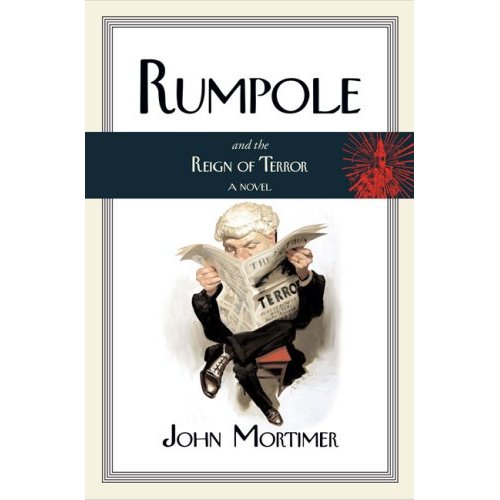
The last item under examination here is by far the sweetest: John Mortimer's new book "Rumpole and the Reign of Terror."

Mortimer is very old (we don't have the exact number at our fingertips, but he's got to be pushing seventy), and he's known for decades that he's succeeded in one of the rarest tasks of any author: he's created an immortal character. In most people, this would create a certain tendency to rest on one's laurels.

Not so Mortimer. His latest Rumpole book (a novel rather than the more usual collection of short stories) is one of the strongest stories he's ever told, every bit as trenchant and hilarious as the earliest stories were, decades ago - maybe even a bit moreso.

In this latest book, battered but unbowed Old Bailey hack Horace Rumpole defends a Pakistani doctor who's been accused by the Homeland Security drum-bangers of being an al-Qaeda operative. As readers of the series well know, Rumpole never pleads guilty - so we're off to the races.

I confess, I started the book with a bit of trepidation. One of the sweetest pleasures of entering the Rumpole universe is how TIMELESS it is: the chambers of Number 3 Equity Court will always be overcrowded to the point of chaos; Chateau Thames Embankment will always flow at Pomeroy's wine bar; Judge Graves ('my hearing is exceptionally keen'), Judge Bullingham ('Mr. Rumpole, that was an outrageous thing to say'), and Judge Oliphant ('Use your common sense') will always headline Rumpole's courtroom rogues gallery; She Who Must Be Obeyed will always loom over the flat in the Gloucester Road like Attila the Hun in sensible shoes.

I worried that the introduction of 'relevant' elements - al Qaeda and homeland security - would burst that bubble, with negative effects (surely I'm not the only one who wishes Watson had never moved out of 221b Baker Street, much less that an aged Holmes had ever felt 'an east wind' blowing).

I needn't have worried, and the relief was only deepened by the quiet perfection of it all. Who better than Rumpole, I quickly realized? Who better to stand up in a court of law in his dirty wig and soiled waistcoat and make a jury by turns laugh and rage at the silly, paranoid fascism of the times?

"Rumpole and the Reign of Terror" is a wonderful book and a deceptively easy read. As with all Rumpole books, absolutely no knowledge of the previous volumes is necessary - so here's an hearty encouragement for all of you, fans and newcomers alike! This little book won't disappoint.

And there we have it for now, yet another romp through book-land! More to come, as always ...

penny press! the new york review o' books!


A very full issue of the New York Review of Books this time around (thanks, no doubt, to our young friend Sam's ever-increasing sway behind the scenes at that august establishment! Stand up and take a bow, Sam!), so let's start sorting the wheat from the chaff, shall we?

(The sorting can begin by one of your clever little marmosets finding me a visual of the COVER of this issue, something 30 minutes of tooling around the Web on my own failed utterly to do)

As I predicted, Jason Epstein's piece on Google's plan to create an enormous, unlimited virtual library garnered some heated responses in the letters page.

Google plans to digitally scan vast innumerable piles of books, to be available at the touch of a button to anybody with access to the Internet. The ruckus arises over copyrighted material - Google says it will offer only 'snippets' of such, presumably with readers able to pay them to see the whole work. Naturally, this has authors and bookstores in an uproar.

Law professors in an uproar too, apparently. Peter Friedman, an associate professor of law at Case Western, writes:

"Jason Epstein writes in 'Books @ Google,' that Google's creation of a searchable database of copyrighted texts without the permission of the copyright holders cannot constitute 'fair use' under US copyright law because the creation of such a database 'violates the provision of copyright law that forbids copying more than a brief passage.' There is no such provision.

Professor Friedman goes on from there, but that's where we here at Stevereads stopped and said, 'Yes there is. Dickwad.'

It's a well-known mental affliction, contracted mostly by lawyers and law professors, that leads them to believe their profession consists of sacred books locked away from the soiling gaze of the knuckle-dragging public. Alas for them, despite the level best efforts of the present administration, all American laws are matters of public record. If you've passed the fifth grade, you can look them up and READ them.

So: yes there is such a provision. Dickwad.

Equally frustrating is a little assertion tossed off in an otherwise excellent piece by Peter Green. He's reviewing three books on the archeology of Homeric Greece, and since he's a towering authority in the field and one of the smartest classicists alive today, the review is absorbingly good.

Except for this:

"Though the famous love affair between Catullus and Clodia Metelli ('Lesbia') is better documented than many other episodes in Roman history, there are still distinguished Latinists determined to treat it as fiction."

As Beepy would say, What the Eff?

This is probably as good a time as any to point out that Peter Green, despite having written a shelf-full of great histories and translations, is a bit of a nutjob. Not a nutjob, really, but ... well, shall we say 'stubborn in the holding of eccentric opinions'?

But even so, this one really puzzles. The history of ancient Rome prior to the death of Trajan is one of those subjects on which I can safely say I know as much as anybody in the world, and I'm telling you, boys and girls: there's absolutely NO 'documented' love affair between Catullus and Clodia. There's no surviving evidence they ever met. There's no evidence Clodia and Lesbia are the same woman. It's a pretty surmise alright, but 'documented'? I have no idea what Green is thinking.

Unless he's enough of a nutjob to consider passionate love-poems to be 'documents.' But that surely can't be - nobody in the world could be that dense.

And finally, it was density of another kind that kept cropping up in Larry McMurtry's review of Gore Vidal's latest memoir, "Point to Point Navigation."

On first glancing at the table of contents, I smiled: a wonderful match! Two excellent prose stylists, one patrician the other plebian, both outstanding historical novelists.

Then I read a bunch of other things in the issue and forgot about the symmetry. By the time I got to the review, I'd even sort of forgotten McMurtry was its writer. Instead, I just dug right in.

And almost immediately started snagging on the prose of the review itself. Some curious mental block prevented me from thinking of McMurtry every time this happened - instead, I was mentally cursing WHOEVER the editorial nobody was who could write like this:

"Gore Vidal has the looks of a prince, the connections of a prince, more wit than any prince I can presently recall, and a prose style that should be the envy of the dwindling few who realize that prose style matters, both for the glory of it and also because if one makes one's living mainly by the making of prose sentences, as Gore Vidal has, it's nicer if the sentences are strong, supple, and pleasing."

Geez. I'd have handed that back to a freshmen in high school.

OK, I thought, once I'd reminded myself that it was, in fact, McMurtry writing the piece. Anybody can find themselves in a rhetorical box canyon now and then. But it keeps happening:

"After the death of Barbara Epstein saddened this journal, I wrote a tiny tribute, along with many others.
None of these offerings is more painful to read than the dozen harrowing pages Gore Vidal devotes to the passing of his long, long companion, Howard Austen."

Again, geez. So McMurtry wrote a tiny tribute - and then wrote many other tiny tributes? So 'Gore Vidal' is a single nomenclature, never to be shortened to 'Vidal' (in the entire course of the piece, it never is ... the effect is hilariously and ironically Eucharistic)? So Howard Austen was really, really long?

After enough of this, I found it impossible to concentrate on the review AS a review ... at least, not a review of Vidal's - sorry, Gore Vidal's - new memoir (I'll have to look elsewhere for that, or perhaps bite the bullet and read it myself). Only belatedly did I realize what I was reading in this review, and the realization came with a little twist of pain:

This review is, quite unintentionally, the best tribute yet paid to the editorial skill of Barbara Epstein.

Wednesday, November 15, 2006

books! Of all kinds!


Books of all shapes and sizes cross our desks here at the palatial offices of stevereads, and here is where an editorial that starts in such a manner would limp home with something like 'and we can't possibly read them all.'

Needless to say, we're made of sterner stuff here at stevereads. We can, in fact, read them all - and we do, we do. We burn through books with the speed (and beady eye towards the stash) of an addict. Er, that is, of a BIBLIOMANCER.
Talking about all these books here on this site would take forever, and it would be crushingly demoralizing to all you slow-readers out there (actually, it might be even more demoralizing to the comparatively fast-readers among you, for obvious reasons).

So we pick and choose which books to mention here, which ones to blurb here, which ones to pan here, and, more rarely, which ones to review at length here. It's a mysterious process, and of course no part of it is open to debate ... although, in our more sentimental moments, we sometimes wonder what all you marmosets would say, if you had a voice in the running of this kingdom; would you cry out for more book reviews, more book blurbs, more books, books, books? Or would you opt for more political commentary, with no books involved? Or would you have it be video game commentary, all the time?

Ah, but such sentiment always passes, and the burden of sole leadership descends once again across our shoulders. So here's what we're offering for your interest today:

"A Call to the Sea" by Claude Berube and John Rodgaard - this is the first full-length biography of Captain Charles Stewart, whose career as a naval officer stretched from the American Revolution to the Civil War.

The authors do a very workmanlike job assembling their materials - they know they're breaking ground and setting precedent, and they're determined to leave no ceremony out.

Neither one can write worth a scupper's cup, but that must be forgiven - especially since Charles Stewart is extremely unlikely to receive the attention of a truly skilled biographer. He's just one of many countless excellent skippers throughout the ages who will never get the book they deserve - in fair truth, it's something of miracle he got even this much.

This is much: Berube and Rodgaard's book is heavily sourced and footnoted, a dutifully balanced and written acount, and thoroughly hagiographic.

Stewart was a wonderful man, despite the repeated efforts of his two hagiographers to assure you so: he was stupid, funny, totally loyal, wonderfully funny when drunk, totally fearless, and, what's to the point, an absolutely first-rate eviscerator of his enemies on the open water.

It's amazing, in its own minor key, that our two authors manage to drain the events of Stewart's life so deeply of the drama that filled it. Stewart wasn't just a great sea lord - he also has the distinction of being the greatest master that dear, mighty warship, the U.S.S. Constitution, has ever had.

Some of you will know that we here at stevereads dream of some day saving the funds necessary to spend a vacation week in the great city of Boston, Massachusetts. It's a long way from our native Indianapolis, but the trip would be vindicated by one experience alone: walking the deck-plates of this lethal lady of the sea-lanes. Not a replica, not a museum ride, but the ship herself, surpassed by the crafts of later days but not out-done by any of them, not one single one of them.

There were years, there were decades, there were, above all, battles wherein the fate of America itself depended on the actions of this one ship.

She found her perfect commander in Stewart. He could feel her every shift and mood under his feet. And he USED that connection - something seldom felt by the privateers and British place-seekers against whom he fought - to perform battles that in retrospect look like miracles.

None moreso than the spectacular victory he achieved against the Cyane and the Levant simultaneously. If you loyal readers of stevereads had the patience of judges, oh! the tale we could tell you, of that grand and totally impossible battle!

Stewart did it with incredible Robert-E.-Lee style itution and pure balls, only a fraction of which actually make their way into this staid account, but no matter. It's a worthy book, though not one we here at stevereads can recommend to the general reader.

"Letter to a Christian Nation" by Sam Harris - here, in a book the slender length of a long letter, is the argument Richard Dawkins' "The God Delusion" SHOULD have been.

My esteemed colleague Hippolyta recommended the booklet to me, and she was right: Harris is fantastic in the clear, fearless way he takes on organized religion - he never overreaches, never antagonizes the crackpots, and his narrative method, addressing his polemic to an imagined 'you' representing Christian America, gains power and momentum very subltly as the pages go by.

He makes some devastating points, and unlike Dawkins, he never glories in them. He points out that no matter how you view the destruction of New Orleans in the wake of Hurricane Katrina, the doomed faithful trapped in their attics as the waters rose were 'talking to an imaginary friend' when they prayed to a God who was either impotent or vindictive. He relentlessly points out how the Bible itself never shows any sign of having been written or inspired by anbody with any more advanced knowledge of the world than the first century of the present era - no hint of higher mathematics, no suggestion of future science, literature, or even morality (he's particularly hammering on the Good Book's benevolence toward the practice of slavery).

It's a damning portrait, and one that Christians would counter by saying God wrote only a book the minds of his followers could understand at the time. Harris has an answer for this - that surely a kind deity would take into account how chary He'd be with future Revealed Texts and throw in at least something about the Crusades, or World War One, or the bird flu.

The book is broadside short mainly because that's all it NEEDS to be, if its author eschews the throwing of stinkbombs and sticks to his task. This author does, magnificently so - again, not a book to give to Aunt Bertha (unless you're lucky enough to have a COOL Aunt Bertha, but that's not likely), but definitely something to give to any of the young faithful you might know. If it gets under their skin, good - the world can use both more atheists and more thoughtful Christians. It's thorough, conscientious case for the opposition, and you can tell them I said so.

But make sure to CREDIT me! That admonition really comes home after reading Richard Posner's tiny new book, "The Little Book of Plagiarism," in which the big subject is explored with rigor, candor, and an appealing prose style.

Judge Posner quickly and intelligently shows us that the concept of plagiarism is far more complex than simple copying, and it's amazing how much ground he illuminates in only 110 pages. No matter what you think of the several high-profile plagiarism cases to make the news in recent years, you'll find this book thought-provoking.

It has only one lacuna, and it's a puzzling one. Judge Posner likes to tout himself as a take-no-prisoners intellectual, but on the subject of plagiarism, he lets Alan Dershowitz off with barely a slap on the wrist. Dershowitz plagiarized huge, iceberg-sized chunks of his book "The Case for Israel" from Joan Peters' book "From Time Immemorial," and yet neither these books nor Peters' name is even mentioned in Posner's book.

We here at stevereads have long wondered why Dershowitz didn't lose his job over "The Case for Israel." True, he generously cites Peters' book, but he also generously steals from it even when NOT citing it, and the point-by-point comparisons were brought to the public's notice in several periodicals. And yet, there Dershowitz is today, still publishing every word that crosses him mind, and here, in a book on plagiarism that actually mentions him, the case isn't even discussed. So the mystery goes on ...

No mystery involved in our last item, "World Poetry," an anthology of world verse edited by Katherine Washburn, John Major, and Clifton Fadiman. The only question some readers may have is why I'd buy a copy of a book I already own.

Ah, thereby hangs a tale. You see, years and years ago, I was wooing a young poet (my rival was his own time-wasting narcissism, a formidable foe), and this big, fat anthology was our sacred text. Many's the night we'd drunkenly read choices from the gushing cornucopia herein represented!

As a result, my original hardcover grew tattered, despined, and drenched in wine-stains. Ordinarily, this would be no bar to citizenship on my bookshelves (I'm not, as some of you may know, the most fastidious person on Earth) - except that in this case, young poet or no young poet, I still love and regularly consult "World Poetry" - which is difficult to do, when a book is falling apart. Hence, the new volume.

But oh! New volume or no, the old charms remain! Here again are all the poems my young poet and I read back and forth in our giddiness to become friends! We ranged the whole of the world and back, but you loyal readers need only be patient for the two poems I feel safe in calling our favorites:

Drinking Alone in the Moonlight

Beneath the blossoms with a pot of wine,
No friends at hand, so I poured alone;
I raised my cup to invite the moon,
Turned to my shadow, and we became three.
Now the moon had never learned about drinking,
And my shadow had merely followed my form,
But I quickly made friends with the moon and my shadow;
To find pleasure in life, make the most of the spring.

Whenever I sang, the moon swayed with me;
Whenever I danced, my shadow went wild.
Drinking, we shared our enjoyment together;
Drunk, then each went off on his own.
But forever agreed on dispassionate revels,
We promised to meet in the far Milky Way.

That's of course Li Po, translated by Elling Eide. And here's the other:

Late Night Ode

It's over, love. Look a me pushing fifty now,
Hair like grave-grass growing in both ears,
The piles and boggy prostate, the crooked penis,
The sour taste of each day's first lie,

And that recurrent dream of years ago pulling
A swaying bead-chain of moonlight,
Of slipping between the cool sheets of dark
along a body like my own, but blameless.

What good's my cut-glass conversation now,
Now I'm so effortlessly vulgar and sad?
You get from life what you can shake from it?
for me, it's g and t's all day and CNN.

Try the blond boychick lawyer, entry level
At eighty grand, who pouts about the overtime,
Keeps Evian and a beeper in his locker at the gym,
And hash in tinfoil under the office fern.

There's your hound from heaven, with buccaneer
Curls and perfumed war-paint on his nipples.
His answering machine always has room for one more
Slurred, embarrassed call from you-know-who.

Some nights I've laughed so hard the tears
won't stop. Look at me now. Why now?
I long ago gave up pretending to believe
Anyone's memory will give as good as it gets.

So why these stubborn tears? and why do I dream
Almost every night of holding you again,
Or at least of diving after you, my long-gone,
Through the bruised unbalanced waves.

That's an adaptation from Horace by J. D. McClatchy, and it's concluded many a wonderful late-night talk between that young poet and myself. The thing is beautiful in itself (although its defeatism and cynicism are in no way a mirror to Horace), made all the moreso by that sweet, sentimental association.

And there you have it, but a small sampling of some of our most recent books! Some are in print, some aren't yet published, some out of print - and more such notices to come, in due time ...

Tuesday, November 14, 2006

Comics! The Doctor is in!


A slim week for Pepito's stolen comics this week ... although not slim enough to prevent him from sniffing out at least SOME crap! He picked out this new J. Michael Straczynski hack-job 'Bullet Points,' after all ...

.... Still, some of the crap he picked out didn't LOOK like crap on the surface. This is certainly true of the latest 52, which was boring, hyperventilated, and completely unsatisfying.

I've noticed this about '52' - some of the issues (like the last one) work perfectly, managing to deliver an enjoyable comic book while at the same time being part of a much larger storyline. And some of them both don't do that and also suck. This was such an issue.

There's a lot of shouting in it - poor, bereaved Elongated Man gets the vengeance-inflicting powers of the Spectre just long enough to make the soul of his wife's murderer suffer for all e-teerrrrrnity, and Eclipso comes in for a bit, dunno why ...

But the issue wasn't a total loss: it had a wonderful backup feature detailing the origin of Black Canary, with rip-snorting good pencils by the mighty Howard Chaykin. Which made me wistful! Chaykin seems to be 'back' - willing and able to do mainstream comic work ... so why not a mini-series about the original Black Canary, the mother of the current one? That would be Canar-ific!

And even Pepito, with his crap-sense tingling, couldn't pass up the second issue of the great new Doctor Strange mini-series 'The Oath.'

The thing I love about this title is that its writer, Brian Vaughan, is smart enough not to re-invent the wheel. His Stephen Strange is looser and funnier than any previous incarnation (hands-down favorite line of comic book dialogue in 2006 happens in this issue: when confronted with a cadre of killer robots, the good doctor says "By the hoary #%*-ing hosts!" Hee), but he's still the same character Stan Lee and Steve Ditko created decades ago, and for good reason: that character works.

So, no 'he's really an alien' or 'secondary mutations' or any of that nonsense. This is still the man who was a brilliant but arrogant surgeon, who lost the skill of his hands in a car accident, and he learned the mystic arts from the Ancient One. In fact, this issue's best sequence is a flashback showing us just how big a jerk the pre-accident Stephen Strange was.

(and post-accident, as when the recovering Strange says he feels 'like suing whoever made seatbelts too damned uncomfortable for any reasonable man to wear')

Two things are certain about this mini-series: first, it will be collected in a nice trade paperback (so Pepito really shouldn't be buying it, but let's not tell him that)(he won't read it here, since this site has nothing to do with Menudo), and second, it will certainly re-launch a monthly Doctor Strange comic - let's hope the creators of the mini-series stay on board!

Let's finish up with some Doctor Strange trivia, to keep my little marmosets on their toes:

1. The presence of the Night Nurse in this issue raises the question: how many super-heroes have also been practicing members of the medical community? A full list, from memory!

2. In addition to his vast mystic abilities (learned from the Ancient One) and his considerable martial arts abilities (learned from who knows who - there's a great mini-series to be mined from the time when Strange and Mordo were students), Doctor Strange also has one other rather unusual superhero-trait. From memory, no peeking - what is it?

3. The good doctor knows at least one real-world literary giant - who can tell me who it is?

OK ... by the Vapors of Valtorr, by the hosts of Hoggoth, and by the Belches of Beepy, that's all for now!

The Penny Press! Boots on the ground, and Germans!


The latest London Review of Books offers a few interesting items, most of them good and rant-worthy (and be honest! If you weren't enamored of my rants, would you really still BE here?)

Our first item is a positive review by James Wood of Edward St. Aubyn's new book "Mother's Milk."

The review is positive, but that need not detain us here: we at stevereads haven't yet read the book in question, and therefore none of YOU know whether or not it's any good. Once I read it, I'll tell you all what to think about it.

In the meantime, this review gives me the perfect opportunity to whole-heartedly recommend St. Aubyn's previous book, "Some Hope," which is indeed available in this country (I know, I know - thanks to the Interweb, everything's available everywhere ... nevertheless!).

"Some Hope" is marvellous, and its middle chapter, a truly harrowing fictional account of what it's like to be a drug addict, is outstanding. "Some Hope" is a strong, subtle, totally knowing book, not exactly the kind of thing you'd recommend to your Aunt Bertha, but still - it's well worth hunting up yourself, for a fictive experience you'll remember a long time (unless of course you're stoned when you read it)

Elsewhere, there's an omnibus review of entirely online sources, a first in my reading of proper literary journals. All the sources deal with the US invasion and occupation of Iraq and the pig's breakfast it's become, or was from the start.

A typical paragraph:

'Iraq has a Commission on Public Integrity, along with the Iraqi Board of Supreme Audit and inspector generals in the ministries, which is supposed to investigate corruption. Arrest warrants were issued last year for several former cabinet ministers. The defence minister Hazem Shaalan, accused of being party to corruption involving more than $1.3 billion, fled to London. He is now said to be in Iraqi Kurdistan. The transport minister Louay Hatim Sultan al-Aris disappeared. The electricity minister Abdul Muhsin Shalash is reportedly living in Jordan. There are signs that the efforts to prosecute these people are finally being stepped up. The labour minister Laila Abdul Latif at least went to court, though she was only convicted of a minor offence and given a suspended sentence. Another electricity minister, Aiham al-Sammarai, has now been convicted of corruption and embezzlement and sentenced to two years in prison. But he's also an American citizen so he isn't in an Iraqi jail."

Reading such accounts makes me sigh a heavy sigh for the days when military occupations - and let's be clear, that's exactly what the United States is conducting in Iraq, no matter what it tells itself - were conducted with a maximum of effeciency and a minimum of garden-variety futzing around.

Let's have a little clarity about what a military occupation is, shall we? I'll give you a small hint: it has nothing whatsoever to do with electricity ministers getting two-year jail sentences..

In a true military occupation, there are no grey areas, no confusion, and, after a very brief initial settling-in period, no chaos. Most ordinary Iraqis hate the American military people in their midst not on idealogical grounds but on practical grounds - those armed men and women are the face of the vast, unthinkable chaos now at loose in their land. Chaos only happens in poorly-run occupations.

This is not a mystery - at least a dozen army commanders on the ground in the Green Zone know exactly what to do, what changes to make. They're hampered only by an ignorant chain of command and absolutely ridiculous set of restrictions.

Step One, an important trifle: banish all forms of reportage. Revoke all press privileges, criminalize the production of all video footage of any kind, and evict all reporters from the country.

Step Two, far more important: impose uniform martial law and an ironclad sunset curfew. This means exactly what it says - martial law means you can't do anything, not any little thing at all of any kind whatsoever, without obtaining written permission from your occupiers, and sunset curfew means if you're seen outside after sunset for any reason, any little reason whatsoever, you get shot and dumped in a ditch. No reporters to cry your outrage to: you'll simply be gone.

Step Three grows out of Step Two: once you've declared an honest-to-gosh martial law, anyone - anyone at all - operating outside its boundaries is your openly declared enemy. Once the rules are clearly, non-politically declared - and once the press is absent from distorting them - things become very simple. Unpleasant, yes, but simple. You have a gun, a bomb, a knife, a rock? You're dead. You're demonstrably connected to such? You, too, are dead. You're approaching an armed picket, talking a bluestreak in a language he doesn't understand? You're dead, because it's after dark. No reporters - and hence no idiotic court of world opinion - to litigate or mitigate for you.

It's obvious immediately, the benefits of such an arrangement, such a true military occupation. For starters, the nascent civil authorities would have a great deal of weight taken from their shoulders - they wouldn't need to look around every corner whenever they go to meetings, nor would they need to take time out of their busy schedules to LEGISLATE over matters more properly left to the military occupation force.
This would leave them free to create a working government - which is a good thing since no military occupation should last too long... there being, after all, other places to occupy.

But the benefits most certainly extend to the average citizen, whose water supply, road infrastructure, and basic utilities (including electricity, as we've seen) will no longer be mishandled by corrupt or incompetent civil officials - the Army Corps of Engineers will be in charge, since in a true military occupation, no vital system (and certainly no system that could possibly be used against the occupiers) is left in civilian control.

Two things need to be pointed out about such a genuine military occupation, however: first, it would be more expensive, in the first few months, than the current patchwork non-method in place (there'd need to be more troops, and they'd need additional training), and second, it shouldn't be done. The United States shouldn't be occupying Iraq. The United States should certainly be occupying Mexico, and perhaps North Korea, but not Iraq.

But such a genuine military occupation WOULD work. When it's done properly, military occupations almost always work. If you swapped out their swords for guns, the Roman 10th Legion could have Baghdad blood-free and peaceful in about three months. What's needed is the stomach for it.

Speaking of stomachs, there's something else in this issue that TURNED ours, here at stevereads. It crops up in the long and very sympathetic review Neal Ascherson gives of Gunter Grass' new memoir:

"In the postwar decades, foreigners were upset by the apparent inability of many Germans to grasp the suffering that their nation had inflicted on others. But somebody - perhaps it was Grass - wrote recently that this silence was really the continuation of another, earlier silence: their reluctance to be open about what they themselves had suffered."

To which we here at stevereads respond: Nein!

If your country tries to take over Europe once, wellllll MAYBE the rest of the world can let it slide. Chalk it up to youthful hijinks, that sort of thing.

But if your country tries to take over Europe TWICE in twenty friggin years, you don't get to talk about YOUR suffering, and you don't get to feel self-pity when nobody else talks about it either.

For ten years, Hitler preached a doctrine combining unapologetic militarism and jubilant anti-Semitism. Then for ten years he ACTED on exactly that. Say what you want about the man, but he was no hypocrite.

Granted, a technical majority didn't vote for him - which raises two points: 1) how did he get even what votes he got, and 2) why didn't the technical majority FIGHT?

The German people acquiesced to a virulent dictator because he offered them a way out of the crushing economic and psychological depression they'd been in since the end of the last war. He told them exactly what the INGREDIENTS of that way out were, and they swallowed it anyway. None of this 'we didn't know' business - they knew perfectly well and they did it anyway.
Which renders me slightly disinclined to credit their suffering, unless it's the remorse of having made a mistake.

And it isn't! Every German I've ever met, I search their eyes, their minds, their voices for it, and it's never there. Germans - and especially Germans of the war years - aren't sorry they tried Hitler. They're sorry Hitler didn't WORK.

So let's wrap things up, Larry King-style (Cantabridgians: he's a television commentator):

Rants - great, aren't they?

Iraq - should US stay or go, and why?

Germans - genetically evil, or what?

Sunday, November 12, 2006

the TLS! Erasmus et al!


One of the many nice things about the mighty TLS is that, being the pinnacle of all literary reviewing organs currently publishing on the planet, is that its writers need not be staid in order to be sagacious. When you're the TLS, your gravitas is assured, so you can just write about things.

Things like this new Tate exhibition 'Holbein in England' ... such laudatory things that we here at Stevereads are considering requiring one of you to pay for our plane ticket across the pond to see it ourselves.

The formidable Diarmaid MacCulloch reviews the exhibit for the current TLS, and he calls it 'altogether remarkable,' which is the TLS equivalent of gushing 'OMG!'

As will come as no surprise to anyone familiar with MacCulloch's work, he's wonderfully evocative at describing what he clearly enjoyed taking in. Here's his description of Holbein's chalk drawing of Mary Wotton:

His delightful coloured-chalk sketch of Mary Wotton, Lady Guilford, catches her glancing at Sir Henry Guilford with the amused affection of a wife who has just heard her husband say something absurdly pompous, and not for the first time.

Or this, his description of young Chistina of Denmark:

She stands brilliantly illuminated, a teenager agreeably conscious of how much her widow's mourning dress flatters her Scandinavian paleness.

Or this:

Derich Born, a merchant from Cologne in his early twenties, who leans confidently out of his picture, savouring the effect of his brown-eyed good looks on the viewer.

Or this, about Thomas More's father:

Judge John More, Sir Thomas's father, combines a continuing steely ruthlessness with the possibility that he might enjoy playing with his grandchildren.

MacCulloch's review has only one painful sentence, one gentle swipe at what might have been:

There had been a moment in the 1510s when it seemed as though Erasmus and his fellow-humanist scholars, with patrons like More, might reform all Europe in a peaceful remaking of culture and religion.

This is perforce a truth to be told by Reformation historians, but oh! It bears repeating in secular company! This sentence is entirely, tragically correct: if Erasmus had been allowed to work his slow, knowing magic, if his writings and his popularizings and his New Testament and his endless soothings and cajolings and remindings, if above all his counsel of PATIENCE had been heeded, well, there cannot be an accurate accounting of the human misery that would then have been averted in the subsequent four centuries.

The pig Luther ended all chance of that. In his infinite sweaty wisdom, he opted to set afire a building not yet condemned, one with many hundreds of thousands of innocents still inside. Talk, simple, complex, persistent, and above all funny talk - Erasmus' talk - would have succeeded even in reforming so corrupt an organization as the Catholic Church, if it'd been given the time it needed.

As a result of Luther, not only did tens of thousands of people die who otherwise wouldn't have, but the very IDEA of slow, patient, funny TALK solving anything serious took a hit from which it has not succeeded, even after all these ceturies, in recovering.

But that's a post for another day, perhaps on the occasion of a new Erasmus biography! In the meantime, let's move on!

On, that is, to the single most reliable joy of any issue of the TLS: the magisterial hatchet-job. In this case it's the latest book by child-abuse opponent Alice Miller, and its reviewer, Carol Tavris, takes it out for a trot:

Are you fat, do you have headaches, do you have intestinal difficulties, are you unmotivated, do you smoke too much? Has it taken you nearly half a century to get out your paintbrushes? Poor child, you were not loved enough; you were too gifted and unappreciated. You can't remember being abused? Your body does. Because Miller never draws breath long enough to define what, precisely, she is talking about, let alone to bolster her argument with anything as tedious as scientific data, readers who already love her will cry in recognition of her case studies (which suspiciously conform to her argument and sound awfully like her own voice). The rest of us will cry in exasperation.

When the hammer finally falls, the blow is a crushing one:

Miller's confirmation bias is narrower than most, being almost entirely self-referential. A physician who was still promoting medical beliefs and interventions that had been discredited decades earlier would be out of business, but Miller goes on interminably. I'd say there is no excuse for what seems a wilful blindness to the advances of science in her own profession, especially one that has such a direct impact on her clients' and devoted readers' lives, but obviously there is: she was an abused child.

We turn from the carnage to something more innocent: the weekly contest in the TLS called 'Author, Author' wherein they pose three thematically related quotes and challenge readers to name the sources.

Ordinarily, getting all three is quite simply impossible, which leads me to think their normal compiler must be on vacation - this week's are entirely within the capability of a well-read general reader. Here they are:

1. "... the isle is full of noises ..."

2. " ... the deep Moans round with many voices."

3. "The sea has many voices, Many gods and many voices ..."

I trust we here at Stevereads operate by at least as strict a code of honor as the general rabble answering the TLS (well, OK, not exactly a general rabble - the three dozen of us who read it are generally well-mannered). I trust I need not remind that there should be no googling, no making the long arm to the reference shelf - you've either got these bits locked in the book and volume of your brain, or you don't. First one to get them all correct gets a book! (a process somewhat in arrears? I seem to recall owing Jeff a book due to some prematurely snotty crack I made at his expense, and I think I might owe Kevin a graphic novel, for some rare bit of sagacity he showed in the dim and distant past .... ulp ....)

Friday, November 10, 2006

comics! World's Finest What The Eff?


Two comics for myself this week, and they don't come any more basic: Superman and Batman. Despite what some of you out there might think, this is not rote loyalty on my part. I've almost never followed any of the various Bat-titles. I've only decided to follow this one for the same reason I ever do: the fantastic artwork. Andy Kubert's work here is so damn good, so wonderful in layout and execution, that every time I see him up his game (which he, unlike so many brand-name artists out there, consistently does) I'm tempted to bring up the Forbidden Subject: is he - or his almost-equally good brother - actually BETTER than their revered father Joe Kubert?

The answer's still no - Joe's work portraying Tarzan (perhaps the only other 'superhero' as iconic as Superman and Batman) has a worldly wisdom underlying it that neither of the sons has - yet.

True, I am the world's biggest Superman fan - but buying that title wasn't rote either! There've been plenty of times I stopped buying the title (um, shoulder length hippie hair? Um, big blue energy-being? True, I stuck around for John Byrne - but that was the equivalent of being mesmerized by a horrible highway accident). But Kurt Busiek and Carlos Pacheco are doing such a fantastic job with this title that - despite our rather bumpy courtship - I'm completely hooked.

Both issues were wonderful, and, oddly enough, both issues had a great big What The Eff moment that left me jaw-dropped and hovering between pity and outrage.

The Moment happens at the end of this current Batman issue - the storyline is hugely promising: a boy claiming to be Batman's son by Talia demands to be let into Batman's life. He's brought to the Batcave, where - since he was brought up by the League of Assassins - he proceeds to attack everybody with a pulse, overcoming Alfred and Robin and provoking a lot of Bat-yelling from the big guy. Using the element of surprise, the boy badly wounds Robin (this week's Stevereads award for the most inadvertently creepy detail: the Cave has its own private blood supply), so Batman has no choice but to take him along to Gibraltar, which, um, Talia wants to take from the UK.

Batman and the boy show up to foil the plan, and there's lots of great action, and Talia offers Batman a chance to 'convert' her to the cause of good - a fascinating twist I'm amazed nobody's thought of before. Everything is tense and balanced to go either way. And then ...

BOOM! Our writer, Grant Morrison, slams a British torpedo into Talia's ship, and the issue ends with Batman watching the burning wreckage from shore, and with Stevereads saying, you guessed it, What The Eff?

We can assume that both Talia and the boy survived and will be back (after all, in comics nobody dies but Bucky ... grrrrrr), but even so, what is such an ending but Morrison basically saying 'Mmmmmmm, I'm bored .... I'll come back to this later.'?

Over in Superman, a delightfully snotty Arion is detailing a post-apocalyptic future to our cast, a future in which a small handful of unlikely heroes led by Lex Luthor are making their way through a nearly destroyed world.

And what's responsible for this apocalypse? Why, our second What The Eff moment, that's what!

Or rather, that's who - a new super-villain named Khyber, who's clearly intended to be comics first Islamic villain - certainly the first major villain who's Islamic identity is the biggest part of his villainy.

I know, I know - in the issue, Khyber is never explicitly described as Islamic himself, only as using strife between Islamic extremists and the West to further his own plans. But the wording is so delicately ambiguous that we're clearly meant to make some heavy-duty associations, and I think those associations are dead wrong.

I know, I know - it's been done before. During WWII, wildly prejudicial anti-German and anti-Japanese were all over comics, and there's nothing very subtle about villains like the Yellow Claw.

But this is different. No goose-stepping Nazis ever waved their lugers around Times Square, and no bayonet-wielding Viet Congs ever boarded planes at Logan. Creating a sooper-evil Islamic villain who beats on Superman and causes the end of the world ... well, in its own small way, it's intensely irresponsible. Islamic extremism is the fastest-growing social movement in the world, and it has two salient characteristics: it's unchecked by geographical borders, and it's very, very touchy. Creating a character like Khyber encourages ignorance just to tap into a little topicality, and I wish Busiek had gone a different way in adding to Superman's rogues gallery.

Anyway, I passed on Teen Titans, Green Arrow, 52, and a bunch of other things this week, but I'm sure Elmo and my nemesis Pepito will furnish the gaps in due time. You must be patient, my little marmosets ...

(by the by, for you techno-heads out there, I tried for 30 utterly wasted minutes to find a copy of the cover of the current Superman to post here, totally without success .. if any of you can find such a holy image, feel free to tell me where, so I can avoid giving preferential treatment to a non-superpowered character.... yech ...)

Thursday, November 09, 2006

Books! Augustus, dude!


Some of you will know how dearly I love the genre of biography. To my mind, there's no reading experience to equal a masterly-written life of an interesting person. That person doesn't need to be a king or a prince - ordinary people can be every bit as fascinating (the Pastons prove that, among others), if the writer is up to the task.

The biographer is key. The discipline requires extraordinary skill, even moreso than history does - because the biographer signs on for a kind of marriage with their subject. It's an explicitly personal connection that the regular historian doesn't have, and shouldn't have (with rare exceptions - surely Thucydides' history is better for his having participated in what he analyzes, and surely William Shirer's history of the Nazis is only the better for his hating them so).

A good biographer must walk the same line that destroys more marriages than it saves: the line between knowing an enormous amount about somebody and still managing to stay objective about them.

Most marriages fail this test, and most biographies do too. Either the biographer conducts the entire enterprise with rose-colored glasses firmly in place, or else the biographer starts to engage emotionally with their subject - which may or may not be bad for the reading experience, but which is certainly bad for the objectivity of the work.

There's one huge difference between these two failings: the latter can sometimes produce great works, and the former never can.

It's clear beyond doubting that by the end of her researches into Alexander the Great, Mary Renault had (like virtually everyone who came to know him well) fallen in love with her subject. Likewise Francis Hackett clearly came to hate Henry VIII by the time his book on he monarch was done.

And yet - both The Nature of Alexander and The Personal Life of Henry VIII are great works of biography, both saying to their readers: OK, I feel very strongly about my subject, and I think you'd be crazy NOT to, but either way, here are all the facts so you can judge for yourself.

(and of course in the most extreme of cases, can there be any doubt that all serious biographies of, say, Hitler have been written by people who went in hating their subjects and wrote in full possession of that hatred?)

Still, exceptions aside, most biographies fail because their authors have forgotten that their subjects are dead (as for the modern vogue in which this isn't the case, we here at Stevereads give it the back of our hand - the very least thing a person has to do to get written about, in our view, is to die. Until you at least do that, NOBODY can tell whether or not you were a loser) - instead, through all this time they've spent reading and researching, they've come to think of their dead subjects as living spouses ... with predictably lamentable results.

The ones that ALWAYS fail are the put-up jobs. The campaign biographies. The partisan apologia, the mere sycophancy.

Your suspension of disbelief (no less necessary with nonfiction) can survive knowing or suspecting that your biographer has an emotional axe to grind - one way or the other - with their subject. It absolutely can't survive the faintest wiff of toadyism, the faintest hint that the biographer might want a JOB from their subject.

Odd as it sounds, Anthony Everitt is looking for a job from the emperor Augustus.

I know, I know - the hope comes a trifle late for any chance of fulfillment. But how else to explain Everitt's new, stupid, and virtually useless biography of a man who's been dead for 2000 years?

Of course I acknowledge my own personal stake in the matter: Augustus was a monumental asshole who pulled off the ultimate irritating asshole-trick: he managed to convince nearly everybody that he was the exact OPPOSITE of an asshole (those of you groping for a contemporary analogy need look no further than erstwhile singer-cum-sainthood candidate Bono)(since of course the days of ACTUAL upstart emperors - men who connived and stole and lied their way to power over ancient republics and then maintained it by manipulating popular religious sentiment - are long since over)

Even so, I'm willing to read a well-researched, well-written biography of the man - not because I can be shifted in my opinion of him, but because only a fool doesn't admire passionate advocacy (or passionate condemnation).

And I've read such accounts! Gawd knows, there's been no shortage of them. I read Shuckburgh's great, myopic work on the man, and Firth's more dyspeptic account. I read Rich Holmes' searchingly objective but turgid account, and Buchan's towering masterpiece from the 1930s. All these men had several things in common: they were all classically educated, they were all steeped in the primary sources, and they'd all read extensively in biography and history - not just of their own periods, but of all periods.

Ladies and gentlemen, say hello to Anthony Everitt. Perhaps you remember him from the halls of Ridgemont High.

Everitt very much belongs to the FORMER school of biographers. He scans the rolls of historical characters, picks somebody his previous background has disposed him to like, and then writes a 'biography' in which he proceeds to like the daylights out of them for about 280 pages (any more would be, you know, boring).

Jupiter's balls, but this is a dumb book.

Everitt's last book was a life of Cicero, and it was dumb too - but there was a symmetry to it, since Cicero's life and endless pronouncements were mostly dumb too. Cicero's anile chattering about himself dovetailed gracefully with Everitt's anile chattering about him.

A life of Augustus must perforce delve into deeper, darker waters. There's much more to determine here than which of the stories Cicero told about himself are true and which aren't. The young man who became Augustus trod the most twisting political and social paths in Western history, and enough of it comes down to us indirectly documented so that you very much want a skilled, scholarly, savvy guide to help you thread the undercurrents. The LAST person you want helping you out is a semi-sentient ex-footballer with a penchant for cliches.

And boy, does he love his cliches! They crawl over the text of this book like ants at a picnic. Virtually every title chapter is a cliche proudly paraded ('Unfinished Business' 'Killing Fields' 'Golden Age' 'Parthian Shots' East is East and West is West' 'Showdown' 'The Long Farewell' 'Whom the Gods Love' 'The Bitter End'), and the text itself is larded with them too - innumerable characters 'sit on their hands' or 'cool their heels' or 'sit this one out.'

All of which would be passably bearable if a book were spirited enough to circumvent such crudities, but alas, this isn't such a book.

Instead, this is a David McCullough-style least-common-denominator popularization, only without McCullough's (admittedly slight) ability to craft competent prose (it's without McCullough's team of editorial janitors too - there are typos and clearly unintentional sentence fragments, and the index is gigantic game of musical chairs; Marc Antony, in typical wastrel fashion, only shows up for about half the pages he's credited with, for instance, and a couple of times when Lucius Domitius Ahenobarbus' name is called in the index, his brother Gnaeus is the one who actually shows up in the text ... probably our author didn't notice the difference, since they looked so much alike)(and besides, who can keep all these crazy names straight anyway?).

But the crowning offense of the thing isn't its bluster and bungling (although those are pretty damn bad, in a 'popular' history that might actually snare one or two unwary readers) - it's the author's naked pretensions to get a seat at the big boy historian table. Since his nominal subject is the tumultuous era when Rome went from Republic to Empire, he sets his sights on the Everest of the period, Ronald Syme's masterly The Roman Revolution. Syme's book is almost inhumanly great, and Everitt loudly hails it as his guiding light.

Syme worked on his book for fifteen years. Its critical apparatus goes on for some thirty pages. Its Latin passages are offered without translation. It's serious history, for serious readers of history.

Everitt's book still has wet ink. It uses about twenty-five secondary sources (including websites), all of which - except for Syme - were written very recently. All of its primary sources are credited in recent translations. The numerous glosses throughout the book lead one to doubt severely that Everitt can read Latin (they lead to a moral certainty that he's innocent of Greek).

In short, Sir Ronald would not be amused.

Everitt flatly states at the onset of his book that all previous biographies of Augustus failed to delve the heart and soul of their subject. This leads to the obvious conclusion that he hasn't bothered to read any of the books mentioned above, especially Buchan's. I whole-heartedly recommend that he go and do so, and I make the same recommendation to all of you. In the meantime, don't even briefly consider giving this book to your Uncle Morty ('I don't know, he likes history...') over the holidays. The tables at your local Barnes & Noble offer much, much better pickings.

Sunday, November 05, 2006

comics! the sivana family!


When young Elmo presented me with this week's wopping-big batch of comics, I naturally inquired as to which ones were his and which ones he'd pinched from my nemesis Pepito's plywood lean-to.

In response to this perfectly natural question, Elmo said 'Eh ... snorf' and flitted off. So I pitched the comics all together, shook vigorously, and played a little game: see if I can tell which issues are crappy enough to be Pepito's!

Some of them are easy calls. Only Pepito would still pay good US money for Daredevil, for instance. Likewise only Pepito would think any good could ever come from the current Captain America 'Bucky's back - and Cap's got him!' storyline.

I can understand why Pepito would feel an imperishable flicker of hope about the Legion of Super-Heroes ... I feel it too, the unquenchable hope that this, the single greatest of all comic titles (don't even step up, ya miserable squadges! You KNOW I'm right, for all your Spawns and Magnus Robot-Fighters and Serbian Lesbian Cancer Patients), will somehow turn around and be good again.

Alas, no. This current re-launch (not just its current incarnation, 'Paris Hilton and the Legion of Super-Heroes,' but the entire Waid/Kitson run) was doomed at birth - mean-spirited, soulless characters (and ineptly drawn, needless to say - Kitson has absolutely zero vision and couldn't draw a convincing teenager if his life depended on it), the whole stupid parents-just-don't-understand premise, the weird plotting that has absolutely nothing whatsoever to do with any kind of heroism. I could kiss Pepito for his undying hope (except for his extensive facial boils, that is), but nevertheless: we should scrap this run of the Legion and start over. For a new premise, how about this: on a routine shuttle-flight, the galaxy's richest man is saved from mugging by three teens using their respective powers out of sheer, spontaneous heroism. The rich man realizes, in a sudden burst of inspiration, that these young people represent something that's sorely missing from the pasteurized, homogenized world of the 31st century (while maybe also realizing the tremendous marketing potential of the concept, being a businessman and all). The idea catches on, and the THRILL of the series is the birth of a new legend.

Wacky, I know. But it just might have some worth to it.

Certainly it was Pepito who picked out the new Midnighter series (great to see Chris Sprouse drawing a comic again, if only for a couple of issues - and you just KNOW it'll only be a couple of issues ... I tell you, I don't give a crap about 'artistic sensibility' - what so many comic book artists lack is just plain DISCIPLINE, the making-themselves DRAW PAGES every day), which is blandly bad. And Pepito probably plunked for the penultimate issue of Secret Six - understandably, I guess, since this title's been getting better with every issue and this issue is pretty good overall. But when all is said and done, all the characters are pretty much losers (like over in Checkmate, except for the occasional appearance by Alan Scott) and nothing in the storyline means anything.

Also certainly it was Pepito who bought the latest issue of Uncanny X-Men, despite the fact that the title has sucked like a sump-pump for about 30 years. This current storyline is just about as bad as it gets - an interminably convoluted storyline so unfriendly to newcomers it might as well have a 'keep out' sign on it, plus boring artwork, plus trite, stupid dialogue ('Die now'? Um, 'die now'? Hmmmm ... I seem to recall a major recent science-fiction movie where a villain uses that exact line; let me think, what WAS it .... Lord of the ... Lord of the something-or-other ...) and one of the most boring mutants ever conceived, a white guy who can throw around unbelievable amounts of nondescript energy with no apparent harm to himself. Yawn.

I guess I'm blaming Pepito for the first issue of the Alan Davis miniseries 'Fantastic Four: the End' - this is very, very familiar territory ... we've seen this exact same motif over at DC, when Alan Davis drew two different runs of 'The Nail.' Put things an undisclosed stretch in the future, have Alan Davis draw it impeccably, and haul in every character in the continuity. It ends up being boring because a) it's just an imaginary story, and they don't interest readers anymore (mainly because the current trend of story-arcs with writers and artists who OBVIOUSLY won't be staying for anything resembling a long-haul), and b) in order to make these things work, you have make virtually all the characters involved act in un-characteristic ways. Pepito was probably just fascinated by all the pretty colors.

It was certainly Elmo who picked out the latest issue of JSA Classified, which finishes up the two-part Bane/Hourman storyline. This conclusion is really good - sharp writing and more of Scott McDaniel's incredible artwork. Every time I see his fantastic work, I harken back to the glory days when month after month we got to enjoy it on Nightwing. Far be it for me to suggest locking an artist forever onto one title - he doesn't have to do Nightwing. As some of you may recall, my own first choice for his employ would be Batman - I thought his stint on that book was paradise itself. But I'd be willing to settle for something else - Adam Strange? Phantom Stranger? Any of you have suggestions?

And speaking of the Phantom Stranger, he makes a delightfully drawn appearance in the latest issue of Justice League of America .... and the sad fact is, it's the most exciting part of the issue. Much as we here at Stevereads had hopes for this relaunch, and much as we like Brad Meltzer personally, surely this issue is a good point to concede that this title isn't working? Or maybe that it's working extremely well for a 180-page graphic novel but not at all for a monthly comic. This current issue has one, maybe two sequences that are worth a single issue's cover price (although at least the Big Three's game of Dungeons and Dragons has been forcibly interrupted).

Luckily, we end things on not one but two strong notes, both certainly attributable to Elmo, not the despicable Pepito. The first is the Batman/Superman annual, which is freaking hilarious and should be read by every comic reader despite its hideous cover.

And even that annual is surpassed - as is every other comic this time around - by the latest 'Beast Who Came to Dinner' issue of 52.

This title is doing more and more wonderful things every week - warping the continuity, complexing everything up, and especially introducing - or more accurately re-introducing great, first-rate new characters.

And best of all, this issue - re-introducing as unlikely a concept as the brawling, uneven Sivana family, the perfect counterpart to the regal, austere Black Marvel family.

This is hilarious stuff, capped off with a beautiful closing scene between the teenage Osiris and a wonderful new character who will certainly be named after the ancient Egyptian crocodile-god.

A weekly treat - surely something Elmo would appreciate ... and something the felonious Pepito wouldn't know anything about ...

Saturday, November 04, 2006

100th post and all that!


That Dawkins piece was our 100th post here at Stevereads, which naturally prompts some questions for all of YOU! Are you enjoying what's going on here? Are you up for another 100 posts? Thoughts? Reflections? (I'm including another picture of myself, as a self-serving ploy to improve my own ratings by further underscoring what a stone-cold super-hottie I am)

Friday, November 03, 2006

Books! Gawd and Goodman Dawkins!


It's a very familiar moment, well-known to countless men: you're sitting at a bar, elbow-to-elbow with a stranger. The first few cupfulls, you stew in the silence that is every man's right at the end of a working day ('a working day?' I hear my young friend Sebastian asking in deep confusion, 'what's that? Do days sometimes malfunction?'). But after a while, you're warmed up enough to go from contemplating to complaining, and that's when you turn to the guy seated next to you.

And it goes swimmingly, at first. You click - you like each other instantly, and the first hour's conversation makes it clear the two of you share a large variety of opinions more or less in common. There's a solace in this that's hard to explain. It - and running tabs - is what keeps people coming back to bars.

Then comes that moment. You're talking with your newfound friend, you're feeling a warmth that's not entirely chemically produced, when your seat-mate, out of the blue, starts his next sentence like this: "And then there are the damned niggers ..."

It's an awful moment. It turns your guts to stone. The entire house of cards the two of you had built - full of good will and the silent, low-key yearning for more good will. But that single moment stops all of that in its tracks.

It's impossible for me not to feel that horrid moment, when reading Richard Dawkins' new book The God Delusion.

Because I like him - his book is one hell of a lively ride, scabrously, hilariously written (you have to smile at a guy who calls Michel Foucault, Roland Barthes, and Julia Kristeva "icons of haute francophonyism"), wonderfully, snarkily intelligent from first to last. This is an entirely different kind of book from the same author's mighty, magisterial The Ancestor's Tale. That book was a giant work, scrupulously intelligent, the single greatest volume concerning evolution by natural selection written since Darwin.

The latter book is an impassioned, tossed-off screed, ironically enough the same KIND of screed you might hear in a bar, if the screed-er were one of those annoying individuals who tend not to lose their powers of ratiocination even while drinking. Such individuals are immensely irritating - just ask somebody who knows one! - but they're rare enough so that you can reasonably expect to avoid them in random bars.

Dawkins is smart enough to toss off a screed that encompasses everything from Hindu scriptural texts to the current perturbations of the blogosphere. And every single OUNCE of his smarts is conveyed in his incredibly enjoyable, energized writing style. That oft-said but seldom-true description actually applies to this book: there's not a dull page in it..

And because I agree with him - I myself am an atheist, and I vigorously hate virtually all religious practice (and unlike SO many people who claim to be atheists, I actually know the enemy's territory in chapter and verse). Dawkins' book might just be the smartest, funniest, and most consummately ruthless attack on religious practice yet written.

He doesn't leave any theological stone unturned. It's amazing, when you finish the book, to look back and remember just how much is in it. Everybody from Aquinas to intelligent design apologists, regardless of historical gravitas, gets a fanny-spanking.

Dawkins finds all the weak seams, all the weak seams that have always been there, in every religion, throughout time. He's organized (or, as he problematically puts it, 'supernatural') religion's worse nightmare: scientifically trained, religiously sensitized, and articulate as all hell.

Arguments for the existence of God, arguments for the value of organized religion, arguments for the solace of faith ... every aspect of the subject is atomized, always with the same zest and sarcastic humor, always with at least the outward protestations of fairness.

So yes: I like him and I agree with him. And then he starts his next sentence with 'And then there are the damned niggers ...'

It's not the fact that the book has flaws - it has them, as all books do (sorry Jack!). It's the fact that the book's flaws add up to a system, an agenda ... which is, if you think about it, the very last thing a supposedly open-minded examination of religion should have. Surely if organized religion is as stupid and harmful as you maintain, you shouldn't need to rig the game going in?

Dawkins rigs the game going in. When he lurches into his own version of that barroom talk-stopper, you suddenly realize you're in the presence of somebody every bit as intransigently close-minded as the religious zealots he condemns (and manages to FIND, in huge numbers, like a pig sniffing out nutjobs). In violently pre-judging that all organized religion is manipulative and evil, Dawkins shortens the work he needs to do - at the expense of his argument.

Take for example his discussion of the way devout Christians react to news of their own imminent mortality. Dawkins asks why, if these people believe in the immortality of their souls, they aren't happy at the prospect of their physical deaths:

Why don't religious people talk like that when it the presence of the dying? Could it be that they don't really believe all that stuff they pretend to believe? ...wouldn't you expect that religious people would be the least likely to cling unbecomingly to earthly life? Yet it is a striking fact that, if you meet somebody who is passionately opposed to mercy killing, or passionately against assisted suicide, you can bet a good sum they will turn out to be religious. The official reason may be that all killing is a sin. But why deem it a sin if you sincerely believe you are accelerating a journey to heaven?


You can hear the tone clearly here - the nah-nah schoolyard taunt of someone who's asking questions BUT WILL NOT LISTEN TO THE ANSWERS (with just the smallest flavor of the conspiracy-crackpot, with that 'could it be that they don't really believe' or that 'official reason' business). This is an 'inquiry' made by somebody who's decided ahead of time that no valid or thoughtworthy answers are forthcoming.

I believe whole-heartedly in assissted suicide, but nevertheless: that 'official reason' Dawkins so snidely mentions is the Bible, and the twenty centuries of moral and legal codes it spawned. A religious person who's not a crackpot (they comprise a large chunk of the world's population - I think there are about two of them in Dawkins' book - and he gets both of them on a really bad day) would probably respond to Dawkins' taunting questions by saying the spirit is willing, but the flesh is weak - they do believe in a bright afterlife, but losing THIS life is fearful anyway (a less close-minded atheist than Dawkins might point out how many millions, while dying, have been spared the full measure of mental agony by clinging to some kind of religion ... Dawkins might scoff 'deluded to the end!' but surely deluded is better than pointlessly terrified). They might say that their beliefs make it a sin to lose hope.

I know a handful of deeply religious people - not Italian grandmothers with their compulsive rosary beads, but intelligent, educated people who are as wise to the ways of the world as Dawkins is. These are not deluded dupes, nor are they status-seeking hypocrites. And the fact is, their faith genuinely BETTERS them. For whatever reason, through whatever mechanism, they are able to access deeper, richer, better aspects of themselves through faith than they would be able to do without it. They are kinder, more giving, more actively GOOD because of their faith - and once you realize that despite any of this, in Dawkins' eyes they're just damned niggers, well ... a large amount of the fun goes out of his book.

And once that happens, you start to notice something else. Something not only disagreeable about the book but downright fish-stinky.

You first notice it with all the predictable Dawkins nonsense about 'memes' ... you can append your own bulleted one-phrase definition here, and they'll be as many of them as there are readers, since nobody really knows what the Hell Dawkins is talking about when he refers to them. 'Units of cultural inheritance' is the phrase Dawkins uses here, and as far as I can make out, he conceives of them as some kind of 'soft' equivalent to genes.

He faces up to the problems with this, and he gamefully defends his conception. Take the objection that "memes are copied with insufficiently high fidelity to function as Darwinian replicators."

The problem, Dawkins says, is illusory:

Think of a master carpenter demonstrating a particular skill to a young apprentice. If the apprentice faithfully reproduced every hand movement of the master, you would indeed expect to see the meme mutate out of all recognition in a few 'generations' of master/apprentice transmission. But of course the apprentice does not faithfully reproduce every hand movement. It would be ridiculous to do so. Instead, he notes the goal that the master is trying to achieve, and imitates that. Stitches in knitting, knots in ropes or fishing nets, origami folding patterns, useful tricks in carpentry or pottery: all can be reduced to discrete elements that really do have the opportunity to pass down an indefinite number of imitation generations without alteration. The details may wander idiosyncratically, but the essence passes down unmutated, and that is all that is needed for the analogy of memes with genes to work.

Not hardly. Not by a wide margin. The only way this analogy even BEGINS to hold up is if the master carpenter's teachings - the instructions themselves, not the words or gestures used to convey them - exist separate from the man himself. And they don't. They're TEACHINGS, which are acquired and disseminated - or not - by an act of will. Genetic inheritance in all its variation works works uninhibited even upon people who don't know what genes are. There's no similarly mindlessly biological equivalence going on in the act of TEACHING.

The fact that Dawkins believes there is would be telling enough all by itself, but he goes much further when he talks on and on about the Zeitgeist.

Ah, the Zeitgeist. In the entire century of its ridiculous life, it's never done anything but make otherwise intelligent individuals sound like morons. The Zeitgeist, the so-called collective spirit of the times .... how unutterably tired I am of this bogeyman. The Zeitgeist, a concept invariably adored by Cantabridgians who're proud of the fact that they don't read newspapers and don't own TVs.

Dawkins is no different. The minute he invokes the Zeitgeist, he sounds like a damn fool, a blinkered cafe-savant. It only worsens things that he believes the Zeitgeist is moving 'forward' and 'upward,' that things are steadily getting better:

we have almost all moved on, and in a big way since biblical times. Slavery, which was taken for granted in the Bible and throughout most of history, was abolished in civilized countries in the nineteenth century. All civilized nations now accept what was denied up to the 1920s, that a woman's vote, in an election or on a jury, is the equal of a man's. In today's enlightened societies (a category that manifestly does not include, for example, Saudi Arabia), women are no longer regarded as property, as they clearly were in biblical times. The Zeitgeist moves on, so inexorably that we sometimes take it for granted and forget that the change is a real phenomenon in its own right.


Not hardly. Not by a wide margin. As is always the case when I encounter somebody talking about the Zeitgeist, I'm astonished by the evasions, corner-cuttings, and boneheaded howlers that come out of their mouth. It's all the more glaring here, in a book that so fetishizes rationality.

You can see it even in this little excerpt. Notice how he's forced to retreat from 'we' to 'civilized' to 'enlightened' societies just in order to keep TALKING about it, this chimerical Zeitgeist bogeyman. So there are no slaves in the world anymore? So the lot of women is now deplorable only in a few isolated non-enlightened corners of the globe? It's always the same: get a cultural ostrich to pull its head out of the sand long enough to talk about the Zeitgeist, and this kind of crap comes dribbling out of its beak.

In another book, it'd just be a little burr under the saddle, a place to politely cough and look away. And do you know why? Because things like memes and the Zeitgeist are supportable only by presupposing an invisible, ineffable web, a means of communication and propaganda that cannot be measured or directly observed.

In other words, they're religious concepts. The God Delusion is, under all its flash and bluster, a deeply religious book.

Even in the midst of fulminating against the perfidy of worldwide religious psychosis, Dawkins can't stand alone. He can't completely abandon the idea of a phantom floating SOMETHING out there, preserving, guiding, and uplifting human life (and, it should be pointed out, only human life). Since I'm an ACTUAL atheist, I don't really care what Dawkins calls his god.

It doesn't dismiss the bulk of his book, which is sharp and delightful and well worth reading. But it does CHARACTERIZE the book, in pretty damn clear terms.

This isn't Charles Dawkins' The Origin of Species, in other words. It's more like The Confessions of St. Richard.