Showing posts with label london review of books. Show all posts

Wednesday, November 16, 2011

Tricks of the Trade in the Penny Press!


It's a pleasure to watch practiced hands at work in the roller-derby world of professional letters, and this week in the Penny Press contained plenty of smiles in that department.

Those smiles came even in venues where a reader might expect nothing but sorrow - as in The New Yorker's annual? semi-annual? Far too often "Food Issue," which always features vast barren tundras of bland food-oriented writing that could scarcely interest the grandmothers of the authors (who are invariably mentioned in the pieces, so there you go). "Food" issues, "Money" issues, and especially the dreaded "Fashion" issues of any otherwise-respectable magazine drive this particular reader to the brink of subscriber-despair - and drive me to hurriedly flip pages in search of the non-theme scraps that almost always manage to fall from the table.

In this case, there were two - but oh, they were tasty! First, there was Thomas Mallon's rumination on "the genre fiction's genre fiction," alternate-history novels. Mallon gives proper credit to Harry Turtledove's fantastic 1992 novel Guns of the South and make the very sharp observation about Don DeLillo's Libra that it "has always seemed more accomplished than satisfying." You know somebody's doing a good job covering a subject when you finish the article and just wish they'd kept writing - I'd have loved a wider sampling from Mallon. I assume he's read and loved L. Sprague DeCamp's 1939 classic Lest Darkness Fall, but what about three of my more recent favorites, Douglas Jones' The Court-Martial of George Armstrong Custer from 1976,  Robert Skimin's 1988 Gray Victory, or J. N. Stroyar's massive The Children's War from 2001?

And the trick of the trade he employs in his article? He discusses Stephen King's rancidly narcissistic new JFK-assassination novel with actual adult intelligence and discrimination, rather than the opprobrium it deserves - because King mentions his own work favorably in the book. Sigh.

Right next to that article in the same New Yorker is a fantastic piece by Martin Amis (why is it, I wonder, that some of my least favorite modern novelists are some of my most favorite literary journalists?) about the aforementioned Don DeLillo's new book The Angel Esmeralda, and it brandishes its own trick of the trade right up front. When presented with a book that's a self-evident trifle, a writer of readable prose who's lucky enough to have a trusting editor has several options open to him - and my favorite of these (one I've been known to use myself!) is the one Amis employs here: use the book as a dog-and-pony show for some wonderfully indulgent stem-winding of your own (and get around to your actual review later on in the piece - or, if your Harold Bloom, not at all).

In Amis' case, this takes the form of a nifty little challenge:
When we say that we love a writer's work, we are always stretching the truth: what we really mean is that we love about half of it. Sometimes rather more than half, sometimes rather less. The vast presence of Joyce relies pretty well entirely on "Ulysses," with a little help from "Dubliners." You could jettison Kafka's three attempts at full-length fiction (unfinished by him, and unfinished by us) without muffling the impact of his seismic originality. George Eliot gave us one readable book, which turned out to be the central Anglophone novel. Every page of Dickens contains a paragraph to warm to and a paragraph to veer back from. Coleridge wrote a total of two major poems (and collaborated on a third). Milton consists of "Paradise Lost." Even my favorite writer, William Shakespeare, who usually eludes all mortal limitations, succumbs to this law. Run your eye down the contents page and feel the slackness of your urge to read the comedies ("As You Like It" is not as we like it); and who would voluntarily curl up with "King John" or "Henry VI, Part III"?

Hee. Wonderful stuff. I could read it for hours, whether I agree with it or not (needless to say, I don't in this case - "King John" has plenty of good stuff in it, and Amis shouldn't so readily admit his inability to find the worth in Daniel Deronda). In his tirade, Amis claims that even Jane Austen isn't immune from his theory - he speculates that the only two exceptions might be Homer and Harper Lee. And of course it prompted two natural questions: would Amis be brave enough to apply his theory to his own novels? Or, braver still, those of his father?

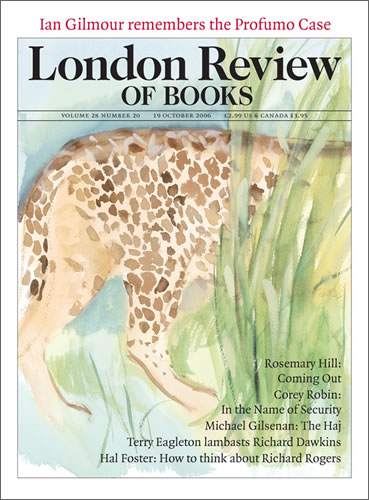
One of the oldest and most enjoyable tricks of the trade happens over in the latest London Review of Books (featuring the very first Peter Campbell cover-painting I've ever actually liked - and I'll never get another shot, since we're informed in this issue that the artist died in October): the letter-column rumble! In an earlier issue, Pankaj Mishra turned in a magisterial condemnation (a dismissal, really, at epic length) of Niall Ferguson's latest tome, Civilisation: The West and the Rest, coming as close as he legally could to calling it the steaming pile of smug racist jingoism it is. In the letters column of this latest issue, Ferguson writes an outraged, bombastic reply to that review, claiming he's been libelled and blimpishly demanding an apology. And Mishra, bless him, pens a response that's if anything more tart and damning than the original review.

Now Ferguson has been a show-boating very public historian for a decade or so (and he's done some very good work in that time, mind you), so I'm hoping he knows the tricks of the trade himself. The thing to do at this point is write another letter - letter-column slug-fests must be kept going at all costs, as far too few periodicals seem to realize anymore. The thing not to do is call his lawyers about a possible defamation suit. That's a trick of an entirely different trade.


Friday, March 25, 2011

Aunts, Taunts, and Old Haunts in the Penny Press!

The 17 March London Review of Books (fully enjoyable, like green eggs and ham, on a train or in the rain) is a typically diverse and involving issue of that typically wonderful publication. I've praised the LRB often enough here - In the Penny Press would be a poorer place indeed without it - as being a kind of necessary adjunct to the mighty Times Literary Supplement; I go to the TLS to breathe the pure mountain air of erudition, and to be blasted by that air, article after article, three times the number of articles in any given issue of the LRB.

In the London Review, the reviews are longer, fewer, and in some measures designed to be more accessible - no less intelligent and probing, but with a broader issue-base in mind, and no 4000-word discourses on the latest annotated historiography of late 17th century conversos memoranda. Don't get me wrong: the sheer, bristling brilliance of the TLS' bookishness is one of the wonders of the modern world, gloriously anachronistic in our age of mini-tweets (they'll have my subscription, paid faithfully every year, until the sun goes cold in the sky). But one also likes a slightly more street-level intellectual stimulation, and for that, nothing currently being published (with one possible exception!) beats the LRB.

This 17 March issue is a perfect case-in-point: 15 pieces (plus juicy extra bits, like poetry or short columns) covering as wide a spectrum of subjects as any reading public could want. Even the political stuff is so well-written I very often actually read it, when corresponding piece in The New Yorker get skipped so I can watch David Denby mud-sling semiotics all over the new Angelina Jolie car-chase. But the literary matter is what really shines. The TLS regularly prints the Introductions various authors have written to forthcoming new editions of classics, but those are finished things just showing up in print early - when something similar happens in the LRB, you get the impression more of a workshop than a shop window, and it's nice.

Take the fantastic "The Importance of Aunts" in this issue, by the great Colm Toibin (I'm sitting here trying to remember the last thing he wrote that I didn't like - needless to say, this is not a process that takes a long time, with most authors - and I'm stumped; perhaps I'll consult my own archives): I'm sure

[caption id="attachment_2535" align="alignleft" width="200" caption="the mighty elizabeth spriggs as aunt agatha"][/caption]

this piece was conceived, written, and commissioned elsewhere and for other purposes (is there an Oxford Book of Aunts coming out? If there isn't, there should be - I'd buy a copy), but it still has a convivial air about it that makes it invigorating reading. Toibin looks at the function of aunts in the 19th century novel - his readings don't take him as far as the 20th century and Bertie Wooster, so he doesn't deal with those twin titans of menace, Aunt Dahlia and Aunt Agatha - and he throws off idea after fascinating idea about the pseudo-maternal role aunts play in the fiction of the time. As you'd expect from Toibin, there's a great deal here about Henry James, as when we're told that he "followed the serialisation of Daniel Deronda. He read the book carefully, disapproved of it, and then took what he needed from it." Hee.

His essay wanders around quite a bit, which is what should happen in a piece by an extremely well-read Irishman, and it says lots of really interesting things about the various ways aunts are employed to make things happen, as opposed to the rarer mothers in the period's fiction, whose function is (or would be, if they were around to exercise it) to stop things from happening. Some wag once summarized all British fiction with the single word "aunts," and reading Toibin's essay here almost makes you believe it - I wanted more from him on the subject, which is, curiously, just what you want your readers to be feeling when they finish a piece like this.

Of course, leaving the reader wanting more isn't always - or even usually - a good thing in other kinds of pieces. In straight-up book reviews, for instance, if your reader ends the review by saying "but what about THIS? Or THAT?" then you've done an incomplete job, allowed your personal fixations to block or cramp your review. If you yourself are a high-profile professional book reviewer reading these words right now (I know quite a few of you are regular readers of Stevereads - although unaccountably bashful!), you'll know the many and powerful temptations to let your review be blocked and cramped, to give your personal hobby-horses a little gambol in print. We've all done it, and in essence there's no shame in it (provided you're interesting, the sine qua non of all writing) - the key is to do justice to the book under review, regardless of whatever else you decide to spool on about.

Naturally, in the case of this LRB issue, I'm talking about David Haglund's piece on James Franco's Palo Alto. Because it isn't a piece on Palo Alto, Franco's debut short story collection, even though it's billed as that. Instead, it's a piece on Franco's fraught public persona, with a couple of distracted paragraphs on Palo Alto tacked on. Unless you've allowed your subscription to USWeekly to lapse and are thus Franco-starved, this piece will certainly leave you wanting more, since in the place of Haglund devoting any kind of serious attention to the collection of short stories, we get Haglund drizzling baffled condescension all over Franco's non-writing career. What little there is about Palo Alto is more sizzle than steak, with pat little bits of plate-spinning like this:
But Franco's irony regarding his fame shouldn't lead anyone to underestimate the remarkable earnestness of his artistic ambitions, whether he's able to realise them or not. Indeed, that earnestness may be an obstacle to their achievement, if Palo Alto is any indication.

It's not that I'm expecting reviewers to ignore the fact of Franco's celebrity when discussing his book; authorship is a legitimate component of writership, after all. And I'm not equating Palo Alto with Franco's beloved Turgenev, not by a long shot. But it's a serious book nonetheless, some of its stories written in innumerable drafts to get them just so, and many of its effects genuinely heartfelt. It deserves more than a couple of dismissive paragraphs; Haglund should have resisted his urge to digress at such length about Franco's acting antics, especially since under different circumstances I'd have loved to read his take on those antics. Reading this piece, all I kept thinking was how disappointing Franco himself would find it - not disappointed that the critic didn't like his book (any writer has to be ready for that), but disappointed at how badly distracted the critic let himself be.

Fortunately, focus was in ample supply elsewhere in the issue, including my favorite piece, the redoubtable Tom Shippey's magnificent review of Robin Fleming's Britain After Rome, her great, endlessly entertaining, and beautifully written entry in Penguin's ongoing History of Britain. Shippy wasn't as taken with the book as I was, but he certainly does it justice with a thorough reading - and in the process he crafts an essay that's enjoyable to read all by itself, the true mark of first-rate literary journalism. It's no easy thing to write a knowledgeable 2000-word piece on a historical subject and keep things interesting the whole time - most professional historians, for example, would be helplessly stymied by such an assignment (even though they regularly give such assignments to their students), but Shippey never disappoints (well, until he eventually does, at which point Stevereads will dutifully whack him for it). Here he is on the wealth of pre-Conquest England:
No wonder William the Conqueror thought that England was worth a serious gamble. The country, with its rich estates, centralised bureaucracy, effeciently run coinage and - something at last that Roman Britain didn't have - its hundreds of watermills (a new technology), looked as if it were going to skip the Middle Ages altogether and move on to a new level of prosperity. But it took a long time to get there...

He somewhat snidely mentions how "In every TV programme about Anglo-Saxon England someone is always wheeled on to say, in effect: 'Dark Ages? How can anyone call these the Dark Ages? Just look at the amazing jewellery/magnificent artwork/superb illumination' and then offers a sparklingly pithy correction:
Nails, pots, tiles, bronze and copper coins: it's the absence of useful low-cost items in bulk that make a Dark Age, and their loss is not compensated by the ability to manufacture elite bling.

Marvellous. Couldn't have put it better myself.

There was lots else in this issue of the LRB, as there is in virtually every issue - 'something for everybody' as the useful old tag-line goes. At the risk of sounding boosterish, I'll go ahead and urge you all: take the plunge for a year's subscription, and see if you don't cheerfully renew when that time is up.

Friday, March 04, 2011

Kings, Princes, and Emperors in the Penny Press!


The mighty Colin Burrow could hardly fail to grab my attention in the latest London Review of Books, since the scamp chose to start his review of the new Yale edition of Samuel Johnson's Lives of the Poets with this choice little gem: "Most literary criticism is ephemeral, too good for wrapping up the chips but not worth binding, keeping, annotating or editing."

I tried to resist the urge to race over to Open Letters Monthly and reassure myself that it hasn't been quite as bad as all that for the last four years - instead, I plunged forward with Burrow's own exercise in the journalistic version of lit crit, his wonderful article, which has precisely one paragraph on that poor Yale volume and two glorious pages on Johnson's glorious book (which I'll get around to here on Stevereads one of these fine days, and which I urge all of you to take down from your shelves and re-read). Burrow is a mere stripling in years, but his prose uniformly sparkles with great, knowing lines like this one:
When Johnson has nothing to say in the literary-critical section of a life he will accuse and author of overusing triplets or Alexandrines, or of being merely pretty. He sometimes delivers the squelch complete, as when he says of the unfortunate George Granville: 'His little pieces are seldom either spritely or elegant, either keen or weighty. They are trifles written by idleness and published by vanity.'

I hooted with laughter and had to resist by sheer will-power the urge to rename this blog "The Squelch Complete."

A fairly good example of "The Squelch Complete" is delivered by the redoubtable Mary Beard over in the TLS (it's been a very good fortnight for Burrow's chips-wrappings), where she sinks her teeth into a new biography of the Roman emperor Elagabalus, a Cambridge University Press volume by Leonardo de Arrizabalaga y Prado (names that beautiful just aren't fair, says a Donoghue of 100 generations of boring old Donoghue). It's always a joy to watch Beard at work, although perhaps Arrizabalaga y Prado isn't doing any jigs after this rather public spanking. An entire little universe of mythology has sprung up about Elagabalus in the seventeen or so centuries since he briefly rule the Empire - so much so that he seems far more comfortably the province of fiction than fact (Beard doesn't mention the entertaining 1966 novel about him called Child of the Sun, although I cheered when she alluded to Alfred Duggan's 1963 novel Family Favourites). Arrizabalaga y Prado attempts to cut away all that mythology and get at the boy himself, but apparently his methodology leaves something to be desired ('apparently' because Cambridge has been a bit laggardly in sending me a copy of the book, the caitiffs), since Beard ultimately concludes "... a sceptical historian who cannot sustain his scepticism is even worse than one who was gullible all along."

Scepticism might be the order of the day over in the new issue of Vanity Fair, although it's a corker of an issue just the same. Readers might be forgiven for being sceptical when cover-boy and rancid tobacco addict Robert Pattinson bemoans his fame to interviewer Nancy Jo Sales - except that he seems every bit as aware of the inanity as anybody else would be. "Yeah," he says, "but every time you read about someone famous talking about being famous, you're like, 'Shut the fuck up.'" Sales is a really good writer, but nevertheless, her piece provokes scepticism on many levels. She asserts more than once that Pattinson is a "thinking man," a 'thoughtful' person - but he comes across as just another pretty moron in a ridiculous hat; she portrays him as a sensitive fellow, but the whole time he's being interviewed, his dog is apparently fighting for his life just outside the door; and scepticism is just one of the many unsavoury responses provoked by that weird Annie Leibovitz cover.

Fortunately, the issue wasn't relying solely on this smelly kid's celebrity. There's a spirited, chatty look at the Middletons, who are soon to be the in-laws of the heir presumptive to the British monarchy, and there's a moving little excerpt from Christina Haag's surprisingly heartfelt new book about her time dating John F. Kennedy Jr. - the book, Come to the Edge, is a beautiful little testament to the weird draw the Kennedys could always exert on those they allowed to get close to them; it's pretty much exactly the kind of thing the family patriarchs - Jackie Onassis and Senator Ted Kennedy - would have privately frowned upon, but I'm glad for it just the same; and it certainly helps that Haag has such a vivid, entirely honest prose voice.

And quite apart from all these kinds of royalty - British, American, critical, literary, and vampiritic - VF also had a two-page ad I've seen in other magazines and like immensely .... an about magazines.  In this one, there's a picture of a wide-eyed tree-frog (who bears more than a passing resemblance to Pattison, now that I think about it) and a block of text that's as defiant as it is cheering:
Media continue to proliferate. Attention spans continue to shrink. And free content is available everywhere, from the Internet to the insides of elevators. Why then are 93% of American adults still so attached to magazines? Why do so many people, young and old, spend so much time with a medium that's paper and ink, a medium you actually have to pay for in order to read? In a word, engagement. Reading a magazine remains a uniquely intimate and immersive experience. Not only is magazine readership up, readers spend an average of 43 minutes per issue.

Any lover of books will take issue with that 'uniquely,' but still: I like reading such a battle-cry, because I'd hate to live in a world without magazines - and what would our too-infrequent In the Penny Press do without them?

Sunday, January 09, 2011

Pomes, Proems, and Porkers in the Penny Press!


In the waning months of 2010, I got quite a few comments from the Silent Majority asking me whatever became of regular In the Penny Press updates. And it's true: I neglected writing about my vast magazine-reading, mainly because the year's impending end had me thinking more and more about all the books I still wanted to write about.

 
But as the American magazine industry is forever reminding us these days, despite the Internet and the decline of literacy, magazine-reading is as healthy as its been in decades. And I certainly contribute my share to that! I read every issue of National Geographic, Esquire, GQ, Vanity Fair, Men's Journal, Outside, The American Scholar, Royalty, Majesty, Natural History, Harper's, The Atlantic, The New Yorker, New York, Rolling Stone, Asimov's, the TLS, The New Yorker, The London Review of Books, Publisher's Weekly, The Romantic Times Book Club, The Boston Review, and the New York Review of Books, and I usually find something noteworthy about every single issue of every single one of those ... so it's a tad laggardly if I stop blogging about them here. If Stevereads is the autobiography of my reading, scanting on magazines would be like skipping a chapter.

 
Hence, I started off the year with a Penny Post entry, and I'll keep it up - starting now, with a very strong little pod of titles consumed at my usual table at my little hole-in-the-wall Chinese food place in Chinatown (not the same hole-in-the-wall place that served me for a whopping 30 years - it closed! - but a newer, even smaller place that's unknown both to stupid American customers and, I suspect, to the Boston Board of Health... I get a HUGE plate of food for a pittance, and I'm left alone to read in sweet peace for as long as I want, because the staff is wonderful and also because there are never any other customers). The opening dish, as it were, was The New Yorker, which featured, among other things, a poem I rather liked and which I include here in place of my late, apparently unlamented 'Poetry Class' feature:


In the little house filled with dogs and resilient plants

She left only a glass and a blank sheet of paper.

The stadium up the road like a siren called with silent applause

To climb up, climb beyond the seats and the grass

Where a team of young girls kicked a white ball.

Maybe she knew they were there, maybe she was calling back

A line a male poet committed to the page a decade ago,

About time made simple by the loss of detail.

Maybe she then cast out every detail but the unencumbered air

To keep it simple. And then fluttered away from us.

That's called "Air" by Daniel Halpern, and I like it quite a bit.

 
Amazingly, I also liked the beginning of this issue's short story - and the reason it's amazing is because the story, called "The Years of My Birth," is by the dreaded Louise Erdrich, whose work I've hated since the Great Depression. And keep in mind, I still hate her work - this story is slightly less wretched than her usual blather, it's true, but it still falls apart almost completely on both a plot and an execution level. But the opening is, against all odds, first-rate:


The nurse had wrapped my brother in a blue flannel blanket and was just about to hand him to his mother when she whispered, "Oh, God, there's another one," and out I slid, half dead. I then proceeded to die in earnest, going from slightly pink to a dull gray-blue, at which point the nurse tried to scoop me into a bed warmed by lights. She was stopped by the doctor, who pointed out my head and legs. Stepping between me and the mother, the doctor addressed her.

 
"Mrs. Lasher, I have something important to say. Your other child has a congenital deformity and may die. Shall we use extraordinary means to salvage it?"

 
She looked at the doctor with utter incomprehension at first, then cried, "No!"

 
While the doctor's back was turned, the nurse cleared my mouth with her finger, shook me upside down, and swaddled me tightly in another blanket, pink. I took a blazing breath.

 
"Nurse," the doctor said.

 
"Too late," she answered.

Any story that begins with that kind of crackle just naturally compels you to keep reading - which I unfortunately did, but still.

 
(The issue also features a droll, enjoyable essay by Joan Acocella about the popularity of the Stieg Larsson novels. She makes a few good stabs, but ultimately she can't figure it out either)

 
And as enjoyable as I find practically every issue of The New Yorker, I turned with special eagerness - I always do - to my own metier,  book-criticism. And boy, what a great double-barrelled blast of book-criticism you get when you read The London Review of Books and the TLS back-to-back! In the London Review this time around there's an absolutely howlingly great take-down of George W. Bush's Decision Points, which is sly and vicious and fleet-footed and would be sufficient to induce authorly catatonia, if the former president ever actually read it. Which seems, all in all, unlikely. The piece is by Eliot Weinberger, and surely its most glorious paragraph is this one:


This is a chronicle of the Bush Era with no colour-coded Terror Alerts; no Freedom Fries; no Halliburton; no Healthy Forests Initiative (which opened up wilderness areas to logging); no Clear Skies Act (which reduced air pollution standards); no New Freedom Initiative (which proposed testing all Americans, beginning with schoolchildren, for mental illness)l no pamphlets sold by the National Parks Service explaining that the Grand Canyon was created by the Flood; no research by the National Institutes of Health on whether prayer can cure cancer ('imperative' because poor people have limited access to healthcare); no cover-up of the death of football star Pat Tillman by 'friendly fire' in Afghanistan; no 'Total Information Awareness' from the Information Awareness Office; no Project for the New American Century; no invented heroic rescue of Private Jessica Lynch; no Fox News; no hundreds of millions spent on 'abstinence education'.

Hee. Of course, many of the items on that list are very nearly as fraudulent in their glancing mention here as their omission from Bush's book is (Open Letters' own Greg Waldmann, taking the less fun but more measured tone here, no doubt renders things more correctly, even at the cost of pyrotechnics), but the spittle flying off the piece was hugely enjoyable just the same.

 
(And while we're on the subject of OLM-echoes, Peter Campbell turns in a piece in this same issue in which he takes in the Thomas Lawrence exhibit now at the National Portrait Gallery and appreciates Lawrence's work as much as I did here. He writes: "There are some tremendous pictures among the things gathered here. Pictures of 'real genius'? Well, 'genius' is not an easy word, but certainly vivid, appealing and, sometimes, as in the case of the military or of fashionable ladies, necessarily tawdry")

 
If I had to pick one highlight of the issue, however, it would be the utterly sui generis meditation on wild boars (and Paul Celan? I still haven't figured that part out yet) by the great novelist Lawrence Norfolk (whose greatest novel, In the Shape of a Boar, almost certainly generated this piece by accident years ago), including this little gem: "In the late 1980s, two young boars attacked an F16 fighter plane attempting to land at Jacksonville International Airport in Florida, causing its destruciton." (The anecdote is no more true than some of Weinberger's slung-around accusations, but it's just as much fun)

 
And the riches on hand in the TLS were, if anything, greater - starting with a wonderful extended explanation for the dismayingly phoned-in little squib I took Adam Hirsch to task for in the Book Review here. In this issue of the TLS, he delivers a long and gloriously intelligent review of a thoroughly unworthy subject, the letters of Saul Bellow, and the piece is every bit as smart as his Book Review piece was vapid, every bit as detailed as his Book Review piece was vague. Virtually every paragraph of this spectacular review sparkles with nerve and insight:


The soul makes the flesh, which is why it can't survive the flesh. And this insight is guaranteed, for Bellow, by the very vividness with which the physical world appeals to him - an intensity so powerful that he could not believe it was merely subjective. This very early intuition is what led Bellow to his late enthusiasm for Rudolf Steiner, whose books are so dreadfully written that only a deep spiritual aspiration could have led a reader of Bellow's sensitivity to tolerate them.

I find I can forgive any number of fatuous essays on the Role of the Book-Critic Today if the essayist in question is still capable of knocking reviews like this one out of the ballpark. If a tongue-lashing from Stevereads was all it took to get Kirsch back in line, I'm happy to serve.

 
And speaking of tongue-lashings! Some of you may have noticed the pan I gave to Ron Chernow's new hagiography of George Washington, so of course I read Mark Spencer's review of the same book with great interest. Alas, he decides mostly to praise the thing despite the fact that its manifold deficiencies are in full display on every page. This is as close as Spencer comes to invective: "Convincing us to trade in our "frosty respect for Washington" for a "visceral appreciation of this foremost American" sometimes leads Chernow beyond the evidence of the historical record."

 
Needless to say, I disagree with such a positively Jeevesian level of restraint. Maybe Spencer would profit from a tongue-lashing ...

Thursday, March 18, 2010

Flecks of Gold in the Penny Press!

Since I’m the argumentative sort (this will be no news-flash to most of you), it’s easy for me to get so caught up in yelling at the Penny Press that I overlook one of the biggest reasons to read it – and the biggest single reason why you should all be reading Open Letters every month: it’s only in the admittedly amorphous field of ‘literary journalism’ that you’ll find really smart, really articulate authors cutting loose with wit, acid, accumulated experience, and a certain free-floating brilliance you often won’t see in their more considered (i.e. less deadline-driven) prose. We all revere Edmund Wilson, after all, but who wouldn’t honestly prefer reading him dishing up his thoughts on John Dos Passos than slog through To the Finland Station again? The same thing with Virginia Woolf: the difference between reading one of her novels and reading her glorious, chatty, discursive book-essays is the difference between listening to your parish priest give a sermon during Mass on Sunday morning and listening to him freely discoursing after supper and supper’s cordial glass of wine – the former is no doubt good for your soul, but the latter is good for your mind, for your mercurial heart.

It’s only in literary journalism (a bugboo of a title, I know, by which I essentially mean short essays about somebody else’s art-production: a theater review, an author career-overview, one of Locke Peterseim’s brilliant movie reviews, somebody writing intelligibly about dance, etc) that an author will ask questions for which he doesn’t already have a whole seminar’s worth of answers prepared; it’s only in literary journalism that you’ll find lifelong serious readers actually talking about books, as opposed to lecturing about them. This difference is facilitated – almost necessitated – by the nature of the genre: a book-critic is forcibly reminded that his subject exists on a continuum: the author is still alive (usually – or not usually, in my own case), the work is still ongoing, so not all the answers are in. Great theater reviews can’t avoid this provisional humbling: they’re seeing one, at most two performances of a show before deadline comes calling. Literary journalism – especially the online variety – is more plastic than literature … corrections can be made, debates can flourish in letter columns, and everybody’s still filling all their spare time with reading. It’s thrilling.

Well, it can be, when it’s done well. Which, admittedly, is not all that often. We’ve all read countless book reviews, movie reviews, TV reviews, etc. that were ‘phoned in’ (a rhetorical holdover from when it was literally true, when distant reporters would commandeer a phone line and call in their stories to waiting typists back at the newsroom – the implication of haste has largely scrubbed off the term, but the implication that the resulting prose wasn’t considered at all by its writer is still with us, and still accurate) – a writer will pick up a couple of obvious points off the surface of a work, roll them around for a few paragraphs, then toss off a semi-witty exit-line and call it a day. The goal of any editorial team worth its salt is to use such pieces as seldom as possible, to hunt continuously for better, more lively prose to publish. It can’t always be found in time for deadline, but when it is – oh! Then you can have some great reading experiences!


Take the latest Harper’s – not the place I tend to go for such pith and merit, and my trepidation only increases when the subject of one such potential experience is Arthur Koestler, a boring, overrated author who’s nevertheless managed to snare and hold a certain amount of critical attention for the last fifty years. Literature periodically turns up such people, like rocks in a plowed field, and then you just have to wait patiently for the vogue to die down (which it sometimes doesn’t do – I’m still waiting for the world to wake up to the fact that 90 % of Hemingway is garbage and 100% of Gertrude Stein is too, but thanks to the heedless engines of academia, it isn’t likely to happen).

I was encouraged this time around by the fact that the article in Harper’s was written by Nicholas Fraser, one of the best book-essayists working today. And he didn’t disappoint: his review of Michael Scammell’s mammoth new biography of Koestler is infinitely better reading than the 200 pages of that book I managed to wade through before feeding it to my dogs – hell, it’s infinitely better than almost everything Koestler himself wrote. And the joy here, as I opened so many windy paragraphs ago, is that of great prose finely honed against the ticking clock:
… he repaired to the English countryside and played chess, preferring the company of his dogs to that of humans. In his later years, he wrote many books in which he alternately proffered science as a solution to the ills of mankind and attacked scientific pretensions on the grounds that science had become an orthodoxy as powerful and misleading as the Communism of his youth. Some of these books sold well, but without exception they have aged badly. Koestler attained brief moments of notoriety in the late 1960s when he said that man’s violence might be tamed by the development of a drug that diminished aggression. He became famous for encouraging and even attending unsuccessful spoon-bending sessions. Koestler insisted that his later work was important; he was wrong, of course, but one must appreciate in the aging, cranky Koestler the true skeptic’s disposition to overthrow any orthodoxy in sight.

That ought to stand as the final word on the author – at least until some equally talented writer comes along and offers a spirited challenge to that ‘he was wrong, of course’ – I hope it happens in Harper’s: the symmetry would be appealing.

Still, it’s not usually Harper’s where I go to find such great stuff; usually, I start with those twin titans of the literary-criticism world: the Times Literary Supplement and the London Review of Books.


In the latter, Tim Dee writes a very lively “Diary” essay about bird-watching (with a tip of the hat to Jeremy Mynott’s Birdscapes, which also got a favorable review at Open Letters) – or rather, bird-watching versus birders:
It’s easy to distinguish between the two types. Birders are the green-clad, kit-festooned action men of blasted headlands, sewage farms and reservoir causeways. They take pelagic trips and dribble a bucket of rancid bouillabaisse behind a boat to entice rare petrels: this is called ‘chumming’. What is crucial for them is the moment between sighting a bird and identifying it. There is a potent second or two (this can extend to hours if a tricky rarity is glimpsed) when the bird is wrested from a backdrop of wind or sea or marsh, or singled out from a cloud of lookalikes, and then named. In their itch to tag the wild, birders travel through the world as if they were closing it down.


But the prettiest gem this time around comes from the TLS, where Juliet Fleming turns in one of the most delightful, insightful theater reviews I’ve read so far this year. She’s writing about Peter Hall’s new production of "A Midsummer Night’s Dream" for the Rose Theatre, and practically every line of her review is ebulliently quotable, starting with the very first, which made me laugh out loud:
Could it be that A Midsummer Night’s Dream is not a very good play?


She’s talking about what a poorly-constructed, scatterbrained, ultimately silly play it is, but she’s mindful of the fact that a play – especially one by Shakespeare – can be all of those things and still work incredibly well, and she’s absolutely right that this is a defining characteristic of the play in question:
A Midsummer Night’s Dream, in particular, celebrates the power of theatre to move audiences in ways for which there is no accounting.

This is wonderful stuff (as is her throwaway quip while narrating the performance’s action: “So far, so adequate”), and yet it will likely never be anthologized anywhere or reprinted in any venue – it enjoys its only brief lifespan right here, in this evanescent staging where so much fine, fun writing happens. Like I said: thrilling.

Friday, November 13, 2009

Quotable Bits in the Penny Press!


A laurel and hardy handshake to the London Review of Books, which turned thirty years old this month with a lavishly overstocked issue of reviews and commentary, including a surprisingly enjoyable review by Colm Toibin of the new John Cheever biography. Not surprising because it deals with Cheever (whose work I mostly dislike), but surprising because it's written by Toibin (whose novels I entirely dislike) - providing yet more evidence of a literary phenomenon I'm tempted to dub the Zadie Smith Syndrome, in which a generally overpraised, talentless novelist shows first-rate skills as a book reviewer. I keep reading Toibin's deplorably lazy novels based entirely on the strength of the non-fiction stuff he's done that pleased me (including the epic, indispensable Penguin Book of Irish Fiction, which I'll get to one of these fine days here at Stevereads), so 2009's been the old one-two punch: a wretched novel, and this delightful Cheever piece.

The review is of the book by Blake Bailey, and it's a classic 'fulcrum' work - not well-written or otherwise intrinsically worthwhile, but irresistible to a wide swath of reviewers who don't want to review the book so much as use it to talk about the book's subject (not at all a despicable aim, although the shadow-ground it occupies between essay and review has never been fully charted). The LRB gives Toibin a nice generous amount of space, and his article is never less than fascinating. Here are some of the highlights, like this bit about Cheever's male lovers - and his weird belief that sexual activity sharpened his eyesight:

Since Cheever took the view that sexual stimulation could improve his eyesight, part of Max's function, once their affair began, was to offer the same comfort as a good pair of spectacles might have.


Or, after discussing Cheever's intensely strange novel Falconer ("The sense of violence, hatred, pain and deep alienation is offered raw; beside this, love, or something like love, comes as dark redemption or another form of power. In the middle of somewhere are the grim ordinariness of prison life and some brilliant sex scenes") this great little tossed-off line:

If you ignore the upbeat, cheesy ending, Falconer is the best Russian novel in the English language.

Hee.

Or this, culled from Cheever's journals (which Knopf paid a whopping 1.2 million dollars for the right to publish):

In the next entry, he ends with a remark which is one of the few endearing remarks in his journals and should be the motto of every writer alive: "All right, I want something beautiful, and it will be done by June."

Now I'm not saying we've got the Miracle of Lourdes going on here - Toibin's singularly un-Irish tin ear for prose is still occasionally on display (that weak ending "might have," for instance, or those ploddingly repeated "remark"s) - but this is generally excellent stuff, as have been all of Zadie Smith's literary essays in the last year. A piece like this makes me eager to see more of Toibin's work - which is certainly an odd feeling.

Saturday, December 27, 2008

The Ways of War in the Penny Press!


Our last look at the Penny Press in 2008 features two accounts of the shot and fray of war - and some of the perils attendant in writing about it!

In the 18 December London Review of Books, Thomas Laqueur turns in a long and extremely thoughtful review of Drew Gilpin Faust's This Republic of Sorrow and Mark Neely's The Civil War and the Limits of Destruction. Faust's book he loves ("a spectacularly good book," which sounds a little like a contradiction), and Neely's book frustrates him with its central tenet that the American Civil War was neither so bloody nor so destructive as 150 years of historians have rejoiced in saying it was.


I thought Faust's universally-praised book was almost hysterically overwrought, and I thought Neely's book was simply dull - you would never read a long, detailed exegesis of either one of them on Stevereads (much less Open Letters). But Laqueur is always worth reading, even when I don't agree that his subjects are worth reviewing. In this case I think he might be a little too hard on Neely, taking him to task for relativizing what he never meant to belittle. For instance, Laqueur has little patience with Neely's subtraction from the overall mortality of the Civil War the many thousands of deaths from infection and disease, although it's hard not to agree with a reviewer when he's making his points so calmly and eloquently:

The 225,000 Union and 194,000 Confederate soldiers who died from disease were just as dead as their comrades. They too left survivors bereft; they too filled graves, probably in disproportionate numbers because their bodies were more easily identified and recovered. More important, death from disease or exposure is not an act of God but a real consequence of the violence of war. It would be very odd to exclude those who died of cold and hunger in Napoleon's or Hitler's Russian campaigns if one were trying to quantify their human cost.

Likewise, over in the 12 December TLS, W. V. Harris reviews two volumes in the Cambridge History of Greek and Roman Warfare series - Volume One, on Greece and the Rise of Rome, and Volume Two, on Rome from the Late Republic to the Late Empire. Here, also, there's disparity and a little literary bloodletting (this being the TLS, the latter is significantly less delicate than in other review organs).

Some of Harris' observations are a little wobbly, as in his lengthiest digression:

At the Battle of Pydna, for instance, the commander Aemilius Paullus is said to have thrown a precious Roman standard in among the Macedonian enemy, which in effect obliged the legionaries under Paullus' command to drive the enemy back in order to retrieve it. .... Unimaginable in a modern army, this sort of behaviour was apparently quite common in Republican Rome.

Not so common: military commanders who tried such melodramatic stunts risked a great deal, and certainly a general as experienced as this particular Aemilius Paullus never actually did it. But I'd argue that it isn't so unthinkable in a modern army, or at least its modern equivalent isn't. And that equivalent wouldn't be 'throwing a standard in among the enemy, thereby forcing your men to more greatly endanger themselves to retrieve it' but rather 'imitating Alexander the Great' - who pulled that stunt (and the much riskier one of the personally leaping into the press of his enemies himself, thereby forcing his men to rescue not just the standard but the standard-bearer) quite often. And if we generalize that to 'imitate the great stories of what battlefield courage is supposed to be,' the thing becomes easily imaginable, even in modern-moment Iraq.


But that's a quibble, and it shouldn't keep us from Harris' own bloodletting, this time in the form of a classic lightning-quick TLS knife-thrust. He's running down the various merits of some of the Roman volume's better essays when the knife suddenly goes in:

At the other extreme is a chapter on Rome's early international relations marked by quite breathtaking vapidity.

Eeep. Perhaps fortunately for all involved, the writer of that chapter isn't named. The morbidly curious will have to Google it on their own.

These two forays into military history and the reviewing of military history form our last look at the Penny Press in 2008. It hasn't exactly been a banner year for periodical reading. Harper's has been almost relentlessly inconsequential; GQ and Esquire have amped up their gadget-and-g-spot coverage, at the expense of anything else (ditto Men's Journal and Outside); Vanity Fair has become thinner and slighter; The New Republic has become shriller; The New York Review of Books has become almost distractingly more political; worst of all, The Atlantic's move and recent redesign have combined seriously to undercut its intellectual heft.

Fortunately, the mighty TLS remains the same. And Open Letters keeps getting better and better. So there's hope, in the Penny Press.

Wednesday, November 12, 2008

In the Penny Press - part two!


The 6 November London Review of Books featured two stand-out pieces, one long, one short. The long one is a delightful ramble through the bloody mess that is Thomas Mann and his family, done with signature aplomb by Colm Toibin. As a reviewer and writer of fizzy prose, Toibin can do no wrong, and it's a testament to his talent that you're smiling all the way through this essay, even though the tale it tells - the rise of the Nazis, the exile of German intellectuals who didn't tow the party line, Mann the horrible, dysfunctional father (who both lusted after his young sons and emotionally disdained them), the inevitably screwed-up kids - is hardly a laughing matter.

There were many Mann children - wayward parasite and drug addict Klaus, strident and strong-willed Erika, well-meaning Elisabeth, passive and perceptive Golo, and the two youngest, Monika and Michael - but Toibin's story largely concentrates on Klaus and Erika (he's reviewing Andrea Weiss' book In the Shadow of the Magic Mountain: The Erika and Klaus Mann Story, but even so, the tale couldn't have stressed things any other way) and their various pre- and post-World War II misadventures. Toibin seems a little charmed by the pair, although only a little:

Despite the fact that they often seemed in these years to be the silliest pair of people alive, they came nonchalantly and almost naturally to believe that their right to freedom and fun and half-baked opinions was something worth preserving.

Hee. That's as deliciously sharp as when Toibin refers to Klaus as the writer of "a few almost interesting books."

Klaus was a twit, certainly, and he spent his entire life in the shadow of his much more famous father (Toibin gleefully relates the reaction of his literary acquaintances in New York upon learning that he was going to publish an autobiography: "What will you call it? The Invisible Man? The Subordinate Klaus?"), but there's a pathos in the story nonetheless - this was an unhappy family very much being unhappy in its own way. Still, if Toibin's review is any indication, In the Shadow of the Magic Mountain could very well be worth getting from your local library. Unless the worth of the book has been deceptively represented by the fact that an Irishman wrote a fantastic review of it - that's been known to happen, so be sure to browse the book before you commit to it!


A book you can avoid with a clear conscience is the subject of the second bonny bit in our brief tour of the Penny Press today: Jenny Diski reviews Alastair Campbell's All in the Mind and proceeds to carve the book into tiny edible pieces. But as good as the point-by-point demolition of the review is, the concluding paragraph is soaringly better. Every single writer of fiction or would-be writer of fiction should read the whole of this marvelous paragraph every morning before they start writing:

There is no doubt that a lot of work has gone into writing this book. This is true of all novels, every damn one - eighty thousand words and more take a long time to write, and getting them in the correct order requires a good deal of effort. But though admirable in some Protestant sort of way, trying hard, even trying very hard, isn't quite enough if you can't write and lack wit. If Alistair Campbell wanted to write a novel about such a thing as people's lives coming alive, then he or his editor should have tried much harder to wrench the language away from the turgid and the thought away from the banal. The craft of fiction is not working out a plan that looks balanced on a spreadsheet and then clothing it with words. The trick about writing a good novel is to be a good writer, though I understand that many A-level students these days are assured that there is no such thing as good writing, or even good novels, only what readers like. That'll be the market. 'It'll only sell if it's good,' Campbell says. Or was that 'It's only good if it sells?' And there's that rabbit hole again.


(One side-note to all of this, as pointed to the first part as the second now that I think about it: Golo Mann, though not nearly as limelight-hogging as his older brother and sister, grew up to be a really fine, effortlessly readable historian, in many, many ways a better writer than his father. I doubt his various works of history are available in English, but if you should ever find any, give them a try ... you won't find the insane brilliance of Mann the Elder's best novels, but you'll find a good deal of worthwhile stuff in its own right).

Friday, February 02, 2007

Penny Press! Autocracy and Ruin in the London Review!


Two items of interest in the latest London Review of Books, one long and one short.

The long one is VERY long, refreshingly so: Perry Anderson uses the murder and funeral of outspoken Russian journalist Anna Politkovskaya (also written up at length in last week's New Yorker) as a springboard to examine the length and breadth of Putin's Russia on a broad variety of topics.

Anderson is very good and very thorough, and by the end of his survey the reader will feel he has the matter of modern-day Russia well in hand. That alone justifies the price of the issue, since the subject is a formidable tangle.

And of course the central problem is the United States and its seemingly incurable itch to export its own brand of democracy to every country on Earth.
Most of these attempts have been land-and-cash-grabs thinly wallpapered with jingoism, but even the casual reader of history (that's all of you, ya mewling tools) will see that often they've been sincere. The sincere belief that America's ways - and thereby its successes - ought to be emulated by nations that have it less good.

That this is naive doesn't entirely forgive it even in the thinking, and very little forgives it in the attempting. Those who've done any amount of honest travelling in this world (package tours and hotel-to-hotel ratepayers, quietly take a seat in the rear, thanks) know that the single good thing about the otherwise-noxious and loathesome fad of 'multiculturalism' is that it prompts otherwise hidebound, insular, flyover-state people to consider the serious possibility that other nations, other cultures, might have a stand-alone intrinsic worth of their own. A worth sometimes very different from strip-malls and tent-revivals.

There's an obdurate truth at the heart of this problem that ought to make Americans proud, not ashamed: this country was blessed in its birth. In its pre-destiny days, it was blessed with two essential elements of spadework: a biddable multi-millionaire (in the person of John Hancock) and a tireless opinion-changer (in the person of Samuel Adams). And when the destiny days came about from their work, there came a host such as no newborn country has ever had or could ever reasonably hope to have again. John Jay, James Madison, Josiah Quincy, Benjamin Rush, Paul Revere, Caesar Rodney, James Wilson, John Marshall, Daniel Webster ... these names make an impressive roster, and that's BEFORE you get to Benjamin Franklin, Thomas Jefferson, John Adams, and most of all Alexander Hamilton. Even George Washington managed not to get captured and hanged on national TV.

Add to such a pantheon lucky timing (the mother country from which they rebelled was exhausted from nearly a century of continuous warfare) and lucky location (as we've maintained all along here at Stevereads, if the British Empire had been run from Montreal instead of London, we'd all be subjects of the crown today), and you get a very potent formula.

If luck and geography make a thing so, it's hardly destiny. And yet, looking around them and seeing that thing work, Americans consistently try to IMPOSE that thing on other countries, without regard for luck or geography. And the results are almost never good.

Anderson reserves comment on the subject, merely pointing out that when Communism fell apart in Russia in the 1980s, the United States was quick to praise and slow to guide. And he very rightly hints that no guidance would have amounted to much in any case.

Russia has no history of democracy, no racial memory of Magna Carta, no safeguards in place against the ravages of capitalism (a more savage creed by far than socialism or fascism, in its undiluted form). To expect Russia to embrace American-style democracy as soon as the Berlin Wall falls is the epitome of American wishful thinking.

The point of Anderson's long article is that Russia under Putin seems to be drifting back to itself, to its thousand-year-old pattern of a strong, quasi-autocratic centralized government. This is different from the American pattern (increasingly so with every day, thank Gawd), and that rankles Americans - but as Anderson correctly points out, Putin is overwhelmingly more popular with his people than either Bush or Blair is with their own.

Anderson is very good with the big picture:

"The reality is that Russia's rank in the world has been irreversibly transformed. It was a great power continuously for three centuries: longer - this is often forgotten - than any single country in the West. In square miles, it is still the largest state on earth. But it no longer has a major industrial base. Its economy has revived as an export platform for raw materials, with all the risks of over-reliance on volatile world prices familiar in First and Third world countries alike - over-valuation, inflation, import addiction, sudden implosion. Altough it still possesses the only nuclear stockpile anywhere near the American arsenal, its defence industry and armed services are a shadow of the Soviet past. In territory, it has shrunk behind its borders at the end of the 17th century. Its population is smaller than that of Bangladesh. Its gross national income is less than that of Mexico."

The overview Anderson gives will no doubt make some of Stevereads' older readers nostalgic for certain aspects of the Cold War days. This certainly isn't Anderson's intention, though: he wants to give a soup-to-nuts summary of the way things stand now in Russia, and he succeeds admirably.

A trifle less successful - and a helluva lot shorter - is Philip Conners' review of Cormac McCarthy's "The Road," also in this issue.

As some of you may recall, we here at Stevereads largely enjoyed "The Road" (and it remains one of the few witching-hour works on which we and The Mama Chan actually agree, so call your stock brokers), and we've been following its reception in all the major outlets.

Connors is fairly praising, although he spends more time assessing McCarthy in general than this book in particular, sometimes amusingly:

"There are briefs against McCarthy. A chilling detachment from the psychology of his characters. A dearth of well imagined women. An obsessive attraction, bordering on glorification, to blood and violence. A reliance on gnomic utterances by cameo prophets. Enough evidence can be marshalled on each of these counts to convict him of the overarching crime of not being Henry James."

We here at Stevereads largely agreed with his review, but only up to a point, as when he writes: "... for sheer dexterity and inventiveness with English prose there is no contemporary American novel that stands beside 'Blood Meridian.'"

Sigh.

Needless to say, we disagree (and consider it fairly cheeky that a limey publication would have to stones to make such a sweeping claim). Oh, we're well aware of how excessively the celebrated Harold Bloom has praised "Blood Meridian," and we like it well enough ourselves. And we suppose Connors might be relying heavily on that 'contemporary' to shield his outrageous claim from people like John Barth or Joseph Heller, both of whom could write rings around McCarthy. But surely the corpse of Carol Shields is still warm enough to merit her being called 'contemporary'? And are not Pete Dexter and Peter Matthiessen still alive and working? For that matter, since we're talking about 'sheer dexterity and inventiveness with English prose' how about Norman Mailer, who proves with "The Castle in the Forest" that he's very much still in the game of dextrous, inventive Enlish prose?

No, when the history books are closed on Cormac McCarthy, we here at Stevereads feel confident he'll be ranked as a great good writer, not a good great writer. And there's surely nothing wrong with that, no matter what poor beleagured Saint Harold might say.

Tuesday, December 12, 2006

Penny Press! Poor old Christopher Hitchens!


There's a pattern to these things, and the arc of it is as etched as the path of the sun. At some point almost everybody thinks they'll be the exception to the pattern ... but they never are. This particular pattern has no exceptions by which its rule is proven.

It starts with a large, genuine creative talent. Acting, musical composition or performance, and perhaps especially writing. At the start, the talent glows in equal measure that it burns, but there's an immunity to it at the beginning.

Then fame or the frequent doing of it wear away the immunity, and the burning becomes problematic. It's a hard thing to live every waking moment in unshielded contact with the fires of who you are. If you're lucky, you'll have learned along the way to blunt the burning with regular, disciplined work-habits. But even if you have, you'll yearn for the time when you could hold the fire and not be burned. You can't - that's reserved only for talent's infancy (regardless of your age when you come to it). But you yearn anyway.

So you turn to chemicals. Absinthe, opium, alcohol, tobacco ... anything that even vaguely approximates the rush you're yearning for. When you do this, you're invariably solaced by the long history of the talented doing so. That helps to avert the feeling of shame.

At first, you picture the chemicals of your choice as FUEL for your talent, as servants to it. You tell yourself that only through opium do you reach the ecstatic state needed for your vision. You ritually uncork a liquor bottle before sitting down at the typewriter. You smoke incessantly during a play's run. All the greats have done so, you mordantly observe (as one colleague succinctly put it once, "I'm a writer, so I drink.").

Then (not, keep in mind, 'often' ... we're talking about a pattern here, one as certain in its final stages as it is in its early ones) the chemicals take over. You're no longer drinking while you write, you're writing while you drink. And then you're NOT writing while you drink (you refer to this stage as 'taking notes' or 'making sketches,' but in reality, you've quietly shifted your hurried intervals of actual writing to your mornings or afternoons, although you still go through the motions in the evenings).

You'll still be writing - your work habits and your financial obligations will see to that. But you'll drift steadily further and further from your talent, and it (under the undiminished onslaught of your chemicals, which are steadily eroding your physical state) will slowly atrophy.

There are no exceptions to this pattern, though all you out there with talent are mentally thumbing the names of your candidates. You have the comments field to name them, but I warn you: it'll be unpleasant for you when I sledgehammer them. There are no exceptions to this pattern.

Consider the 20th century alone - F. Scott Fitzgerald smoked more tobacco in a day than many family farms grow in a month. Hemingway was drunk by one in the afternoon Monday through Friday, and those were what he referred to as his WORK days. Gore Vidal, Norman Mailer, Anthony Burgess, John Steinbeck, Doroty Parker, John O'Hara, Kurt Vonnegut, Eugene O'Neill, John Barth ... the list is long, of writers whose later works dribble off into artistic irrelevance, and that's just among the writers. And all because they turn to chemicals rather than face the fact that you're only young once.

The pattern holds for content, too. After all, these people DID all start with genuine talent, and that dies hard. Even wasted and trashed and hung over and at half-strength, they can still dazzle those of us who don't have talent. And more and more, as time goes on, they RELY on that gradient.

So the work keeps appearing, and the critics keep talking about it, and the devotees keep outdoing themselves explaining (i.e. apologizing for) it, and the acolytes make careers out of their increasing disillusionment.

You've probably all guessed by now that I'm leading up the Christopher Hitchens, right?

A double dose of the pattern, this time around.

In last week's London Review of Books, John Barrell reviews Hitchens' book "Thomas Paine's Rights of Man: A Biography" and leaves pretty much nothing but a bloody stain on the water when he's done.

Ordinarily, seeing somebody as pugnacious as Hitchens get so thoroughly walked around the park would be a thrilling, pleasant thing; in your mind, you'd be picturing both the envy of the reviewer and the forthcoming blistering response of the author.

But this is something quite different:

"... if any radical, misled by George Galloway's description of Hitchens as 'a drink-soaked former Trotskyite popinjay', should suggest that this book was written out of vanity, he would surely be mistaken. A vain man would have taken care to write a better book than this: more original, more accurate, less damaging to his own estimation of himself, less somniferously inert. The press release accompanying the book led me to expect something much livelier; Hitchens, it exclaims, 'marvels' at the forethought of Rights of Man, and 'revels' in its contentiousness. There is a bit of marveling and reveling here and there, but it is as routine as everything else in this book, which reads like the work of a tired man.
"Too tired, to begin with, to check his facts."

There follows a depressingly long list of factual errors Hitchens makes in what I'm certain was a tossed-off work (and, more importantly, a work dashed off in a crapulous morning, after an evening spent diligently MEANING to write but only drinking instead).

But the list of errors isn't the most depressing part. It gets worse:

"This is only a selection of the many errors in this book, and they are not trivial; they misrepresent matters of fact that are essential to an understanding of the context of Paine's writings, and it is in the course of Hitchens's attempt to describe that context that they occur. It is the more surprising to find these errors, as none of them occur in John Keane's biography of Paine (1995), on which Hitchens depends heavily - it must have been open on his desk as he was writing this book."

There follows ... well, there follows enough instances of what Barrell diplomatically refers to as "the same selection of facts in the same order" to make something worse than deterioration of talent readily apparent.

Still, all this could still somehow be spleen on Barrell's part. It looks damning on its face, but we here at Stevereads haven't read the Hitchens book in question, so it's at least possible.

But the proof is and always will be in the pudding, and there's a big rancid puddle of said pudding in the latest Vanity Fair. There's a Hitchens piece there about why women aren't generally funny.

In case you think I'm being mean, the thing is titled "Why Women Aren't Funny," and as far as I can tell, it isn't a gag. I suspect that, for various reasons associated with the pattern, Hitchens is no longer capable of a prolonged piece of tongue-in-cheek satire.

No, the piece is tossed off and thus embarrassingly revealing, and what it says about Hitchens' attitudes toward women doesn't exactly make you envy his wife.

'Women' is undoubtedly too strong a word here. Chattel, children, chumps, even chimpanzees, yes, but 'women' implies some baseline parity with men - and that's nowhere in evidence in this embarrassing piece of screed.

Screed masquerading as benevolent toleration, yes certainly ... the essay fairly drips with benevolence. Those nutty, zany women! The deserve no less!

Why, just listen to how GIVING Hitchens is:

"Humor is part of the armor-plate with which to resist what is already farcical enough. (Perhaps not by coincidence, battered as they are by motherfucking nature, men tend to refer to life itself as a bitch.) Whereas women, bless their tender hearts, would prefer that life be fair, and even sweet, rather than the sordid mess it actually is."

Isn't that the truth, huh guys? (in case you missed it, that 'motherfucking' was a little joke for you, bro's ... the little ladies, lost in their dreamy little world, won't catch it, bless their little hearts) God forbid we even hint that perhaps, just maybe, there's an outside chance women are far better acquainted with 'motherfucking nature' than any man ever could be.

One suspects that either of Hitchens' wives might already know that life is a 'sordid mess' - especially if life at all resembles the Hitchens apartment the morning after a night of hard writing, with the endless ashtrays to empty and the countless empty bottles to bag.

But then, cleaning up after a night of hard writing is only a side-job to the main job Mrs. Hitchens - and every other woman - holds down:

"For women, reproduction is, if not the only thing, certainly the main thing. Apart from giving them a very different attitude toward filth and embarrassment, it also imbues them with the kind of seriousness and solemnity at which men can only goggle."

Yes, men goggle. We goggle all the time at the breathtaking seriousness of the baby-bags among us. Of course, that leaves us with very little to tell the hundreds of women we personally know who DON'T view a-birthin' as the sum and essence of their reason for being on Earth ... but hey, each of Hitchens' wives successfully whelped, so at least we're not talking about anybody important.

In point of fact, there are some women who find a pole star in their lives quite without bearing children. And, it bears pointing out, there are young mothers of my acquaintance (say hello, milady Galadriel!) who, though they love their broods, still are they not totally summarized by that happy fact.

But then, there are lots and lots of women who are funny as all Hell, so arguing from any kind of reality-based approach here is probably pointless. The point is, in fact, one we've already covered: after enough deterioration, the talented chemical-addict can't just toss off sterling pieces anymore. The rot starts to show everywhere, even in the trifles.

So we're leaning toward believing Barrell's sad tale of skimming and cribbing. And we're sorry about that. Hitchens once wielded a pen dipped in fire, and the loss of it leaves the literary landscape a little barer.

So, dear wayward Christopher - should you read this entry, perhaps you'll pause and take stock. A hint that you're approaching rock-bottom can be found in this patronizing, sexist little Vanity Fair rant of yours. In it, you write a line that only somebody in dire straits would even conceive:

"Though ask yourself, was Dorothy Parker ever really funny?"

Oh my. Oh dear.

Thursday, October 26, 2006

More from the London Review!


Though not worthy of inclusion with the Eagleton/Dawkins donnybrook, there were a couple of other things worth mentioning about the latest London Review of Books this time around.

For instance, there's this letter from Russell Seitz of our own Cambridge Mass.:

Back in Nasa's glory days, even photographers were kept 17,000 feet away from the Apollo 11 launch pad - about a mile per kiloton of explosive yield were the Saturn V to suffer a mishap. Yet one enterprising colleague of mine slipped away down a canal to a point two miles closer. The lift-off safely hurled the 'spam in a can' astronauts moonwards, but the wayward journalist emerged hours later, stone deaf and looking like Wile E. Coyote on a bad day. He recovered sufficiently to take the press bus to the base of the launch pad, which we were aghast to find sprinkled with Saturn V nuts, bolts, and other bits shed during lift-off. Nasa declined to comment, but a Mercury astronaut later explained their significance. Any damn fool can get close to a virtual hydrogen bomb, but it takes the right stuff to climb into one fully aware that it had been built by the lowest bidder.

Bravo, Russell! Thanks for at least trying to convey how an earlier generation looked up to its astronauts ...there's no equivalent today - or rather, I should say today's society isn't equivalent.

Also good in this issue was a review by Peter Campbell of the new exhibit at the Tate of Hans Holbein's drawings and portraits.

Campbell is a very good, very sensitive reader of Holbein's work - work which has always been deeper and more mischievous than it seems at first blush.

He begins with an extended conceit that's so irrestible I immediately wanted somebody to WRITE it, as a novella - except I'm the only person I know who could write it, and I'm kind of busy:

Imagine a party attended by sitters from English portraits. The Gainsborough crowd rustle in, a blur of silk and powder. You can't quite bring their faces into focus, but you seem to recognise them. They are elegant and casual. The people who come with Reynolds are their contemporaries, but the atmosphere changes. The men have more gravitas and fall naturally into classical poses, the women are winsomely theatrical. The aristocratic Van Dycks tend towards the soulful and control the arrangement of their pedigree-revealing features, their gestures and their ringlets with an exquisite care that intimates carelessness. The Lelys tumble through the door from another party - the men's coats unbuttoned, the women's bosoms as white as their eyes are bright. The Hogarths, a decent, prosperous lot, are here for the food and drink. The Hilliards - some in allusive fancy dress - are full of poetry. The Freuds, who haven't dressed up at all, slump in armchairs. Some of them fall asleep.
"Imagine such a party and you see that while individuals differ - and while successful portrait painters must, in getting a likeness, preserve differences - painters also turn their sitters into types, sometimes, but not always, flattering ones...
"What distinguishes the Holbein contingent at the party is that they don't know there is a party. Holbein doesn't suggest congeniality by imposing his personality on their personalities. You will remember each face, and would recognise it years later in an identity parade, but as itself, not as one managed by Holbein.

Although none of you care about Holbein portraits any more than you care about Chilean water-additives, I liked this bit. Holbein - volatile, explosive, every inch the 'tempermental artist' - would have loved this description.

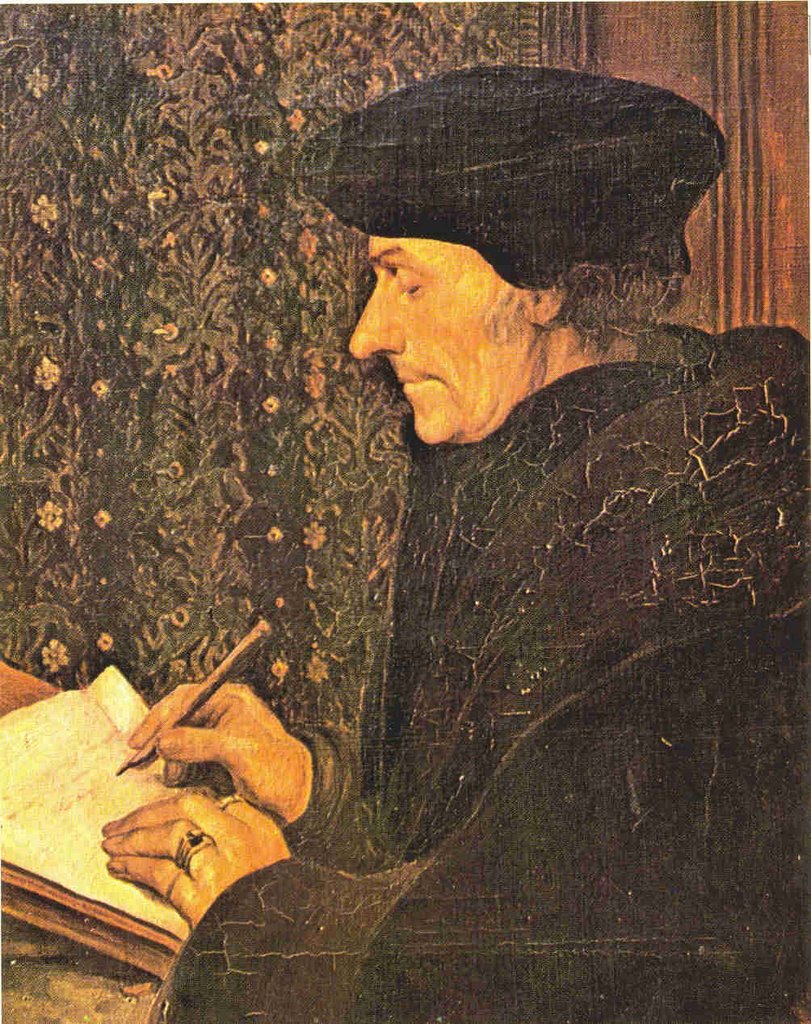
Holbein's portrait of Erasmus is a little marvel, we here at Stevereads can attest directly. The great man, the middle-aged world-famous humanist, is sitting bolt upright at his cantilevered writing table. He's dressed thickly, against the perennial cold of all 16th century houses, but there's another reason too: the robes and cap he wears are costly things, signs of the commercial bankability of the sitter.

His spatulate hands are at work on some enterprise of the mind or soul, but on his fingers are rings of jewel and gold, remunerable artifacts.

He's almost smiling, this man who never in life stopped smiling. He's wearing heavy clothes against the chills that always plagued him. He's not working, but you can tell from the semi-ironic cast of his long, expressive face that he KNOWS he's not working, that he knows he's pretending to work for the sake of the painting. 'Look,' the painting says, 'This is Erasmus; this is what he does, and he's obviously successful doing it.'

Easily the most impressive thing about the painting is exactly what Campbell says: once you've seen it, you know above all just what Erasmus actually LOOKED like. It's a rare thing to combine that ability with genuine artistic sensibility, so if one of you loyal readers would like to pony up the funds to send me to the Tate, I promise to blog all about when I get back!

Wednesday, October 25, 2006

The Penny Press! that damnable Dawkins!


The London Review of Books is a steady, pleasant publication, far more intelligent than the New York Times Book Review, and far less fiercely complex and involved than the mighty TLS. Its articles and reviews amble about comfortably on the midslopes of Parnassus, so when something really firebrandy pops up, it's immediately noticeable.

This latest issue has one such piece - hoo boy, does it ever.

The piece is by Terry Eagleton, and it's a review of Richard Dawkins' latest book, The God Delusion.

Eagleton begins promisingly:

Imagine someone holding forth on biology whose only knowledge of the subject is the Book of British Birds, and you have a rough idea of what it feels like to read Richard Dawkins on theology.

He goes on in this vein, much like he's preparing a case:

If they were asked to pass judgment on phenomenology or the geopolitics of South Asia, they [most book reviewers] would no doubt bone up on the question as assiduously as they could. When it comes to theology, however, any shoddy old travesty will pass muster.

This is promising stuff, especially if you've already read Dawkins' book, as I have; it looks to be building the case that Dawkins' latest book is a shoddy, tossed-off affair - this is certainly true, and a beginning like this one makes the prospect of a full-length spanking suddenly appealing.

Alas, the prospect is dashed pretty early on. And what takes its place is weirdly unsatisfying. The reader quickly becomes aware of three facts: 1) Eagleton hasn't in fact read Dawkins' book, 2) Eagleton is loopily religious in exactly the same degree and measure that Dawkins is loopily atheist, and 3) Eagleton isn't even prepared to make a coherent case FOR faith BASED on faith. He'd much rather pontificate:

Believing in God, whatever Dawkins might think, is not like concluding that aliens or the tooth fairy exist. God is not a celestial super-object or divine UFO, about whose existence we must remain agnostic until all the evidence is in. Theologians do not believe that he is either inside or outside the universe, as Dawkins thinks they do. His transcendence and invisibility are part of what he is, which is not the case with the Loch Ness monster.

Reeling, we move on:

The Jews of the so-called Old Testament had faith in God ... they had faith in God in the sense that I have faith in you. They may well have been mistaken in their view; but they were not mistaken because their scientific hypothesis was unsound.

At which point your loyal reader stopped, looked up gasping at his Chinese waitstaff, and said aloud: "Yes they were."

Transcendence and invisibility are the absolute CORNERSTONES of the Loch Ness monster and the tooth fairy. They're the cornerstones of EVERY human fantasy big and small through all of history.

I believe in you because I can SEE you. I can watch your behaviors, develope a sense of your patterns, rudimentarily predict your actions (Sebastian will always make some unconscious, incredibly condescending comment to waiters in restaurants - like carefully spelling out the word 'soup'; Jeff will always have a practical solution to any problem that turns up in company, whether he's heeded or not; John will always be between ten and three hundred minutes late for any pre-arranged meeting; Pepito will always grow attached to the live chickens he buys for his santeria rituals and end up KEEPING them and giving them snuggly names, etc)

If I couldn't see you, if nobody I'd ever known had ever seen you, if nobody in any reliable record had ever spent a single moment in your presence, you can be damn sure I WOULDN'T believe in you, and nobody else would either. God is not a celestial super-object or a divine UFO? Both descriptions seem pretty near perfect.

But Eagleton isn't nearly done:

God is not a person ... he is, rather, the condition of possibility of any entity whatsoever, including ourselves. He is the answer to why there is something rather than nothing. God and the universe do not add up to two, any more than my envy and my left foot constitute a pair of objects.

This, not some super-manufacturing, is what is traditionally meant by the claims that God is Creator. He is what sustains all things in being by his love; and this would still be the case even if the universe had no beginning. To say that he brought it into being ex nihilo is not a measure of how very clever he is, but to suggest that he did it out of love rather than need.

Oh my.

Oh my, my, my.

At the very least, we know conclusively by now that we are no longer reading a book review. This would be interesting in a stretch of autobiography, but it's extremely depressing in the London Review of Books.

But Eagleton, somehow getting all this past an editor, has a LOT more to say:

God is transcendent of us (which is another way of saying he did not need to bring us about), he is free of any neurotic need for us and wants simply to be allowed to love us.

Somehow, 'oh my' just doesn't seem to adequate at this point.

Love? Where did love come into this? Love, the name that humans append to an EXTREMELY narrow bandwidth of an EXTREMELY narrow emotion? Love? What does the universe know of love?

The universe is a beyond-calculation huge expanse of open space and hydrogen one degree above absolute zero. It knows nothing of love, but that's OK, since Eagleton clearly means '20/21 st century America' when he talks about transcendence.

And what about his wild claim that his hippy-granola lower-g god wants nothing more than to be allowed to love 'us'?

To say the very least, to say the comically least, God - the Jewish God, the Christian God, the Muslim God - wants a great deal more from His believers than simply an invitation to a cuddle-puddle. The God of the Jews tells His followers that they are the chosen people and all others are worthy of contempt or pity. The God of the Christians tells His followers to make disciples of all nations. The God of the Muslims (it STRENUOUSLY bears pointing out that we're talking about the EXACT SAME God here) tells His followers to murder the unbeliever. That's hardly the same as this Facebook friend folderol Eagleton so blandly calls fact.

All of this would be more endurable if Eagleton had actually read Dawkins' book, as I said. But if he can write "Dawkins considers that no religious belief, anywhere or anytime, is worthy of any respect whatsoever," he clearly hasn't. But it's even more alarming that he obviously hasn't read his Bible in quite a while either, as when he writes that Jesus was put to death "because the Roman state and its assorted local lackeys and running dogs took fright at his message of love, mercy, and justice..."

The local lackeys in question (not sure how the Roman-hating elders and chief priests of the Temple would have liked that description, but we'll skip over that) sought the death of Jesus not because they were buzzkills to his love-jones but because he defied their authority by a) denouncing them publically and b) smashing up their concession stands. And the Romans killed him because he declared himself the King of the Jews, which in the Roman world was treason.

OK, so Eagleton hasn't read Dawkins' book, and he hasn't read the Bible ... but what about a feckin newspaper now and then? What but a total ignorance of the world and everything in it could account for a passage like this:

On the horrors that science and technology have wreaked on humanity, he [Dawkins] is predictably silent. Yet the Apocalypse is far more likely to be the product of them than the work of religion.

Yeesh. Can Eagleton really be this dense? Attributing the swiftly-approaching Apocalypse to technology is like attributing toast to the toaster. The next time a building blows up, or a city is flattened by a suitcase nuke, or cloud of chemical death is loosed, I guarantee you it will be religion that does it - religion merely USING technology. Religious conflict has accounted for more human death and suffering than any other possible factor or all such factors put together. It takes exactly zero mental work to see this.

But Eagleton is so intent on putting Dawkins in his place that he fails to notice that his own idealogy is equally absurd.

As some of you will know, we here at Stevereads are calmly, 100 percent atheist. We say: of course there is no God, no afterlife, no nothing of any kind. There's this tiny little blip of life, and that's all.

When people assert that the above is true for all other living things that have ever walked the Earth EXCEPT mankind, who at death sends off a carbon-copy ghost that travels to an alternate dimension and lives there forever with consciousness and personality intact, we calmly point out that if you just sat and THOUGHT about that scenario for a second, you'd see how silly it is.

Humans are afraid of dying. Humans have an enormously complex brain, prone to creating fantasies. Put those two things together and do the math yourself.

So, if Dawkins had written an excoriation of the evils of religion that was GOOD, we'd applaud it. And likewise if Eagleton wrote a either a condemnation of Dawkins' book or a defense of religion that was GOOD, we'd love reading it, as we love reading C.S. Lewis.

But as it is, the book and the review are equally dumb and irritating. I'll keep you all posted on the letters page fallout that's SURE to happen.