Showing posts with label peter green. Show all posts

Friday, January 07, 2011

Alexander and His Nature!

Our books today are two slam-bang fantastic biographies of Alexander the Great: Peter Green's masterful 1970 volume Alexander the Great and Mary Renault's more emotional, empathetic 1975 volume The Nature of Alexander. Both books do a superb job of assembling and presenting the known facts of Alexander's life and times (they remain the two best works on the subject ever written in English, by my reckoning), and they quite unconsciously form very illuminating counter-points to each other. Unlike many historical subjects, Alexander can bear this kind of multiplicity of interpretation - not only are the accounts of his life less than we would like, but those facts were hospitable to legend even while Alexander was alive - indeed, even while he was still a boy. Then as now, there's a very pleasing sense that none of these accounts might be right - or that all of them might be right at the same time.

Green, the intense classical scholar, treats his sources with rigor and his subject with a cold kind of equanimity:
I have tried, insofar as the evidence would allow it, to strip away the accreted myth, and discover the historical Alexander of flesh and blood - no easy task. His true genius was as a field-commander: perhaps, taken all in all, the most incomparable general the world has ever seen. His business was war and conquest. It is idle to palliate this central truth, to pretend that he dreamed, in some mysterious fashion, of wading through rivers of blood and violence to achieve the Brotherhood of Man. He spent his life, with legendary success, in the pursuit of personal glory; and until very recent times this was regarded as a wholly laudable aim.

Whereas Renault, a novelist who wrote two great fictional works about Alexander, is far more impressionistic, far more willing to extrapolate the personal, lived reality of her subject, as when she imagines his death-scene:
Ever ready to die in war, he must long have been prepared to die in pain, and resolved it should not diminish him. The exhaustion must have shortened his last hours, but it is unlikely at this stage he could have recovered. The necessary suffering he accepted in return for what had been essential to him all his life: to be equal to his legend; to be beloved; and to require it extravagantly, regardless of expense. Whether sustained by pride, by philosophy, by belief in the immortality of his fame or of his soul, he met his end with not less dignity, fortitude and consideration for others than Socrates himself. And he, till he drank the quick painless hemlock, was a healthy man with a long, fulfilled life behind him; Alexander carried it through with a great design in ruins, and in the distress of a mortal sickness.

Our two editions in question today - the Praeger version of Green's book and the big Pantheon hardcover of Renault's - were part of a very welcome trend in the 1970s toward larger, profusely illustrated nonfiction books. Green's photo editor and Renault's have ransacked the ancient and modern worlds, providing slightly differing versions of virtually every image even remotely associated with Alexander (mercifully, both these books being from the '70s, neither one features the sight of Colin Farrell in eye-liner). I like this approach much more than the current crop of hardcover works of history with their marooned little sheaf of photos stuck in the middle. Both these books are visually fascinating, which is always a welcome bonus.

But the true draw is the prose, of course, in both cases - sharp, intelligent prose from both authors, but employed to very different ends. Green wants us to shed the accretion of myth and soft track-lighting that has accompanied Alexander for two thousand years. He never misses an opportunity to cut the diminutive conqueror down to size:
Like most personally austere leaders, he had an ill-disguised contempt for humanity in the mass, and seems to have felt he could manipulate his troops as he pleased simply by indulging their grosser appetites.

Whereas Renault, being more than a little in love with her subject, wants her readers to love him too and is willing to defend him even sometimes against the weight of fact, as in her characteristic aside about his wanton sack of the great palace at Persepolis:
This action is know today by people who know virtually nothing else about him (and who remain more impressed by this outrage to an empty building than by the living holocausts of Coventry and Dresden); fit retribution, if he deserved it, for a man who cared intensely about his good name.

I just the other day re-read both these books back-to-back, and I came away all the more impressed with each of them despite their enormous philosophical differences. Both are readily available in scads of editions (although I happen to think these two are the prettiest), and each in their own way would have pleased Alexander's erratic egotism, although he'd have been shocked by how much both must necessarily indulge in conjecture. He had a horror of being unknown to the future, and reading how different these two intelligent, well-researched treatments of his story are, you suddenly realize just how fragile that story is.

Friday, December 19, 2008

Classical Cats Indeed!


From the letters page of last week's TLS, a short, sharp little note from world-renowned classicist (and current Iowa City resident!) Peter Green:

Whether Noel Coward met Dirk Bogarde in 1939 or 1947, and did, or didn't make a pass at him, and whatever the truth about Bogarde's sex life (or possible lack thereof), in 1954, or so tradition has it, the Master, contemplating a poster advertising both Bogarde and Michael Redgrave in a now mercifully forgotten film entitled The Sea Shall Not Have Them, was heard to observe: "I don't see why not; everybody else has."

Hee.

Wednesday, August 23, 2006

In the Penny Press! Ovid and John Masefield!


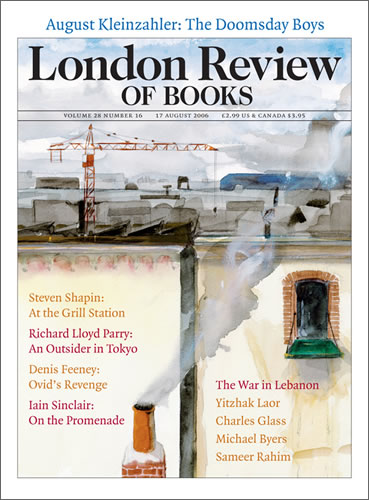
Some fun and interesting things in this week's London Review of Books and the TLS.

Mark Kishlansky writes a very good, succinct piece on the Restoration, reviewing a new massive two-volume history by Tim Harris. Kishlansky's review is negative, which is surely not something an author wants to read after spending 1100 pages on his subject (we'll see what other critical organs have to say about the books), and one thing he writes distracted me from the rest of his review:

Kings refused to justify their actions, or, as in the case of the secret Treaty of Dover (signed by Charles and Louis in 1670), were deliberately misleading about them. Divine-right monarchs didn't always care about the opinions of their citizens. Kings reigned, a concept so out of fashion as to be almost unrecoverable.

A ruler who believes he acts on God's wishes, who deliberately misleads, and who does what he does without reference to the opinions of even the majority of his people? Such a concept may be "unrecoverable" in the UK, but who in present-day America wouldn't offer a rueful little laugh at the suggestion that it's gone from the world entirely?

Also in this issue, Denis Feeney has a very good, verp penetrating piece on Ovid's exile years. He's reviewing Peter Green's new and excellent translation of Ovid's exile poems, but he takes the opportunity to examine many facets of Ovid's time at Tomis, at the furthest edge of the Roman world.

My only quibble? Feeney writes that Ovid's tragedy 'Medea' is "the only work of his that did not survive to the age of printing." This is hardly the case. Not only does Feeney ignore the raft of little or occasional poems alluded to in Ovid's extant works, but he overlooks the fact that Ovid himself mentions one other work of his we don't have, potentially the most interesting thing he ever wrote: a work in the language of Tomis. For me the idea has always been fascinating - the picture of this most cosmopolitan of poets, exiled from the greatest city in the world and fetched up at the ass-end of nowhere, but still compelled to write - and not only to write, but to seek an immediate audience, even if he had to learn an entirely new language to do it. There's no doubt at all that the world of literature is markedly less for the lack of the great works Ovid would have created if he'd been allowed to remain in Rome (or even if he'd been allowed to return). But even so, the exile poems are weird and sad and a little crazed and ultimately very beautiful, I think, though in a very bleak vein.

Over in the TLS, in addition to a long and masterful damnation by Brian Vickers of the new Oxford Complete Works of Shakespeare (after ten or fifteen paragraphs, reading it had all the visceral fascination of watching a bloodsport), there were two fun little bits.

The first was in the letters page, where Richard Boston writes in response to the disclosure last time that Poet Laureate John Masefield would always submit his poems with stamped, addressed envelopes - in case of rejection. Boston writes:

Near the end of Masefield's life, I was working for your predecessor, the late Arthur Crook, on the TLS. One day, A.P. Ryan, who had the not very onerous job of editing the Times's sole book page, sought our advice on what to do about the bard's latest contribution. Masefield had written about a royal visit to Australia. Unfortunately, the old boy had got his wires crossed.
The visit had been to Austria. An easy mistake: the names of both countries begin and end with 'A'. Easy solution: remove the 'al' from 'Australia'. This proved not to be enough. The people of Vienna would still have been not the only ones puzzled by the references to kangaroos and boomerangs.
This may well have been the only occasion on which the stamped addressed envelope had to be used. I have the idea that it may also have been, sadly, the last time Masefield sent in a poem. I do hope that someone, somewhere, somehow has a copy of the Australia poem.


I'd bet my last farthing this plea either turns up the long-lost Australia poem or turns up some egghead clarifying the poet's mistake. I'll keep you posted.

And of course there's the main attraction of the TLS, at least for me: the magisterial smackdown. This is not a sunny, bird-chirping book review where everybody is presumed to be doing their best and if you can't say something nice about somebody, you don't say anything at all. This is the NFL, and sometimes it can be delightful (like, for instance, if you hated your older brother and his book received just such a spanking).

Take the case of Lisa Chiu's new book When a Gene Makes You Smell Like a Fish - and other tales about the genes in your body

Jonathan Hodgkin spends two paragraphs of his three-paragraph review summarizing and describing, and then he finishes with this:

This survey of human genetics, written for a general audience, is readable and sometimes engaging, but it is carelessly written and inconsistent in the level of explanation used. Technical terms are introduced before being adequately explained, and several of the stories are left dangling unsatisfactorily, or ended with a labored pun. Chiu also misses some key points - for example, she writes about the discovery of FOX2P, the first candidate for the 'gene for language', but fails to mention one of its most exciting and suggestive properties, namely its remarkably rapid evolution. Better books of this type have been written, such as Matt Ridley's Genome and Armand Leroi's Mutants. When a Gene Makes You Smell Like a Fish has the advantage of being reasonably up to date, but otherwise there is not much to recommend it.

Hee.

The review stops, as they all do, just one step short of advising the author to go out and kill themselves.

Aside from those two wonderful publications, the only ITPP news comes from this morning's Metro, which has a one-paragraph (naturally) blurb enthusiing about World War Z. So now that all the STUPID people in Boston have been made aware of the book, it only remains for the Globe to tell all the ordinary people and the Phoenix to tell all the smart people. Fingers crossed ...