Showing posts with label restoration. Show all posts

Friday, July 16, 2010

Sir John Vanbrugh!


Our book today is Kerry Downes’ big, thorough 1987 biography of that hustling, bustling Restoration polymath, John Vanbrugh.

Vanbrugh was one of those masterful thinkers they don’t seem to make anymore – a relic from a time before specialization was expected of every intellect. He was a soldier, a diplomat, a wine merchant, a book dealer, and two more things, the two that most deeply mark his life and legacy: he was a playwright, and he was an architect. The typical easy English major dichotomies – “so-and-so-wrote works of art that will outlast the greatest monuments of his age” – fall to pieces when dealing with somebody like Vanbrugh, since in addition to his works of art, he also built some of the greatest monuments of his age, and they’re with us still. It’s as if Hawksmoor had taken time out to write the sonnets of Shakespeare, or Christopher Wren had put aside his architectural notebooks just long enough to dash off Handel’s Water Music.

The plays – The Confederacy, The Relapse, The Provok’d Wife and many others – stand at the pinnacle of Restoration stagecraft for their wit, their intricacy, and their sheer animal force (Vanbrugh counted both Dryden and Pepys among his fans, although not at the same time). And the monuments – Seaton Delaval, Castle Howard, Blenheim Palace – are as gorgeous as they are inexorable in sweep and odd delicacy of design. The man himself lived through one of the most tumultuous periods in English history – the Dutch wars, the Plague, the Great Fire, the sudden-feeling shift from old-style monarchy to a land ruled by Parliament – and he lept into its currents with more energy than later ages would find it convenient to summon.

It’s amazing to me that figures like Jack Vanbrugh aren’t revisited frequently by biographers. The material is so enviably rich and voluminous, whereas the would-be writer on Shakespeare or Jane Austen has just the same old small stack of index cards with which to conjure. And yet: Wren has had only two full-dress popular biographies in English in the last century, and Hawksmoor and poor Vanbrugh have had only one apiece – and they were both written by the same guy, Kerry Downes. Not that I’m characterizing this as a misfortune for Vanbrugh: Downes is an incredibly thorough and thoroughly entertaining biographer, and his enormous book , Sir John Vanbrugh, would likely stand unchallenged as the definitive work on its subject even if it had any challengers. Downes is unabashedly old-fashioned in his approach: he likes his subject. “Some critics have found something particularly unfortunate or even unbecoming in Vanbrugh’s blank verse,” he tells us at one point, “but in literature as in architecture his is the kind of genius which no aesthetic theory dependant on a rigid system of categories will accommodate with fairness.” I’d hope a biographer of mine would strike just that kind of note!

And as noted, in addition to sympathy, Downes has one further strength for his thankless job: he’s a heck of a story-teller. A life like Vanbrugh’s makes that somewhat easy (anecdotes like the time he and Congreve and Lord Halifax dropped their britches on a particularly hot day and ‘sopped their arses’ in the fountain at Hampton Court are not hard to come by), but much still depends on the writer’s verve, seen, for instance, here in Downes’ description of the harrowing ‘Great Storm’ that swept through the south of England on 26 and 27 November of 1703:
A great wind came from the south-west, accompanied by thunderstorms. Orchards were destroyed, many thousands of oak trees were felled in the New Forest and the Forest of Dean, their roots often raising huge mounds of earth as they were wrenched out of the ground. Many of the surviving trees in agricultural areas were festooned with the remains of haystacks caught up in the whirlwind. Church spires were blown down, and in the City pinnacles were taken off some of the new churches and the roof works of the still unfinished St Paul’s were damaged. Houses lost their roofs or were even blown down, and the sheet-lead roofs of churches were rolled up by the gale. Falls of soot were everywhere, and at Wells the Bishop and his wife were killed as they lay in bed when a chimney stack collapsed on them. In the Channel many ships were sunk or damaged and sailors drowned. London was filled with rubbish of all kinds, while the center of Bristol was clogged with wrecked ships raised from the port basin by the combined forces of high wind and high tide. Congreve wrote to a friend that at Whitehall some of the big sash-windows, only recently installed in the Banqueting House, were sucked out and blown away.


Downes’ book is full of line-drawings of Vanbrugh’s various surviving blueprints and sketches, and it’s generously supplied with photos of his surviving architectural masterpieces (which yet have their own second life in film, Blenheim most recently starring in Kenneth Branagh’s wretched “Hamlet” and Castle Howard, of course, doing magnificent stand-in duty for Brideshead in “Brideshead Revisited”) – and best of all, Downes himself is there at every crucial juncture, always with a spirited opinion or an inspired interpretation (his reconstruction of the years Vanbrugh spent captive in France – including a stint in the Bastille – are particularly strong). So all in all, if a great figure in history is going to be ignored by the panty-waist popularity-hound ‘lite’ biographers of today, Vanbrugh is at least lucky he got such a marvelous volume before his fame went silent.

Tuesday, October 28, 2008

Clarendon and His Friends


Our book today is Richard Pollard's luminously good 1987 Clarendon and His Friends, about a man who had what one person aptly called a "genius for friendship."

Clarendon was the name of the Earldom Edward Hyde thought up for himself - he hardly ever referred to himself that way, although there was something fitting in it, as Pollard himself writes in the first paragraph of his book, a paragraph of such easy, relaxed beauty and rhetorical strength that the reader is assured literally from the first moment that this is a book they'll be able to both absorb and trust, at least as much as any work of history can be trusted:

Clarendon is so much a part of the landscape of English civilisation that he is almost lost in it. Unlike his greatest opponent Cromwell he presents no unfamiliar outline to arrest the curiosity or stir the emotions of his countrymen. The title that he chose for his earldom carries the sound of church bells heard across the fields in summer; tranquil, dignified, ordered, at home with itself. The Clarendon building at Oxford, tall, firm, balanced and quietly magnificent, evokes responses of the same order. Yet if one thinks of him by the name he bore throughout the conflict that gave him both his place in history and his subject-matter as a historian, the associations of sound are very different though not less true to the man. Mr. Hyde (as he habitually refers to himself in the History and the Life), or Sir Edward Hyde, as his contemporaries knew him when he was forging the policy of constitutional Royalism, sounds as if he ought to be a more acerbic, quick-witted, ambitious, amusing person than the ponderous figure, swathed in his Lord Chancellor's robes, that gazes at us, not without an inviting sparkle of intelligence, from the engraved frontispiece of the History of the Rebellion.

Hyde was named Lord Chancellor by Charles II while there was as yet no country for him to be Lord Chancellor of; Hyde had followed Charles into exile after the victory of Cromwell, and there he stayed at his king's side through every manner of near-vagabondish deprivation and hardship. Ollard writes well of the hopes of those forlorn days:

The enemy, until death removed him in September 1658, was Cromwell. Although he did not assume the position of Head of State until 1654 he had established himself in supreme power by executing the King and crushing the Levellers in 1649. The subjugation of Ireland and Scotland had reinforced his impregnability and had destroyed any hope of maintaining a Royalist redoubt behind which an army might be embodied. If Cromwell was to be got rid of, there were only three ways to do it: a general rising, a coup d'etat, or assassination. They were not, of course, mutually exclusive.

At first, Charles was appropriately grateful, although Hyde, like everybody else to whom the Merry Monarch owed anything meaningful, was eventually betrayed by the man he'd served. There was never a king nor hardly yet a man with less loyalty than Charles II, but for more than twenty years, Hyde was blissfully unaware of this fact, or chose to look the other way when he saw others rudely discover it.


He was a quiet, mostly fastidious little man, a worrier who talked very loudly when drunk, a merry letter-writer, a better-than-average prose stylist, and an indefatigable reader. He wrote a history of Cromwell's rebellion and an autobiography that are both very much worth reading (later historians had a great deal of fun nit-picking both, usually with far less understanding and always with far less literary skill than their poor victim). One of the greatest pleasures of Clarendon and His Friends is Ollard's terrier willingness to attack any and all received opinions of Hyde, especially those conflicting with demonstrable evidence, like for instance Macaulay's slander (one of many) regarding Clarendon's alleged dislike of young people. Macaulay writes, "Toward the young orators, who were rising to distinction and authority in the Lower House, his deportment was ungracious: and he succeeded in making them, with scarcely an exception, his deadly enemies."

Ollard responds:

Had he, in Macaulay's phrase just quoted, 'an inordinate contempt for youth'? When he died in 1674, an exile, broken and forgotten, one of his young friends wrote to inform another of the private arrangements for his burial in Westminster Abbey. The recipient of the letter, Sir John Nicholas, Edward's eldest son, had also been the recipient of some of Hyde's most charming letters in the 1650s. The writer, Henry Coventry, was the elder brother of William, one of Hyde's most redoubtable critics. How many statesmen would have taken the trouble, as Hyde did, to write to an ambassador, Rochester, telling him how his son watched every post for a line from his father? How many fathers had lived so happily and affectionately with their own children and have been so warmly and so movingly remembered? He liked the young.

He liked the life of the mind too, as Ollard consistently points out. Hyde was a great reader, a lover of finding things out and getting them down right (he kept innumerable commonplace books, as impetuously started as they were abandoned ... now all lost, I believe), but he was more than just a passive receptacle for everything he read: it filled him with plans, ideas, and schemes for his own writing. Ollard, as always, finds the right quotes and knows their significance:

That he was itching to get back to his history is evident. Did he ever tinker with what he had written, or make notes for its revision and extension? When he talks of 'falling to my book,' does he simply mean that he is going to read? Probably, but not certainly. Even when he was Lord Chancellor of England at the height of a war, passing sleepless nights over the mounting Bills of Mortality occasioned by the Great Plague, he found, or made, time to write. "I find myself insensibly ingaged in my olde exercise of writinge ...

(Hyde's love of those happy studies, reading and writing, was born and nurtured in tandem with the great friend of his young manhood, Lucius Cary, second Viscount Falkland, as smart and lively and promising a young man as anybody could ever hope for as a friend; Lucius Cary was immensely wealthy, extremely handsome - his one surviving portrait shows hardly anything authentic except his habitual slouch - and winningly outgoing, and there can be little doubt - Ollard certainly doesn't doubt it - that Hyde loved him more than he loved him more than anybody else in his life. Falkland had that effect on virtually every friend he made, and when he died, age 30, at the Battle of Newbury in 1643, Hyde wasn't the only one so grief-stricken he couldn't function for a few days).

Hyde's daughter Anne was a spirited, delightful spark of a girl, able to hold her own in conversation with anybody, and unabashedly confident of her fine-tuned ability to hone and wield her sexual allure ("wantonness" was something she despised as much as her father did, but for different reasons: for him, it was an open door to lavish, untenable expense; for her, it was amateurish). It's typical of sexist nomenclature to say such women "ensnare" men (whereas aside from the most notorious mustache-twirling villains in Clarissa, nobody ever says it about sexually confident men), and who are we to argue with sexist nomenclature? Anne ensnared James, the Duke of York, the big-boned and droolingly stupid brother of Charles II, and matters quickly reached the awkward point where something had to be done.

She married James (her daughters, Anne and Mary, Hyde's granddaughters, both became queen), and in recognition of that fact (or compensation?) Charles offered Hyde a Dukedom. Hyde didn't want to appear grabby, so he settled for an Earldom - not that any of it mattered when Charles II had one of his periodic needs to hang some close confederate out to dry, as happened to Hyde in 1667 when he was driven out of office and into exile by the House of Commons for alleged misdeeds stemming from the Second Dutch War. At any point in the proceedings, Charles could have saved him, but the king did nothing but watch.

Hyde lived in exile for the rest of his life, writing the whole time and keeping up the incredibly industrious correspondence for which he was famed in his own day among his friends and enemies alike. Friends received an endless stream of letters, long, wonderful, casually erudite letters that actually rewarded periodic re-reading. Only the stream wasn't, of course, truly endless: eventually Hyde was taken ill and died, and there were no more letters. One bereft correspondent put it this way:

"Of late he was pleased to entertaine a a particular and kind commerce with me by ample letters in literatory matters; and I persuade myselfe one of mine was one of the last which he read before his falling sicke, which I am certaine His Lordship's delight in subjects of that nature would have produced a large and learned reply if it had pleased God to lett him and his bookes together a little longer ..."

Hyde was a picky reader, and he could be prickly of his pride, but it's hard to believe he wouldn't have felt honored by Clarendon and His Friends, even though it's no hagiography and takes him to task in clear language for all his shortcomings. It's that clear language that would have won him over; this is just a wonderfully-written book. Anyone interested in the English Civil War shouldn't be without it.

Wednesday, August 23, 2006

In the Penny Press! Ovid and John Masefield!


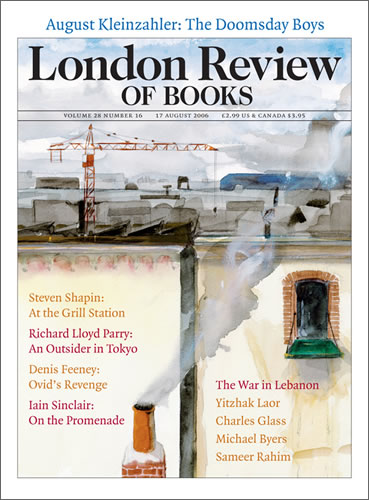
Some fun and interesting things in this week's London Review of Books and the TLS.

Mark Kishlansky writes a very good, succinct piece on the Restoration, reviewing a new massive two-volume history by Tim Harris. Kishlansky's review is negative, which is surely not something an author wants to read after spending 1100 pages on his subject (we'll see what other critical organs have to say about the books), and one thing he writes distracted me from the rest of his review:

Kings refused to justify their actions, or, as in the case of the secret Treaty of Dover (signed by Charles and Louis in 1670), were deliberately misleading about them. Divine-right monarchs didn't always care about the opinions of their citizens. Kings reigned, a concept so out of fashion as to be almost unrecoverable.

A ruler who believes he acts on God's wishes, who deliberately misleads, and who does what he does without reference to the opinions of even the majority of his people? Such a concept may be "unrecoverable" in the UK, but who in present-day America wouldn't offer a rueful little laugh at the suggestion that it's gone from the world entirely?

Also in this issue, Denis Feeney has a very good, verp penetrating piece on Ovid's exile years. He's reviewing Peter Green's new and excellent translation of Ovid's exile poems, but he takes the opportunity to examine many facets of Ovid's time at Tomis, at the furthest edge of the Roman world.

My only quibble? Feeney writes that Ovid's tragedy 'Medea' is "the only work of his that did not survive to the age of printing." This is hardly the case. Not only does Feeney ignore the raft of little or occasional poems alluded to in Ovid's extant works, but he overlooks the fact that Ovid himself mentions one other work of his we don't have, potentially the most interesting thing he ever wrote: a work in the language of Tomis. For me the idea has always been fascinating - the picture of this most cosmopolitan of poets, exiled from the greatest city in the world and fetched up at the ass-end of nowhere, but still compelled to write - and not only to write, but to seek an immediate audience, even if he had to learn an entirely new language to do it. There's no doubt at all that the world of literature is markedly less for the lack of the great works Ovid would have created if he'd been allowed to remain in Rome (or even if he'd been allowed to return). But even so, the exile poems are weird and sad and a little crazed and ultimately very beautiful, I think, though in a very bleak vein.

Over in the TLS, in addition to a long and masterful damnation by Brian Vickers of the new Oxford Complete Works of Shakespeare (after ten or fifteen paragraphs, reading it had all the visceral fascination of watching a bloodsport), there were two fun little bits.

The first was in the letters page, where Richard Boston writes in response to the disclosure last time that Poet Laureate John Masefield would always submit his poems with stamped, addressed envelopes - in case of rejection. Boston writes:

Near the end of Masefield's life, I was working for your predecessor, the late Arthur Crook, on the TLS. One day, A.P. Ryan, who had the not very onerous job of editing the Times's sole book page, sought our advice on what to do about the bard's latest contribution. Masefield had written about a royal visit to Australia. Unfortunately, the old boy had got his wires crossed.
The visit had been to Austria. An easy mistake: the names of both countries begin and end with 'A'. Easy solution: remove the 'al' from 'Australia'. This proved not to be enough. The people of Vienna would still have been not the only ones puzzled by the references to kangaroos and boomerangs.
This may well have been the only occasion on which the stamped addressed envelope had to be used. I have the idea that it may also have been, sadly, the last time Masefield sent in a poem. I do hope that someone, somewhere, somehow has a copy of the Australia poem.


I'd bet my last farthing this plea either turns up the long-lost Australia poem or turns up some egghead clarifying the poet's mistake. I'll keep you posted.

And of course there's the main attraction of the TLS, at least for me: the magisterial smackdown. This is not a sunny, bird-chirping book review where everybody is presumed to be doing their best and if you can't say something nice about somebody, you don't say anything at all. This is the NFL, and sometimes it can be delightful (like, for instance, if you hated your older brother and his book received just such a spanking).

Take the case of Lisa Chiu's new book When a Gene Makes You Smell Like a Fish - and other tales about the genes in your body

Jonathan Hodgkin spends two paragraphs of his three-paragraph review summarizing and describing, and then he finishes with this:

This survey of human genetics, written for a general audience, is readable and sometimes engaging, but it is carelessly written and inconsistent in the level of explanation used. Technical terms are introduced before being adequately explained, and several of the stories are left dangling unsatisfactorily, or ended with a labored pun. Chiu also misses some key points - for example, she writes about the discovery of FOX2P, the first candidate for the 'gene for language', but fails to mention one of its most exciting and suggestive properties, namely its remarkably rapid evolution. Better books of this type have been written, such as Matt Ridley's Genome and Armand Leroi's Mutants. When a Gene Makes You Smell Like a Fish has the advantage of being reasonably up to date, but otherwise there is not much to recommend it.

Hee.

The review stops, as they all do, just one step short of advising the author to go out and kill themselves.

Aside from those two wonderful publications, the only ITPP news comes from this morning's Metro, which has a one-paragraph (naturally) blurb enthusiing about World War Z. So now that all the STUPID people in Boston have been made aware of the book, it only remains for the Globe to tell all the ordinary people and the Phoenix to tell all the smart people. Fingers crossed ...

Monday, August 21, 2006

books! crocodiles and kings!


Two books in our interval, both continuing my little streak of good reads.

Karleen Koen's big book Dark Angels turned out to be a quite enjoyable piece of Restoration historical fiction. This was a relief, since the Restoration, worse than any period (except of course the Regency), tends to bring out the Amelia Nettleship in so many writers (for those of you who don't know the name, it refers to a lady novelist and "bottler of historical bilge-water" in John Mortimer's immortal story "Rumpole and the Bubble Reputation"). Certainly Koen herself gave me cause to worry, since right there in her Author's Note she refers to Charles II as "the merry monarch." That's usually a sign of trouble.

But Dark Angels is almost entirely free of trouble! Happily, Koen has done a large amount of research - a student of the Restoration (such as myself, for instance) will find comparatively little to wince at in this book. Of course the squalor possible even at the highest levels of court is omitted (Regency novels are especially guilty of this), and I can assure you all that never in his life did Charles II ever utter the word "gadzooks." But these are minor things - the overall feel of the book is historically accurate.

The book is a prequel to Through a Glass Darkly. It tells the adventures of one of that book's best-drawn characters, Alice Verney, when she was a girl at the court of the King, and it moves along with a surprisingly light touch. The King, the Queen, Monmouth, Clarendon, Nell Gwynn - they're all here, and Koen brings a very enjoyable freshness to her portrayal of all of them.

Charles himself is the toughest nut to crack, for historians and novelists both. He was extremely intelligent but also lazy and doubting and self-doubting, and the overall combination is almost impossible to catch in all its facets. Rose Tremain gives a very good modern spin to it all in her novel Restoration, and of course the gold standard here is the mighty Forever Amber, so far unequalled and certainly not seriously challenged by Dark Angels. Kathleen Winsor's huge, bawdy, funny, smart novel hangs over almost every page of Koen's book - not in a bad way, but impossible not to notice.

Fortunately, Dark Angels succeeds on enough of its own terms to avoid being hurt by the comparison. This is a big, readable novel set in a perennially favorite time period: it'll be a snap to recommend.

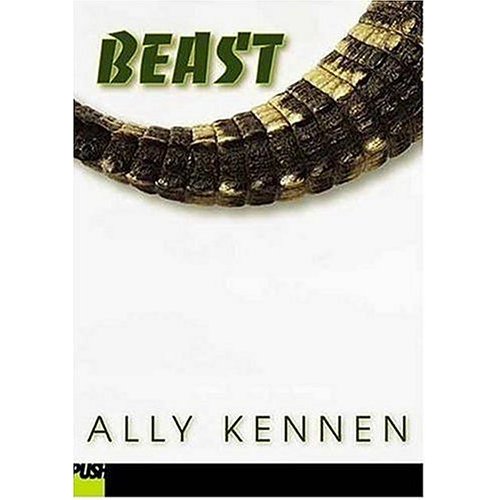
Likewise the second book here, Beast by Ally Kennen. It's the story of young Stephen, living in foster care, not all that bright, lunatic mother and seedy, criminal father, working jobs he hates in order to afford the biggest secret of his life: that he's keeping an enormous salt water crocodile captive in an abandoned reservoir.

The crocodile is huge and always hungry, and of course the secret gets out and of course the crocodile gets out, and all of it is just begging to be made into a movie starring Zach Efron.

Nevertheless, it's a very good read - utterly unpretentious and utterly without cutesy-poo preciousness. No attempt is made to polish up the fact that Stephen, though a decent enough kid, is a loser from a family of losers. And the crocodile itself is never in any danger of being turned cutesy or wise - it's just a big vicious animal that'll do anything to survive.

I resisted the urge at any point in the novel to consider the crocodile a metaphor for something else, and I'm grateful to Kennen that the book ALLOWED me to refuse to do that. With all due apologies to Kafka, extended metaphors like that virtually never work. Despite whatever other levels are operating in it, this is very much the story of a kid who's secretly keeping a giant crocodile caged and fed, period.

And of course my liking of the book was increased by one little sub-plot handled well. At one point early in the novel, Stephen comes into possession of a miserable little stray dog he names Malackie. Almost as soon as he acquires the dog he gives him to his derelict father, which caused me as a reader to clench my teeth. The whole time I was reading the book, the whole while I was following the building tensions involving the crocodile, I was praying Kennen wouldn't simply forget about the dog. But I got all the way to the end and there was no mention of it, and I was prepared to hate the book on that account alone. Then I reached the last page, where Stephen goes back to his father's abandoned shack:

I see him.
He's so thin he looks like a starvation victim. He's too weak to move far, but there's a stagnant bucket of water he must have been drinking from. Just enough to keep him alive. There's rubbish all around. Turds and food, a broken-open box of cookies, a wrapper of ham. A bread bag.
"Poor old bugger," I say gently, and touch his head. He looks up at me and sighs. His coat is wet through. I wonder how he hasn't died of exposure. I reckon he's been out her for nearly two weeks. I untie my top from around my waist and wrap it around him.
I loosen the rope. It's so tight it's bitten right into him. The skin is red and raw underneath. I only allow myself to think briefly about what it must have been like tied up out here, day after day, night after night, slowly starving to death.
"It's going to be alright," I say. "I'm back. I'm looking after you now."
I pick him up and hug him to my chest. He's so light.
"Come on, Malackie, my boy," I say. "Let's go."

That's the way I like books to end (although it was, of course, the water and not the bucket that was stagnant) ... although it'll be tricky recommending this to people, since it's a hardcover and I'm still a little unclear on exactly who buys hardcover teen novels.

Up next? Why, I'm not really sure! Tonight I'll be re-reading Chapterhouse: Dune in preparation for reading - gigantically against my better judgement - the new 'sequel' to it by Frank Herbert's son. But my next brand-new book? It eludes me at the moment! I expect by this time tomorrow I'll have read it, and your faithful scribe shall divulge!