Showing posts with label after shakespeare. Show all posts

Sunday, October 19, 2008

The Running Press Unabridged Shakespeare!


Our book today is the Running Press Unabridged William Shakespeare, a fat, friendly complete edition of the Bard's plays, poems, and sonnets. It was published in 1989 as an edition, although its text was the revised Globe edition of 1911, and its dense textual notes were originally done by Israel Golancz for the Temple Shakespeare. Even the one-page introduction isn't new - it's from the Globe edition. In the Running Press edition itself, there is nothing new or original.

That's what's so nice about it. There's no tacked-on fourteen pages of windy "enduring glory" "mirror to mankind" blah-blah-blah jobbed out of some quasi-known professional intellectual, first published in The New York Review of Books and now pasted on mutatus mutandis to an overpriced and unwieldy hardcover. There's no Larchmont must-have-it wonder of the season about it. The Running Press Shakespeare is, as far as any collected Shakespeare ever can be, a humble thing. It's meant to give you Shakespeare, with as little interference as possible.

Collected Shakespeares have appeared in vast, bristling legions ever since 1623, when John Heminges and Henry Condell brought out what we call the First Folio - complete with a blah-blah-blah introduction warning readers that any other collected Shakespeare they may encounter is to be scorned. The idea of a collected Shakespeare seems so natural - he wrote enough to make a hefty volume of close-printed pages, but not so much that such a volume is impossible. There's no such thing possible as a Running Press Unabridged George Bernard Shaw, for instance, and the Running Press Unabridged Aeschylus wouldn't be that big a book.


Shakespeare is so essential a piece of intellectual furniture - one of that small handful of authors every intelligent person must not only know but strive to know well - that it's both a duty and a joy to be constantly re-reading him, and everybody has their own favorite way of doing that. I think the best set-up is threefold: first, you need to have the great second edition of the Riverside Shakespeare (the brown one, not the weird black one with its fourteen variations of "Hamlet" and its twenty-three variations of "King Lear"), because its blah-blah-blah material is actually splendid and eternally relevant. Second, you need all the plays in good convenient individual paperbacks, for separate study - probably the best candidates are the Signet Classic paperbacks, since a) their notes are excellent and b) they have the ingenious addition of including Shakespeare's original sources for that particular play, plus a usually good selection of criticism on that play.

But in addition to those two things, you also need a good knockabout complete Shakespeare. The Riverside is too big and, it must be said, too dignified - you can't grab it off the shelf and race out the door for the park or the subway or jury duty. You need all its scholarly apparatus for those times when you're delving deep into some textual question or other, but sometimes you just want as much Shakespeare as you can comfortably hold in your hand (note: Beepy - and the Earl of Southampton - just started paying attention).

For such a volume, the paper of the pages must of course be thin but not too thin; the print must be small but not too small; the lines must be double-columned (and maybe the part-names abbreviated, as irritating as that is) but not triple-columned. There won't be room for footnotes, and really, when you start reading Shakespeare, really reading him, you can largely dispense with footnotes without harming your understanding of what you're reading. What you want is something reassuringly solid but not carpally painful.

For me, that's the Running Press volume, which is currently not in print (is Running Press even in existence anymore? Ah well ... even if it's not, its text is, and who knows where it'll crop up again). In it, you get everything Shakespeare wrote in one handful about the size of child's shoebox. The cover design is simple and artful, the binding is durable, and inside it you get Shakespeare without distraction.


There's a list of character names, a list of sonnet first lines, and about fifty pages of small-printed endnotes delineating where and how the lines of the various plays differ from one version of Shakespeare to another. There's a massive amount of learning in those fifty pages. Here's an example from "Twelfth Night":

Act II, scene v, line 44: "the lady of the Strachy"; this is one of the unsettled problems in Shakespeare. Hunter ingeniously suggested that Shakespeare ridicules, in the scene between the Clown, Sir Topas, and Malvolio (IV. ii.), the exorcisms by Puritan ministers, in the case of a family named Starchy (1596-99), and the difficult Strachy was a hint to the audience to expect subsequent allusion to the Starchy affair. Others suggest 'Strozzi,' 'Stracci,' 'Stratarch.' Halliwell refers to a Russian word meaning lawyer or judge. The incident of a lady of high rank marrying her steward is the subject of Webster's The Duchess of Malfi.

That's a lot of detail, hard-studied and pithily put, but none of it clutters up the pages of "Twelfth Night" itself; if you're reading the play and find yourself impassibly confused by that "lady of the Strachy" mention, you can jog back to the last fifty pages and find the above excellent elucidation. But if you're reading the play and want to skip over it (believe it or not, the general sense of it is quite obvious in the scene), the Running Press volume won't get in your way. That's exactly how scholarly appendages to great writers should work.

So if you're scouting around used book stalls for a one-volume Shakespeare (to supplement your Riverside, not replace it, mind you), you could do a lot worse than to opt for the Running Press edition. And while you're at it, you might like their volumes of Mark Twain, Edgar Allen Poe, and especially Jack London. Big fat volumes, full of treasure.

Sunday, July 27, 2008

After Shakespeare


Our book today is After Shakespeare, subtitled "Writing Inspired by the World's Greatest Author" and edited by that greatest of 20th century editors, John Gross. It's a huge and bursting compendium of things written about Shakespeare, and we here at Stevereads can confidently tell you one amazing truth: of all the countless thousands of books written about Shakespeare, this is the first one to have, the one to buy and thumb through and lose yourself in even before you acquire Bradley or Burgess or some collected Coleridge. Gross has done his usual herculean best and brought together such a staggering variety of fun stuff that you'll be happily lost for hours and days before you even think about wandering elsewhere.

Gross is right, in his preface, to say that no author has inspired more writing than Shakespeare (no discernible author, he points out, which is his neat way of not giving Homer the top spot), and the goal of this anthology is to sample from as much of that writing as possible. A million anecdotes are here, and diary excerpts, and poems galore, and even chunks from fictions written about the Bard, all of it presented with a minimal whisking of clarifying footnotes and introductory matter.

Gross laments that only one thing is missing, because he couldn't find it: the reactions to Shakespeare of the so-called Common Reader, although Gross isn't sure this is a bad thing: "The Common Reader is an admirable and indispensable thing, but I suspect that when he picks up his pen or sits down at his word processor, he has a way of turning into the Commonplace Critic." But this confession itself is a little odd, since as readers of Stevereads will know, there exists at least one Common Reader who never hesitated to share his thoughts on the Swan of Avon, as for instance:

September 29 - to the King's Theatre, where we saw "Midsummer Night's Dream", which I had never seen before, nor shall ever again, for it is the most insipid ridiculous play that I ever saw in my life.

Yes, of course, it's Samuel Pepys, and he's liberally quoted in After Shakespeare, despite being denied his Common Reader (and Commonplace Critic) status.

Virtually everybody else is in here too, from the Edwardian actor who sniffingly said, "My Rosencrantz was not up to much, but my Guildenstern was tremendous" to this immortal exchange between P. G. Wodehouse's Bertie Wooster and his man Jeeves:

"Remember what the poet Shakespeare said, Jeeves."
"What was that, sir?"
" 'Exit hurriedly, pursued by bear.' You'll find it in one of his plays. I remember drawing a picture of it on the side of the page, when I was at school."

There's Victor Grey's vicious parody of the 'Seven Ages of Man':

Seven ages, first puking and mewling,
Then very pissed off with one's schooling,
Then fucks, and then fights,
Then judging chap's rights;
Then sitting in slippers, then drooling.

Of course, as is only fitting, there's a long passage from Anthony Burgess' great Shakespeare novel Nothing Like the Sun, in which a blithe and slightly stupid Henry Wriothesley, Earl of Southampton, cannot see how much Shakespeare, WS, is in love with him:

'Will,' said Harry, 'I am in love.'
WS put down his pen carefully. He stared for full five seconds. 'In love? In love?'
Harry giggled. 'Oh, it is not marriage love, it is no great lady. It is a country Lucrece in Islington. She is the wife of the keeper of the Three Tuns.'
'In love. In love. Oh, God save us.'
'She knows not who I am. I have been with Chapman. She believes I too am a poet. She will have none of me.' He giggled again.
'So the seed stirs at last. Well. He is in love.' Then WS began to laugh. 'And what thinks the husband of all this?'
'Oh, he is away. His father is dying in Norfolk, and yet he will not die. It is a slow quietus. I must have her, Will, before he returns. How shall I have her?'
'I should think,' WS said slowly, 'that your new friends will help you there. The Sussex men are, I hear, a wenching crowd.'
'They are not. They are all for boys. There is a house in Islington.'
'Well. Well, well. In love.' He picked up his pen, sighing. 'I have a poem to write, a commission of your lordship's. My mind is wholly taken up with the harm that comes to those who force the chastity of noble matrons. I should think like harm will come to the author of lowlier essays.'
'You mock me now. Write me a poem I can give to her. You have written sonnets enjoining me to love a woman, now write one that shall persuade a woman to love me.'
'Your friend Master Chapman is perhaps less busy than I that he can take you drinking to Islington. Ask him, my noble lord.'
'Will, I have no taste for this mockery. George cannot write that sort of verse. She would never understand any poem of his.'

The transcribing of Burgess makes us sorry for one exclusion After Shakespeare, one book missing that should have been excerpted: John Mortimer, he of Rumpole fame, wrote the novel that accompanied his BBC mini-series "Shakespeare" many years ago (the mini-series is well worth your time, if you should ever come across it, with Tim Curry like you've never seen him act before, in the title role), and for our money here at Stevereads, his Shakespeare is in many ways the single best Shakespeare novel ever written.

But such lapses are almost unknown in After Shakespeare, which features heaping helpings of just about everybody else, from Frank Harris to Duke Ellington to Herman Melville to Cole Porter to Virginia Woolf, who wrestles with the author in her journal as mightily as Jacob with the angel:

I read Shakespeare directly after I have finished writing, when my mind is agape & red & hot. Then it is astonishing. I never yet know how amazing his stretch & speed & word coining power is, until I felt it utterly outpace & outrace my own, seeming to start equal & then I see him draw ahead & do things I could not in my wildest tumult & utmost press of mind imagine. Even the less & worser plays are written at a speed that is quicker than anybody else's quickest; & the words drop so fast one can't pick them up. Look at this, Upon a gather'd lily almost wither'd (that is a pure accident: I happened to light on it.) Evidently the pliancy of his mind was so complete that he could furbish out any train of thought; &, relaxing lets fall a shower of such unregarded flowers. Why then should anyone else attempt to write. This is not 'writing' at all. Indeed, I could say that Shre surpasses literature altogether, if I knew what I meant.

And of course where would any anthology of Shakespeare writing be without that sprightliest of intellects, John Jay Chapman, writing with his customary verve:

Parts of Shakespeare are ugly, and much of him is whimsical, and some of him is perverted. But his work is all a natural product, like the silk worm's thread. One can never be quite sure that even Thersites may not show under the microscope some beautiful patterns on his back, as Caliban does.

Make no mistake: you should all pull down your Shakespeare and read him first, for pleasure, for education, for the sheer goose-pimply thrill of his brilliance. But if you're in a mood for something connected but different from that great treasure-trove, another such trove awaits you. After Shakespeare will keep you reading, enthralled, until way past your bedtime.

Wednesday, September 27, 2006

in the penny press!


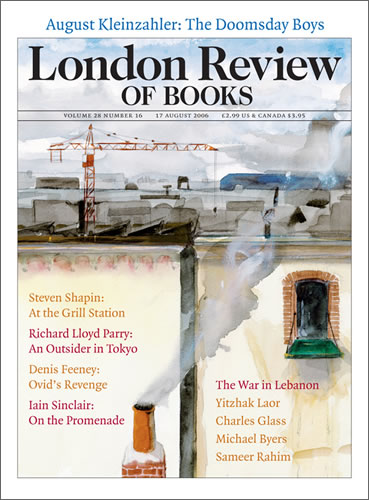
The trifecta of book review organs - the New York Review of Books, the London Review of Books, and of course the mighty Times Literary Supplement - are guaranteed to provide a solid hour of the highest quality mental stimulation when sat down and read in unison.

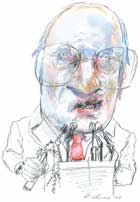
The highlight of the New York Review this time around, at least for me, was Joan Didion's forensic examination of Dick Cheney. She strikes an absolutely priceless tone (unintentionally, I assume), mandarin befuddlement threaded all the way through with deep distaste ... like a society doyenne hearing a loud, wet crunching sound and finding an unknown creature on the bottom of her shoe, half-crushed but still attempting to squirt venom.

She can't riddle him out into the light, of course. Morgoth is gone, but even his lieutenant Suaron is still largely incomprehensible to the minds of Men.

But in the process of her bafflement, she runs through the usual story with a wonderful, icey precision that's a joy to read.

The London Review of Books likewise had a highlight for me: Jerry Fodor's review of Michael Frayn's "The Human Touch: Our Part in the Creation of a Universe." It's a pan, but the peculiar combination of steep intellect and po-faced humor Fodor uses are more reminiscent of the TLS than the LRB:

As the blurb on the front of Frayn's book puts it:

'What would [the] universe be like if we were not here to say something about it? Would there still be numbers, if there were no one to count them? Or scientific laws, if there were no words or numbers in which to express them? Would the universe even be vast, without the very fact of our tininess and insignificance to give it scale?'

Why, yes, it would. (Frayne often treats rhetorical questions as though they were philosophical arguments; it's a bad tactic.) The universe would still be just the size it is even if there weren't astronomers to measure it. And water would still be H2O even if there weren't chemists to analyse it. And water would still run downhill, and there would still be hills for it to run down, even if none of us were here to take note of its doing so. You can't pin the natural order on me, Frayn; I'm not guilty. I didn't make the universe; I wasn't even there at the time.

But it's the TLS that really comes through, as always. For instance, Oliver Taplin reviews two new books on ancient Greece, and in the course of doing so, he lets his favorite editorial hobbyhorse out into its paddock:

My philhellenism outweighs my admiration for the BM (great though that is), so I shall make up for these omissions. The ultimate legal claim of the Museum, which bought the goods from Lord Elgin, sheltering behind an Act of Parliament, is a fortiori even dodgier than his claim to legality in dismantling large stretches of ancient masonry to get at the frieze and other sculptures. It is a tasty irony that the piranhas of the press cluster round the Getty and other newer Museums who are being hounded to return antiquities that were taken after a certain legalistic date, while the great museums of Europe complacently give pride of place to all the booty that was expropriated before the barrier came down. But there is a crucial and underappreciated point about the Parthenon Marbles, regardless of legal questions. Elgin hacked them off less than twenty years before the beginning of the War of Independence which would liberate the core of Greece from centuries of Ottoman rule. Even as the swell of Hellenism was rising throughout Europe, he took advantage of a declining regime that cared nothing for the heritage of Greece; he snatched them from the outstretching hand of freedom.

Sorry - no sale. The 'outstretching hand of freedom' in this case cared no more about Hellenistic treasures than the lazy old Ottomans did. Lord Elgin almost certainly SPARED the Parthenon friezes from destruction. And even if he hadn't, he still did the right thing.

The British Museum has nothing to apologize for. It spends millions every year on expert restoration, meticulous upkeep, and state of the art climate control for all of its archeological treasures. England's breathtaking cathedrals are guarded and upkept by a veritable army of caretakers. The same thing is true even moreso in the United States.

As far as I'm concerned, ANY country that can't say the same should cough up its art treasures. Those treasures, cultural or otherwise, belong to the whole world. Young children yet unborn deserve to experience root wonder-shock of looking up at the Great Pyramids. Hungrily sensitive artists who're only babies now deserve to stand in silence before every Vermeer there is.

Been to the Hermitage lately? Seen what the rampant smog and pollution (not to mention teenagers with spray-cans) have done to the Acropolis? Anybody know until how recently docents were allowed to smoke in the Sistine Chapel?

Send the big, Atlas-class medivac platform-helicopters to every corner of the globe, as far as I'm concerned. Pluck up every great building and work of art currently being dripped on or cluttered with McDonalds wrappers and deposit them in carefully manicured grounds in Japan, Switzerland, England, and the United States. If Egypt objects to the resulting big parking lot at Gizah, tell them they should have thought of that when they were looking the other way while kids on mopeds took runs half-way up the sides of the pyramids, or while drunken wedding parties were allowed to cavort deep inside them. Then tell them to shaddup. Tell you what - when you go to canopied, climate-controlled Sphinx Pavillion in the gorgeous country of Kent, you can have free admission with proof of your Egyptian citizenship.

Elsewhere in the issue, Eric Griffiths turns in a wonderful review of the new Royal Shakespeare production of 'Troilus and Cressida' - which, as many of you may know, is one of Stevereads favorite Shakespeare plays. At some point, every halfway creative type who's been heavily influenced by Homer feels the urge to take a whack at the master's material, and this is Shakespeare's (serving double duty as a reference to Chaucer as well, although it's best not to explicitly compare the two; great as Shakespeare is, he's no match for Chaucer when they're both working the same material at the height of their respective powers)(arguers feel free to Comment ... and of course any of you who feel like piping up in defense of the artistic merits of Troy War are welcome to do so)

Griffiths largely dislikes the new RSC production, but he has marvellous things to say about the play itself and its dynamics - all good stuff, like this:

Of all Shakespeare's works, 'Troilus and Cressida' is set furthest back in time, while it simultaneously bristles with idioms jazzy in their day.

Of course, with all this brilliance comes some trepidation as well. It turns out that virtually all of this edition's fiction reviews were devoted to historical fiction. This is where the ice water came into the afternoon's reading, because, as some of you know, I myself am that most improbable of beings, a historical novelist. And I can tell you this: we live in terror of two things: 1) some closeted, micro-obsessive expert calling us on some fact in our books ('it wasn't sunny on the 14th of May 1202'), and 2) the TLS (let's be honest: the only review organ that realistically could) taking us out behind the woodshed. Even seeing this happen to others produces not the faintest hint of schadenfruede.

One of the novels in question, C. J. Sansom's Sovereign, just barely gets a pass. It's a Tudor novel (again, a close call - I myself have written a Tudor novel), and although the reviewer, Michael Caines, calls it 'less demanding' than such Tudor-fiction classics as The Man on a Donkey or The Blanket of the Dark, he largely absolves it of blame, albeit grudgingly:

Sovereign is sore afflicted with outbreaks of humourless, barking laughter, sighs, frowns, raised eyebrows, and the setting of lips. It has a bad case of 'Jesu!' - the expletive for all occasions - and at least one impassioned cry of 'Fie!'. These are things to make the reader smile and read on.

Two of the other specimens under review are of particular interest to stevereads: Michael Cox's The Meaning of Night because we largely kinda-sorta liked it, and Diane Setterfield's The Thirteenth Tale because, as some of you may have noticed, Barnes & Noble has decided, for reasons known best to themselves, to strip down to its skivvies and hop into bed with this book - huge, eye-catching displays at the front of every B&N in the whole country, huge amounts of money spent to make this author the next Dan Brown (all based, one likes to believe, on one buyer's joyful reaction to the book, somewhere way back along the chain of evidence). Sheer human nature prompts a body to want the TLS to savage the book.

Sadly, the dice fall otherwise. Judith Flanders (a psuedonymn) doesn't exactly savage The Meaning of Night but she doesn't leave you any reason to go out and buy it either:

The Victorian elements are intensively researched - there are references to Evan's Supper Rooms, the Toxophilite Society in Regent's Park, mudlarks scavenging in the Thames - but throughout there is a sense of a list grimly being got through, each item ticked off and out of the way. Glyver does nothing at Evans's; he visits it simply so that it can be described.

On the other hand, Setterfield's book gets a sanctioned pass: "Setterfield is singularly successful in her aims." So those of us wanting to hate The Thirteenth Tale must hold our breath until we've actually read the book (I have, and I largely share the verdict of my esteemed colleague The Mama Chan: it's hyperventilated boilerplate, not entirely without literary merit but two fat fingers' worth away from actually being good).

Our final item? Druin Burch's good-cop/bad-cop review of David Wooton's Bad Medicine and Katrina Firik's Brain Matters.

Burch loves the first, and it quickly becomes apparent that he's going to USE that love to jump up and down on Firlik's book, in absolutely delightful fashion:

Katrina Firlik's Brain Matters makes a stimulating change from all this compelling originality and provocative thoughtfulness. If you have ever suspected that pushing a finger into the soft goo of another person's brain leads to fresh and startling conclusions about human life, this is the book to disillusion you. Firlik is full of breathless enthusiasm; so full of it, unfortunately, that other qualities are kept at bay. She wants to tell you about her life as a neurosurgeon, and her best point is her infectious eagerness. The style is reminiscent of a teenage essay on 'what I did during my neurosurgical training', and the insights are at roughly the same level. She reveals that sick patients are people too, 'not just a collection of clinical data'; she lets us into the fact that 'life is not a dress rehearsal', and that 'you can't judge a person's intelligence by his outward appearance'.

Initially, it's hard to pin down exactly why her thoughtless and cliched anecdotes are so insufferable. Blind adoration is appealing in its way, but Frilik seems to worship even the most stupid and destructive aspects of the American hospital system. Teaching by humiliation, pointlessly long hours and the infliction of needless operations on damaged patients are all held up for praise. But the source of the real chill gradually becomes apparent. It is Frilik's conviction of her own superiority, and her misguided overestimation of her own dull, workplace thoughts. At the end of 'Brain Matters' she invites us to marvel with her at the superlative intelligence of a group of her colleagues. 'What might be accomplished,' she asked, awed at the qualities of people like herself, 'if the same group lent their collective brain power to, say, improving public health education or homeland security?' Both books demonstrate the dangers of doctors who think too much of themselves.

Hee.

And that's all we have for you at this moment in the penny press ... sure, there's news tonight of a marauding bobcat out in Grafton - and the consequent bobbling-newshead paundering about the THREAT TO OUR SUBURBS, but nevertheless: reading-wise, that's all you need to worry about.

Wednesday, August 23, 2006

In the Penny Press! Ovid and John Masefield!


Some fun and interesting things in this week's London Review of Books and the TLS.

Mark Kishlansky writes a very good, succinct piece on the Restoration, reviewing a new massive two-volume history by Tim Harris. Kishlansky's review is negative, which is surely not something an author wants to read after spending 1100 pages on his subject (we'll see what other critical organs have to say about the books), and one thing he writes distracted me from the rest of his review:

Kings refused to justify their actions, or, as in the case of the secret Treaty of Dover (signed by Charles and Louis in 1670), were deliberately misleading about them. Divine-right monarchs didn't always care about the opinions of their citizens. Kings reigned, a concept so out of fashion as to be almost unrecoverable.

A ruler who believes he acts on God's wishes, who deliberately misleads, and who does what he does without reference to the opinions of even the majority of his people? Such a concept may be "unrecoverable" in the UK, but who in present-day America wouldn't offer a rueful little laugh at the suggestion that it's gone from the world entirely?

Also in this issue, Denis Feeney has a very good, verp penetrating piece on Ovid's exile years. He's reviewing Peter Green's new and excellent translation of Ovid's exile poems, but he takes the opportunity to examine many facets of Ovid's time at Tomis, at the furthest edge of the Roman world.

My only quibble? Feeney writes that Ovid's tragedy 'Medea' is "the only work of his that did not survive to the age of printing." This is hardly the case. Not only does Feeney ignore the raft of little or occasional poems alluded to in Ovid's extant works, but he overlooks the fact that Ovid himself mentions one other work of his we don't have, potentially the most interesting thing he ever wrote: a work in the language of Tomis. For me the idea has always been fascinating - the picture of this most cosmopolitan of poets, exiled from the greatest city in the world and fetched up at the ass-end of nowhere, but still compelled to write - and not only to write, but to seek an immediate audience, even if he had to learn an entirely new language to do it. There's no doubt at all that the world of literature is markedly less for the lack of the great works Ovid would have created if he'd been allowed to remain in Rome (or even if he'd been allowed to return). But even so, the exile poems are weird and sad and a little crazed and ultimately very beautiful, I think, though in a very bleak vein.

Over in the TLS, in addition to a long and masterful damnation by Brian Vickers of the new Oxford Complete Works of Shakespeare (after ten or fifteen paragraphs, reading it had all the visceral fascination of watching a bloodsport), there were two fun little bits.

The first was in the letters page, where Richard Boston writes in response to the disclosure last time that Poet Laureate John Masefield would always submit his poems with stamped, addressed envelopes - in case of rejection. Boston writes:

Near the end of Masefield's life, I was working for your predecessor, the late Arthur Crook, on the TLS. One day, A.P. Ryan, who had the not very onerous job of editing the Times's sole book page, sought our advice on what to do about the bard's latest contribution. Masefield had written about a royal visit to Australia. Unfortunately, the old boy had got his wires crossed.
The visit had been to Austria. An easy mistake: the names of both countries begin and end with 'A'. Easy solution: remove the 'al' from 'Australia'. This proved not to be enough. The people of Vienna would still have been not the only ones puzzled by the references to kangaroos and boomerangs.
This may well have been the only occasion on which the stamped addressed envelope had to be used. I have the idea that it may also have been, sadly, the last time Masefield sent in a poem. I do hope that someone, somewhere, somehow has a copy of the Australia poem.


I'd bet my last farthing this plea either turns up the long-lost Australia poem or turns up some egghead clarifying the poet's mistake. I'll keep you posted.

And of course there's the main attraction of the TLS, at least for me: the magisterial smackdown. This is not a sunny, bird-chirping book review where everybody is presumed to be doing their best and if you can't say something nice about somebody, you don't say anything at all. This is the NFL, and sometimes it can be delightful (like, for instance, if you hated your older brother and his book received just such a spanking).

Take the case of Lisa Chiu's new book When a Gene Makes You Smell Like a Fish - and other tales about the genes in your body

Jonathan Hodgkin spends two paragraphs of his three-paragraph review summarizing and describing, and then he finishes with this:

This survey of human genetics, written for a general audience, is readable and sometimes engaging, but it is carelessly written and inconsistent in the level of explanation used. Technical terms are introduced before being adequately explained, and several of the stories are left dangling unsatisfactorily, or ended with a labored pun. Chiu also misses some key points - for example, she writes about the discovery of FOX2P, the first candidate for the 'gene for language', but fails to mention one of its most exciting and suggestive properties, namely its remarkably rapid evolution. Better books of this type have been written, such as Matt Ridley's Genome and Armand Leroi's Mutants. When a Gene Makes You Smell Like a Fish has the advantage of being reasonably up to date, but otherwise there is not much to recommend it.

Hee.

The review stops, as they all do, just one step short of advising the author to go out and kill themselves.

Aside from those two wonderful publications, the only ITPP news comes from this morning's Metro, which has a one-paragraph (naturally) blurb enthusiing about World War Z. So now that all the STUPID people in Boston have been made aware of the book, it only remains for the Globe to tell all the ordinary people and the Phoenix to tell all the smart people. Fingers crossed ...