Friday, October 13, 2006

In the Penny Press! The Many Lives of Anthony Burgess!


Here at Stevereads, we're accustomed to the reliability of certain cosmic forces. The sun being too bright and hot, for instance, or the comment-silence of 90 percent of this blog's readers, or the gassiness of basset hounds (neighbors' basset hounds, of course: our own dogs, Leni and Blondi, never pass gas at all). Enshrined on such a list from time immemorial (= since Tina Brown) is this: the content-slightness of the New Yorker.

So imagine our distress when for the second consecutive week, the venerable magazine has been relatively PACKED with interesting stuff. The world whirls.

This week's double-sized 'media' issue is so full of noteworthy stuff that it's getting an entire entry of its own. Let's hit the highlights:

David Denby reviews the new Martin Scorcese film 'The Departed' to generally lukewarm effect, writing at one point:

All the characters are unusually intelligent, and the fast, scurrilous talk binds the tightly edited short sequences together. Scorcese, however, is trying to do with words what he used to accomplish with the camera, and he doesn't produce the kind of emotional involvement that once made his movies so exhausting and also so satisfying.

I disagree that Scorcese's movies have always or even often been either of those things, but again, this isn't the blog for that. But while we're on the subject, I will say this: I can't wait for 'The Departed' to be old, to be no longer getting reviewed. Why? Because then there'll be no reason for EVERY SINGLE REVIEW to feature that same still from the movie. I'm sure you know the one I mean: Leonardo DiCaprio in the GAYEST POSSIBLE punch-windup and Matt Damon in the GAYEST POSSIBLE 'not the face! not the face!' defense posture. If I never see that picture again, it'll be too soon.

Also in this issue was Jill Lepore's review of a new Tom Paine biography (it hardly matters which one, since she says virtually nothing about it), in which she gives a lively recap of the high and low points of Paine's life and times.

I liked the piece well enough, except for this:

Adams, who had been the colonies' most ardent advocate for independence, refused to accept that Paine deserved any credit for Common Sense.

And I wouldn't object to this either, if Lepore were talking about the right Adams. But unfortunately, she's referring to John, when in fact it was Samuel Adams who'd been the most ardent advocate of independence, talking it up in taverns and farmers markets and meeting halls long before cousin John jumped on board the movement. The only reason there WAS a movement to jump on board was because Samuel Adams started one. You should all keep that in mind while taking in the Boston Public Library's excellent new show, 'John Adams Unbound.'

Under the already-alarming section headline of 'The Wayward Press,' Nicholas Lemann writes a piece about the continuing appeal of conspiracy theories, and it starts out well.

His initial focus is of course 9/11, and he points out some genuinely disturbing questions that have not been answered:

... the debris found near September 11th sites does not match debris from the purported planes; that Larry A. Silverstein bought the Twin Towers and took out a large insurance policy that specifically mentioned terrorist attacks, only days before September 11th; that the two American Airlines flights that crashed that morning had not been scheduled to fly.

But about half-way through his article he stumbles rather badly:

We've been too deeply conditioned by years of reading books with bibliographies and footnotes to be entirely persuadable by those which don't have them; and prose itself, when deployed at length by people less gifted than James Joyce, is a somewhat plodding medium, demanding the use of conventional logic and temporal sequencing. The most powerful and memorable material about what misdeeds the Bush Administration may be secretly up to appears in documentary films.

To which we here at Stevereads offer the only fitting rebuttal: Fuck you and the horse you rode your lazy ass in on.

Plodding enough for you, you illiterate dickhead?

But it's his conclusion that really irks:

It [the paranoid mindframe]'s a view of how the world works that mistakenly empowers particular, and evil, force with the ability to determine the course of events, and it misses the messiness and contingency with which life actually unfolds ... One doesn't have to deny the horrors of the story to see it as not so neatly explicable. Tragedy is more profound if it is permitted to entail not just malignancy but also people screwing up.

What irks about that, you ask (well, you DON'T ask - you wonder about it privately while reading this and then don't respond at all, but let's use it rhetorically)? I mean apart from the misuse of both 'contingency' and 'malignancy' (guess Joyce wasn't available for the rewrite)?

It's the patronizing tone, the underlying assumption that because all conspiracy theorists are paranoid nutjobs, all conspiracy theories are nutjob fantasies. But conspiracies do exist; little ones and big ones come to light virtually every day. Evil people do things, orchestrate things, that they don't want anybody to know about. I'm very much unconvinced that the plane crashes of September 11 were one such instance, but honestly - is there ANYBODY who isn't convinced that the Bush administration orchestrated a lying cover-up of its motives for invading Iraq? Some conspiracies are real, alas.

Orchestration of a different kind was the focus of Malcolm Gladwell's fascinating article on Epagogix, a company in the business of predicting - and manufacturing - Hollywood blockbusters.

I'm no expert on the movie industry (if only there were a funny, irreverent, authoritative blog by someone who was...), but I found this article absorbing. But then again, according to no less an authority than William Goldman, "Nobody knows anything ... Not one person in the entire motion picture field knows for a certainty what's going to work. Every time out it's a guess ... why did Universal, the mightiest studio of all, pass on 'Star Wars'? ... Because nobody, nobody - not now, not ever - knows the least goddamn thing about what is or isn't going to work at the box office."

But according to Gladwell, Epagogix would like to prove Goldman wrong. The article is full of 'hit clusters' and 'neural networks,' but the main point of Epagogix's equations is that they don't care about being in Tom Cruise's Myspace Friends list:

It doesn't care about maintaining relationships with stars or agents or getting invited to someone's party. It doesn't care about climbing the corporate ladder. It has one master and one master only: how do you get to a bigger box-office? Nobody else in Hollywood is like that.

Of course, the idea of a future in which artistic intent is entirely removed from movies - where formulae and statistics command everything that's there on the screen - is pretty depressing. But I confess to a deep fascination in the road we take to get there (and on the plus side, if you remove all personal or artistic elements from movie-making, future generations would be spared their equivalents of 'Garden State' ... no small incentive, that ...)

But by far the most interesting thing in the latest New Yorker was Ian Parker's long and beguiling profile of Anthony Burgess, an incredibly prolific and often brilliant British ex-pat with disasterous hair and posture, a penchant for dim-bulb leggy wives, and a bottomless, hopeless addiction to tobacco and alcohol.

Ooooops ... my mistake: Parker's actually writing about Christopher Hitchens! Which means either we're dealing with an uncanny coincidence, or Christopher Hitchens is, as many have long suspected, a living, breathing trope.

Either way, the piece is fantastic. Not only does Parker quote his subject liberally, but his quotes ABOUT his subject are all stellar:

He also has the politician's trick of eliding the last word of one sentence to the first of the next, while stressing both words, in order to close the gate against interruption.

He seems to be perpetually auditioning for the role of best man.

He writes a single draft, at a speed that caused his New Statesman colleagues to place bets on how long it would take him to finish an editorial. What emerges is ready for publication, except for one weakness: he's not an expert punctuator, which reinforces the notion that he is in the business of transcribing a lecture he can hear himself giving.

Regular readers of Stevereads (the Silent Majority, as it were) will recall that I myself have now joined the swelling ranks of those who've publicly tussled with Hitchens, but I nonetheless approached the article with a hopeful neutrality - the fact is, Hitchens has given me a great deal of reading pleasure over the years. His literary essays prior to about the mid-90s were almost always beautiful and startlingly eye-opening, and his evisceration of Mother Teresa, The Missionary Position, is gleeful malice (or do I mean 'malignancy'? Dammit, when is that Joyce guy getting back from lunch?) pressed between book-covers.

But I'm not the only one who's noticed a change, a diminution, in the last few years. This isn't ideological, it has nothing to do with whether or not I agree with his political beliefs (although I think his central tent-post, that it was right for the United States to remove Saddam Hussein from power, is dead wrong). It's completely about his prose, about his innumerable articles - is there anyone reading this who doesn't think the quality of these things has been in steady decline for some time now?

Parker's article holds the answer, I think. As in any profile of Hitchens, his soggy substance-abuse takes center stage. We're told that he smokes and drinks pretty much incessantly (vignette after vignette has him already drinking at noon, with the vague assertion floating around that he does a peck of work in the mornings, before the day's imbibing)(as I mentioned, the Burgess echoes are deafening, all throughout the piece), but Parker resorts to the tired, stupid old cliche of the writing man who somehow manages to keep all this incessant smoking and drinking separate from his work - the tiresome Dorian Gray dichotomy: TWO Hitchenses - one who lounges around drinking all day and partying all night, and the other who spends what would have to be vast amounts of time reading, researching, and above all writing, the physical act of writing.

Parker seems to buy this line entirely:

He was not a 'piss artist,' he explained, 'someone who can't get going without a load of beer, who's a drunk - overconfident and flushed. I can't bear that.' He went on, 'I know what I'm doing with it. And I can time it. It's a self-medicating thing.' I took his point. Hitchens does drink a very great deal (and said of Mel Gibson's blood-alcohol level at the time of his recent Malibu arrest - O.12 per cent - 'that's about as sober as you'd ever want to be'). But he drinks like a Hemingway character: continually and to no apparent effect.

Quite apart from the fact that no Hemingway character would be caught dead using such a whining, telltale word as 'self-medicating,' there's the obvious parry to such a claim: there IS apparent effect. The writing has suffered. Somebody who's very often drunk all day very often grows to NEED to be drunk all day, and there are certain things you can't do while drunk. You can teach undergrad courses while drunk. You can beat up on opposing talk show panelists while drunk. You can write sloppy, off-the-cuff prose while drunk.

But you can't meaningfully read while drunk. You certainly can't research while drunk. And despite what a million authors known and unknown have claimed, you can't write WELL while drunk. All of those thing require CONCENTRATION, which is one of the first attributes to disappear when somebody starts drinking.

Of course, this is where the Burgess comparison comes to a complete halt - since Burgess drank if anything more than Hitchens and yet was eerily, almost superhumanly productive AND good (usually) throughout his entire career. As good as The Missionary Position or The Trial of Henry Kissinger are, it's nevertheless true: Hitchens has yet to produce a book that will outlive him. But by the time Burgess was Hitchens' age, he'd produced ... what? How many books that would outlive him?

My young friend John Cotter (visit his grim website at http://www.johncotter.net and see how damn depressing it is to be young, handsome, well-friended, and talented! Search the site in vain for a single non-hipster smile!) is, believe it or not, one of the world's foremost authorities on Anthony Burgess. I'm sure the Silent Majority would be interested in his thoughts on the whole Hitchens/Burgess comparison. Alas, he stopped reading this blog once he saw that it was entirely devoted to young adult fiction ... but maybe he'll come across this entry one day and treat us all to a few paragraphs on the subject.

In any case, just LOOK at how much matter was crammed into that single issue of the New Yorker! This will certainly make the NEXT issue a colossal letdown, but let's smell the roses while we can!

In the Penny Press! St. Gore and the Jews!


The latest issue of Vanity Fair is a perfect demonstration of why I don't dismiss this title, despite its copious fashion-spreads and noxious perfume-samples. This issue abounds in content.

The single best piece in it, the one that glowingly deserves to be anthologized, is William Langewiesche (hello? heard of a pen-name, Bill Lang?)'s article on the Haditha massacre in November 2005. Some of you will remember the incident and its subsequent headlines: a land mine kills a 20-year-old Marine, and his fellow Marines proceed to kill 24 Iraqi men, women, and children in apparent retaliation.

Lang is a terrific writer, and in this piece he's at the top of his form. He writes about the Marine company in the moments before the bomb blast:

Were they alert? Sure, why not, but another fact of life is that you cannot see much out of an armored Humvee, and even if you could, you have no chance of identifying the enemy until you first come under attack. You've got all these weapons, and you've been told you're a mighty warrior, a Spartan, but what are you going to shoot - the dogs? You're a Marine without a beach. So you sit zipped into a filthy Humvee, trusting the guys up on the guns to watch the rooftops and the traffic on the road, trusting your driver to keep his eyes on the ground ahead, holding your M16 muzzle-up between your knees, calming enduring the ride. The radio crackles. Your head bobs with the bumps. You don't talk much. There's not much to say. If you're dumb you trust your luck. If you're smart you're fatalistic. Either way it usually works out fine.

Of course on this particular morning things did not work out fine, and Lang spends the rest of his great article thoroughly excavating why. His prose is fluid and disarmingly muscular in a way designed to circumvent dated topicality and live a long time:

The problem is what happened next, after a quick search revealed that the car [all of whose occupants were shot dead by the Marines] contained no weapons or explosives, or any other evidence that linked the men to the insurgency. The Iraqis perhaps should have been held for a while, or better yet, allowed to take their car and leave. Instead, all five of them were shot dead by the Marines. Later, the Marines reported that they killed them because they had started to run away. Even if true, by normal standards this raises the question of what threat these men could have posed when they were fleeing unarmed - or at least what threat could have justified shooting them down. But in Iraq the question was moot, and for reasons that give significance to the Haditha story beyond mere crime and punishment. The first and simplest reason is that, because of reluctance to second-guess soldiers in a fight, the rules of engagement allow for such liberal interpretations of threat that in practice they authorize the killing of even unarmed military-age men who are running away. The second reason derives from the first. it is that the killing of civilians has become so commonplace that the report of these particular ones barely roused notice as it moved up the chain of command in Iraq. War is fog, civilians die, and these fools should not have tried to escape.

Luckily, not everything in the issue is so grim as this. In a delightful piece, British historian Lady Antonia Fraser shares the diary she kept during the making of Sofia Coppola's 'Marie Antoinette,' which was in part based on Fraser's recent biography of the last queen of France. Reading the article, one wishes Evelyn Waugh were still alive: there's a delicious novel to be written from this material: the hugely authoritative British historian's encounter with the fizz and glimmer of Hollywood in the form of a bubblegum-popping like-whatever teen director and her equally-ditzy cast (Jason Schwartzman, with his list of questions in a notebook and his lament about all the eating he has to do in the movie - "I have to eat mounds of pheasants and things which they don't make in tofu" - is particularly giggle-inducing). Judi Dench could play Fraser, and of course Kirsten Dunst would be Coppola's stand-in.

Some of the author's diary-entries made me groan, for different reasons. For instance, when she relates how Coppola asked her at one point, "Did they have something like cocaine then? What was snuff?" - and then mentions that many of these moronic outbursts happened via e-mail, I wanted to scream - not just at how stupid the questions were, but at the fact that I don't have Fraser's e-mail! Lady Antonia, if you're reading this, drop me a line! Not all Americans are spoiled Hollywood royalty!

Another groaner was Fraser's disparagement of a previous movie made from one of her books, "Mary Queen of Scots" starring Vanessa Redgrave and Glenda Jackson, which Fraser calls "remarkably dull." She says:

"As the rival royal ladies, Elizabeth and Mary, Glenda Jackson trumpeted and Vanessa Redgrave emoted, and there was no historical reality - or any other. One felt complete indifference to the story."

Not so! Not so, Lady Antonia! "Mary Queen of Scots" is a very good movie, and although I MIGHT agree that Redgrave's performance is a trifle wandering, Glenda Jackson's Elizabeth is nothing less than a cinematic triumph, in every way as brilliant and joyful as Robert Shaw's portrayal of Henry VIII in "A Man for All Seasons."

Ultimately, Fraser ends up liking the movie:

"Certainly the thing I had worried about didn't matter at all. i simply forgot about the varied accents, for example: such things matter only, I suspect, in a bad or boring film."

Speaking of bad and boring films, this issue also includes an excerpt from Gore Vidal's upcoming memoir Point to Point Navigation about his friendship with Italian director Federico Fellini.

The piece starts off evenly, but my instincts were trembling nonetheless. Over the years, unopposed by friends and unattacked in the public fora, Vidal has slowly devolved from a witty raconteur to a cranky, self-deluded, egotistical crackpot, and I found myself wondering how long it would take for that to crop up in this piece.

One paragraph, it turns out. The second paragraph begins thus:

Over the years we saw each other from time to time, usually when he wanted something.

This is the nature of Vidal's degeneration: he's become in his own mind (and, since he's a writer, in print) the Lone Voice of Reason, crying out in the wilderness. In every anecdote nowadays, he's the one who was right all along, the one who secretly got everything done, the power behind every throne. Stories about Georgetown parties he couldn't get into have morphed over time into stories about Georgetown parties in whose pantries he was elbow-to-elbow with a hapless JFK, doling out advice.

In this excerpt, Fellini is a hysterical, incomprehensible gnome and Vidal himself is a combination of Jeeves and James Bond:

"He rang me one day. 'We must meet immediately.' He came to Largo Argentina, all smiles of a guileless, child-like nature. 'Giorino, is problem.'

'Casanova?' I made a guess.

'How you know?' Eyes wide with alarm as if I were a master of dark arts. His inability to finance a film about Casanova had been for some time on the front pages of the Italian press. I gazed thoughtfully into an imaginary crystal ball. 'Yes,' he said, 'is Casanova. I need $1 million to begin. Paramount will give it on condition ...'

'That you shoot in direct sound from a script in English.'

He nearly made the sign to ward off the evil eye. 'YOU know ALL this?'

There's quite a bit of this, all equally nauseating (I don't know which detail of the above exchange I like better: that the world-famous director would of course go to Vidal's place instead of vice-versa, or the condescending, imperialist caricature of an Italian director who didn't know what story had been 'for some time on the front pages of the Italian press') Even Vidal's remaining fans (are there any, apart from the man himself?) will be hard-pressed to stomach a whole book of this self-serving tripe.

But far, far less palatable is Michael Wolff's piece in this same issue. It's called "Slurs and Arrows," and its nominal subject is anti-Semitism - and how it's in DECLINE.

Yes, you read that right. Take a moment to collect yourselves, and then we'll move on.

Wolff touches on the primary defeat of Joe Lieberman, on Gunter Grass' confession of his Nazi past, and of course on Mel Gibson's Malibu meltdown. And from that starting-point he quickly goes to places that are so jaw-dropping you don't know whether to laugh before or after you're offended:

The point is that hate, or, rather, being hated, is good for business. one is defined by one's enemies. Your enemies - as all fund-raiser know - are money in the bank.

We'll never know (thankfully) the internal processes that make such an appalling sentence possible, but Wolff has more, much more, in store:

Anyway, it could mean, this love affair between the Jews and the political establishment, between the Jews and the right-wing political establishment, that, really, arguably, for the first time in history, we have entered a truly post-anti-Semitic age.

Surely, surely that sentence would rank high on two different lists: Things Surely Written by a Gentile, and Things Surely Written by an Anti-Semite.

So we'll close out this edition of In the Penny Press on that totally surreal note, so glib and crazy that no amount of odium is too much for it: we're finally done with anit-Semitism! Somebody email Israel and let them know that crackerjack military of theirs isn't necessary anymore!

Geez. The things you read in magazines...

Thursday, October 12, 2006

Books! Big, Fat PRUSSIAN books!


As some of the more loyal Stevereads advocates among you may know, I read very fast, and my speed is only increased by the fact that, unlike the rest of you, when I read I do so with very nearly complete concentration - no fidgeting, no clock-watching, no crotch-scratching (well ... OK, a little ...).

As a result, I burn through books. And though some of the more beleaguered among you might not believe it, this is a mixed blessing. Yes, I get to cover a lot more ground - unlike all of my reading friends, I don't feel overwhelmed by the on-surging tide of new books (barely ... I just barely don't feel overwhelmed) - which is, I find, a tremendous boost the morale: it removes the faint penumbra of DEFEAT that accompanies the reading of so many people I know, the sense that they're only chipping away at a small vein of what's being written.

(I'm not really chipping away either - 200,000 new titles every year in the U.S., close to 400,000 in the UK every year; more than half the US number are increasingly more remedial college textbooks, and a good portion of the rest are Bibles and biblical addenda ... but that still leaves about 20,000 titles annually; lop off say 15,000 for the attrition predictable with 'men's adventure,' 'chick lit,' 'Dummies' books, and all but a handful of kids' books, and that STILL leaves you with 5,000 new and potentially worthy books published every year - but I come a little closer than most)

The upshot of all this, you wonder? Well, the upshot that concerns us today is a tangent: I love big fat books! I read very fast and sleep very little, which means it's very difficult for me to experience the wonderful sensation of 'curling up' with a book - I go through them too fast. Only big fat books (preferrably heavily annotated history and biography) afford me that wonderful feeling of LIVING with a book for a stretch of time.

And I just had that wonderful feeling with the big fat book under discussion today!

The book is Christopher Clark's new history of Prussia, Iron Kingdom, and it's really good. It's dense, serious history, a long, even-handed look at the 350-year history of the country that was completely dismantled at the end of the Second World War.

I'm aware that many of you won't have heard of Prussia (except perhaps as a place referred to by Mr. Burns on 'The Simpsons'), but that awareness can't deter me in my pursuit of really good big fat books to read.

You can take my word for it that Prussia as a country had a rich and colorful history, in spite of its summary disappearance (the Allies viewed it as the really 'evil' part of all the 'evil German' things that had happened up 'til that point in the 20th Century)(when we all know that's not exactly right...).

Clark's lively, readable prose captures that history perfectly, without sentiment or condescension (as he himself writes, either would have been inexcusable, since he himself is an Australian national writing at the beginning of the 21st century). His enormous critical apparatus at the back of the book make it clear how gruesomely tedious he could have made this book, if he hadn't been vigilant and narratively gifted.

There are natural highlights to his long story - two individuals, in fact, who'd be guaranteed to steal the show on any stage you put them: Bismarck and Frederick the Great.

Clark's portrait of Bismarck is interestingly more sympathetic than AJP Taylor's or Edward Crankshaw's. The old walrus still comes off as a semi-hysterical wheedling control freak with the seemingly effortless ability to read the minds of everyone around him. But there's a wide variety of more human attributes (good and bad) that Clark weaves in, and it works. Unlike any other book I've read about the man, this one made me wonder what it would have been like to work with him.

And as sure-handed as Clark's depiction of Bismarck is, it's overshadowed by the chunk of his book that's overrun by Frederick the Great.

Warrior, poet, historian, musician, and endless source of great quotes, Frederick the Great (Clark shies away from the honorific, but that's just him being a sissy - history, in its own inscrutable way, awards its 'great's as it sees fit, and they deserve to stick) would have stood apart in a national history three times as long and three times as populated.

Clark seems to realize that in the length and breadth of his book he's not going to have any more fun than when he's sharing pages with Frederick, and it's those pages that are the book's best, lively and funny and lightning-fast.

Reading that part of the book, I couldn't help but remember Robert Asprey's truly magnificent biography, Frederick the Great, the Magnificent Enigma - I can't praise the book enough and whole-heartedly recommend it. Of course it's out of print, but as usual, I'd be happy to find a copy for any of you who want one.

But then, none of you WILL want one, will you? A 700-page biography of Frederick the Great? A 750-page history of Prussia? Hell, it's not likely any of you read this 700-word entry ABOUT those things.

Still, I'm not complaining. It's lonelier at the deep end of the pool, but it's more exhilerating and besides - I don't spend all my time there.

So: a very good, very long history of Prussia gets two thumbs up! Tune in tomorrow for more details!

Tuesday, October 10, 2006

comics! Doctor Strange and beyond!


The latest little batch of comics to come across our editorial desk here at stevereads comes courtesy of Elmo, not my nemesis Pepito. And what a batch it was! Unlike Pepito, Elmo very seldom buys crap (we'll pass over Agents of Atlas in diplomatic silence).

The latest issue of '52' features more great pencils by Eddy Barrows (hey! let's find a real good writer - I nominate Elmo himself, but I'd be happy to do it if he isn't interested - and match him with Barrows on a re-re-re-launch of the Legion of Super-Heroes! Wouldn't that be FUN?) and more plot-twists than an Irish Catholic Thanksgiving dinner.

The centerpiece of the issue - and the thing I liked the most about it - was the re-introduction of the character Super-Chief (except, of course, for the unbelievably dorky codename). One of the things I'm liking most about '52' is this trend, this introduction or re-introduction not just of makeweight cyphers and minor characters. '52' is introducing a huge number of new characters to the DC universe, and a very large number of them are characters actually worth keeping (unlike the upshot of 'Crisis on Infinite Earths' ... Harbinger, anyone? a guy whose superpower is strategic panicking? Yeesh). The new, superpowered Steel, the huge crowd of new Teen Titans characters, MOST especially Isis (DC, like Marvel, DESPERATELY needs female super-heroes who are genuine heavyweights, power-wise), and now, um, Super-Chief. These are hugely superior to Marvel's bland and utterly forgettable Sentry character, or any of the innumerable new 'more powerful than anybody EVER' energy-casters cropping up regularly in X-Men (the third Summers brother is SO distinctive, and wasn't there a guy whose head was a star?)

Comic companies always seem to be gun-shy of inventing (or resurrecting) characters who are genuine heavyweights - that's why DC's recent re-invigoration of Black Adam has been so completely refreshing, and for me it's the interest that keeps '52' going.

I should stress in the strongest possible terms that NONE of this praise applies to '52's bone-headed, ill-conceived, ill-executed and utterly disasterous re-creation of Batwoman. The Bat-franchise is over-crowded as it is, with Robin, Nightwing, Huntress, Batgirl, Oracle, and fewkin Jason Todd. Adding a Batwoman - with no tragic past, no Bruce Wayne connection, and, above all, no combat training - just to grab a few headlines is a waste of time somebody down the road is going to have to correct. We can only hope the character - lesbian or otherwise - dies a quick death, but I think the opposite is likely ... a monthly title, more disastrous dilution.

We move from '52' to the latest issue of 'Beyond!' - a little series that's turning out to be just fantastic. Its basic premise, although none of the creative folk involved would admit it, is to MAKE GOOD on all the many, many missed opportunities of the original Beyonder storyline.

One of the ways to make this happen - at least, unless you factor in a good writer, as opposed to Jim Shooter, who's only a good writer when he damn well wants to be, which is virtually never - is to limit the cast, and that's what this mini-series does. Our cast is small and wonderfully mixed.

There's Spider-Man, of course, and the new Kraven the Hunter, a gun-happy new character called the Hood, and an altruistic (and certainly doomed) new hero named Gravity, plus Medusa, Henry Pym, Firebird (amazing how even in a small cast, this character is utterly forgettable ... as in, you literally forget that she was there at all; giving her her own book would be hilarious! Nobody would remember buying it or reading it), Venom, and the Wasp.

There's SO much to recommend this series - the new Deathlock, for instance, or the continued badass emphasis on Medusa (talk about heavyweight female characters), or the way this current issue puts Janet Van Dyne's Wasp in unquestioned charge of how the 'team' tactically advances in a crunch situation. This is entirely right and clear in the existing continuity, wherein the Wasp has led the Avengers two or three dozen times and would naturally be the person who'd take military charge of such a heterogeneous group when it's required.

But as good as that issue was, it wasn't the best of the batch Elmo gave - no, top honors go to the first issue of the new Doctor Strange mini-series 'The Oath.' Written by Brian Vaughan and wonderfully drawn by Marcos Martin.

Reading this issue - Doctor Strange's faithful manservant has a rare disease, and the good doctor will stop at nothing to find a cure - brought to my mind how many great memories I have of this character, throughout his various incarnations. Most especially the great run Gene Colan did on the book back in, what? the early 80s? There are few art treats more reliable than Gene Colan inked by Tom Palmer, and their style worked wonderfully for the character (and let's not forget the doctor's er, well-endowed assistant Clea! How many sidekicks have sex with Ben Franklin? I'm guessing just the one).

This mini-series, even on the strength of this first issue alone, deserves a place in those upper ranks. It's full of clever bits and the aforementioned great artwork, but I think the thing I like most about it is Vaughan's choice to make Stephen Strange's MEDICAL background the fulcrum of the story.

The cover of this issue says it's 1 of 5. I don't think I've read SADDER numbers all week. If Marvel had any creative sense (the ultimate 'What If' storyline!), they get this writer and this artist to do a regular monthly series.

Either way, this is certainly one graphic novel I'll happily re-read.

Sunday, October 08, 2006

In the Penny Press! Darwin and others!


The latest New Yorker has two pieces of interest - and one that most decidedly AIN'T.

The AIN'T piece is a little thing called 'What is a Novelist?' by Milan Kundera, and it's broken up into many nonsensical parts which, taken all together, go a long way toward proving that Kundera is a few transepts short of a cathedral. Calling these confused ramblings fragments would insult every jigsaw puzzle in Christendom. If only the piece had been called 'What is a Good Novelist?' - that way, Kundera would have been disqualified and we might have heard from somebody who DOESN'T have a bunch of little burrowing worms in his head.

Fortunately, the other two pieces of note were compensurately good. The first was a short story called 'Landfill' that was one of the best stories I've read in the New Yorker in quite a while. Which is noteworthy, but not half so noteworthy as the author - hold onto your hats, boys and girls:

JOYCE CAROL OATES.

Yes, it's true, and nobody's more amazed than yours truly: I actually LIKED a short story by the odious, self-referential, theatrically mandarin Joyce Carol Oates. And only a little while ago in the New Yorker, I actually liked a short story by Martin Amis. What's the world coming to?

The second piece was a nonfiction article about repeat prison-escapee Richard McNair by Mark Singer, and it's a picture-perfect example of the way reporting that's really well done makes you interested in things you'd otherwise ignore. I love that quality in the best journalism, and this piece is steeped in it.

Singer's main source of joy in the piece is the fact that at one point a police officer actually stopped McNair to question him about the fact that he very nearly matched the description of this wanted fugitive everybody was looking for - and the entire encounter is caught on the video camera operating in the cop's car, so the whole world can marvel at the cop's stupidity:

McNair is a convicted murderer. The bulletins in the wake of his most recent escape - his third - noted that he should be considered 'exremely dangerous.' His encounter with the police officer in Louisiana, however, which lasted about ten minutes and happened to be recorded by a video camera mounted on the dashboard of the officer's cruiser, hardly suggested this. Within two hours of receiving instructions to be on the lookout for a freshly escaped prisoner, the cop spotted a man jogging along a railroad track who turned out to be carrying no identification and who roughly matched a description of the fugitive. Yet, somehow, the men's conversation ended with the jogger saying, 'You have a good day now,' and the cop replying, 'Be careful, buddy,' and sending him on his way. Only by wrestling the officer to the ground and seizing his weapon could McNair have demonstrated more literally what it means to be disarming. By the time his new friend had grasped whom he'd been talking to, McNair was miles away.

'The general drift is that Barney Fife would have made the collar. It's easy to imagine the recording being appropriated as police-training instructional material, a concise depiction of how to be bamboozled by a sociopath: cop stumbles upon fugitive, has good reason to take him into custody, yet, astonishingly, lets him go. Having watched it now more than twenty times, I find myself at moments talking back to the screen ('Hey! Carl! Eye on the ball!')'

A charitable interpretation of this episode is that Bordelon [the cop] inadvertently saved his own life. Had he been more aggressive or skeptical, McNair might well have reacted violently; one man wore a gun, but the other was plainly in a superior state of readiness. 'I think he was really lucky,' Lieutenant Clay Brister, of the Rapides Parish Sheriff's Department, said of Bordelon. 'Knowing what I know now about McNair, I think he would've killed him. He's just a cool, calm guy. He used everything to his advantage.' ... Within twenty minutes of assuring McNair that he'd be on duty 'till we find this son of a gun,' Bordelon, back in his patrol car, happened upon a pair of B.O.P. employees, told them about his conversation, showed them the tape, and - dang.

Hee.

The sarcastic laughs keep on coming over in the latest TLS, where the ever-reliable J.C. weighs in on syrupy America:

Over the past year or two, many American novelists have felt obliged to hitch their narratives to the events of 9/11 (cf Paul Auster, Jay McInerney, Richard Ford, John Updike, Claire Messud), with mixed results. So here we make a plea to poets not to follow. If a demonstration of what lies that way is required (and it's not, really), read Babylon Burning: 9/11 five years on, edited by Todd Swift. after doing so, let us know if Joe Ross has eased your pain:

I wake up too early
and want to tell my too young son
that the world is fucking up
again.

Hee. The thing I love most about really bad poetry is how unreasonably it haunts the minds of poets who are actually good. My young friends Tyron and Sebastian are both very good poets, and they're both secretly terrified of turning out something like the above, even though there's no chance whatsoever they actually would. I guess that's the service ALL bad art provides to good art.

Alas, the bell-note of this TLS, its most memorable piece, is not only negative but personally, alarmingly so.

John Turner takes the opportunity of reviewing The Richness of Life, a new collection of the writings of the late Stephen Jay Gould, to take a hacksaw to Gould's very existence.

Turner's piece starts off with some carefully measured praise of Gould - so carefully measured that even while I was appreciating it, I was tensing up at what I increasingly felt was coming. But Gould was such an amiable figure, I couldn't guess how bad it would be.

Turner deplores Gould, and once he's done with his perfunctory bit of praise, his blows land fast and hard all over the man's life and work and psychology.

During the years when I worked at the late great Cambridge bookstore Wordsworth, I had occasion to traverse Harvard Yard twice every day, and I often ran across Gould. The first time I did so, I did the stereotypical thing: I thanked him, for all the hours of reading pleasure he'd given me over the years. I routinely do this with authors I meet face to face, and their reactions span the spectrum; Evangeline Walton visibly flinched, Eudora Welty patted my hand and said (with dubious prophetic ability) 'you'll do it too,' Julia Child grabbed me into a truly all-enveloping bearhug and said 'I simply NEVER tire of hearing that!', and the less-and-less immortal Dot Parker wonderfully quipped, 'well! You'll never get into a lady's panties with fresh talk like THAT'

Gould's reaction was intensely typical: utter, arrested seriousness. He stopped in his tracks, pushed back the shock of hair that always seemed to need pushing back, looked me straight in the face, and said, 'well thank you. I know what that's like, so thank you.'


After that, whenever we'd meet in the Yard, I'd ask him questions about whatever topic was the lead in the Globe that morning, or he'd ask me what was 'hot' at the bookstore. It wasn't in much of a way personal - if you dug up Gould and asked him, I'm sure he'd say he doesn't remember me. But it was enough of a connection for me to wince when Turner brought the sledgehammers out:

Gould generally 'knows the man his neighbor knows'. His literary quotations are familiar to the point of being patronizing. Like every successful popular writer, he has judged his readership perfectly, and most of the time tells them only a little more than they want to hear. His conclusions, though beautifully packaged, are too often trite. Hence he tackles big moral questions - the roots of evil, the responsibility of science - without offering more than platitude and reassurance; and he never frightens the horses.

Turner is a proponent of a recent pseudo-scientific wrinkle called 'evolutionary psychology,' and the fact that Gould was not apparently rates him fair game.

Of course it doesn't hurt that Turner, like SO many other people (most certainly NOT including Gould), deeply misunderstands the very nature of evolution by natural selection. Just listen to this vindictive windbag:

Gould agonizes about his career-long struggle of conscience over the theory of natural selection. Like Alfred Russel Wallace and George Bernard Shaw, he perceived its cruelty: nature might well be red in tooth and claw, but if we ourselves have evolved by natural selection, the claws are ours. Any evolutionary biologist who can think has at some time had to confront the applications of natural selection in, successively, social Darwinism, eugenics, and the Holocaust.

Well, no ... not so much. It is, in fact, entirely possible to think about evolution by natural selection without thinking about eugenics or the Holocaust - it certainly isn't necessary to think of them all at the same time. Eugenics and the Holocaust were intentional creations, ideological creations with long-term goals in mind. 'Any evolutionary biologist who can think' should be able to see a difference between an intellectual construct of man and a natural phenomenon.

Natural selection, it apparently bears repeating, isn't cruel. Breeding creatures seize on mutations and specific attributes that have immediate, practical applications to their day-to-day lives. They see a potential mate who's found a unique food source, or who leaps higher, or whose fur is pale enough to blend in against a snowy backdrop, and they compete and mate accordingly - and all of it done in complete blindness, as to the long-term future. No plan, no grand design - which is, in my opinion, the REAL problem control-freak Christians have with evolution.

The end result is not a master-race. The end result is the wild, beautiful, endless diversity of the living world. That living world includes both opportunistic omnivores like the coyote and extremely vulnerable specialists like the tree sloth. There is no cruelty - only age-old choioces that have wither worked out or not. No right or wrong, no good or evil ... just happenstance. Happenstance and time - no wonder evolution strikes so many people as unpalatable or incomprehensible.

Turner keeps slapping away, always around the edges:

...in fighting monsters he had run the risk of himself becoming a monster. He could be a lot more radical when addressing excited students in the 1970s than he ever was in his essays. The editor's introduction reports with no hint of shame that E. O. Wilson, the founder of evolutionary psychology, was sufficiently distressed about getting in the lift to go past Gould's floor (they shared a building in Harvard) that Wilson was nicknamed - in print - 'the ghost in the elevator'. Around the launch of evolutionary psychology, things got fairly nasty: analogous to the kind of religious persecution that Gould excoriates in his essay on the Defenestration of Prague. And while Gould himself did not, I think, behave badly, he failed to distance himself from those who did.

You reach a point, in reviews like this, when you realize that the fix is in, that the SUBJECT of the review is never, in fact, going to get a fair shake. It's ultimately distracting:

Gould the historian evaluates Gould the scientist; Gould the scientist muddies the historical record. In The Mismeasure of Man, his history of the I.Q. controversy, he was so keen to show that male and female brains might be the same size that he applied the same statistical correction (age and its encroaching pathology) twice to obtain the result - exactly the sort of bias for which he shames the nineteenth-century pioneers. His overall conclusion about male and female intelligence is probably correct, but in science 'right for the wrong reason' still counts as wrong.

The affronted schoolmarm tone of all this (that is NOT the way we do things here at the Prentiss Institute, Master Gould) is all but unbearable, and the simple truth is, Stephen Jay Gould is not only not well-served by this huffery but not well-represented by it either. It's shameful that the TLS gave this space to Turner's vituperation - we'll have to hope that the volume's eventual stateside publication elicits more appreciative evaluations of the man and his work.

Nevertheless, the capstone to this edition of In the Penny Press isn't this graceless hack-job done on a man so many wish still alive (something that can't, one suspects, be said about Turner himself).

No, we must give the capstone to Jason
Epstein himself, over in the New York Review of Books. He writes a wandering, stuffshirt review of a handful of new books about Google and the rise of electronic library media (this is the very dictionary definition of the EVILS of omnibus reviews ...if it's not about ALL of the books, individually, it's really about none of them).

In the process of this weird, unedited rambling, he uncorks a sentence that needs to be enshrined forever in the Bulwer-Lytton archive of truly horrendous writing, a single sentence that is SO BAD it actually manages to blight an entire review of some 15,000 words. Here it is, boys and girls, from the pen of man who ought to know better:


Spurred by Google's initiative and by lower costs, higher profits, and immense reach of unmeditated digital distribution, book publishers and other copyright holders must at last overcome their historic inertia and agree, like music publishers, to market their proprietary titles in digital form either to be read on line or, more likely, to be printed on demand at point of sale, in either case for a fee equal to the publishers' normal costs and profit and the authors' contractual royalty, thus for the first time in human history creating the theoretical possibility that every book ever printed in whatever language will be available to everyone on earth with access to the Internet.


There you have it, boys and girls - the single worst single sentence in the written record of the last calendar year! Written by a man who's simply too old and too busy to THINK much about what he's writing (except that any well-educated person, Jew or Gentile, should know that Adam was not expelled from a 'prelapsarian' Eden ... by necessity, in fact). It's no great pleasure to report it in this tawdry place, but it serves as a cogent reminder: everybody, all of us, need an editor or two - friends, confidants, beloved wives .. otherwise, sentence-things like this escape us.

Saturday, October 07, 2006

Poetry Class!


Here we are again, with yet another poem I'm throwing open to the judgement of all you clever young people out there. This one's called 'Picnic's Over' and it's by Erica Wagner:

Here is the lesson these travellers took:
a river, a lover, a broken book.
Dressed for the weather, naked as rain,
roped one to the other they set out again.

That one has packed up his tricks for the night:
the jack-knife, the skein, the mariner's light.
The wren is the gift at the heart of the wood;
her song is washed clean in the travellers' blood.

This one lays bait for the stars to devour:
a feather, a saltbox, his enemy's power.
He thought that the sandwiches tasted of shame,
his hunger a dog off the edge of the frame.

I will go with you, the fifth one remarked,
past the bridge over silence and into the dark;
the blade and the seed to temper disaster,
the clatter of horns will carry our laughter.

Here is the lesson these travellers took:
a ladder, a letter, a scarlet book.
Stripped by the rain, worn in the weather,
the lover, the enemy, vanish together.

The poem is inscribed 'After Elaine Fasula,' but since I have no idea who Elaine Fasula is when she's at home, it sheds no light on the thing. I kind of like this, despite its flaws ('wood' and 'blood' don't go together, nor do 'disaster' and 'laughter') - it certainly FEELS like it's ABOUT something. Is this wrong? Is it gobbledygook masquerading as something more?

Either way, that line 'the wren is the gift at the heart of the wood' is, in my opinion, perfect. It instantly went into my long-term memory.

So let me hear from you all! Like, dislike? Sebastian, I assume you've slept with both Erica Wagner AND Elaine Fasula - perhaps you can shed some light? And what about you, Elmo? Not only in your own right but what about your crickety skating-partner? Doesn't she dabble in poetry?

I await the verdicts of my betters.

Thursday, October 05, 2006

Open forum: re-reading!


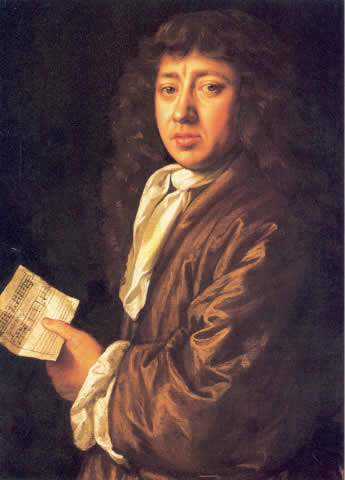
The other night, in the midst of my ceaseless toil blogging on behalf of all you ungrateful little guttersnipes, I took a brief half-hour's respite by dipping into Pepys.

The half hour grew to two hours before I even thought to look up at the clock, so subsumed was I in the hustling world of Pepys, in the squirrel-rushings of his thoughts, in the marvelous portrait he paints of his whole world, shifting with his inimitable idiosyncrasy from the most mundane details of daily life to the most important goings-on of court and country ... and all of it told with that chatty, totally human voice. Two hours fled like a snatch of dream.

And it got me wondering, as I so often do, about the whole act of re-reading books. A sizeable portion of all the reading I do is re-reading, and yet I've never been able to quite define what it is we DO when we re-read a book.

Some books are so complex and crammed that re-reading is virtually a necessary componant of enjoying them at all. Who entirely grasps Tale of Genji the first time through, or Vanity Fair, or Gravity's Rainbow? And certainly five or ten years between readings brings a very different US to the books we read once before - allusions that went over our heads the first time are now caught and savored.

But what about those books we re-read not only once but repeatedly? Further understanding a book you read once before makes perfect sense ... but how to explain re-reading a book you not only understand completely but quite often know virtually by heart? What's going on, when we're doing that?

I have a regular stable of authors I revisit in this way. Pepys. Chaucer. Ariosto. Kipling. Arthur Conan Doyle. Wodehouse. Herodotus. And of course more than any of them Horace. Almost every serious reader I've ever met has a comparable list, often broken up into specific needs, like we were talking about medicines in a cabinet ('so and so when I'm depressed, so and so when I need to forget the world,' etc).

So I'm opening the question to the assembled hordes of stevereads fans, especially the die-hard readers out there! How do YOU explain this thing we all do, this thing that after enough times can't really be called 'reading' in the normal sense of the word? Is it the intersection of reading and religion, or is it just creepy and compulsive?

And, of course: give me YOUR perennial authors/books. I know some for some of you but not all for all, so feel free to list 'em all!

comics! Civil War escalates!


My nemesis Pepito, in his blind and stumbling way, sometimes picks some comics that are actually good. This week, the haul that ever-vigilant Elmo yoinked from Pepito's room while its occupant was off dirty dancing at the Kit Kat Club was mostly well-done.

True, there was the usual proportion of crap so characteristic of Pepito: there's still swill like 'Supergirl and the Legion of Super-Heroes' (when, oh when, will the plug be pulled on this, the VERY WORST incarnation of the Legion that's EVER EXISTED?) and 'Secret Six' (yeesh - of all the lame-ass concepts for a super-team book... made all the worse to see by this issue's guest-star, the Doom Patrol, one of the BEST concepts for a super-team book, but without a book of their own these sixty or seventy years) ... and Pepito also bought 'Ultimates,' about which I've already said all I'll be saying.

But the rest of it - from a very good, surprisingly good issue of 'Daredevil' to yet another winning issue of 'Blue Beetle' (the title is in direct violation Steve Peeve #114-50/c: established comics characters being replaced by second-grade recruits chosen for their gender or ethnicity - it's a sign of the worst corporate craven irresponsibility), an issue that includes a classic riff on the oft-used 'newbie meets Batman' motif:

Blue Beetle: I can tell my parents I helped the Batman

Batman: say Superman

Blue Beetle: Huh?

Batman: Trust me. Tell them it was Superman. Everybody likes him.

Blue Beetle: Doesn't anybody like YOU?

Batman: They're not supposed to.

Hee

Quite a few other DC titles had similarly good parts. In 'The Trials of Shazam' poor crippled Freddie Freeman goes to visit Mary Batson in the hospital. As you may recall from last time, Freddie lost his superpowers during battle with some super-demons, and Mary lost her powers while battling a harpy far, far above Puerto Vallarta. Because comics is still a boys' world, Mary ended up comatose and paralyzed in a hospital room, while Freddie ended up with a soul patch and a hot black girlfriend. Sigh.

At one point in his bedside recriminations, Freddie says the word Shazam' and WAMMO! He's lightning-bolted to the rock of eternity to have an audience with the new Wizard thereof, the former Captain Marvel. Freddie is probably too stunned to ask where the heck his CRUTCH is, even though it's clearly shown getting zapped right along with him. But stunned or no, you'd think it would occur to him to ask where his LIMP is.

In any case, the new Wizard informs him that he'll no longer be Captain Marvel Junior, at which point Freddie had to be thinking "Yes! No longer will I be the only superhero who can't say his own name without losing his powers." The new Wizard informs him that if he survives his upcoming trials, he'll be known as .... Shazam! At which point Freddie had to be thinking "D'oh! I STILL won't be able to say my own name!"

But it seems he'll have lots of company even so - the new Wizard informs Freddie that ALL the Marvels will be reborn - and sure enough, on the panels behind him we see the disastrous, embarrassing rest of the Marvel extended family, including Uncle Dudley (guess the old pederast will actually have super-powers now, instead of only pretending to). We'll have to see if Judd Winick can make it work.

The latest issue of "52" and the latest "Teen Titans" neatly dovetail, since in the former we first meet the characters who are so scattered and embittered in the latter. '52' has great panel breakdowns by Keith Giffen and wonderful pencils by Joe Bennett, and 'Teen Titans' features the increasingly-annoying artwork of Tony Daniel. Both issues kept things moving along fairly briskly, although the writers really should make an effort to, you know, actually TALK with each other. In 'Teen Titans' Zatara (Zatanna's cousin, possessing her same backwards-magic powers) tells his erstwhile teammates that his powers only work on things, not people. But in '52' he's stopped right in the middle of backwards-ordering Blockbuster to 'freeze' ... and while we're on the subject, shouldn't the writers make it clear that this restriction certainly DOESN'T apply to Zatanna herself? Because if it did, I can think of a couple of fairly big DC storylines in the last two years that wouldn't have happened ...

The other two DC picks I enjoyed mostly for their artwork: Scott McDaniel doing great work on an Hourman issue of 'JSA Classified' and Andy Kubert doing great work on Batman. The Hourman story is fairly standard, but kudos to Grant Morrison for his sparkling dialogue in 'Batman.'

But the top honors for the week go to Marvel's latest batch of 'Civil War' tie-ins - despite all my problems with it, this storyline is turning in consistently involving issues. We have three this time around:

Frontline #6 - this title is still annoying me with its multiple-storylines, but that annoyance is lessened when a couple of the storylines are really good. The Ben Urich strand in this current issue makes for very good reading (although again, the people involved really ought to talk to each other about what they're doing ... this issue shows Thor killing Goliath by blasting his head with lightning, when the latest issue of Civil War itself shows - in graphic detail - Goliath getting lightninged straight through the heart). And the issue's shocker is Speedball getting shot (the artist re-creates the famous photo of Oswald getting shot) - he's on his way to testify to Congress about his innocence, having had his safety personally guaranteed by Reed Richards. This was interesting reading but incredibly depressing, since the Oswald invocation is SURELY meant to throw suspicion on Reed Richards ... call me naive, but I just don't want Mr. Fantastic to be secretly orchestrating the execution of pesky jailbirds. Iron Man going all villainy I can barely stomach, but not that ...

Captain America #22 - Finally, Cap hashes out his position with Sharon Carter in this issue. They toss around quotes from Thomas Paine and Ben Franklin, and there's some very good lines, like when Sharon asks 'If Captain America doesn't follow the law, who does?' or when Cap points out that America isn't a country founded on law - it's a country founded on the breaking of a law, an unjust law. But as impressive as all of this is, what impressed me the most is that Cap and Sharon waited to have this deep philosophical debate until AFTER THE BOOM-BOOM ... they're getting out of bed and getting dressed when the political science fur starts to fly. Grown ups! They keep their priorities straight!

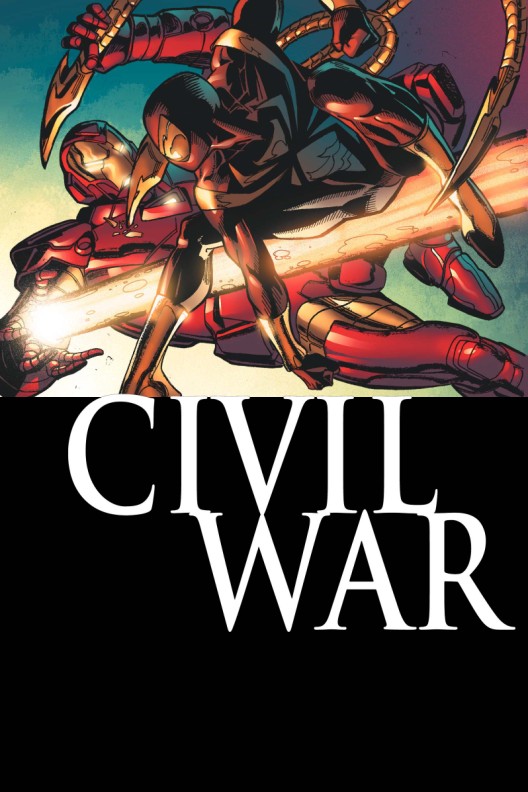
Amazing Spider-man #535 - Well, this is the issue I've been waiting for: the defection of Spider-Man from the cause of fascism, Peter Parker's realization that he's made a horrible mistake supporting the Registration Act and all the subsequent measures Tony Stark has enacted.

Ron Garney's artwork is once again the best he's ever done, but it's J. Michael Straczynski's writing that's the star of the show. This is the issue that finally confronts several major parts of the whole Civil War storyline, and above everything else, it cements Iron Man's role as the main villain of the piece.

Peter Parker insists on inspecting the gigantic Negative Zone jail Tony Stark and Reed Richards have devised to house all the super-beings who refuse to fall into line with the Registration Act. After the tour, Iron Man says. "So if you had notions of some kind of inhumane gulag, or a dark, dank prison dripping sludge and human misery, you were mistaken." Peter replies that he supposes the place is alright as an interim solution, whereupon Iron Man brings him up short: "This isn't temporary, Peter. This isn't interim. This is permanent. Get with the program." And when Peter is naturally shocked, Straczynski puts even more first-rate dialogue in Iron Man's mouth: "You can't put an atomic bomb on probation! You can't put somebody who flies under house arrest! It's real simple, Peter: they either sign up, or they stay here until they do sign up! And if they never sign up then they stay here for the rest of their natural lives! Do you get it, Peter? Do you get it now?" To which Peter replies "Take off the helmet. And tell me that again when I can see your face." And then for the first time we get a glimpse of the Tony Stark old Iron Man fans would actually recognize: "Do you think I like this, Peter? Do you think I worked my whole life to become someone's jailer? I hate this, Peter. I hate every minute of it. I hate everything about it. I haven't had a good night's sleep in weeks. But we have no choice. We have to follow the law ..."

So there it all is, out in the open, and the next thing we know, Peter is waking Mary Jane and Aunt May in the middle of the night, trying to slip them off the premises before anybody notices. The issue ends with Iron Man exploding through a wall and tackling Spider-Man - although what kind of a fight it could possibly be, considering the fact that Iron Man built the suit Spider-Man is currently wearing and almost certainly retains some kind of electronic control over it - remains to be seen.

But in the meantime, kudos to Straczynski for turning in the single best Civil War issue to date .... always knew he had it in him!

Tuesday, October 03, 2006

some books I've been reading


As some of you already know, certain periods in history fascinate me more than others. Ancient Rome, of course, from the Punic Wars to Justinian. The Plantagenet Middle Ages. The Italian Renaissance, of course. Dutch maritime history. The Restoration. The American Revolution. The American Civil War (so it's a long list - so sue me).

Ancient Greece has never done it for me (although none of you should get frisky at this admission - just because these areas don't fascinate me doesn't mean I don't know more about them than any of the rest of you. Settle down back there). The Crusades have never done it for me. The Wars of the Roses. The Victorians. Vietnam ... all dutifully studied, yes, but none of them really tripping my trigger.

Another subject that eternally fascinates me is World War Two, and an intense subset of that is Nazism and the Holocaust. The subject is as endlessly fascinating to me as it is grim.

Niall Ferguson's huge new book The War of the World squarely locates this fascination:

Yet there was something qualitatively different about the Nazi's war against the Jews and the other unfortunate minorities considered to be 'unworthy of life.' It was the fact that it was carried out by such well-educated people, the products of what had been, at least until 1933, one of the most advanced educational systems in the world. It was the fact that it was perpetrated under the leadership of a man who had come to power by primarily democratic means. The Nazi death machine worked economically, scientifically, and euphemistically. In a word, it was very, very modern.

Three of the books I've read recently deal with this subject.

The first was Nazi Terror by Eric Johnson, and it was a little dull, its phrases carefully rounded off and sanded free of eccentricity at the expense of color. The most interesting part of the book is its notes, where Johnson, maybe feeling nobody's watching, feels free to loosen up and more directly engage with his subject.

The second book was Making Friends with Hitler by renowned Hitler biographer Ian Kershaw. Anbody familiar Kershaw's books knows they'll be encountering very good writing, and this book - about Lord Londonberry and his circle of Nazi partisans (and the larger public ambivalence toward the Nazis) - is no exception.

Kershaw has done a very satisfying amount of research on his specific subject, but the real interest of the book is its broader background. It's a thing that needs remembering as the Second World War fades further and further into the past: unless you were a Jew (and not always even then, wishful thinking being a omnipresent human trait), it was entirely possible in 1933 to view the Nazis as a more or less legitimate democratically elected party. Granted, the tell-tale signs plied up quick - by the time anybody was using the word appeasement, it was already a criminally horrible idea.

So Making Friends with Hitler was a much better book. But it fell quickly into the shadow of the third book, Richard Evans' The Third Reich in Power. This is the second of Evans' volumes - the first was The Coming of the Third Reich, and one presumes the final volume will be The Third Reich at War.

Evans' Third Reich in Power is a thick, satisfying little plug of a paperback, so massively researched and so beautifully, sparsely, angrily written that the reader becomes entirely subsumed in the vision of the thing.

The numerous accolades showered upon this book aren't amiss: it's stupendously good, a wildly multifaceted look at exactly the phenomenon we were discussing: the slow, creeping, daily insinuation of the reality of Nazism into the lives of those who lived under it, both its partisans and its victims.

If you want to read about the subject, hie thee hence at once to your local Barnes & Noble and snap up these two long, wonderful volumes (the Johnson and Kershaw will have to wait, you being not made of money). They're some of the best history being written.

Friday, September 29, 2006

comics! Pepito's pile o' crap!


My nemesis Pepito is, as has been said before, an odd duck, especially in his comic-buying habits. You'd expect that somebody who knew enough to LIKE good titles would also know enough to AVOID bad ones, but no! There Pepito is, trawling the new-release shelves of the Android's Dungeon with all the indifference of a Russian shrimp-ship.

Take this latest batch, for instance. In order to get to the good bits, you have to wade through Grade A crapola like Moon Knight and Ion and Checkmate and this new Heroes for Hire title that reeks so much of ass you come away from it with a craving for pee.

True, the pile includes 52, which is consistently good. And the latest issue of the Flash which has a wonderful scene starring Jay Garrick, the original Flash. He's attempting to stop a couple of crooks making a getaway when he's upstaged by a new character called the Griffin, who very nearly kills the bad guys in the act of stopping them. Jay Garrick takes him to task, telling him "A real superhero can stop crime without leaving a trail of corpses."

But still, it's a long journey to Birds of Prey and Robin, both of which are excellent. And at the end of the road is Justice League of America #2.

I just recently met the writer, Brad Meltzer, and a nicer guy you couldn't ask to find. It will make bitching about his book just that much harder.

Nevertheless, bitch I shall! This issue was just as well-written as the first one, and the artwork is just as good, but the flush of the new has worn off - cracks are starting to show.

Crack #1: As a framing device in the first issue, it worked just fine ... but - Batman, Superman, and Wonder Woman are STILL sitting around a table talking about trading cards? I know this is all taking place in Inevitable Graphic Novel time, but still - it's starting to look a little silly.

Crack #2: Vixen's superpowers come from a piece of JEWELRY. And she's dumb enough to let a super-villain TAKE it. But we're supposed to believe this is League material?

Crack #3: While we're on the subject - I'm assuming that the lineup on this issue's cover will end up being the lineup of the team when this Inevitable Graphic Novel is concluded - which leaves me wondering what kind of bong was being passed around while the Big Three were playing with their trading cards. Black Lightning? Arsenal? Hawkgirl? Red Tornado? Vixen? Vixen, for gawd's sake?

There's a reason we're not talking about A-listers here. There's a reason we're not seeing Green Arrow or the Flash or Hawkman or even Zatanna. The reason is Batman - the new team is noticeably light on members who were involved in Batman's mind-wipe from last year's Identity Crisis. I just wish Meltzer would MENTION that fact, maybe have the Big Three TALK about it.

Crack #4: Vixen? So we turn down Captain Marvel and Power Girl, but we definitely WANT somebody who gets lured to a bar for a booty-call and LOSES the source of her powers to a couple of D-listers nobody's ever heard of?

I realize some of this is certainly corporate (though Meltzer swore it wasn't) - DC comics are still doing the whole 'one year later' thing, and the ultimate fates of characters like Aquaman, Supergirl, or the Atom have to remain up in the air. But let this entry serve as a silent plea to Meltzer and the DC Powers That Be: eventually, might we have back the Magnificent Seven? Superman, Batman, Wonder Woman, Green Lantern, the Flash, Aquaman, and the Martian Manhunter ARE the League.

Vixen? We've been down that road before, remember? It featured the world's first and only BREAK-DANCING SUPERHERO. Surely once is enough?

comics! Ultimates!


I've got a plea for all of you, involving Ultimates #12:

Please let this be the last Mark Millar comic you ever buy.

That's not just failed anticipation talking, although I WAS looking forward to this issue. No, it's a broader indictment: 'comics these days' only get that way if we LET them.

Some of you are familiar with the storyline so far: angered by the Bush administration's war-mongering and meddling in the Middle East, the 'axis of evil' (aided and abetted by Loki for reasons of his own) developes Middle Eastern equivalents of the Ultimates. These equivalents (wonder if that's their team name?) lead an army of huge machines and goons in power-suits on a full-out invasion of America. At the end of the last issue, the Ultimates' cause seemed hopeless, until the last-panel appearance of the Hulk.

OK, flash forward the year it took for this issue to come out, and here we are, Hulk smashing big machines like they were Dixie cups, while the rest of the team faces off with their foreign (= evil) counterparts.

The centerpiece duel is between Captain America and Abdul al-Rahman, but it doesn't amount to much because in the first second of the fight, Hawkeye, who has infallible aim and two sharp shards of glass, AND who's out of Abdul's line of sight, sends one shard into his left ear and one into his right Achilles tendon, crippling him and taking him out of the fight.

Oh wait ... that doesn't happen! Instead, Hawkeye tries to JUMP ON Abdul and gets picked off by the foreign (=evil) version of Quicksilver. So Captain America and Abdul fight.

Meanwhile, the foreign (=evil) version of the Hulk is kicking the crap out of the Ultimates version, crowing the whole time that the key to his ability to do so is that he retains his super-genius intellect, whereas the Hulk has the mind of a brutish thug.

Meanwhile, Hawkeye's bacon is saved by the real Quicksilver, who grabs onto his foreign (= evil) counterpart and runs so fast the poor SOB is torn apart by the speed. Right before he's torn apart, he pleads for his life. Right after he's torn apart, Quicksilver triumphantly says 'That's what happens when you threaten my friends' even though he and Hawkeye hate each other.

Meanwhile, in one of the worst-drawn fight-sequences since Herb Trimpe was still alive, Captain America and Abdul continue to duke it out. Abdul yells at Cap to 'Stop talking! Stop talking!' and then talks a bluestreak himself.

Cut to the real Hulk/foreign (= evil) Hulk fight, which is going poorly for the bad guy. We stay just long enough to see that he, too, is begging for his life.

We look away long enough to see Iron Man return to the fight, drunk, blasting away at the bad guys from the middle of his very own stash of WMDs. We know the tide has turned.

Then we return to the Hulk fight, just in time to see the foreign (= evil) Hulk get both his arms ripped off by our hero. The villain whines, "I ... I don't understand. How could you do it, Banner? How could you beat me? When I'm so much smarter? It doesn't make sense..."

To which our hero replies, "You know your problem, ugly scientist guy? YOU THINK TOO MUCH!' The last said while Hulk punches his fist clean through the head of his foe.

Meanwhile, Abdul is clearly losing his fight with Captain America, who urges him to give up. To which suggestion Abdul says "And why should I give up? So you can humiliate me and execute me before your fellow officers?" To which Cap replies, "Don't be ridiculous. That's not the way we do things in this country."

Just then a handy crowd of power-suited goons pile on top of Captain America, and Abdul, saying he takes no pleasure in it, prepares to cut his head off. At the last second, the Hulk grabs Captain America's shield, forgets that he hates the Ultimates, forgets also that Cap's shield has no sharp edges, and throws it at Abdul, severing both his hands (in a clever bit of scripting, Cap then throws off his goons by saying 'Hands off, creeps!')

When Abdul says 'My God, do you even appreciate why we did this thing?' Captain America impales him through the heart with his own weapon. You know, the guy who doesn't have any HANDS anymore? Yeah, that one - that's the guy Captain America IMPALES.

At one point in the issue, some of our heroes rescue President Bush from the wreckage of Air Force One. As they're bringing him to safety, he tells them he ain't gettin' outta Dodge until he knows the Vice President is safe. You get used to that sort of thing - the President is often portrayed in Ultimates as a dimwitted boob.

But don't be deceived. This comic comes to you straight from the middle of a GOP wetdream.

I'm not talking about the fact that our heroes not only kill their foes by the bushel when they could just as easily capture. I'm not even talking about the fact that lots of the foes killed are killed in the act of begging for mercy.

I'm talking about the culture of distrust the Bush administration has created in this country. The president is just an ordinary joe, and he actively distrusts 'eggheads' of any kind - a fact so beautifully brocheted by Steven Colbert to the President's face. He believes in simple, dead-or-alive frontier justice, without any nuance or ethic whatsoever.

And he's found his super-team at last.

Millar wants the dumb, bloodthirsty 13-year-old boys in his audience (regardless of their chronological age) to look at each successive panel in this issue and yell 'Hell yeah!' He doesn't care what he has to have these characters do, as long as he gets that reaction.

But you can't snort your coke and have it too. If this team is a bunch of fascist stooges who consider morality or thought to be excess baggage, that's Millar's choice as a writer. But readers have choices too.

Readers have choices too. When I saw that panel where the Hulk punches his enemy's head off yelling 'YOU THINK TOO MUCH!' (when what's clearly meant is just 'YOU THINK!'), I stopped reading Ultimates. Oh, I limped along to the end of the issue (yet another cliffhanger, and one I've longed to see). But at that point I was done with Mark Millar.

I urge you all to be so as well. The world doesn't need any more of this kind of thinking - it needs a whole lot less. You can't do anything about what's said at the U.N. ... but you can skip buying Ultimates #13.

Poetry Class!


In acknowlegement of the fact that a) some of my readers are also popular young roaring-boy poets and b) my own poetic tastes run to Tennyson and Longfellow and don't extend much further than Robert Service, I'll periodically include a poem here at Stevereads.

These won't be poems like "The Song of Hiawatha," where I already KNOW that it's a great work of art. These will be poems that struck some kind of note inside me - and I'll be inviting you-all to write in and TEACH me about them, for good or ill.

My first example comes from this week's New Yorker. It's by somebody named Deborah Digges, and it's called 'The Birthing':

Call out the names in the procession of the loved.
Call from the blood the ancestors here to bear witness
to the day he stopped the car,
we on our way to a great banquet in his honor.
In a field a cow groaned lowing, trying to give birth,
what he called front leg presentation,
the calf come out nose first, one front leg dangling from his mother.
A fatal sign he said while rolling up the sleeves
of his dress shirt, and climbed the fence.
I watched him thrust his arm entire
into the yet-to-be, where I imagined holy sparrows scattering
in the hall of souls for his big mortal hands just to make way.
With his whole weight he pushed the calf back in the mother
and grasped the other leg tucked up like a closed wing
against the new one's shoulder.
And found a way in the warm dark to bring both legs out
into the world together.
Then heaved and pulled, the cow arching her back,
until a bull calf, in a whoosh of blood and water,
came falling whole and still onto the meadow.
We rubbed his blackness, bloodying our hands.
The mother licked the newborn, of us oblivious,
until he moved a little, struggled.
I ran to get our coats, mine a green velvet cloak,
and his tuxedo jacket, and worked to rub the new one dry
while he set out to find the farmer.
When it was over, the new calf suckling his mother,
the farmer soon to lead them to the barn,
leaving our coats just where they lay
we huddled in the car.
And then made love toward eternity,
without a word drove slowly home. And loved some more.


I can see some faults in this thing right away (the willfully erroneous grammar and punctuation, to sound all 'poety,' and of course that 'of us oblivious'), but I kind of like this.

What does everybody else think? Not just the poets, either - did anybody else like this?

In the Penny Press! Foodies and John Donne!


The Penny Press is abuzz this week with Helen Mirren's performance in 'The Queen,' but alas, no echo of that great shout of acclaim will reach this site. This is, after all, Stevereads, and one doesn't read a movie (what a blessed thing it would be if one could!).

In a perfect world, when you were all done savoring the glories and delights of this site, you'd all click over to lockewatches.com and delight in all his thoughts about the movies and tv he's been watching. The prose would be just as tangy, the jokes would be less dependent on a working knowledge of Latin, and the cultural references would be a little more current. But this is not, as the ever-burgeoning popularity of Rachel Ray demonstrates, a perfect world.

Rachel Ray's name comes up in one of the latest New Yorker's most interesting pieces - Bill Buford's article on the rise of food TV in America.

We here at Stevereads are indifferent to foodie passions (some of you will have first-hand knowledge of the exact state of our culinary discrimination ... kindly keep it to yourselves), but one thing about which we certainly aren't indifferent is Julia Child. And you can't write about the current boom in food-tv without pretty much starting your story with Julia Child.

Buford's tribute to her is too brutally idiosyncratic to be anything but heartfelt:

Child, too, was unlike anything else on television: six-feet-two, virtually hunchbacked, seeming too ungainly for a small screen, with a long, manly face, but one that was also remarkable for its intelligent expressiveness. In it you could see her making connections, finding wonder in the properties of egg whites or the behavior of gelatine, a wonder that was at the heart of what now seems like a natural pedagogical imperative. She made people want to cook, often inspiring them with a single detail.

Buford's piece winds its way through the usual suspects of successive celebrity chefs - and his narrative comes to a halt once it enters the ever-expanding empire of Rachel Ray. He rightly assesses that her fame rests mainly on her 'supper in 30 minutes' tactic, and he tries to be diplomatic.

He talks about media savvy and cross-market appeal, but he avoids one central detail: not to put too fine a point on it, but Rachel Ray is, in addition to all her other qualities, an idiot. And the marketing strategy that's made her into an empire is aimed squarely at an audience composed of other idiots. It's not 'supper in 30 minutes' because everybody's over-extended these days - it's not that, no matter how many marketing executives tell you it is. No, it's 'supper in 30 minutes' because the network estimated - and rightly so - that the vast majority of TV-watching Americans are TOO STUPID to handle anything more complex. Rachel Ray is Cooking for Dummies brought to perky everygirl life.

Julia Child would have wept. Like James Burke and Carl Sagan and David Attenborough, she was a populizer in the old, vanished sense of the word, someone who believed you could LEARN anything, that you could stretch your mind to gain any new skill. Rachel Ray and her ilk believe in lopping off parts of that new skill until it's small enough and simple enough to fit in a Happy Meal box. Gawd forbid you should ask the American public to WORK to learn something.

Fortunately, as has been said here many times, there's always the mighty TLS.

The cover of this week's issue sports the 1595 painting of John Donne (the one that bears more than a passing resemblance to my young friend Sebastian), and there are two wonderful pieces on the poet inside.

And there are many other wonderful things inside! You can always count on the TLS reviewers to toss off carefully-considered statements you want to write in some kind of commonplace book. For instance, in a review of three books concerning empires, John Dunn (hee) says this:

No one has ever reflected more deeply about empire as either a cultural artefact or a political enterprise than Gibbon, and no one has ever seen more deeply into the political and economic realities of human collective life on a global scale than Adam Smith.

One thing that WASN'T in this issue was any kind of critical backlash to the lambasting the TLS served out upon the new Oxford Book of American Verse. John Ashbery writes in with a tepid little factual correction, but there are no howls in defense of the work itself. Maybe next issue...

(this issue also features a glowing review of 'The Queen,' but again, this isn't THAT blog ...)

Wednesday, September 27, 2006

in the penny press!


The trifecta of book review organs - the New York Review of Books, the London Review of Books, and of course the mighty Times Literary Supplement - are guaranteed to provide a solid hour of the highest quality mental stimulation when sat down and read in unison.

The highlight of the New York Review this time around, at least for me, was Joan Didion's forensic examination of Dick Cheney. She strikes an absolutely priceless tone (unintentionally, I assume), mandarin befuddlement threaded all the way through with deep distaste ... like a society doyenne hearing a loud, wet crunching sound and finding an unknown creature on the bottom of her shoe, half-crushed but still attempting to squirt venom.

She can't riddle him out into the light, of course. Morgoth is gone, but even his lieutenant Suaron is still largely incomprehensible to the minds of Men.

But in the process of her bafflement, she runs through the usual story with a wonderful, icey precision that's a joy to read.

The London Review of Books likewise had a highlight for me: Jerry Fodor's review of Michael Frayn's "The Human Touch: Our Part in the Creation of a Universe." It's a pan, but the peculiar combination of steep intellect and po-faced humor Fodor uses are more reminiscent of the TLS than the LRB:

As the blurb on the front of Frayn's book puts it:

'What would [the] universe be like if we were not here to say something about it? Would there still be numbers, if there were no one to count them? Or scientific laws, if there were no words or numbers in which to express them? Would the universe even be vast, without the very fact of our tininess and insignificance to give it scale?'

Why, yes, it would. (Frayne often treats rhetorical questions as though they were philosophical arguments; it's a bad tactic.) The universe would still be just the size it is even if there weren't astronomers to measure it. And water would still be H2O even if there weren't chemists to analyse it. And water would still run downhill, and there would still be hills for it to run down, even if none of us were here to take note of its doing so. You can't pin the natural order on me, Frayn; I'm not guilty. I didn't make the universe; I wasn't even there at the time.

But it's the TLS that really comes through, as always. For instance, Oliver Taplin reviews two new books on ancient Greece, and in the course of doing so, he lets his favorite editorial hobbyhorse out into its paddock:

My philhellenism outweighs my admiration for the BM (great though that is), so I shall make up for these omissions. The ultimate legal claim of the Museum, which bought the goods from Lord Elgin, sheltering behind an Act of Parliament, is a fortiori even dodgier than his claim to legality in dismantling large stretches of ancient masonry to get at the frieze and other sculptures. It is a tasty irony that the piranhas of the press cluster round the Getty and other newer Museums who are being hounded to return antiquities that were taken after a certain legalistic date, while the great museums of Europe complacently give pride of place to all the booty that was expropriated before the barrier came down. But there is a crucial and underappreciated point about the Parthenon Marbles, regardless of legal questions. Elgin hacked them off less than twenty years before the beginning of the War of Independence which would liberate the core of Greece from centuries of Ottoman rule. Even as the swell of Hellenism was rising throughout Europe, he took advantage of a declining regime that cared nothing for the heritage of Greece; he snatched them from the outstretching hand of freedom.

Sorry - no sale. The 'outstretching hand of freedom' in this case cared no more about Hellenistic treasures than the lazy old Ottomans did. Lord Elgin almost certainly SPARED the Parthenon friezes from destruction. And even if he hadn't, he still did the right thing.

The British Museum has nothing to apologize for. It spends millions every year on expert restoration, meticulous upkeep, and state of the art climate control for all of its archeological treasures. England's breathtaking cathedrals are guarded and upkept by a veritable army of caretakers. The same thing is true even moreso in the United States.

As far as I'm concerned, ANY country that can't say the same should cough up its art treasures. Those treasures, cultural or otherwise, belong to the whole world. Young children yet unborn deserve to experience root wonder-shock of looking up at the Great Pyramids. Hungrily sensitive artists who're only babies now deserve to stand in silence before every Vermeer there is.

Been to the Hermitage lately? Seen what the rampant smog and pollution (not to mention teenagers with spray-cans) have done to the Acropolis? Anybody know until how recently docents were allowed to smoke in the Sistine Chapel?

Send the big, Atlas-class medivac platform-helicopters to every corner of the globe, as far as I'm concerned. Pluck up every great building and work of art currently being dripped on or cluttered with McDonalds wrappers and deposit them in carefully manicured grounds in Japan, Switzerland, England, and the United States. If Egypt objects to the resulting big parking lot at Gizah, tell them they should have thought of that when they were looking the other way while kids on mopeds took runs half-way up the sides of the pyramids, or while drunken wedding parties were allowed to cavort deep inside them. Then tell them to shaddup. Tell you what - when you go to canopied, climate-controlled Sphinx Pavillion in the gorgeous country of Kent, you can have free admission with proof of your Egyptian citizenship.

Elsewhere in the issue, Eric Griffiths turns in a wonderful review of the new Royal Shakespeare production of 'Troilus and Cressida' - which, as many of you may know, is one of Stevereads favorite Shakespeare plays. At some point, every halfway creative type who's been heavily influenced by Homer feels the urge to take a whack at the master's material, and this is Shakespeare's (serving double duty as a reference to Chaucer as well, although it's best not to explicitly compare the two; great as Shakespeare is, he's no match for Chaucer when they're both working the same material at the height of their respective powers)(arguers feel free to Comment ... and of course any of you who feel like piping up in defense of the artistic merits of Troy War are welcome to do so)

Griffiths largely dislikes the new RSC production, but he has marvellous things to say about the play itself and its dynamics - all good stuff, like this:

Of all Shakespeare's works, 'Troilus and Cressida' is set furthest back in time, while it simultaneously bristles with idioms jazzy in their day.

Of course, with all this brilliance comes some trepidation as well. It turns out that virtually all of this edition's fiction reviews were devoted to historical fiction. This is where the ice water came into the afternoon's reading, because, as some of you know, I myself am that most improbable of beings, a historical novelist. And I can tell you this: we live in terror of two things: 1) some closeted, micro-obsessive expert calling us on some fact in our books ('it wasn't sunny on the 14th of May 1202'), and 2) the TLS (let's be honest: the only review organ that realistically could) taking us out behind the woodshed. Even seeing this happen to others produces not the faintest hint of schadenfruede.

One of the novels in question, C. J. Sansom's Sovereign, just barely gets a pass. It's a Tudor novel (again, a close call - I myself have written a Tudor novel), and although the reviewer, Michael Caines, calls it 'less demanding' than such Tudor-fiction classics as The Man on a Donkey or The Blanket of the Dark, he largely absolves it of blame, albeit grudgingly:

Sovereign is sore afflicted with outbreaks of humourless, barking laughter, sighs, frowns, raised eyebrows, and the setting of lips. It has a bad case of 'Jesu!' - the expletive for all occasions - and at least one impassioned cry of 'Fie!'. These are things to make the reader smile and read on.

Two of the other specimens under review are of particular interest to stevereads: Michael Cox's The Meaning of Night because we largely kinda-sorta liked it, and Diane Setterfield's The Thirteenth Tale because, as some of you may have noticed, Barnes & Noble has decided, for reasons known best to themselves, to strip down to its skivvies and hop into bed with this book - huge, eye-catching displays at the front of every B&N in the whole country, huge amounts of money spent to make this author the next Dan Brown (all based, one likes to believe, on one buyer's joyful reaction to the book, somewhere way back along the chain of evidence). Sheer human nature prompts a body to want the TLS to savage the book.

Sadly, the dice fall otherwise. Judith Flanders (a psuedonymn) doesn't exactly savage The Meaning of Night but she doesn't leave you any reason to go out and buy it either:

The Victorian elements are intensively researched - there are references to Evan's Supper Rooms, the Toxophilite Society in Regent's Park, mudlarks scavenging in the Thames - but throughout there is a sense of a list grimly being got through, each item ticked off and out of the way. Glyver does nothing at Evans's; he visits it simply so that it can be described.

On the other hand, Setterfield's book gets a sanctioned pass: "Setterfield is singularly successful in her aims." So those of us wanting to hate The Thirteenth Tale must hold our breath until we've actually read the book (I have, and I largely share the verdict of my esteemed colleague The Mama Chan: it's hyperventilated boilerplate, not entirely without literary merit but two fat fingers' worth away from actually being good).

Our final item? Druin Burch's good-cop/bad-cop review of David Wooton's Bad Medicine and Katrina Firik's Brain Matters.

Burch loves the first, and it quickly becomes apparent that he's going to USE that love to jump up and down on Firlik's book, in absolutely delightful fashion:

Katrina Firlik's Brain Matters makes a stimulating change from all this compelling originality and provocative thoughtfulness. If you have ever suspected that pushing a finger into the soft goo of another person's brain leads to fresh and startling conclusions about human life, this is the book to disillusion you. Firlik is full of breathless enthusiasm; so full of it, unfortunately, that other qualities are kept at bay. She wants to tell you about her life as a neurosurgeon, and her best point is her infectious eagerness. The style is reminiscent of a teenage essay on 'what I did during my neurosurgical training', and the insights are at roughly the same level. She reveals that sick patients are people too, 'not just a collection of clinical data'; she lets us into the fact that 'life is not a dress rehearsal', and that 'you can't judge a person's intelligence by his outward appearance'.

Initially, it's hard to pin down exactly why her thoughtless and cliched anecdotes are so insufferable. Blind adoration is appealing in its way, but Frilik seems to worship even the most stupid and destructive aspects of the American hospital system. Teaching by humiliation, pointlessly long hours and the infliction of needless operations on damaged patients are all held up for praise. But the source of the real chill gradually becomes apparent. It is Frilik's conviction of her own superiority, and her misguided overestimation of her own dull, workplace thoughts. At the end of 'Brain Matters' she invites us to marvel with her at the superlative intelligence of a group of her colleagues. 'What might be accomplished,' she asked, awed at the qualities of people like herself, 'if the same group lent their collective brain power to, say, improving public health education or homeland security?' Both books demonstrate the dangers of doctors who think too much of themselves.

Hee.

And that's all we have for you at this moment in the penny press ... sure, there's news tonight of a marauding bobcat out in Grafton - and the consequent bobbling-newshead paundering about the THREAT TO OUR SUBURBS, but nevertheless: reading-wise, that's all you need to worry about.