Showing posts with label atlantic monthly. Show all posts

Friday, April 24, 2009

Literary hacks in the Penny Press!


Can we pause from profundity long enough to cheer a little cheer for the best hacks in the world of hackery, the literary journalists?

They don't have a beat, these particular hacks; they aren't obsessed with cutting-edge goth-fusion, or Buffy, or the United States torturing people. They aren't advocating safer parenting, or pond-lining techniques, or same-sex marriage. They don't keep up with the Palins.

Instead, they roam over the whole of the pop culture/literary landscape in search of ... well, I'm not sure what. I'm not sure they're sure what, from day to day. A steady paycheck, yes, but once you've got some momentum going, that can be obtained by writing medical safety compliance pamphlets, or vinyl siding repair manuals, or fifth grade science histories - and yet, the hacks I'm talking about here, the literary journalists, don't write about these things (or maybe they do, but it's done quietly, late at night, with much wine and much shame, solely in order to pay persistent creditors). Instead, they're constantly groping along the contours of the landscape, feelers swaying in the breeze, hunting for something they either know enough to write about or have always wanted to know enough to write about. They aren't specialists, but neither are they quite amateurs. They aren't philosophers, even though they're often pursuing a fairly consistent ideology. And they aren't experts, even though the best of them are rarely caught in open error.

That last point is explained by their peculiar work habits. Once they settle on something, some person or book or movie or school of thought or general topic, the literary journalist will do far more than simply take in the specific artistic item in question - no, in addition to that, they'll take armloads of related books out of the library, or track down endless supplementary items online. In one very concentrated amount of time, they'll allow that subject to utterly consume their lives - and at the end of that very concentrated amount of time, they'll know their subject.

It's a weird kind of knowledge, however: it's often acquired so fast - and often, truth be told, with such a lack of deeply personal reasons - that the literary journalist finds himself aesthetically bifurcated: one the one hand, he's now something of an expert on his new subject (he can tell you the relevant books, he can rattle off the extant controversies and has pet theories about all of them, etc.), but on the other hand, he's still an outsider to it all (he's only been steeped in it for a month at the most, after all).

The result can be incredibly valuable. It's as if you went to the world's leading authority on some subject (World War One? Boer society? Viking ship-building?) and gave him a month's vacation, all expenses paid, in some tropical getaway where the only thing he wouldn't do is give even one thought to his specialty - then you bring him back and ask him to write an article about something in his bailiwick. The articles that would result from such an unlikely procedure - freed for once of academic insularity and infighting, geared for once to a jocular, populist accessibility - would be wondrous invitations to all manner of subjects.

Specialists almost never write such articles, but literary journalists write them for a living - and we're all the richer for it. And the Penny Press is where you go to find such articles, and such writers.

Long-time readers of Stevereads will already be familiar with some of the people I mean. There was, once upon a time, the likes of Gore Vidal and Wilfrid Sheed and Mary McCarthy. And today, there's Christopher Hitchens and Gordon Wood and Jill Lepore and James Atlas and a baker's dozen more.

And in the Atlantic, there's Ben Schwarz, who in the latest issue reviews several books touching on what the average German citizen during the Second World War knew of the campaign of extermination being carried out by the Nazis toward the Jews of Europe. And perhaps even more so, there's the great Caitlin Flanagan, a literary journalist who possesses the quintessential gift of all first-rate hacks: she can take any subject and make her readers interested in it.

Even if the subject is Alec Baldwin.


In the latest Atlantic, she finds herself in the unlikely position of reviewing Baldwin's account of his divorce and single-fatherhood, A Promise to Ourselves. It's not anything she could have predicted:

'I never wanted to write this book,' he tells us at the outset, in a hangdog advisory that we shouldn't expect too much. It was also a book I never wanted to read, but here we are, Alec and I, making the best of a bad situation.


The focal point of that bad situation is of course the leaked cell phone rant Baldwin yelled at his daughter, castigating her for her rude behavior and calling her a "pig." The transcript of that call is, I suppose, appalling (although in all fairness, I myself have never met a teenage girl who wasn't a self-absorbed little A-hole ... my only qualm would be in using the term "pig," since I happen to know pigs are very outgoing, giving individuals); certainly Flanagan opens that it is:

his [Baldwin's] real purpose [in the book] is to exonerate himself from an incident so grotesque that it's hard to imagine any piece of written communication short of a suicide note changing our opinion of it.


Flanagan takes this unpromising material and crafts out of it a review/meditation that will keep you feverishly reading, one delicious paragraph after another (for instance, on the indifferent intimacy of families: "Dad doesn't get too excited by the sight of Mom in her shimmy anymore, for the same reason Buddy's never taken a hankering to Sissy: they've seen too much. It's not community censure that has kept incest in check all these centuries; it's stomach flu"). The piece is easily the best thing in a typically strong issue of the Atlantic, and it keeps returning to that one catastrophic phone call, which Baldwin took outside a restaurant:

Standing on the street, once again confronted by life's inability to meet him halfway with his simple desire to be the center of the universe, he snapped. He raved at the child in the ugliest language imaginable, threatening her and calling her terrible names. Shortly thereafter, the message was leaked to an Internet scandal site (By whom? Cherchez la femme.) And the incident became infamous.

Of course I urge you to read the whole of this issue - of every issue, even in these slightly dumbed-down days of the Atlantic. But even if you skip around and pick and choose, you should make sure not to miss this piece. Back in the pre-Internet days, I used to photocopy (Google it; it was cumbersome) articles like this and make little packets of them to hand to uncaring friends, because these pieces are just that good.

And they're crafted by literary journalists, those most despised of writers, those Parnassian guns for hire - so let's all raise a glass of the cheap stuff to those working professionals! May they all be as magisterial as Helen Vendler, as thrilling as William Langeweische, as well-read as Ben Schwarz, as funny as Anthony Lane, and as damn good as Caitlin Flanagan!

Friday, December 05, 2008

The Fall of an Icon in the Penny Press?


The last issue of The Atlantic was a scarifying caution, mainly because the magazine's new redesign is so damn ugly. But the mere shock of the new look was sufficient grounds for me to give the entire issue a pass, wondering if my aversion to novelty was as much to blame for the lukewarm impression I got as anything the magazine's graphic designers were up to.

This is the second issue of the new design, however, and my shock has abated enough for me to say a couple of things with clear-eyed certainty: first, the magazine's new redesign is so damn ugly, and second, the new graphics are only the surface of the problem.

The real concern here is that finally, after a century (ten times longer than most magazines even survive), The Atlantic has chosen to become dumb.

The re-design only serves to draw attention to the fact that the content of the magazine has undergone a not-so-subtle shift away from the verbose complexity that has more or less always marked The Atlantic. The average length of articles is noticeably shorter, fizzy ephemera like cooking and travel are now up front to catch potential nitwit browsers, instead of in back to reward serious readers with a nice dessert. And James Parker's piece on Jim Carrey would have been embarrassing to find in Maxim. Finding it in The Atlantic is very nearly akin to a sign of the Apocalypse.

True, there were still a few meaty pieces in the issue. Joshua Hammer's piece about the assassination of Lebanese Prime Minister Rafiq al-Hariri, the resulting investigation, and the ripples it'll all have in the Middle East was involving reading and emblematic of the best of the old Atlantic. And book critic Benjamin Schwarz rightly praises Barry Cunliffe's Europe Between the Oceans (and offers an unexpected but equally right endorsement of Norman Davies' massive Europe: A History). And Christopher Hitchens - his 'trenchant book reviewer' cap firmly on - is wonderful writing about Richard Yates.


Likewise the always-delightful Caitlin Flanagan, who here is the inspired choice to dissect the phenomenon of the Twilight saga by Stephenie Meyer, although when she refers to that saga as "contenders for the most popular teen-girl novels of all time," she must sure mean very distant contenders; as impressive as the sales figures for the Twilight saga, they don't as yet come near the figures for, say, the Anne of Avonlea series (to say nothing of a certain intrepid girl detective who has - and always will have - everybody else easily beat). Still, Flanagan, Schwarz, and Hitchens are all reliably good in this issue, although even such a mighty trinity can't entirely distract from the troubling developments in the front of the magazine.


Any change, a friend recently reminded me, necessarily involves growing pains - maybe this is so with The Atlantic. I certainly hope so, although this issue gives me little grounds for such hope. We'll see what next month brings.

Tuesday, October 17, 2006

In the Penny Press! Crikey!


Since about 250 pages of the latest Atlantic Monthly are devoted to Joshua Green's profile of Hillary Clinton, it seems only right to start off with that - and to note right away that Green comes off as ... well, not to say 'an asshole' but certainly a CAD.

He spends the gigantic bulk of the article maintaining all the bells and whistles of journalistic objectivity - the hours logged with his subject, the tells-it-like-he-sees it descriptions, the wide-ranging secondary sources. For 249 of its pages, I was reading intently and learning something on every page.

Then I got to the last paragraph and uttered a 'what the fuck?' that I'm sure was also uttered in a certain breakfast-nook in Chappaqua:

Yet it is fair to wonder if Clinton learned the lesson of the health care disaster too well, whether she has so embraced caution and compromise that she can no longer judge what merits taking political risks. It is hard to square the brashly confident leader of health-care reform - willing to act on her deepest beliefs, intent on changing the political climate and not merely exploiting it - with the senator who recently went along with the vote to make flag-burning a crime. Today Clinton offers no big ideas, no evidence of bravery in the service of a larger ideal. Instead, her Senate record is an assemblage of many, many small gains. Her real accomplishment in the Senate has been to rehabilitate the image and political career of Hillary Rodham Clinton. Impressive though that has been in its particulars, it makes for a rather thin claim on the presidency. Senator Clinton has plenty to talk about, but she doesn't have much to say.

Yeesh. I'm guessing somebody's access-codes have been shredded ...

The issue also features a heartfelt though somewhat scatter-brained tribute to YouTube written by Michael Hirschorn. Like so many writers who set out to describe just exactly what YouTube is revolutionizing and just exactly how it's doing so, Hirschorn quickly loses his way and begins nattering (amazing how lenient we become toward this - nattering, but extremely well-paid nattering in a premium forum ... the latter two qualities, you'd think, disqualifying the former; personally, off the top of my head, I can think of four people I know who could have written this piece better, ALL of whom would benefit immensely - personally and professionally - from having a piece published in the Atlantic).

Of course I, like everyone else, worship YouTube. I spend at least 30 minutes a day there, indulging in every stray whim of visual curiosity. College girls puking in plain view? You got it! Precision-flying plane slamming into a crowd of spectators? You got it! Surging ocean waves at sunset? You got it! Insane basset hound named Lucy having a fit right in front of the camera? You got it!

I'm not convinced that it spells the death-knell of anything, let along movies and tv, but nevertheless: I'm entranced. If I could figure out how to TRANSPLANT YouTube videos onto these posts (as even a casual glance at other blogs reveals EVERYBODY else knows how to do), I'd be treating you all to my latest finds practically every day. But alas, the last time I called up one of my young friends and asked him to give me step-by-step instructions on how to import something to my site, my phone's battery died (and the sun came up) while he was still going strong.

So in the meantime, you'll have to make do with typing 'crazy cat' and 'crazy dog' into YouTube yourselves! Endless hours of mindless fun!

Of course, there are those who would say that if you're willing to plug yourself into YouTube, you're one step closer to being willing to LIVE video games all the time. Lots of those people are quoted in Jonathan Rauch's article on video games in this issue.

Much space is devoted to how COMPLEX video gaming technology is becoming, how the graphics and sound effects are becoming more and more lifelike all the time, how the interface of user-interaction is getting more and more complex all the time.

The piece concludes with this:

We can't know where the quest to build interactive drama will lead, but we do know that the dramatist's tools are the oldest and most potent of all emotional technologies. Sooner or later, drama will converge with the video game, the newest and most vibrant of all entertainment technologies. And then? Not long ago, I attended a stage performance of Aeschylus' The Persians,' the most ancient work of the dramatic literature. Even in translation and at a remove of 2,500 years, it left an audience of modern Americans feeling stunned and disembodied, as if the intervening millennia had disappeared. Wow, I heard myself think, if I could play that, I'd be so excited!

To put it mildly, there's a lot wrong with this. We'll pass over that bit about stage-plays being referred to as 'entertainment technologies' and focus on the central nub of the issue, the one I focus on with all the hundreds of video game addicts I know.

You know them too, I guarantee it. You're statistically likely to BE one yourself. These are the young people who, when you ask them at work or school every morning what they did the evening before, sheepishly offer vague non-answers: 'nothing,' 'not much,' 'stuff' .... because the real answer, in each and every case, is: "I played video games from 6:30 pm until I passed out, between 2 and 4 am, fully clothed but unfed and unwashed."

Some of these people might say this sordid little truth out loud once - it'd be good for an office chuckle. But none of them would ever say it as many times as it actually happens, because it happens every single time they have free time of any kind. 10 page papers with footnotes are written on the B line on the way to the class where they're due, so that radioactive mushrooms can be detonated from 6:30 pm to 4:30 am.

Some of these addicts are intelligent young people, and some of them have in the past attempted to defend or even justify their addiction to me, on just the same grounds as the above ridiculous quote does: that video games AREN'T just passive thumb-exercises. That they have depth and worth and dramatic power and even (in one arguer's disasterous case) LITERARY merit.

I realize nobody wants to admit when they've let something into their lives they can't control, but this is just silly. Rauch here is being willfully blind to the gaping problems in his own assertions.

The reason his modern American audience was enraptured by 'The Persians' has nothing to do with 'entertainment technology' - it arose from the fact that Aeschylus, the play's single, human author, used a combination of intellect, historical knowledge, intuition, and most of all poetic talent to craft a thing that would draw an audience in and work a deep impression on them.

But he didn't specify WHICH impression, or which shades of different reactions each person would feel. I'm sure no two of Rauch's fellow audience-members felt the EXACT SAME exhilaration over the performance - it would be altered by their seat-mates, their view of the stage, their knowledge of Athenian history, their experience of life and of theater. In other words, although everybody in the audience would be moved by the power of 'The Persians,' no two audience members would have seen the exact same play.

That's literature's central power: its ability to transform us, individually.

Nobody has ever been transformed by a video game (well, except for those few - their number grows every year - who, by playing literally non-stop, managed to transform themselves from living to dead), and nobody ever will be. And the reason is simple: video game users are entirely passive. All their possible interactions with their game are pre-programmed, and knowing this prevents them from CARING what their own reactions are to anything that happens.

While stage plays seem on the surface even less flexible (Hamlet never lives; Mary Tyrone never takes up jogging), Rauch could testify that in reality they're far moreso - since when they're done well they form an intensely interactive, intensely individual bond with each member of the audience, and audience that, through the strength of that bond, VERY MUCH cares about its own reactions.

All of which is already known to video game addicts - they weren't advancing their argument in any kind of sincerity. They were just killing time until they can get back to their hand-controls.

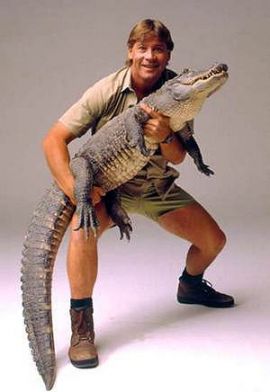
Still, as irritating as I found this video game piece, I'm afraid top irritation honors for this issue go to the regular 'Post Mortem' feature, this time eulogizing 'crocodile hunter' Steve Irwin.

We here at Stevereads have little patience with the old nostrum about not speaking ill of the dead. We think it probably originated in the Middle Ages, when there was a good chance the dead would pop back out of the ground and SMACK your ill-talking pie-hole. But nowadays, thank to 'C.S.I.' our dead STAY dead, so we're free to ill-talk our heads off.

And what's the point of it anyway? It does a disservice to the truth to whitewash ANYTHING. If I were ever going to be dead, I'd like to think my friends would be frank about my shortcomings (and if me being dead was offered hypothetically, my having shortcomings is SO much moreso...), just like I'd want my enemies to at least grudgingly admit my good points.

That being said, some of you may already know what I think of this opportunistic blockhead Irwin.

But if you didn't know, this post mortem, written in high priggish style by Mark Steyn, would take you on a guided tour of all my reasons.

Steyn takes the same line on Irwin that Irwin took on himself during his brief, unbearable tenure as something that could be passed off for a kind of sort of 'naturalist.'

Irwin died of a stingray barb to his heart, as most of you know. Any guesses on how you get a stingray to barb you in the heart? Let me tell you, since my freakish little nature-boy Elmo never speaks on this blog: you pick one up and FUCK with it. Otherwise, you - and it - are perfectly safe.

Steyn quotes Irwin on the subject:

We can't keep looking at wildlife on a long lens of a tripod. Then there's this voice of God telling you about the cheetah kill. After 450,000 cheetah kills, it's not entertaining anymore.

That's Irwin in a nutshell: the pseudo-naturalist for the video game age. An adult cheetah accelerates to 70 mph in under seven seconds; its frontal cortex analyzes course-changes in its intended prey so fast that neuroscientists can't tell you how the brain tissue in question can do it; the entire hunt takes roughly fifteen seconds from start to finish, and the smallest mishap can result in a broken leg for the cheetah, thus death. In the entire animal kingdom, just about three creatures rely on the adaptation of spectacular speed-bursts to secure their prey.

But is that 'entertaining' enough for the joystick generation? NOOOOOOO.

It makes matters worse, very much worse that Steyn decides to burnish Irwin by tarnishing somebody who does it right: believe it or not, David Attenborough comes in for a paragraph of trashing:

In the presence of animals, he lowers his voice to a breathy whisper ... Sir David keeps his breathy whisper even when he's back in the BBC studio doing the voice-over.

Well, OK, except: no he doesn't. He keeps the 'breathy whisper' (note the sneer associated with feeling awe or reverence for the natural world ... pshah! what's this simp THINKING?) only when he's doing voice-overs for on-site lines uttered in that whisper that didn't come out clearly on tape - his actual in-studio voice-overs are all done in normal voice.

The differences, of course, go much deeper. Attenborough has studied birds and animals his entire life; all that Irwin knew about the animals he FUCKED with was what he hurriedly glimpsed on his cue cards.

I watched a program of his once - he was in India, and some local residents told him there was a 20-foot anaconda living in a nearby drainage ditch. And that was all it took: without further ado, while the cameras watched, Irwin walked over to the open brackish ditch and lept in - I remember thinking 'the man is insane, literally insane - he has no idea if the anaconda is anywhere nearby, no idea if four or five actually poisonous snakes are in the ditch, no idea what skin-fungi he'll pick up, some of them untreatable, some of them fatal. '

I remember asking myself: why on Earth would anybody DO such a stupid thing?

Subsequent viewings gave me my answer. The entire thing was about money - Irwin grabbed at ratings the way he grabbed at wildlife. It turns out he did both ineptly - TV sees no better nature-ratings than David Attenborough's, and it's a little unlikely that Sir David will ever die by a sea-snake up his ass.

A tragedy for Irwin's wife and family, yes, and I suppose his viewers will miss him for the five minutes it takes to find another lunkhead adrenalin junkie to jump into drainage ditches.

But in my limited but valid brief as spokesman for at least a corner of the animal kingdom (the wonderful branch of canidae! One can't help but notice that Irwin never decided to FUCK with any kind of wild dog; he might not have known much about wild exotica, but give the man credit: he could sense when he stood a good chance of being ripped apart like a fat rag-doll), I have to say: good riddance.

The immense marvels of the natural world - those who've survived the onslaught of humanity - aren't here for the ratings-amusement of mankind. They are their own gorgeous, incommunicable worlds, and naturalists like David Attenborough understand that. Jackass croc-jumpers like Steve Irwin not only don't but don't WANT to.

So: the 'crocodile hunter' got a stingray barb in the heart. Great final-ever ratings stunt, but please: let's have no others.

Wednesday, September 20, 2006

In the Penny Press! ME ME ME


Obviously, INCREDIBLY obviously, the most interesting thing in the latest Atlantic is ME. Specifically, my letter in the letters page:

In his reply to Alecia Flores, who chided him for taking a gratuitous potshot at President Kennedy, Christopher Hitchens - apparently riding is one-trick pony into the ground - takes yet more potshots at a man who can't fire back!

For instance, he refers to JFK as 'the boy president' - a potshot that also has the virtue of being incomprehensible, since Kennedy was forty-three when he was elected president and had already been a congressman, a father, and a combat veteran. How much, one wonders, had Mr. Hitchens done by that age? How would he have liked being called a boy?

And then there's the old favorite: the smirking insinuation that Ted Sorensen, not JFK, wrote 'Profiles in Courage.' We have mountains of sworn statements; we have eyewitness testimony to the actual act of writing (JFK was in the hospital during part of the book's composition, and, predictably, he was a great favorite of the nurses); we have handwritten and annotated drafts of every single page of the book. But does any of that matter? No! Not when a nod and a wink can pass for knowledge of a subject.

And how many witnesses, how many long-suffering dinner guests trapped in mini-lectures by the commander in chief, how many subsequent references and remarks made by JFK himself, does Mr. Hitchens need before he can refrain from implying that Kennedy wouldn't have read such books as Cecil's 'Melbourne' or Agar's 'Price of Union'?

Finally, Mr. Hitchens gets his dramatis personae wrong. JFK wouldn't have been 'the Galahad of Camelot' - of course, he'd have been the king. One wonders how much patience he'd have had with bargain-basement Mordreds.

Of course Hitchens offers no reply - honestly, how could he? Nevertheless, his silence bespeaks a maturity I thought he'd all but lost! That, plus the superb piece in this selfsame issue on Jessica Mitford - at once fervently enthusiastic and coolly appraising - prompts me to declare an end to our nascent blood-feud!

Also in this issue was yet another wonderful, funny article by Sandra Tsing Loh, this one about uber-parents and the grotesque lengths they go to in order to get their little kids into the right grade schools, high schools, and colleges. The whole thing is a delight, but one tasty quote should suffice:

On the one hand, I worry that unless they join some sort of MTV-sponsored witness-protection program, such children have no hope of ever getting laid. (One imagines [the kids and their parents] years down the road, sharing a lone Zima at a vast granite kitchen island as the pair of them nostaligically go through old torts). On the other hand, I have to admit to a grudging admiration for the sheer professionalism, the smoothly oiled Bonnie-and-Clyde teamwork of these academic parent-child hit squads. I too had insanely pushy parents, but in retrospect they seem like pikers. Yes, my Danzig-born mom wrote all my sister's school papers (which my sister then dutifully copied and presented as her own). However, the result was not Ivy League entry but instead, as my sister will joke, 'my strange German syntax, to shake, I have never been able.' When I was a senior at Caltech, my Shanghai-born scientist dad kept calling my dorm room to shout, over the thumping ZZ Top, 'Sandra! Apply to any grad school in any engineering major!' Sadly, thanks to the freedom of the EZ student loan the great cheapskate himself had helped me secure, I was already off dating a rock-bagpipe player and spectacularly bombing my physics GRE. (Out of a possible 99, my percentile was 7 - that's right, one digit - a number so low it inspires almost Talmudic awe in those who hear it uttered).

Hee.

The oddest thing in the issue was Virginia Postrel's piece on Superhero movies called "Superhero Worship" which, despite those two facts, seems to have nothing whatsoever to do with superheroes or superhero movies. Great topic idea, though...

Over in Esquire (the same issue in which Brad Pitt says he and Angelina Jolie will get married once everyone in the country can legally marry), there's a brief interview with a 21-year-old creature named "David Lehre" (apperently, he's a filmmaker who's 'exploding' ... but there's a picture, and he doesn't look old enough to NOCTURNALLY explode, if you catch my meaning) who at one point affirms that he, like all other right-thinking individuals, is a fan of "High School Musical."

There's also a page-long pan of Cesar Milan, the so-called "Dog Whisperer" during which several ACTUAL dog-experts speak up about what a fraud the guy is. I've read his book, but far more importantly I've now seen his show, and I can tell you one thing beyond any doubt: most of the dogs he 'fixes' are only badly surprised, not rethinking their lives.

Domesticated dogs aren't exactly the smartest species in the world, but they know perfectly well that a human isn't a dog. Milan's whole approach - establishing himself as 'alpha dog' and then claiming he gets results when a 'pack' structure then forms with him at the top - well, it just isn't happening on his show. Instead, time after time, you see a dog go blank-eyed and immobile when confronted with this human acting so weird.

Almost all domestic dogs WANT to please humans - they've been genetically engineered over thousands of years to do so. Importing this pack-leader crap is literally turning back the clock 8,000 years.

So if you're having problems with your dog, kindly DON'T bare your teeth and kneel on their chest. Patient conversation will do just fine (except in your case, Beepy ... sorry about that).

Elsewhere in the issue, Tom Junod writes a book review of the Koran that's just a few good sentences shy of being utterly imbecilic. If any of you should happen to read it (i.e. if any of you can teach me how to link directly to it), please disregard it entirely. Even a 'Dummies' book will give you a better introduction to what is, beyond doubt, the most important book in the world today.

But by far the weirdest thing in this issue was Chuck Klosterman's article on 'Survivor' and 'Lost.' Heck, not even the whole article, just one sentence:

" 'Lost' is probably the best network drama in the history of television (The only other candidate might be 'Twin Peaks')."

Even in this day and age of 24-hour inane commentary, that's got to be the single DUMBEST fucking sentence I've read in the month of September.

So we'll close out this edition of In the Penny Press on that note and hope for better sense next time.

'Lost' the best network drama in the history of television? Jesus Christ on a fucking cross.