Showing posts with label god delusion. Show all posts

Monday, February 05, 2007

Penny Press! Fire & Brimstone in the TLS!


Both the sacred and the secular come in for a bit of a toe-stubbing in last week's TLS (we here at Stevereads are always a week behind on the TLS, because instead of simply buying it on the few newsstands that carry it, we wait for our good and true friend the canon of Colchester to send along his own copy - mainly so we can enjoy all his spidery marginalia).

The sacred part comes in the form of another review of its most dogged watchkeep, Richard Dawkins. Steven Weinberg reviews "The God Delusion" to generally favorable effect, although it's a far more timid-sounding piece than Weinberg usually submits.

For instance, Dawkins' silly, indefensible concept of 'memes' is given a complete pass:

"In the unkindest cut of all, Dawkins even argues that the persistence of belief in God is itself an outcome of natural selection - acting perhaps on our genes, as argued by Dean Hamer in 'The God Gene,' but more certainly on our 'memes,' the bundles of cultural beliefs and attitudes that in a Darwinian though non-biological way tend to be passed on from generation to generation."

That's rich, that 'Darwinian though non-biological.' It's very uncharacteristic of Weinberg, to float such a fat one over the plate.

Allow us to clear something up before our young friend Elmo jumps in and does it first: there is absolutely NO 'non-biological' way for ANYTHING to get 'passed on' from one generation to the next (other than via culture, which in most societies changes fairly rapidly - see examples below). Dawkins says there is, being an intensely religious man: he says small, discrete cultural items somehow exist separate from the particular humans who create them and can float from one generation to the next.

Gawd only knows what a 'meme' really is - Dawkins himself has wandered all over the map in defining it - but the single truth remains: as my old friend Lydia says, only a mortal could ever imagine a daffy idea like memes.

When two young male friends are out in public in America, they link arms and walk shoulder-to-shoulder as they go down the street. When a single young woman in America goes out in public, she paints two bright nickel-sized spots high up on her cheeks. When anything tragic happens in public - an ambulance howling by, a fire, a gargantuan traffic snarl - every witness ostentatiously raises their left thumb to their mouth in unison and bites down HARD, usually until blood comes.

We here at Stevereads would be willing to bet real money that not one of our readers, of whatever age, RECOGNIZES any of those behaviors. And yet, only two generations ago (a mere eyeblink, in Darwinian terms), they were the unquestioned norm in this country. We won't even talk about: never questioning the authority of the police (most certainly including individual policemen), the inefficacy of 'lady drivers,' and fish on Fridays.

And now, two, even ONE generation later, it's all gone. And lots and lots of other things have taken their place - texting, speed-dating, myspace - and THEY'LL all be gone, in the blink of an eye, replaced by other, unguessable things.

In other words, there's no such thing as memes. Even if you narrow your scope to the northeastern United States (as you bloody well shouldn't, if you're really talking about any truly biological axiom), the idea is lunacy. Truly generational transmission ONLY happens biologically .... Dawkins knows this, but he can't stand the reality of the world his own ideas call into being.

That world - a world in which there are no invisible,sanctified things, a world in which all life is happenstance, a world in which all LEARNED things are capable of vanishing utterly, indeed most often do so - that world is too frightening for more mortals, most certainly including Dawkins, to contemplate. The great ruck and run turn to conventional religion to gain sucrease from such realities ... Dawkins chooses another path, but one no less theological. And Weinberg gives him a pass, in order to discuss other aspects of "The God Delusion."

One of those aspects is the sweeping, even-handed way Dawkins disposes of all religions equally. Weinberg's objections are well put:

"I don't know on what ground one can say a peaceable well-intentioned person like Abdus Salam was any more a true Muslim than the murderous holy warriors of Hezbollah and Islamic Jihad, the clerics throughout the world of Islam who demonstrate against supposed insults to their faith, but not against the atrocities committed in its name. Dawkins treates Islam as just another deplorable religion, but there is a difference. The difference lies in the extent to which religious certitude lingers in the Islamic world, and in the harm it does. Richard Dawkins's even-handedness is well-intentioned, but it is misplaced. I share his lack of respect for all religions, but in our time it is folly to disrespect them all equally."

We here at Stevereads certainly DON'T share Dawkins' disrespect for all religions ... but even so, this is surely on the money, a weakness in Dawkins' book we'd failed to spot ourselves: the thing's naive.

Naivete is at the heart of the secular matter on our agenda as well. Marybeth Hamilton turns in a review of Chris Anderson's "The Long Tail."

Being somewhat familiar with the world of retail, we here at Stevereads have read Anderson's book with great interest - and eventually great disgust. Anderson argues that the marketplace is undergoing a radical change in its very nature, from the traditional model - in which large retailers sell a few copies of a wide variety of items and very many copies of a small number of items (blockbusters, be they albums or films or books) - to a wild new frontier in which anything and everything can be a blockbuster to its own niche. Needless to say, this is a phenomenon of the young, as Hamilton points out:

"Already teenagers - 'the leading edge of all our futures' - make no distinction between 'mainstream' and 'underground' tracks on iTunes, produce their own music digitally as often as they consume it, and are guided in their purchases not by the print media but by peer comment and blogs. In those developments, Anderson sees a democritization of creativity, a diminishing of the rarefied aura surrounding the artist, and an erosion of the authority of intellectuals. Above all, he forecasts an end to an all-encompassing, homogeneous mass culture. So say goodbye to Britney Spears and American Idol: we have entered the world of the Long Tail, where the mass audience is dissolving into masses of niches, and unfettered choice in creating endless demand."

Endless demand ... enough to give any old retail warhorse pause ....

There's something missing from this shining picture of utopian egalitarianism, and it's a something so idiosyncratic and non-reproducible that one despairs of even mentioning it to the hurly-burly track-burning yoots of today.

It's a little thing in the scheme of things, hardly worthy of a pause in Anderson's great theorizing, but it's nevertheless something real, something human, and something each and every one of us has BENEFITTED from, in our travels.

That little thing is this: the advice of a shop clerk.

Anderson's brave new world of commerce leaves out such anachronistic things - as you've all heard, our yoots are leading themselves, blogging and commenting, sharing 'this is kewl's or 'this sux's. Everything becomes instantaneous self-diagnosis, and the very idea of expertise is not only disregarded but mocked as old-fashioned. If you've stuck with any subject long enough to KNOW about it, you must, after all, CARE about that subject - and caring about anything is sin #1 to the X-Box crowd.

Since individual enthusiasms can be genuine and contagious, we'll resist the urge to use the phrase 'the blind leading the blind.' But the fact remains: the apparently endangered phenomenon of the knowledgeable shop clerk. Such a clerk does far more than convey his momentary likes and dislikes; he works like a careful diagnostic specialist, disinterestedly surveying the customer's aesthetic history in order to determine not only what they'll like but what they'll benefit from.

I'm sure that each of you has a story about some such encounter, the wonderful feeling of having such well-stocked experience at your ready access ... even the feeling of being in good hands.

We'll just have to hope Anderson's prognostications fail to come about; there are certainly indications that he might be letting his geek's mania get the best of him. Hamilton points out one such:

"But - a point so obvious as to be almost banal, were it not that Anderson himself never makes it - travel on those pathways is limited to those with access to the technology. For all his expertise on matters digital, Anderson is remarkably indifferent to what even the techno-enthusiasts who compile Wikipedia call 'the global digital divide'. Globalization is mentioned in the book only once, praised for 'the hyper-effecient supply chains it brings.'"

Of course, it wouldn't be an issue of the TLS without the many delights of J.C.'s 'NB' column. But this time around, it's a disturbing thing JC has to report:

"It is sometimes said of Herman Melville's novel 'Moby-Dick' that if you edit out the 600 or so pages in the middle, you would be left with an exciting adventure story. Weidenfeld and Nicolson are doing something of the sort, with the launch of Compact Editions, which cut the classics down to size. 'Anna Karenina,' 'Vanity Fair,' 'David Copperfield,' and 'Moby-Dick' - all defenceless under the laws of copyright - will be issued in abridged versions. 'The reductions in length have been done with sensitivity and in no way detract from the spirit of the original,' the publisher told the Bookseller. 'They retain all the elements that made them a classic in the first place.' According to our grasp of classic logic, cutting 'Moby-Dick' in half means it is no longer 'Moby-Dick.'
Weidenfeld says that 'market research' has shown that a significant number of readers are deterred by the 'elitist image' of literary classics. But our elementary logic tells us that classics ARE the elite. That's why they're classics."

Well, of course we here at Stevereads second JC - to a point. Hacking up the classics and then heavily implying that you're somehow IMPROVING them is perfidy at its worst, fully deserving JC's scorn.

But ... there is something to be said for carefully abbreviated versions of the classics. We here at Stevereads are in the business of getting people (mostly young people, but we're not picky) to read the classics. And we have sometimes been aided in our mission by, among other things, carefully abridging the works we're trying to sell. Take out the 'informational' chapters of 'Moby-Dick,' for instance, or the protocol-heavy chapters of 'Tale of Genji,' or the weird socio-historical disquistions in 'Les Miserables.' Once the reader is hooked on these works, they'll return of their own accord to snap up all the stuff they missed the first time. If they're scared off by the size or complexity of the book before them, they'll never get hooked at all.

We'll just have to wait and see how well-done the edits are in these new slimmed-down classics. We've requested a full spread of them from our representatives in the field, and we'll of course keep you bloodthirsty little ewoks apprised.

Friday, November 03, 2006

Books! Gawd and Goodman Dawkins!


It's a very familiar moment, well-known to countless men: you're sitting at a bar, elbow-to-elbow with a stranger. The first few cupfulls, you stew in the silence that is every man's right at the end of a working day ('a working day?' I hear my young friend Sebastian asking in deep confusion, 'what's that? Do days sometimes malfunction?'). But after a while, you're warmed up enough to go from contemplating to complaining, and that's when you turn to the guy seated next to you.

And it goes swimmingly, at first. You click - you like each other instantly, and the first hour's conversation makes it clear the two of you share a large variety of opinions more or less in common. There's a solace in this that's hard to explain. It - and running tabs - is what keeps people coming back to bars.

Then comes that moment. You're talking with your newfound friend, you're feeling a warmth that's not entirely chemically produced, when your seat-mate, out of the blue, starts his next sentence like this: "And then there are the damned niggers ..."

It's an awful moment. It turns your guts to stone. The entire house of cards the two of you had built - full of good will and the silent, low-key yearning for more good will. But that single moment stops all of that in its tracks.

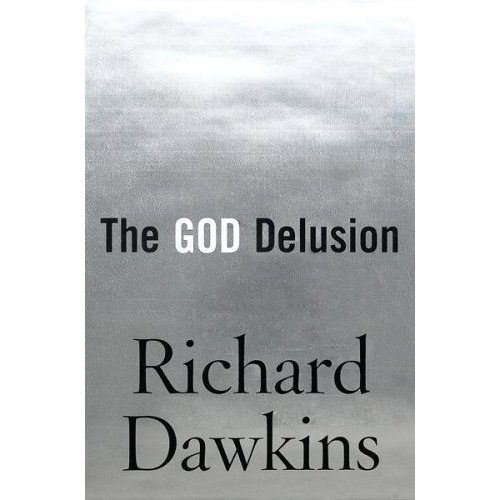
It's impossible for me not to feel that horrid moment, when reading Richard Dawkins' new book The God Delusion.

Because I like him - his book is one hell of a lively ride, scabrously, hilariously written (you have to smile at a guy who calls Michel Foucault, Roland Barthes, and Julia Kristeva "icons of haute francophonyism"), wonderfully, snarkily intelligent from first to last. This is an entirely different kind of book from the same author's mighty, magisterial The Ancestor's Tale. That book was a giant work, scrupulously intelligent, the single greatest volume concerning evolution by natural selection written since Darwin.

The latter book is an impassioned, tossed-off screed, ironically enough the same KIND of screed you might hear in a bar, if the screed-er were one of those annoying individuals who tend not to lose their powers of ratiocination even while drinking. Such individuals are immensely irritating - just ask somebody who knows one! - but they're rare enough so that you can reasonably expect to avoid them in random bars.

Dawkins is smart enough to toss off a screed that encompasses everything from Hindu scriptural texts to the current perturbations of the blogosphere. And every single OUNCE of his smarts is conveyed in his incredibly enjoyable, energized writing style. That oft-said but seldom-true description actually applies to this book: there's not a dull page in it..

And because I agree with him - I myself am an atheist, and I vigorously hate virtually all religious practice (and unlike SO many people who claim to be atheists, I actually know the enemy's territory in chapter and verse). Dawkins' book might just be the smartest, funniest, and most consummately ruthless attack on religious practice yet written.

He doesn't leave any theological stone unturned. It's amazing, when you finish the book, to look back and remember just how much is in it. Everybody from Aquinas to intelligent design apologists, regardless of historical gravitas, gets a fanny-spanking.

Dawkins finds all the weak seams, all the weak seams that have always been there, in every religion, throughout time. He's organized (or, as he problematically puts it, 'supernatural') religion's worse nightmare: scientifically trained, religiously sensitized, and articulate as all hell.

Arguments for the existence of God, arguments for the value of organized religion, arguments for the solace of faith ... every aspect of the subject is atomized, always with the same zest and sarcastic humor, always with at least the outward protestations of fairness.

So yes: I like him and I agree with him. And then he starts his next sentence with 'And then there are the damned niggers ...'

It's not the fact that the book has flaws - it has them, as all books do (sorry Jack!). It's the fact that the book's flaws add up to a system, an agenda ... which is, if you think about it, the very last thing a supposedly open-minded examination of religion should have. Surely if organized religion is as stupid and harmful as you maintain, you shouldn't need to rig the game going in?

Dawkins rigs the game going in. When he lurches into his own version of that barroom talk-stopper, you suddenly realize you're in the presence of somebody every bit as intransigently close-minded as the religious zealots he condemns (and manages to FIND, in huge numbers, like a pig sniffing out nutjobs). In violently pre-judging that all organized religion is manipulative and evil, Dawkins shortens the work he needs to do - at the expense of his argument.

Take for example his discussion of the way devout Christians react to news of their own imminent mortality. Dawkins asks why, if these people believe in the immortality of their souls, they aren't happy at the prospect of their physical deaths:

Why don't religious people talk like that when it the presence of the dying? Could it be that they don't really believe all that stuff they pretend to believe? ...wouldn't you expect that religious people would be the least likely to cling unbecomingly to earthly life? Yet it is a striking fact that, if you meet somebody who is passionately opposed to mercy killing, or passionately against assisted suicide, you can bet a good sum they will turn out to be religious. The official reason may be that all killing is a sin. But why deem it a sin if you sincerely believe you are accelerating a journey to heaven?


You can hear the tone clearly here - the nah-nah schoolyard taunt of someone who's asking questions BUT WILL NOT LISTEN TO THE ANSWERS (with just the smallest flavor of the conspiracy-crackpot, with that 'could it be that they don't really believe' or that 'official reason' business). This is an 'inquiry' made by somebody who's decided ahead of time that no valid or thoughtworthy answers are forthcoming.

I believe whole-heartedly in assissted suicide, but nevertheless: that 'official reason' Dawkins so snidely mentions is the Bible, and the twenty centuries of moral and legal codes it spawned. A religious person who's not a crackpot (they comprise a large chunk of the world's population - I think there are about two of them in Dawkins' book - and he gets both of them on a really bad day) would probably respond to Dawkins' taunting questions by saying the spirit is willing, but the flesh is weak - they do believe in a bright afterlife, but losing THIS life is fearful anyway (a less close-minded atheist than Dawkins might point out how many millions, while dying, have been spared the full measure of mental agony by clinging to some kind of religion ... Dawkins might scoff 'deluded to the end!' but surely deluded is better than pointlessly terrified). They might say that their beliefs make it a sin to lose hope.

I know a handful of deeply religious people - not Italian grandmothers with their compulsive rosary beads, but intelligent, educated people who are as wise to the ways of the world as Dawkins is. These are not deluded dupes, nor are they status-seeking hypocrites. And the fact is, their faith genuinely BETTERS them. For whatever reason, through whatever mechanism, they are able to access deeper, richer, better aspects of themselves through faith than they would be able to do without it. They are kinder, more giving, more actively GOOD because of their faith - and once you realize that despite any of this, in Dawkins' eyes they're just damned niggers, well ... a large amount of the fun goes out of his book.

And once that happens, you start to notice something else. Something not only disagreeable about the book but downright fish-stinky.

You first notice it with all the predictable Dawkins nonsense about 'memes' ... you can append your own bulleted one-phrase definition here, and they'll be as many of them as there are readers, since nobody really knows what the Hell Dawkins is talking about when he refers to them. 'Units of cultural inheritance' is the phrase Dawkins uses here, and as far as I can make out, he conceives of them as some kind of 'soft' equivalent to genes.

He faces up to the problems with this, and he gamefully defends his conception. Take the objection that "memes are copied with insufficiently high fidelity to function as Darwinian replicators."

The problem, Dawkins says, is illusory:

Think of a master carpenter demonstrating a particular skill to a young apprentice. If the apprentice faithfully reproduced every hand movement of the master, you would indeed expect to see the meme mutate out of all recognition in a few 'generations' of master/apprentice transmission. But of course the apprentice does not faithfully reproduce every hand movement. It would be ridiculous to do so. Instead, he notes the goal that the master is trying to achieve, and imitates that. Stitches in knitting, knots in ropes or fishing nets, origami folding patterns, useful tricks in carpentry or pottery: all can be reduced to discrete elements that really do have the opportunity to pass down an indefinite number of imitation generations without alteration. The details may wander idiosyncratically, but the essence passes down unmutated, and that is all that is needed for the analogy of memes with genes to work.

Not hardly. Not by a wide margin. The only way this analogy even BEGINS to hold up is if the master carpenter's teachings - the instructions themselves, not the words or gestures used to convey them - exist separate from the man himself. And they don't. They're TEACHINGS, which are acquired and disseminated - or not - by an act of will. Genetic inheritance in all its variation works works uninhibited even upon people who don't know what genes are. There's no similarly mindlessly biological equivalence going on in the act of TEACHING.

The fact that Dawkins believes there is would be telling enough all by itself, but he goes much further when he talks on and on about the Zeitgeist.

Ah, the Zeitgeist. In the entire century of its ridiculous life, it's never done anything but make otherwise intelligent individuals sound like morons. The Zeitgeist, the so-called collective spirit of the times .... how unutterably tired I am of this bogeyman. The Zeitgeist, a concept invariably adored by Cantabridgians who're proud of the fact that they don't read newspapers and don't own TVs.

Dawkins is no different. The minute he invokes the Zeitgeist, he sounds like a damn fool, a blinkered cafe-savant. It only worsens things that he believes the Zeitgeist is moving 'forward' and 'upward,' that things are steadily getting better:

we have almost all moved on, and in a big way since biblical times. Slavery, which was taken for granted in the Bible and throughout most of history, was abolished in civilized countries in the nineteenth century. All civilized nations now accept what was denied up to the 1920s, that a woman's vote, in an election or on a jury, is the equal of a man's. In today's enlightened societies (a category that manifestly does not include, for example, Saudi Arabia), women are no longer regarded as property, as they clearly were in biblical times. The Zeitgeist moves on, so inexorably that we sometimes take it for granted and forget that the change is a real phenomenon in its own right.


Not hardly. Not by a wide margin. As is always the case when I encounter somebody talking about the Zeitgeist, I'm astonished by the evasions, corner-cuttings, and boneheaded howlers that come out of their mouth. It's all the more glaring here, in a book that so fetishizes rationality.

You can see it even in this little excerpt. Notice how he's forced to retreat from 'we' to 'civilized' to 'enlightened' societies just in order to keep TALKING about it, this chimerical Zeitgeist bogeyman. So there are no slaves in the world anymore? So the lot of women is now deplorable only in a few isolated non-enlightened corners of the globe? It's always the same: get a cultural ostrich to pull its head out of the sand long enough to talk about the Zeitgeist, and this kind of crap comes dribbling out of its beak.

In another book, it'd just be a little burr under the saddle, a place to politely cough and look away. And do you know why? Because things like memes and the Zeitgeist are supportable only by presupposing an invisible, ineffable web, a means of communication and propaganda that cannot be measured or directly observed.

In other words, they're religious concepts. The God Delusion is, under all its flash and bluster, a deeply religious book.

Even in the midst of fulminating against the perfidy of worldwide religious psychosis, Dawkins can't stand alone. He can't completely abandon the idea of a phantom floating SOMETHING out there, preserving, guiding, and uplifting human life (and, it should be pointed out, only human life). Since I'm an ACTUAL atheist, I don't really care what Dawkins calls his god.

It doesn't dismiss the bulk of his book, which is sharp and delightful and well worth reading. But it does CHARACTERIZE the book, in pretty damn clear terms.

This isn't Charles Dawkins' The Origin of Species, in other words. It's more like The Confessions of St. Richard.

Wednesday, October 25, 2006

The Penny Press! that damnable Dawkins!


The London Review of Books is a steady, pleasant publication, far more intelligent than the New York Times Book Review, and far less fiercely complex and involved than the mighty TLS. Its articles and reviews amble about comfortably on the midslopes of Parnassus, so when something really firebrandy pops up, it's immediately noticeable.

This latest issue has one such piece - hoo boy, does it ever.

The piece is by Terry Eagleton, and it's a review of Richard Dawkins' latest book, The God Delusion.

Eagleton begins promisingly:

Imagine someone holding forth on biology whose only knowledge of the subject is the Book of British Birds, and you have a rough idea of what it feels like to read Richard Dawkins on theology.

He goes on in this vein, much like he's preparing a case:

If they were asked to pass judgment on phenomenology or the geopolitics of South Asia, they [most book reviewers] would no doubt bone up on the question as assiduously as they could. When it comes to theology, however, any shoddy old travesty will pass muster.

This is promising stuff, especially if you've already read Dawkins' book, as I have; it looks to be building the case that Dawkins' latest book is a shoddy, tossed-off affair - this is certainly true, and a beginning like this one makes the prospect of a full-length spanking suddenly appealing.

Alas, the prospect is dashed pretty early on. And what takes its place is weirdly unsatisfying. The reader quickly becomes aware of three facts: 1) Eagleton hasn't in fact read Dawkins' book, 2) Eagleton is loopily religious in exactly the same degree and measure that Dawkins is loopily atheist, and 3) Eagleton isn't even prepared to make a coherent case FOR faith BASED on faith. He'd much rather pontificate:

Believing in God, whatever Dawkins might think, is not like concluding that aliens or the tooth fairy exist. God is not a celestial super-object or divine UFO, about whose existence we must remain agnostic until all the evidence is in. Theologians do not believe that he is either inside or outside the universe, as Dawkins thinks they do. His transcendence and invisibility are part of what he is, which is not the case with the Loch Ness monster.

Reeling, we move on:

The Jews of the so-called Old Testament had faith in God ... they had faith in God in the sense that I have faith in you. They may well have been mistaken in their view; but they were not mistaken because their scientific hypothesis was unsound.

At which point your loyal reader stopped, looked up gasping at his Chinese waitstaff, and said aloud: "Yes they were."

Transcendence and invisibility are the absolute CORNERSTONES of the Loch Ness monster and the tooth fairy. They're the cornerstones of EVERY human fantasy big and small through all of history.

I believe in you because I can SEE you. I can watch your behaviors, develope a sense of your patterns, rudimentarily predict your actions (Sebastian will always make some unconscious, incredibly condescending comment to waiters in restaurants - like carefully spelling out the word 'soup'; Jeff will always have a practical solution to any problem that turns up in company, whether he's heeded or not; John will always be between ten and three hundred minutes late for any pre-arranged meeting; Pepito will always grow attached to the live chickens he buys for his santeria rituals and end up KEEPING them and giving them snuggly names, etc)

If I couldn't see you, if nobody I'd ever known had ever seen you, if nobody in any reliable record had ever spent a single moment in your presence, you can be damn sure I WOULDN'T believe in you, and nobody else would either. God is not a celestial super-object or a divine UFO? Both descriptions seem pretty near perfect.

But Eagleton isn't nearly done:

God is not a person ... he is, rather, the condition of possibility of any entity whatsoever, including ourselves. He is the answer to why there is something rather than nothing. God and the universe do not add up to two, any more than my envy and my left foot constitute a pair of objects.

This, not some super-manufacturing, is what is traditionally meant by the claims that God is Creator. He is what sustains all things in being by his love; and this would still be the case even if the universe had no beginning. To say that he brought it into being ex nihilo is not a measure of how very clever he is, but to suggest that he did it out of love rather than need.

Oh my.

Oh my, my, my.

At the very least, we know conclusively by now that we are no longer reading a book review. This would be interesting in a stretch of autobiography, but it's extremely depressing in the London Review of Books.

But Eagleton, somehow getting all this past an editor, has a LOT more to say:

God is transcendent of us (which is another way of saying he did not need to bring us about), he is free of any neurotic need for us and wants simply to be allowed to love us.

Somehow, 'oh my' just doesn't seem to adequate at this point.

Love? Where did love come into this? Love, the name that humans append to an EXTREMELY narrow bandwidth of an EXTREMELY narrow emotion? Love? What does the universe know of love?

The universe is a beyond-calculation huge expanse of open space and hydrogen one degree above absolute zero. It knows nothing of love, but that's OK, since Eagleton clearly means '20/21 st century America' when he talks about transcendence.

And what about his wild claim that his hippy-granola lower-g god wants nothing more than to be allowed to love 'us'?

To say the very least, to say the comically least, God - the Jewish God, the Christian God, the Muslim God - wants a great deal more from His believers than simply an invitation to a cuddle-puddle. The God of the Jews tells His followers that they are the chosen people and all others are worthy of contempt or pity. The God of the Christians tells His followers to make disciples of all nations. The God of the Muslims (it STRENUOUSLY bears pointing out that we're talking about the EXACT SAME God here) tells His followers to murder the unbeliever. That's hardly the same as this Facebook friend folderol Eagleton so blandly calls fact.

All of this would be more endurable if Eagleton had actually read Dawkins' book, as I said. But if he can write "Dawkins considers that no religious belief, anywhere or anytime, is worthy of any respect whatsoever," he clearly hasn't. But it's even more alarming that he obviously hasn't read his Bible in quite a while either, as when he writes that Jesus was put to death "because the Roman state and its assorted local lackeys and running dogs took fright at his message of love, mercy, and justice..."

The local lackeys in question (not sure how the Roman-hating elders and chief priests of the Temple would have liked that description, but we'll skip over that) sought the death of Jesus not because they were buzzkills to his love-jones but because he defied their authority by a) denouncing them publically and b) smashing up their concession stands. And the Romans killed him because he declared himself the King of the Jews, which in the Roman world was treason.

OK, so Eagleton hasn't read Dawkins' book, and he hasn't read the Bible ... but what about a feckin newspaper now and then? What but a total ignorance of the world and everything in it could account for a passage like this:

On the horrors that science and technology have wreaked on humanity, he [Dawkins] is predictably silent. Yet the Apocalypse is far more likely to be the product of them than the work of religion.

Yeesh. Can Eagleton really be this dense? Attributing the swiftly-approaching Apocalypse to technology is like attributing toast to the toaster. The next time a building blows up, or a city is flattened by a suitcase nuke, or cloud of chemical death is loosed, I guarantee you it will be religion that does it - religion merely USING technology. Religious conflict has accounted for more human death and suffering than any other possible factor or all such factors put together. It takes exactly zero mental work to see this.

But Eagleton is so intent on putting Dawkins in his place that he fails to notice that his own idealogy is equally absurd.

As some of you will know, we here at Stevereads are calmly, 100 percent atheist. We say: of course there is no God, no afterlife, no nothing of any kind. There's this tiny little blip of life, and that's all.

When people assert that the above is true for all other living things that have ever walked the Earth EXCEPT mankind, who at death sends off a carbon-copy ghost that travels to an alternate dimension and lives there forever with consciousness and personality intact, we calmly point out that if you just sat and THOUGHT about that scenario for a second, you'd see how silly it is.

Humans are afraid of dying. Humans have an enormously complex brain, prone to creating fantasies. Put those two things together and do the math yourself.

So, if Dawkins had written an excoriation of the evils of religion that was GOOD, we'd applaud it. And likewise if Eagleton wrote a either a condemnation of Dawkins' book or a defense of religion that was GOOD, we'd love reading it, as we love reading C.S. Lewis.

But as it is, the book and the review are equally dumb and irritating. I'll keep you all posted on the letters page fallout that's SURE to happen.