
Books of all shapes and sizes cross our desks here at the palatial offices of stevereads, and here is where an editorial that starts in such a manner would limp home with something like 'and we can't possibly read them all.'
Needless to say, we're made of sterner stuff here at stevereads. We can, in fact, read them all - and we do, we do. We burn through books with the speed (and beady eye towards the stash) of an addict. Er, that is, of a BIBLIOMANCER.
Talking about all these books here on this site would take forever, and it would be crushingly demoralizing to all you slow-readers out there (actually, it might be even more demoralizing to the comparatively fast-readers among you, for obvious reasons).
So we pick and choose which books to mention here, which ones to blurb here, which ones to pan here, and, more rarely, which ones to review at length here. It's a mysterious process, and of course no part of it is open to debate ... although, in our more sentimental moments, we sometimes wonder what all you marmosets would say, if you had a voice in the running of this kingdom; would you cry out for more book reviews, more book blurbs, more books, books, books? Or would you opt for more political commentary, with no books involved? Or would you have it be video game commentary, all the time?
Ah, but such sentiment always passes, and the burden of sole leadership descends once again across our shoulders. So here's what we're offering for your interest today:
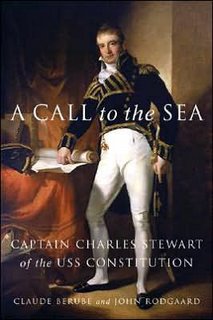
"A Call to the Sea" by Claude Berube and John Rodgaard - this is the first full-length biography of Captain Charles Stewart, whose career as a naval officer stretched from the American Revolution to the Civil War.
The authors do a very workmanlike job assembling their materials - they know they're breaking ground and setting precedent, and they're determined to leave no ceremony out.
Neither one can write worth a scupper's cup, but that must be forgiven - especially since Charles Stewart is extremely unlikely to receive the attention of a truly skilled biographer. He's just one of many countless excellent skippers throughout the ages who will never get the book they deserve - in fair truth, it's something of miracle he got even this much.
This is much: Berube and Rodgaard's book is heavily sourced and footnoted, a dutifully balanced and written acount, and thoroughly hagiographic.
Stewart was a wonderful man, despite the repeated efforts of his two hagiographers to assure you so: he was stupid, funny, totally loyal, wonderfully funny when drunk, totally fearless, and, what's to the point, an absolutely first-rate eviscerator of his enemies on the open water.
It's amazing, in its own minor key, that our two authors manage to drain the events of Stewart's life so deeply of the drama that filled it. Stewart wasn't just a great sea lord - he also has the distinction of being the greatest master that dear, mighty warship, the U.S.S. Constitution, has ever had.
Some of you will know that we here at stevereads dream of some day saving the funds necessary to spend a vacation week in the great city of Boston, Massachusetts. It's a long way from our native Indianapolis, but the trip would be vindicated by one experience alone: walking the deck-plates of this lethal lady of the sea-lanes. Not a replica, not a museum ride, but the ship herself, surpassed by the crafts of later days but not out-done by any of them, not one single one of them.
There were years, there were decades, there were, above all, battles wherein the fate of America itself depended on the actions of this one ship.
She found her perfect commander in Stewart. He could feel her every shift and mood under his feet. And he USED that connection - something seldom felt by the privateers and British place-seekers against whom he fought - to perform battles that in retrospect look like miracles.
None moreso than the spectacular victory he achieved against the Cyane and the Levant simultaneously. If you loyal readers of stevereads had the patience of judges, oh! the tale we could tell you, of that grand and totally impossible battle!
Stewart did it with incredible Robert-E.-Lee style itution and pure balls, only a fraction of which actually make their way into this staid account, but no matter. It's a worthy book, though not one we here at stevereads can recommend to the general reader.
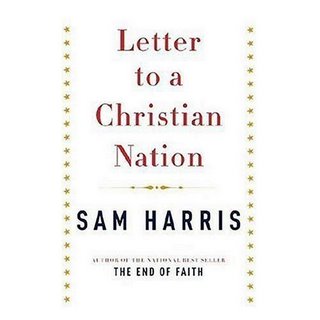
"Letter to a Christian Nation" by Sam Harris - here, in a book the slender length of a long letter, is the argument Richard Dawkins' "The God Delusion" SHOULD have been.
My esteemed colleague Hippolyta recommended the booklet to me, and she was right: Harris is fantastic in the clear, fearless way he takes on organized religion - he never overreaches, never antagonizes the crackpots, and his narrative method, addressing his polemic to an imagined 'you' representing Christian America, gains power and momentum very subltly as the pages go by.
He makes some devastating points, and unlike Dawkins, he never glories in them. He points out that no matter how you view the destruction of New Orleans in the wake of Hurricane Katrina, the doomed faithful trapped in their attics as the waters rose were 'talking to an imaginary friend' when they prayed to a God who was either impotent or vindictive. He relentlessly points out how the Bible itself never shows any sign of having been written or inspired by anbody with any more advanced knowledge of the world than the first century of the present era - no hint of higher mathematics, no suggestion of future science, literature, or even morality (he's particularly hammering on the Good Book's benevolence toward the practice of slavery).
It's a damning portrait, and one that Christians would counter by saying God wrote only a book the minds of his followers could understand at the time. Harris has an answer for this - that surely a kind deity would take into account how chary He'd be with future Revealed Texts and throw in at least something about the Crusades, or World War One, or the bird flu.
The book is broadside short mainly because that's all it NEEDS to be, if its author eschews the throwing of stinkbombs and sticks to his task. This author does, magnificently so - again, not a book to give to Aunt Bertha (unless you're lucky enough to have a COOL Aunt Bertha, but that's not likely), but definitely something to give to any of the young faithful you might know. If it gets under their skin, good - the world can use both more atheists and more thoughtful Christians. It's thorough, conscientious case for the opposition, and you can tell them I said so.
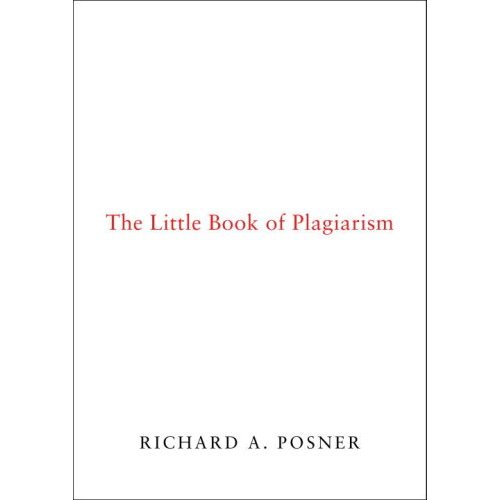
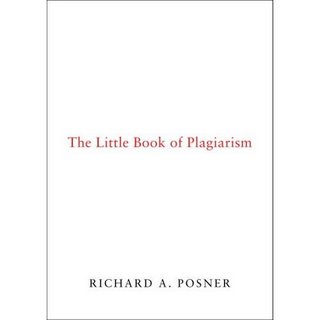
But make sure to CREDIT me! That admonition really comes home after reading Richard Posner's tiny new book, "The Little Book of Plagiarism," in which the big subject is explored with rigor, candor, and an appealing prose style.
Judge Posner quickly and intelligently shows us that the concept of plagiarism is far more complex than simple copying, and it's amazing how much ground he illuminates in only 110 pages. No matter what you think of the several high-profile plagiarism cases to make the news in recent years, you'll find this book thought-provoking.
It has only one lacuna, and it's a puzzling one. Judge Posner likes to tout himself as a take-no-prisoners intellectual, but on the subject of plagiarism, he lets Alan Dershowitz off with barely a slap on the wrist. Dershowitz plagiarized huge, iceberg-sized chunks of his book "The Case for Israel" from Joan Peters' book "From Time Immemorial," and yet neither these books nor Peters' name is even mentioned in Posner's book.
We here at stevereads have long wondered why Dershowitz didn't lose his job over "The Case for Israel." True, he generously cites Peters' book, but he also generously steals from it even when NOT citing it, and the point-by-point comparisons were brought to the public's notice in several periodicals. And yet, there Dershowitz is today, still publishing every word that crosses him mind, and here, in a book on plagiarism that actually mentions him, the case isn't even discussed. So the mystery goes on ...
No mystery involved in our last item, "World Poetry," an anthology of world verse edited by Katherine Washburn, John Major, and Clifton Fadiman. The only question some readers may have is why I'd buy a copy of a book I already own.
Ah, thereby hangs a tale. You see, years and years ago, I was wooing a young poet (my rival was his own time-wasting narcissism, a formidable foe), and this big, fat anthology was our sacred text. Many's the night we'd drunkenly read choices from the gushing cornucopia herein represented!
As a result, my original hardcover grew tattered, despined, and drenched in wine-stains. Ordinarily, this would be no bar to citizenship on my bookshelves (I'm not, as some of you may know, the most fastidious person on Earth) - except that in this case, young poet or no young poet, I still love and regularly consult "World Poetry" - which is difficult to do, when a book is falling apart. Hence, the new volume.
But oh! New volume or no, the old charms remain! Here again are all the poems my young poet and I read back and forth in our giddiness to become friends! We ranged the whole of the world and back, but you loyal readers need only be patient for the two poems I feel safe in calling our favorites:
Drinking Alone in the Moonlight
Beneath the blossoms with a pot of wine,
No friends at hand, so I poured alone;
I raised my cup to invite the moon,
Turned to my shadow, and we became three.
Now the moon had never learned about drinking,
And my shadow had merely followed my form,
But I quickly made friends with the moon and my shadow;
To find pleasure in life, make the most of the spring.
Whenever I sang, the moon swayed with me;
Whenever I danced, my shadow went wild.
Drinking, we shared our enjoyment together;
Drunk, then each went off on his own.
But forever agreed on dispassionate revels,
We promised to meet in the far Milky Way.
That's of course Li Po, translated by Elling Eide. And here's the other:
Late Night Ode
It's over, love. Look a me pushing fifty now,
Hair like grave-grass growing in both ears,
The piles and boggy prostate, the crooked penis,
The sour taste of each day's first lie,
And that recurrent dream of years ago pulling
A swaying bead-chain of moonlight,
Of slipping between the cool sheets of dark
along a body like my own, but blameless.
What good's my cut-glass conversation now,
Now I'm so effortlessly vulgar and sad?
You get from life what you can shake from it?
for me, it's g and t's all day and CNN.
Try the blond boychick lawyer, entry level
At eighty grand, who pouts about the overtime,
Keeps Evian and a beeper in his locker at the gym,
And hash in tinfoil under the office fern.
There's your hound from heaven, with buccaneer
Curls and perfumed war-paint on his nipples.
His answering machine always has room for one more
Slurred, embarrassed call from you-know-who.
Some nights I've laughed so hard the tears
won't stop. Look at me now. Why now?
I long ago gave up pretending to believe
Anyone's memory will give as good as it gets.
So why these stubborn tears? and why do I dream
Almost every night of holding you again,
Or at least of diving after you, my long-gone,
Through the bruised unbalanced waves.
That's an adaptation from Horace by J. D. McClatchy, and it's concluded many a wonderful late-night talk between that young poet and myself. The thing is beautiful in itself (although its defeatism and cynicism are in no way a mirror to Horace), made all the moreso by that sweet, sentimental association.
And there you have it, but a small sampling of some of our most recent books! Some are in print, some aren't yet published, some out of print - and more such notices to come, in due time ...
 Our book today is Archibald Campbell's big fat dense opinionated 1924 volume Horace, which is, pound for pound, my favorite book on Quintus Horatius Flaccus, that most beloved and approachable of Roman poets. So approachable, in fact, that Campbell's book had to win its spot in my heart against some incredibly fierce competition: there have been thousands of good books written about Horace in the last three hundred years, arguing over every single possible aspect of the poet and his work - from the details of his life to the order of his poems to his influence on every poet who's come after him. W. Y. Sellar, Gil Highet, D.R. Shackleton Bailey, Eduard Fraenkel ... the list of first-rate scholars, writers, and popularizers who've taken Horace as their subject is very long. Campbell himself is alive to this fact (he himself was writing in Sellar's shadow) and fills his donnishly chatty book with reasons why Horace would enjoy such an appeal: