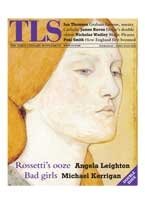
This week's issue of the mighty TLS is a double issue, which immediately prompts the wintry knowledge that there'll be no TLS NEXT week. But at least for now, we can dig in and feast!
Ah, the TLS! The smartest, meatiest literary publication on Earth (Stevereads yields the honor!) - and yet, as enjoyable as it always is, it has its prejudices ... like a beloved grandparent whose well-worn anecdotes sometimes feature 'japs' or 'kikes.' The discordant notes cause a bit of an internal wince, but they don't kill the affection.
And so it is with Adam Kuper's review of the University of Illinois'
Killing Animals in this current issue. The TLS' house line regarding books about what could sloppily be termed 'animal rights' can be summed up as bemusedly Tory: the people who write such books are obviously a little dotty, but they aren't doing anybody any harm, so we might as well pat them on the head from time to time with a review or two.
These are the only occasions when the TLS makes me sigh.
Kuper treats this anthology of animal rights essays with the strained toleration of a parent for a slightly wayward child, and you can tell right from the start that his condescension will cause him to mis-state and oversimplify everything in the book. You know going into the review that you won't be reading a fair review of the book under consideration, but you read it anyway - hoping, I guess.
But there's no hope here. The review is full of snide parenthetical asides (one hopes the book's editors won't stoop to respond) and mandarin deplorings of touchy-feely enthusiasms gone too far. This ought to suffice as an example, though it's distasteful to quote so much of it:
Clare Palmer's essay on the killing of cats and dogs in animal shelters is somewhat out of place here, since her facts are relevant to the United States. Palmer tells us that pets in America are kept for an average of only two years (does this include goldfish?), and gently mocks a new politically correct vocabulary in which pets are referred to as companion animals, while owners are termed guardians. On average, six out of ten stray dogs and eight out of ten stray cats are killed in animal shelters in the US because they are difficult or cannot be placed with new owners. But what is to be done with the stream of animals that are brought to these shelters? As Palmer herself asks, are we supposed to fund an animal welfare state? While she advocates a programme of education for companion animal guardians, it may be that sex educations for pets will be required.... at which point, everyone at the squire's table burbled over with laughter ... and then Mimsy mentioned something about flower-children over in Pennington-by-the-Marsh ...
Ecch.
There's no end of things wrong with that passage, but note for instance how the reader is invited to read 'because they are difficult AND cannot be placed with new owners" ... the not-so-subtle BLAMING of the glut in animal shelters on the animals themselves, who, if they tried a little harder, might be less 'difficult.'
And that oh-so-clever little bit of mockery about sex education for pets - which manages not only to mock the idea of sex education for HUMANS but also to willfully ignore the possibility that human 'guardians' might take responsibility for the problem. Gawd forbid.
The review of course quotes Dr. Johnson (the calm-tide safe haven for all idiot quote-hunters): "There is much talk of the misery which we cause to the brute creation, but they are recompensed by existence. If they were not useful to man, and therefore protected by him, they would not be nearly so numerous."
To which Kuper adds: "Should everyone adopt the Jewish and Muslim taboo on eating pigs, there would soon be only a handful of pigs in existence, and they would be in zoos."
Spoken, it need hardly be pointed out, like a human. I'm going to go out on a limb here and guess that those few pigs wandering around in future zoos - fed every day, washed every week, able to cavort for the cameras of paying customers, wouldn't MIND being the only pigs left on Earth, if the alternative were to live their entire lives in a pen the size of a mailbox, unable to turn around, pumped full of steroids, skin burned off their hind legs by the urine they can't avoid spraying on themselves, never seeing or touching another pig (or another living being) - at least until the last four hours of their lives, where those behind get to hear those in front screaming while they're being slaughtered.
But at least they're ALIVE ...
Luckily, the rest of the issue isn't nearly so bad, although there are dim spots elsewhere as well.
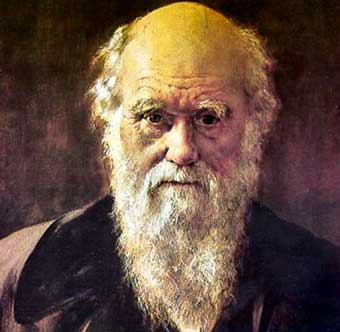
Take, for instance, John Taylor Bonner's review of two massive Darwin compendiums,
From So Simple a Beginning and
The Indelible Stamp.
Bonner writes that Darwin's theory of natural selection met with mixed responses even among biologists of the time: "There was a strong feeling, not always openly expressed, that despite the obvious common sense of natural selection, there must be something else ... the fact that evolution went from simple to complex made it seem that there was something more than directionless natural selection."
He goes on:
What I find fascinating is that this is no more of a scientific explanation than saying it was ordained by God. In both cases there is a mystical force that is beyond the reach of science. It is a quirk of the human mind: there are some things, such as the intricate marvels of evolution, that need more than a bare Darwinian explanation. Natural selection is too simple a principle to account for the vastness of organic evolution. We think today that the current advocates of William Paley's intelligent design err in confusing science and religion, but some biologists over the years, and maybe even now, commit the same sin.Bonner claims to be a scientist himself, so he ought to know better than to say so glibly that evolution goes from simple to complex. I'm sure my young friend Elmo would leap to the same example that occurred to me: the three-toed tree-sloth. Today, after millions of years of evolution, it a) can barely see, b) can barely move, and c) can only live on one kind of leaf from one kind of tree. Things don't get any simpler than that. Judging from tree sloth dental developement, its evolutionary ancestors were wild and crazy guys. In this case - as in so many cases (they're virtually innumerable in the insect kingdom) - natural selection worked from complex to simple, in order to exploit a very specific niche.
And of course Bonner is right to chide present-day evolutionary biologists who've lost sight of the fact that evolution by natural selection is an entirely BLIND process. Or rather, purblind - it addresses any organism's immediate needs, often (in fact, in the overall track-record of life on Earth) with fatal long-term results. Almost nothing is dinosaur-and-meteor. Almost everything is evolution-and-dead end.
Actually, looking over our table of contents, I'm forced to realize that quite a few reviewers this time around irked the daylights out of me. Take John Ray's review of
Rescuing the Past, a book about the whole question of whether or not countries can demand back their great works of art currently housed elsewhere. I'm glad Ray is an amusing writer, but he's still as irritating as a late-night drunken phone call:
One of my favorite paintings is the view by Monet of Antibes which is now in the galleries of the Courtland Institute in Somerset House. I would like the original, and would try my best to dust it regularly. It may be that if I hire some teams of private investigators, and then sex up a dossier or two, I can demonstrate publicly, or at any rate to myself, that there are academics in the world of London art-history whose ethical lives sometimes fall short of that of Mother Teresa of Calcutta. I think I can see the pine tree in the middle of the painting hanging its branches in dejection, waiting to be rescued from all the mediocrity and sleaze. Clearly Monet's work of beauty would be better off in a purer environment, namely on the walls of somebody like me. In practice this will not happen, but what if I had the money and political influence to seriously challenge ownership of works of art on moral grounds which just happen to benefit me?He goes on (and hence, so do I, ya attention-deficited little twerps ...):
Suppose I find a toddler clutching a teddy bear. I recognize the bear as one of an extremely rare transitional design, which perfectly fills the remaining gap in my collection. Intellectually, I can make sense of that bear in a way that the toddler cannot. Obviously my claim to ownership of the toy is superior, because I am a philosopher of these things. Can we demand that he sell it to me, on the grounds that he does not know what he is carrying, and the bear does not deserve such a fate?Ray, obviously, comes down squarely against the idea that there can ever be a superior RIGHT to ownership - while deploring the author's insinuation that artworks' home countries are rude, undeveloped places, Ray unconsciously AGREES with the author by representing such countries as a child with a teddy bear. The upshot of his analogy goes something like this: OK, I accept that the child doesn't understand the significance - or even, on most levels, the beauty (and, by implication, the fragility) of what he's got ... but nevertheless! It's HIS, and we can't up and take it from him under any circumstances, even if it means we have to stand by and watch him rip it to shreds.
To which I say: horsepoop.
The world's great works of art belong to the world. If the country wherein they just so happen to originate can't PRESERVE them (and failure here is exceedingly easy to determine: you turn your head, open your eyes, and LOOK at the fucking thing), they forfeit the right to KEEP them. Any other viewpoint - especially if it involves the words 'cultural imperialism" - is just nonsense. What, there's supposed to be some kind of VIRTUE in watching a masterpiece disintegrate?
Nope, Ray is wrong. Screw the little kid - snatch that teddy bear away!
But look! There's a light at the end of the tunnel! The only other irritating thing in this TLS is a review of Roger Scruton's new memoir
Gentle Regrets by A.N.Wilson.
I'm sorry - did I call it a review? I meant something closer to a sweaty, urgent, yearning hand-job. Words can be so funny, huh?
I honestly don't know what would possess the ordinarily-astute Wilson to go on at such enormous length so fulsomely praising such a monumental boob as Scruton. I assume there were Polaroids in Scruton's possession, and I assume they've now been destroyed.
Audiences were "awestruck" by his opera 'Violet'? Iris Murdoch "especially admired" his novel "Fortnight's Anger"? Scruton is "much better than Bertrand Russell at summarizing other philosophers' viewpoints"? "Professor Scruton draws a portrait of that most fascinating of beings, himself"?
What the Hell did Wilson DO, anyway? Even sheep-shagging wouldn't account for this kind of genuflection. The world may never know.
Ah, but other authors bring joy! Ruth Scurr turns in a delightful review of the diary of John Evelyn, a book you should all read (although not before you read Pepys!).
There are excellent pieces on Christopher Marlowe's poetry, and on the life and trials of Edmund Campion (including a delightful foray into whether or not Philip Sidney was a secret Catholic) ... EVER so much to delight the serious reader of history and literature, in an age where the most you can expect from most other readers along those lines will be their appreciation of
Undaunted Courage or
DaVinci Code.And of course the dessert is J.C.'s "NB" column, where dry wit reigns supreme. For instance, in sampling the contents of the latest
Whitaker's Almanack Pocket Reference, there's this:
The Almanack offers a catalogue of over sixty phobias, all relating to things you felt fine about until you learned of the existence of a phobia. Here are some, concerning which we invite you to provide real-life cases:venustaphobia - fear of beautiful womenpogonophobia - fear of beardsoenophobia - fear of winepeladophobia - fear of baldnesschorophobia - fear of dancingErgasiophobia (fear of work), dentophobia (the dentist) and gamophobia (marriage) are more plausible; given that rhytiphobia (fear of getting wrinkles) is practically universal, we are surprised not to have seen the word before.To which I join J.C. in asking for examples - but from you, my legion of loyal readers! Confession time! How many of the phobias J.C. lists have haunted your darkest hours? Or what other fears might take their place (you can browse the list at www.phobialist.com)?
In the spirit of cooperation, I'll admit that I myself sometimes experience touches of two of the phobias listed (and, needless to say, I very much do NOT ever experience one of those on the list!). And judging from previous comments, my friend Beepy has at least begun to deal with the heartbreak of pogonophobia...