Showing posts with label lord byron. Show all posts

Sunday, January 09, 2011

Byron: The Last Journey

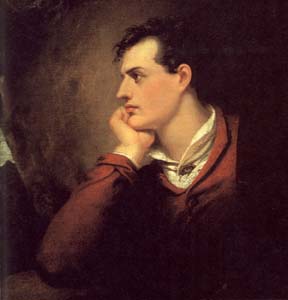
Our book today is Harold Nicolson's quietly stunning 1924 work Byron: The Last Journey, chronicling that strangest of strange biographical stories, the decision Lord Byron made in 1823 to pack up from Italy and go to Greece, to Missolonghi, in order to throw his support, his money, and if need be his physical valor into the cause of Greek independence. It's in every way an exaggerated, outsized story, as crammed with doomed heroism and tattered romanticism as Byron could make it - even if we read an account of it with all the names taken out, we'd know we were reading, somehow, the last adventure of the author of "Childe Harold." Indeed, I sometimes think the foremost tragedy of Byron's pathetic mission to Greece is that he himself didn't live to record it in the beautiful-silly verse of which he was the greatest master since Ariosto.

The story Nicolson tells will be familiar in its bare outlines to anybody who's ever taken a college poetry class. After years of self-imposed exile in Italy, Byron was finally restless enough to extract himself from his vari0us enervating routines and move himself and a limited entourage to Greece, where he hoped his advocacy would lend prestige to the cause of independence - and where he very quickly became frustrated, bored, and then dead.

To his credit, Nicolson tells the story as if it weren't so familiar to his readers - it's this freshness that makes the book so eminently readable, and its a strong force in most of Nicolson's two dozen or so books. He was a hack in the best sense of the word, a literary taxi for hire, someone who would undertake the requisite research and turn out a damn readable book on virtually any subject if a publisher promised money for the job. Such writers are a dime a dozen in this age of Wiki-experts, but at the time this book was written, such a lack of scholarly provenance could tell against an author with the august critics in the TLS and other such tribunals. There's nothing a dabbler hates worse than being called a dabbler.

I think that's why Nicolson is at pains all throughout his book to emphasize that some point he's about to make derives from an original document he has in his possession - a bill of sale, a private notation of an autopsy report, or even a treasured volume:
I have in my possession the actual copy of Moore's "Life of Byron" which belonged to John Cam Hobhouse, the most intimate and the most truthful of all Byron's friends. In the wide margins of these two quarto volumes Hobhouse has pencilled a running commentary - approving, at moments, of Moore's flashy conclusions, supplementing them at moments from his own store of reminiscences, but in general contradicting them with the conviction, and sometimes with the asperity, of more intimate and exclusive knowledge. "Admirable," he has scribbled against certain paragraphs; "excellent but too fanciful," he comments at another place; "very possible," he annotates occasionally, or again, "This is the very man." Such confirmatory rubrics are, however, the exception; in most cases and invariably when Moore has allowed himself the luxury of a too romantic representation, Hobhouse's comments are trenchant and negative: "Most unlikely," he pencils; "I do not believe it;" "This is a lie;" "My dear T. M., you know nothing whatsoever of the true facts;" "Oh, no, Mr. Moore!" And sometimes merely "Oh, no!"

The tour through stalwart Hobhouse's comments is of course hugely entertaining, but that "I have in my possession" crops up throughout the book and speaks of a certain insecurity, as though Nicolson knows he's trespassing on well-trod scholarly ground and needs some stronger passport than his own interest (or the aforementioned promise of pay), when really his best safe conduct is his own marvellous ability to breathe life into his subjects. He stresses that he's got an invaluable primary document right in front of him, but as fascinating as that document is, it's outdone by his own summaries:
He knew that his friend was irresponsible and kind; that he was humourous and childish; that he was infinitely muddle-headed and unspeakably perverse; that he was irritable sometimes, and generally lazy, and a little mad perhaps, but then so sincere, affectionate, gentle; and of course appallingly weak; but then "always so very funny." Hobhouse could never quite get over how very funny Byron was. "Of all the peculiarities of B.," he has scribbled at the end of Moore's biography, "his laugh is that of which I have the most distinct recollection."

Naturally, any account of Byron's last weeks must include a few hatchet-swipes at the deeply divisive figure of Edward Trelawny, the hard-drinking companion who was so distrusted by so many of Byron's friends, with the notable exception of Mary Shelley:
"Trelawny," records Mrs. Shelley in her diary five days subsequently, "is extravagant - partly natural, and partly, perhaps, put on, but it suits him well; and if his abrupt but not unpolished manners be assumed, they are nevertheless in unison with his Moorish face, (for he looks Oriental, yet not Asiatic), his dark hair, his Herculean form; and then there is an air of extreme good nature which pervades his whole countenance, especially when he smiles, which assures me that his heart is good."

Is she - who knew the man - allowed to have her say? Well, not quite:
In this Mrs. Shelley was mistaken: Trelawny had no heart at all; all that he possessed was a capacity, an excessive capacity, for egotistic enthusiasms. Besides, Trelawny was a liar and a cad.

Hee.

But whether Nicolson's (and every other Byron biographer's) dislike of Trelawny springs in any part from jealousy (some time soon I'll have to do a post on the man - he's had some very enjoyable biographies/diatribes written about him in the last two centuries), the fact remains that the characterization, however biased, is magnificently vivid, as are the characterizations of everybody in this book. None more so than the star attraction himself, who Nicolson often approaches with a decidedly novelistic flair that only a very strong writer can pull off:

Byron for his part shared none of these illusions. To him the future loomed more nebulous and less convincing. Subjective and sceptical, he was solaced by none of the confident convictions of his assistant. He did not believe very much in the Crown and Anchor: he had known them all too intimately. He did not believe unduly in the immediate perfectibility of Hellenic character: here again his experience militated against his credulity. He believed least of all in the efficiency of Lord Byron: his irradicable and realistic modesty precluded so seductive a fallacy. For him it was just a wet afternoon like any other; perhaps it would clear by four o'clock, and he could have his ride after all; meanwhile he might fence with Gamba; no, Gamba was in disgrace for the moment, because he had muddled the accounts at Cephallonia, and bought all those yards of red cloth that no one wanted. He drummed again upon the streaming window. It was such a bore being thirty-six.

I came across a pretty paperback reprint of this book just recently (a friend very kindly made sure I saw it) and soaked it up all the more greedily for the fact that I'd just lamented to another friend that I feared I'd finally read all the biographies of Byron. I'd missed this one, and the discovery made an already sweet reading experience all the sweeter. I wouldn't recommend it as anybody's first Byron book, but if you've already got a biography of the man under your belt, find yourself a copy - you'll be well pleased!

Thursday, January 06, 2011

The Oxford Book of Friendship!

Our book today is 1991's Oxford Book of Friendship edited by D. J. Enright and David Rawlinson, a book that clocks in at only about 360 pages and yet is chock-full of great stuff on that most elusive and yet universal feature of human life and certainly human literature: friendship.

To put it mildly, I've made something of a study of the subject in my own life. I was lucky enough to spend most of my childhood with the best friends imaginable, but the luck was double-edged, because those friends were dogs, and it took me a long time to realize that the reason I wasn't finding friendships among humans that were anywhere near as strong as those I found everywhere with dogs was tragically simple: dogs are better at friendship than humans are, in just the same way that, say, humans are better at language than dogs are. "I want to know as I am known," scripture cries out, and of course that's been the driving personal dynamic of humans since they first achieved their current level of murderous sentience. The enormous conceptualizing capacity of the human brain comes with a huge price: the isolation of being the smartest, creepiest, most deceitful species on the planet, or in the planet's history.

Which makes mankind's search for simple friendship all the more moving, I guess - it certainly makes that search an all the more natural candidate for artistic treatment, and for the well-placed quip. Enright & Rawlinson's great book (yet another in a long line of great Oxford Books) is broken into many different aspects of friendship - "Among Men," "Among Women," "Youth and Age," "Animals," etc. - and each section is full of quotes and excerpts from a very pleasingly wide variety of authors. Here's a sampling:
It should be a part of our private ritual to devote a quarter of an hour every day to the enumeration of the good qualities of our friends. When we are not active, we fall back idly upon defects, even of those whom we most love.  (some jasper named Mark Rutherford)

Oscar Wilde said of me 'An excellent man: he has no enemies; and none of his friends like him.' And that's quite true: they don't like me; but they are my friends, and some of them love me. If you value a man's regard, strive with him. As to liking, you like your newspaper - and despise it. I had rather you remembered one thing I said for three days than liked me (only) for 300,000,000,000,000,000 years. (George Bernard Shaw, to Ellen Terry)

A man who has few friends, or one who has a dozen (if there be any one so wealthy on this earth), cannot forget on how precarious a base his happiness reposes; and how by a stroke or two of fate - a death, a few light words, a piece of stamped paper, a woman's bright eyes - he may be left, in a month, destitute of all. (Robert Louis Stevenson, in Virginibus Puerisque)

George wondered if this was what being old meant: everything you wanted to say required a context. If you gave the full context, people thought you a rambling old fool. If you didn't give the context, people thought you a laconic old fool. The very old needed interpreters just as the very young did. When the old lost their companions, their friends, they also lost their interpreters: they lost love, but they also lost the full power of speech. (Julian Barnes, writing out his ass as usual)

Love is like the wild rose-briar,

Friendship is like the holly-tree -

The holly is dark when the rose-briar blooms

But which will bloom most constantly?

The wild rose-briar is sweet in spring,

Its summer blossoms scent the air;

Yet wait till winter comes again

And who will call the wild-briar fair?

Then scorn the silly rose-wreath now

And deck thee with the holly's sheen,

That when December blights thy brow

He still may leave thy garland green.

(Emily Bronte's "Love and Friendship," from 1839)

And we could hardly close on the subject of friendship without this last poem, even though Enright and Rawlinson choose not to include it in their anthology:
When some proud son of man returns to earth,
Unknown to glory, but upheld by birth,
The sculptor's art exhausts the pomp of woe
And storied urns record who rest below:
When all is done, upon the tomb is seen,
Not what he was, but what he should have been:
But the poor dog, in life the firmest friend,
The first to welcome, foremost to defend,
Whose honest heart is still his master's own,
Who labours, fights, lives, breathes for him alone,
Unhonour'd falls, unnoticed all his worth--
Denied in heaven the soul he held on earth:
While Man, vain insect! hopes to be forgiven,
And claims himself a sole exclusive Heaven.
Oh Man! thou feeble tenant of an hour,
Debased by slavery, or corrupt by power,
Who knows thee well must quit thee with disgust,
Degraded mass of animated dust!
Thy love is lust, thy friendship all a cheat,
Thy smiles hypocrisy, thy words deceit!
By nature vile, ennobled but by name,
Each kindred brute might bid thee blush for shame.
Ye! who perchance behold this simple urn,
Pass on--it honours none you wish to mourn:
To mark a Friend's remains these stones arise;
I never knew but one,--and here he lies.

That's of course Lord Byron, writing an epitaph for a beloved dog. He's being hyperbolic (I mentioned it was Byron, yes?), but not much more so than, say, Kipling or Burns would be. And it's hard to think systematically about the phenomenon of friendship without thinking of dogs - at least for me. The rest of you need not worry, though: you'll find this wonderful anthology for the most part very comfortingly human-oriented.

Monday, April 12, 2010

A Garden of Roman Verses!


Our book today is a pretty little volume the J. Paul Getty Museum put out in 1998 – it’s called A Garden of Roman Verse, and it features snippets from dozens of different Roman translations, each set in attractive typeface and accompanied by full-color reproductions of ancient Roman paintings or mosaics recovered from the entombed cities of Pompeii and Herculaneum. The book’s title guarantees that you’ll be meeting Virgil, Horace, Catullus, Ovid and the rest inside, but nevertheless the title is a bit misleading. This isn’t really a garden of Roman verse so much as it’s a garden of English verse.

It’s no less pretty for all that, as even a casual dabbler into the vast translation-literature of English poetry could attest. First flowering in the Age of Elizabeth and continuing in an unbroken tradition to the 19th century (it limped into the 20th and has died almost utterly in the Twittering 21st), the efforts of English poets and classicists to render the ancient greats in contemporary verse were unrelenting. It was the favorite pastime of procrastinating dons, the most predictable route to publication for aspiring poetasters, and a sublime alternate voice for the greatest masters of the various British eras.

The singular charm of this little volume is that it touches on all of those various exponents. This isn’t just Alexander Pope’s Greatest Hits, although of course he’s in here, hilariously letting his ‘numbers’ get the better of him, as in this rather verbose rendering of a mere two lines from Virgil’s 7th ecologue:
Some god conducts you to these blissful seats,
The mossy fountains and the green retreats!
Where-e’er you walk, cool gales shall fan the glade,
Trees, where you sit, shall crowd into a shade,
Where-e’er you tread, the blushing flowers shall rise,
And all things flourish where you turn your eyes.

And in an undertaking such as this one, where there’s Pope, there must be Dryden! Here’s here a few times, never more felicitous than in this bit from Virgil’s Georgics:
Wet weather seldom hurts the most unwise,
So plain the signs, such prophets are the skies:
The wary crane foresees it first, and sails
Above the storm, and leaves the lowly vales:
The cow looks up, and from afar can find
The change of heaven, and snuffs it in the wind.
The swallow skims the river’s watery face,
The frogs renew the croaks of their loquacious race.

I love that almost tactile use of ‘snuffs,’ and the subtle echo of ‘croaks’ in the first syllable of ‘loquaious’ accurately but not pedantically reflects the ‘veteram’ and ‘querelam’ of the original. Dryden was never better than when he was quietly trying to match wits with somebody this way – it’s when he has the poetic stage to himself that he sometimes gets into long-winded trouble.

Long-windedness isn’t a problem for the famous adventurer Sir Walter Ralegh, who here gives us a portion of the soles occidere of Catullus very nearly as taut and pointed as the original:

The sun may set and rise:
But we contrariwise
Sleep after our short light
One everlasting night.

But it’s not just the mighty and famous you’ll find in this volume (if you can find this volume at all – I presume it’s available online, like everything else) – the editors have seen fit, charmingly, to include a small sample from “the young gentlemen of Mr. Rule’s Academy at Islington.” This is a bit of the parcius iunctas of Horace, published in 1766:
The bloods and bucks of this lewd town
No longer shake your windows down
With knocking;
Your door stands still, no more you hear
‘I die for you, O Lydia dear’,
Love’s god your slumbers rocking.

Horace is also represented by the volume’s only selection from a woman, this portion of the solvitur acris done by Lady Mary Wortley Montagu:
Sharp winter now dissolved, the linnets sing,
The grateful breath of pleasing Zephyrs bring
The welcome joys of long desired spring.

The galleys now for open sea prepare,
The herds forsake their stalls for balmy air,
The fields adorned with green approaching sun declare.

In shining nights the charming Venus leads
Her troops of Graces, and her lovely maids
Who gaily trip the ground in myrtle shades

And sadly, there are names here that lack the glitter of either Lady Mary or her arch-nemesis (every writer should have one) Pope, though not from wanting it badly. Foremost here must be our sad old acquaintance Branwell Bronte, the alcoholic failure dreamboat brother of those super-talented Bronte sisters. There’s a snippet of his work on the sunt quos curriculo of Horace – showing, it must be admitted, a bit of strain:
Many there are whose pleasure lies
In striving for the victor’s prize,
Whom dust clouds, drifting o’er the throng
As whirls the Olympic car along,
And kindling wheels, and close shunned goal
Amid the highest gods enroll

And naturally no such anthology would be complete without that most Romanesque of all the Romantics, Lord Byron. His translations form the Romans were, you should pardon the expression, legion – we’ll never known how many he consigned to the fireplace, but what we have is almost universally choice. And really, could there readily be a better latter-day candidate to do justice to the passionate mood-swings of Catullus? We’ll let them both have the last word here:
Equal to Jove, that youth must be,
Greater than Jove, he seems to me,
Who, free from jealousy’s alarms,
Securely, views thy matchless charms;
That cheek, which ever dimpling grows,
That mouth, from which such music flows,
To him, alike, are always known,
Reserved for him, and him alone.
Ah! Lesbia! though ‘tis death to me,
I cannot choose but look on thee.

Tuesday, December 15, 2009

What Ails the Little Fella in the Penny Press?


The Commentary in last week's TLS is by John Barnard (too much to hope that in addition to being a stodgy academic he's also related to the author of such minor-key classic murder mysteries as The Bad Samaritan?), and it's a pretty good example of the hand-wringing pettifogging that does so much to disenchant ordinary civilians with the world and the antics of literary criticism. The essay is heralded on the issue's cover with the preposterous banner-line "Who Killed John Keats?" - the thing is titled "A Sleepless Night," and the teapot hosting this particular tempest is the savage critical reception accorded young John Keats by Blackwood's and the Quarterly Review upon publication of his long poem Endymion in 1818.

Two indisputable facts follow here: 1) Keats was understandably bitter about this kind of ferocious critical response (and he was if anything more outraged at the suggestion that this was some kind of trial by fire, and that reviews of his future works would be correspondingly gentler), and 2) Keats died three years later, of consumption, in Rome. And since the very moment #2 happened, half the nincompoops in the Western world have been trying to prove #1 caused it. In this issue of the TLS, Barnard comes as close as a cautious soul could dare to joining the nincompoops.


Keats' friends started the whole business almost as soon as he died, hinting and then outright saying the depression caused by bad reviews broke Keats, laid him open to the "decline" that eventually killed him. Lord Byron - never a big fan of Keats while Keats was alive, although a grudging but honest admirer after his death (Byron's gracious responses were often tardy but never failed to appear) - told a friend that "poor John Keats died in Rome of the Quarterly Review" and inserted the famous line into Don Juan about Keats being "snuffed out by an article," and the idea caught on. It's the silliest damn thing going, and Barnard's subject in this Commentary is Charles Cowden Clarke, a long-time intimate friend, cheerleader, and sometime-mentor to Keats.

In 1821, Clarke wrote a long letter to the Morning Chronicle describing how badly those negative reviews hurt young Keats' feelings:

If it will be any gratification to Mr. Gifford [the dastardly reviewer, he assumed] to know how much he contributed to the discomfort of a generous mind, I can so far satisfy it by informing him, that Keats has lain awake through the whole night talking with sensative-bitterness of the unfair treatment he had experienced ...

Twenty-five years later, Clarke (who was a good-natured if egotistical boob - a combination that can perhaps be gleaned by the fact that he had his doe-eyed amiable face painted smack-dab between Chaucer and Shakespeare) wrote up a formal memoir of Keats and published it in The Atlantic Monthly, but in this much earlier letter, Clarke describes Keats' first meeting with the painter Benjamin Robert Haydon. Haydon asks Keats if he loves his country, and Clarke writes, "how the blood rushed to his cheeks and the tears to his eyes, at his energetic reply."


Barnard takes that line and has an insinuation field-day with it, writing: "... Keats's ardent patriotism, and the swiftness of his physical responses when emotionally aroused, are both well attested."

Yes, but there's a bit of difference between getting all gushy over love of England and up and dying because Blackwood's hated your book. As Barnard himself reports, we have plenty of accounts that say Keats shrugged off his critical savaging fairly quickly - and his own letters testify eloquently to two facts: 1) he never stopped writing poetry, even during the worst of his critical reception, and 2) he never seems to have seriously doubted that his poetry would make his name immortal. The little tobacco addict was just about as tiny and epicene as an adult human being could physically be, but he was every bit as tough as Lord Byron (who often said that after his own early critical drubbing he drank three bottles of claret and got back to work) when it came down to it.

Clarke loved insinuating otherwise - that this brave young hart of his was drawn and bayed by savage book critics, those purveyors of "coarse pandarism to depraved appetites," those launchers of "the torpedo touch," those deployers of "the pikes and bayonets of literary mercenaries" - and it looks like John Barnard is willing to second him.

But I'm one of those literary mercenaries (and I am, on occasion, rather proud of my torpedo touch), and I say enough's enough! It was plain old Mycobacterium tuberculosis that killed John Keats, who would otherwise have gone right on writing gorgeous poetry no matter what a hundred Quarterly Reviews had to say about it.

Friday, November 14, 2008

The Signet Classic Poetry Series!


Writing about the Oxford World's Classics just now has turned my mind, somewhat predictably, to other book-series I've loved. It's not that implausible a leap: how books are published, the way they're packaged and presented to the reading public, forms a larger segment of how readers enjoy those books than I think gets credit. Certainly my own bookshelves are almost universally populated by not only the books I love most but the versions of those books I love most. If I didn't care about such things, if the only thing that concerned me was raw content, I'd have every Dover edition ever printed, and precious little else.

But invariably, the well-exercised love of books entails more than raw content. We come to like the way certain books feel in the hand, the way they look on the shelf, the way certain notes seem to answer all our questions in just the right way, or how certain abridgements seem to have all the good bits and none of the bad ones, or how the writer who pens the book's Introduction uses just the right tone, inviting but not fawning, collaborative but not condescending. Dozens of intangibles like these go into determining, for instance, which collection of Yeats we'll have, or what edition of The Pickwick Papers.

So it's entirely permissible that I'm thinking about book-series and recalling the ones I've particularly liked. And as Open Letters gears up for its January Poetry Issue, my thoughts naturally turn toward the innumerable volumes of poetry I've owned in my life. Not modern poetry, mind you, although well-meaning friends have been giving me volumes of it for decades - precious little of it seems to find purchase with me, but that doesn't mean I don't love poetry dearly ... and the series I find myself going back to again and again is the long-defunct Signet Classic Poetry Series.


These were solidly-manufactured white paperbacks printed in the 1960s on paper-stock slightly heavier than the norm (then or now) , featuring generous selections from the canonized poets of England and America (Marvell, Sidney, Spenser, Whitman, Milton, Keats, Shelley, etc). Each volume had a specially-commissioned introduction in which the master of ceremonies gave us an overview of the poet's life and times and, in the better attempts, a couple of good quips, as when John Hollander warns us of the "self-absorbed, sometimes drab lyrics" of the Arcadia of Sir Philip Sidney - a good phrase and maybe not entirely wrong about Sidney, who could go on a bit much in this vein:

Over these brooks trusting to ease mine eyes,
(Mine eyes even great in labor with their tears)
I laid my face; my face wherein there lies
Clusters of clouds, which no sun ever clears.

In wat'ry glass my wat'ry eyes I see:
Sorrows ill eas'd, where sorrows painted be.
My thoughts imprison'd in my secret woes,
With flamy breath do issue oft in sound:
The sound of this strange air no sooner goes,
But that it doth with Echo's force rebound,
And make me hear the plaints I would refrain:
Thus outward helps my inward griefs maintain.

John Arthos gets the thankless task of introducing John Dryden to what he had to assume would be an audience consisting largely of college students (there was a time, four decades ago, when you couldn't glance in any direction on any campus in the country without spotting one of these books), and he takes a straightforward approach:

Of all England's poets Dryden is the one for whom the manner of grandeur counts the most. He masters it in a hundred ways - in passion, in thought, in mockery, even in joy. He brings grandeur into the light of common day, and it is still itself.


He comments that poetic tastes have drifted away from such grandeur, and he openly laments the fact that this drift has caused Dryden to be down-graded in the poetic pantheon. "We have too often," he tells us, "disposed of as superior journalism what is in fact literature." He hoped for a Dryden revival, and of course so do I, but that forty years ago, and the general run of hipsters attending poetry slams are still in no mood for stuff like this, from Absalom and Achitophel:

Did ever men forsake their present ease,
In midst of health imagine a disease;
Take pains contingent mischiefs to foresee,
Make heirs for monarchs, and for God decree?
What shall we think! Can people give away,
Both for themselves and sons, their native sway?
Then they are left defenseless to the sword
Of each unbounded, arbitrary lord:
The laws are vain, by which we right enjoy,
If Kings unquestioned can those laws destroy.

And if Arthos had the tough task of trying to get his readers to give Dryden a chance, that's nothing compared to the feat John Donne editor Marius Bewley had before him! Dryden wrote about unfashionable topics with bell-like clarity; Donne writes about unfashionable topics (personal religious faith, than which there can be no less fashionable topic among today's themselves-obsessed young people) too, but he does it with triple-jointed, jagged-brained, almost unfollowable mental twists and turns. Bewley does his best to draft a modern analog:

The influence of T.S. Eliot's poetry on the morale of the young literary intellectuals of the twenties and thirties must have resembled, in certain respects, the stimulus that Donne's poetry provided for an impatient generation long since surfeited with Petrarchism and the poetic conventionalities of the earlier Elizabethans.


But nothing Eliot ever wrote compares to this, and this is Donne trying to be accessible:

Batter my heart, three-person'd God; for You
As yet but knock, breathe, shine, and seek to mend;
That I may rise, and stand, o'erthrow me, and bend
Your force, to break, blow, burn and make me new.
I, like a usurp'd town, to another due,
Labor to admit You, but Oh, to no end!
Reason, Your viceroy in me, me should defend,
But is captiv'd, and proves weak or untrue.
Yet dearly I love You, and would be loved fain,
But am betroth'd unto Your enemy:
Divorce me, untie, or break that knot again,
Take me to You, imprison me, for I
Except You enthrall me, never shall be free,
Nor ever chaste, except You ravish me.

The series got one famous person to write an Introduction. This was W. H. Auden, and for reasons passing understanding, he chose the Lord Byron volume. Thus, for a dozen pages or so, the reader watches, slightly appalled, while a hoof-mouthed and splay-footed irresolute yearner prissily gossips and back-bites about a man who would have eaten him for breakfast and been plenty hungry by lunch. The result is interesting in the way only ghastly mistakes can be, as here, when Auden insinuates for the hundredth time that he, why he himself, might just be a better poet than his subject:

If I had to introduce Byron to a student who knew nothing of his work, I would tell him: "Before you attempt to read any of the poetry, read all of the prose, his letters and journals. Once you have read these, you will be able, when you come to the poems, to recognize immediately which are authentic and which are bogus.

You read something like that and immediately want to corner Auden and ask him which of his own poems are bogus ... but you don't dare, because he would certainly respond by attacking you, and that might damage the gardenia you just this morning put in your lapel. Fortunately, an immutable law holds that when a poet excoriates his betters, he'll always accidentally point the finger at himself, as when Auden gamely tries to figure out just exactly why Byron is so, well, limited:

Byron's aesthetic theories, like those of any poet, were in part a set of working rules to help him write the kind of poetry it was in him to write, and in part an attempt to justify himself for not writing the kind of poetry for which he lacked the talent.


It's all the more maddening because of course Auden the poet is hugely talented, although there's nowhere in him anything as quietly beautiful as this little Stanzas for Music bauble, composed by Lord Byron in an idle afternoon but virtually swimming with translucent serenity:

There be none of Beauty's daughters
With a magic like thee;
And like music on the waters
Is thy sweet voice to me:
When, as if its sounds were causing
The charmed ocean's pausing,
The waves lie still and gleaming,
And the lulled winds seem dreaming
And the midnight moon is weaving
Her bright chain o'er the deep;
Whose breast is gently heaving,
As an infant's asleep:
So the spirit bows before thee,
To listen and adore thee;
With a full but soft emotion,
Like the swell of Summer's ocean.

There's a great deal more to savor in the collected Signet Classic Poetry Series, but alas, the whole run is out of print. Luckily, the books that flooded those campuses (each with a gorgeous, stately cover illustration) now show up regularly in used bookstores (somewhere out there are my Shelley volume and my Milton volume, both having unaccountably vanished from my shelves over the years), ready for you to give them a try.

Friday, April 25, 2008

Byron in Italy


Our book today is Byron in Italy by Peter Quennell, a slim and powerful account of the years the poet spent traveling after his scandalous behavior (alluded to in our last entry, in what is quickly degenerating into Stevereadsbyron) prompted English society to denounce him (most famously at Lady Jersey's party in 1816, in which he was 'cut' by an entire room full of people who only two years ago couldn't invite him out often enough) and England to become too bittersweet a place for him to live.

Byron is a gigantic subject, and Quennell's approach, giving precise detail to one segment of the life, is the most rewarding approach (this book can be seen as a sequel to his earlier work Byron, the Years of Fame, but it can be read entirely separate from that book). Rewarding, but also damn frustrating at times - despite the copious letters and jottings the poet left posterity, he remains maddeningly elusive. In scene after scene, anecdote after anecdote, as you read four or five accounts of one event or outburst, you'll find most of the details lining up toward some kind of unified picture - only to get the disconcerting impression that Byron himself is looking out of that picture's frame, at you, with a mocking smile on his face, as if to say, I wasn't really here; all of this bored me so.

Quennell's book makes its peace with this unsettling impression by piling on the facts and moving straight ahead - and this also is much the best tactic (Quennell's books are uniformly excellent - his biography of Hogarth remained the best work on the subject for sixty years, until it was gently but firmly supplanted in 1997 by Jenny Uglow's own Hogarth book). Here we have Byron and his entourage making their way from Venice to Ravenna to Pisa to Genoa, constantly squabbling and braying and pausing to sleep with the locals.

Byron is only 28 at the time, and he's the constant center in a never-stalling whirlwind of interpersonal drama, played out by the famous cast of characters we meet here again in Quennell's book. There's steadfast friend John Cam Hobhouse; there's opportunistic rogue Edward Trelawney; there's the poet Shelley and his wife; and of course there's poor miserable Doctor Polidori, so pathetically in love with the indifferent Byron. At one point Polidori whines to Byron that he can do anything that Byron can do, is just as good a man. To which Byron responds - you very much get the impression he's listing the first three things (from a very long list) that come to his mind - with three things he can do that Polidori cannot: "I can swim across that river - I can snuff out that candle with a pistol-shot at a distance of twenty paces - and I have written a poem of which fourteen thousand copies were sold in one day." It's a wonder Polidori had the nerve to speak at all.

Quennell is wonderful in giving the reader a sense of what Italy - and most specifically Venice - might have meant to the bitter and aching Byron:

Having touched the rock bottom of gloom and agony, his spirits bounded up again toward the surface, and burst into the sunshine of an ordinary sensual life. To his surprise, he had discovered that he could still enjoy himself.

Of course, even in Venice, where he eventually installed himself, his hangers-on, his mistresses, and his various captive animals in the great, foreboding Palazzo Mocenigo on the Grand Canal, there were impediments to complete enjoyment - foremost being the presence of his own countrymen. In one letter (not in Quennell's book, but still worth quoting!), Byron's mixed tone of contempt and humor is captured perfectly:

Mr. Hobhouse is gone to Naples: I should have run down there too for a week, but for the quantity of English whom I have heard of there. I prefer hating them at a distance; unless an earthquake, or a good real eruption of Vesuvius, were insured to reconcile me to their vicinity.

(Indeed, though Quennell is busy telling the facts of his story, it bears mentioning here that the letters of no other poet in the world are as much sheer fun to read as Lord Byron's - Auden thought them the best introduction students could have to Byron's verse, and reading even a small quantity of them handily demonstrates why: they glow with life).

For all his straightforward narrative intentions, however, Quennell is at his best when digressing to talk about poetry, human nature, and the creative arts. He says of Byron that he possessed "a peculiar degree of self-awareness (a quality very different from self-knowledge)," and he digs deep into the motivations behind the poet's famous excesses:

In every artist's nature, more or less acutely developed, there exists the impulse, which has been conveniently, if perhaps not very accurately, entitled la nostalgie de la boue. With love of order coexists a feeling for disorder; with desire for clarity, propriety, and delicate distinctions - lacking which a work of art cannot emerge from chaos - goes a taste for the kind of experience that is gross but lively. So rarefied is the atmosphere in which art is born that the artist, when he transfers his attention from art to life, often chooses to breathe a steamy and relaxing climate, the air of the brothel, the crowded restaurant, the smoke-fogged drinking party.

In other words, occasionally every great poet must have sex with a double-jointed Romanian.

(Byron himself, naturally, could be eloquent on the subject of his own creative drives, as in another ex cathedra letter:

I am glad you like it [Childe Harold]; it is a fine, indistinct piece of poetical desolation, and my favourite. I was half mad during the time of its composition, between metaphysics, mountains, lakes, love unextinguishable, thoughts unutterable, and the nightmare of my own delinquencies. I should many a good day have blown my brains out, but for the recollection that it would have given pleasure to my mother-in-law.

All of Byron's famous mistresses are here - the terrifying, imperious Marianna Segati, the serene and oddly alluring Countess Teresa Guiccioli (in order to approximate the Venetian pronunciation of her last name, try to imagine what a hissing snake would sound like if it were drowning in its own spittle - that, or dirty water sluicing very quickly through a tangled grating), and Shelley is here too, an otherworldly creature whose fascination with what it might feel like to die seemed entirely to lack the awareness that once you succeeded in feeling it, you couldn't come back and talk about it. And Mary Shelley is here, faithful in the full knowledge of how fruitless her faithfulness was.

And most of all there is Byron himself, dressing like a Renaissance prince, rising late and singing to please nobody but himself (and working - the young poetasters who fashion themselves on Byron would do well to note how fast and steadily the pages flew from Italy to London during this period), lazily smarter than everybody around him and beginning to feel like a parody of himself. That Byron is Quennell's greatest portrait, and it deserves readers.

Sunday, April 20, 2008

Melbourne


Our book today is Melbourne by Lord David Cecil, who is of a branch of the Cecils and is a direct descendant of the illustrious title character - all of which is apropos of nothing, other than that far-ranging sources (material and alive) that might otherwise have been reticent or recondite might have been flung open to somebody with those kinds of biological credentials, whereas a biographer from a row-house behind Euston Station might have had to make do with what was available in the branch library.

Or maybe not, and in either case, as in all cases, the ultimate measure will be the quality of the writing, the sharpness of the historical insight. Pedigree is meaningless to either one of those things, as one of Melbourne's greatest admirers, President Kennedy, would have been the first to affirm. And as luck would have it, Lord Cecil (the fourth son of the Marquis of Salisbury) wrote a damn fine book.

We here at Stevereads no doubt drifted onto this book through contemplating the checkered fates of Ireland over the last 150 years or so, fates in which Melbourne as Prime Minister played a large part. But regardless of the momentary predispositions with which one comes to this splendid book, one is almost immediately subsumed into the story Cecil is intending to tell, and all the old reasons for finding these pages fall away - the pages themselves give you ample reason to keep turning them. Hell, the book's prologue, titled "The World" and describing at length the wealthy Whiggish society into which Melbourne was born, is more informed, more allusive, and more beautifully written than many entire books on the subject:

Still, as unseemly as some of its manifestations were, one must admit that there is something extremely attractive in this earthy exuberance. And, as a matter of fact, it was the inevitable corollary of their virtues. English society had the merits of its defects. Its wide scope, its strong root in the earth, gave it and astounding, and irresistible vitality. For all their dissipation there was nothing decadent about these eighteenth-century aristocrats. Their excesses came from too much life, not too little. And it was the same vitality that gave them their predominance in public life. They took on the task of directing England's destinies with the same self-confident vigor that they danced and diced. .... For they were not unmoral. Their lapses came from passion, not from principle; and they are liable at any time to break out into contrite acknowledgments of guilt and artless resolutions for future improvement. Indeed, it was one of the paradoxes created by their mixed composition that, though they were worldly, they were not sophisticated.

Who can resist a book that spins a spell like that before it's 30 pages old? And the glittering, cheerful prose just keeps burbling along, through Melbourne's birth and upbringing, through his apprenticeship in government and his Prime Ministerships under Queen Victoria (whom he genuinely liked, and who genuinely liked him) - the parliamentary battles, the great questions of the day, the ceaseless drama and tension of a high statesman's life ... it's all here, told in vigorous, thrilling prose.

And of course that other thing is here too, that business that will forever spring to mind as long as anybody who knows anything about Lord Melbourne hears his name. And it's in Cecil's book too, as it would have to be: the torrid affair his wife, Caroline Lamb, undertook with Lord Byron. Being made a fool of by your wife's behavior with another man is quite humiliating enough; if the other man is Byron, well, the whole business gets into the history books.

Unlike the multitude of biographers who've touched on this affair in the last century, Cecil is restrained in his romanticism and strict in his personal assessments. "Society was presented," he writes, "with the extraordinary spectacle of a love drama, performed in the most flamboyant, romantic manner by two raging egotists, each of whom was in fact wholly absorbed in self."

They did not do it very well. Caroline over-acted her part, and Byron could not keep his up. Under the glaring spotlight of public attention, they postured about the stage, getting in each other's way, tripping each other up, turning on each other in childish abuse, pausing to explain to the audience how abominably the other was behaving. Indeed, it would have been an ignominious exhibition enough but for the personalities of the performers. But both in their varying degrees were people of genius, and in the most ludicrous postures, the most farcical contretemps, they managed somehow to remain magnetic and picturesque.

They managed this by both of them happening to be physically beautiful (if Caroline Lamb was a genius, every chicken in China is up for the title), but no matter: Cecil doesn't let the famous affair take over his narrative. Readers get the full details of it, yes, but then the story moves on - at least as much as Melbourne himself was ever able to move on completely from his wife's betrayal and desertion. And thronging 'round this affair, and so much more deserving of our attention, are all the other fascinating figures and issues of the Melbourne's day, here brought to life by a book no biography-reader should miss. This is the genre written just about as energetically and winningly as it gets.

It's out of print, of course. We're working on a brightly-colored link with Alibris, so we don't have to feel quite so apologetic every time we end a glowing review with words to that effect. Or rather, we should say our slope-shouldered, chicken-chested, pocket-protected feckless interns are working on it. As soon as they've come up with something to our liking, we'll proudly unveil it (after first sacking the lot of them for taking so fecking long, that is).

In the meantime, there's always the Brattle, the Strand, and Powell's!