
Tuesday, December 12, 2006

Queen Bee indeed!


Just a friendly reminder: Stone Cold Super-Hottie.

If anything, I'm a KING-Bee!

the eye of the beholder


The latest New York Review of Books also features a wonderful article on the painter Velasquez ... it was nominally written by Ingrid Rowland, but we all know that our own Sam Sacks is the power behind the pen at the NYRB! Good job, Sam!

I'm including the portrait that Velasquez did of Beepy, back in the day. Boy, we were all so much younger then, weren't we Beepy?

Monday, December 11, 2006

Penny Press! Zombies!


A curious item in last week's TLS - Philip Goff's review of Robert Kirk's "Zombies and Consciousness."

It's odd, the antics philosophers get up to, when they're unsupervised. Here's how Goff sets up his piece - see if you follow it any better than I do:

"A philosophical zombie, as opposed to its undead namesake, is an atom-for-atom physical duplicate of a human being, or an animal, which lacks any kind of conscious experience. Your zombie twin is physically indiscernible from you. If you put a knife in it, it will scream and try to escape. If you give it a cup of tea, it will thank you politely and sip with with a smile. It can do your job and chat away with your colleagues as cleverly or as ineptly as you yourself can. And yet there is nothing that it is like to be your zombie twin ("consciousness", as it is defined in these debates, is simply the property things have when there is something that it is like to be them). Its screams are not accompanied by the feeling of pain. Its tea drinking is not accompanied by the taste of tea, or the feeling of warmth or pleasure. It does not have any sensory experience of the three-dimensional world with which it interacts so well. The lights are on but nobody is home.
"Nobody thinks zombies are real, but some philosophers - a sizeable minority - think that zombies are possible. And the question of whether zombies are possible is very important. If your zombie twin is possible, even in the bare sense that God could create such a thing, then it follows that your conscious experience is not physical. For if your conscious experience were a physical property, then your zombie twin would share it, given that it is the same as you in all physical respects. Given that your zombie twin does not share your consciousness, it follows that consciousness, it follows that consciousness is not a physical property. If zombies are possible, then, physicalism - the view that reality is wholly physical - is false."

Zombies, physicalism, and that staggeringly impenetrable parenthetical ... one is left reeling around, disoriented, for a moment being led into thinking ANY of this crapola might be valid.

Our learned friend Jeff E (or 'Jeffy,' to use Kevin's damnably memorable term) is steeped in the philosophical disciplines, so perhaps he can shed some light on all this nonsense. Perhaps, in fact, he can show how it isn't nonsense at all.

In the meantime (Jeff isn't always as chatty as we'd like him to be in our world-famous comments field ... although his 'I won't be (sea) cowed' has earned him an ample amount of slack), this sure as Hell looks like nonsense.

All of the 'ifs' in those quoted paragraphs collapse if they're so much as touched. The sheer number of religious presuppositions in this preposterous idea's premise defy quick calculation.

If the zombie has no 'sensory experience' of the three-dimensional world around it, why would it cry out in pain if knifed? Why would it appear to savor tea? How could it possibly handle the give and take of interpersonal chitchat?

The sense I get here is that the 'sizeable minority' of philosophers involved is constructing a hypothetical that's a whole lot more about zombies - the science fiction movie zombies - than it is about something bearing the hilariously tautological name 'physicalism.'

Of COURSE reality is wholly physical. Even if you're devoutly religious, you believe that. Your belief in whatever god you venerate doesn't preclude - in fact, it's entirely predicated upon - the INTERACTION between a wholly physical reality and something more or outside of it. That's what religion IS, for cripes sake.

You don't cry out or seek to escape when knifed because you lack sensory experience of the three-dimensional world. You wouldn't dream of murmuring over a cuppa if you didn't actually experience the enjoyment of it - why would you? The only possible motive you'd have would be to carry an impression with some unnamed third party.

Here at Stevereads we have a lowly, unpaid intern whose skin doesn't work right - hasn't since a series of fevers damaged it (and, presumably, the parts of his brain beholden to it) when he was a small child. He can't feel pain or even pressure on his skin ... slam a stapler down on his hand, and he won't even know you did it unless he's watching while it happens. Tap his shoulder to get him out of your way and you'll tap the live-long day if you do nothing more.

Is he a zombie, according to this sizeable minority? The fact that he is and he isn't is entirely due to the gigantic sloppiness of the premising question. A person with no sensory experience of the three dimensional world wouldn't even flinch if you cut them with knife, much less scream and try to escape.

So what is this allegedly sizeable minority talking about, since they're obviously NOT talking about the kind of zombies they claim they ARE talking about?

Well, of course they're talking about the SOUL. The soul is the conception that can supersede physical reality. It's only the IDEA of the soul - only the subscribing to such an idea a priori - that can justify even talking about what it would be like not to have one (or more specifically, what it would be like if God hadn't given you one).

Speaking for all of us here at Stevereads (and always holding out hope that a patient Jeffy can somehow show us the error of our ways), we venture to say we liked it better when philosophers were the ENEMIES of religion. Sigh.

Friday, December 08, 2006

Comics! 52 and JSA!


Poor, mucus-sludged Elmo could only muster strength enough to feebly hand over two comic books this week, but oh! what a pair of comics they were!

The first of them was the latest issue of 52, which certainly cemented in my mind the truth of Elmo's earlier assertion that this title is the best thing currently going in comics. This issue is nothing less than epic in its scope and pace, and that would be marvel enough in a MONTHLY book ... it's nothing short of miraculous in something being put out every week.

This issue has it all - sprawling, epic Green Lantern-style cosmic action (and the welcome addition of a A-level super-baddie to the ranks, the power ring-chomping Lady Styx), intimate mustache-twirling evil from Lex Luthor, and the YET AGAIN death of Captain Comet (as all true comics fans know, our Holy Writ - i.e. "Kingdom Come" - the good Captain dies well in the future of our current continuity .... hence this issue's whole bit about 'jettsoning' his 'primary consciousness' ...).

Of course the issue's central knot is the great mass of clues offered us as to the identity of Supernova. Previous to this issue, we here at Stevereads had already taken a guess at the identity of the character ... and this issue's huge amounts of clues confirm our suspicions. There's only one DC character who could possibly be Supernova, and on top of everything there's an indispensible visual clue provided in this issue.

So we here at Stevereads hereby challenge the comic-geeks out there among you: well? You have by now ample clues! Surely one of you has seen the key detail? Surely one of you can tell me who Supernova is? As Ralph Dibny says in this issue, the answer's pretty obvious, once you see it from the right angle.

But as good as '52' was this week, it can't hold a candle to the week's best book, the first issue of the relaunch of 'Justice Society of America.'

The contrast couldn't be any starker, comparing this relaunch with that of the Justice League, which after three issues is already mired in inept, compartmentalized storytelling.

This first issue is a triumph almost from the first page - a triumph not only of plot and artwork (quietly stellar work by Dale Eaglesham) but of balancing the geek-fest wants of old fans with the expository needs of your potential first-issue-attracted new readers. A total stranger to the JSA would be pulled into this issue every bit as fast as a veteran of the last six relaunches.

This is the best JSA relaunch ever! (the only possible superior - and it may not even qualify, technically - would be the first issue of the Roy Thomas/Rich Buckler All-Star Squadron ... but since they've never been collected and happened before all of you were born, I doubt anybody will be able to comment on it). It's got everything: the old guard (Jay Garrick, Wildcat, and Alan Scott, at last back to being called Green Lantern) being saluted by the new (Superman, Batman, and Wonder Woman); the rebel-wildcard member, in the form of Damage; the requisite newbie to throw everything into contrast (guess Stargirl has seen too much, so the new newbie is the granddaughter of Ma Hunkle, gifted with her own tornado-y powers); the big mysteries (not only who attacked Mr America - wonderful to see that old character so forcefully revived - but also the new Starman, about whom more later).

And then there's the sweetest pleasure of all with any highly-planned and anticipated first issue: the cover. The artist always knows more about what's coming up than the writer is willing to reveal up front, and it almost always bleeds through.

This time is no different. Some things are obvious: of course Hawkman and Doctor Midnight and the new Johnny Thunder and Mr. Terrific will be on the team, even though they weren't in the issue (although we get a quick description of Mr. Terrific as 'the world's third smartest person' ... I confess, I wasn't immediately sure who the first two are - I assume Batman and Lex Luthor, but if so, THEN what are we saying? That the top honor goes to a BAD guy? Or is there somebody I'm leaving out?)

Other things are less obvious but equally welcome: good to see Power Girl in the picture once and for all (and FINALLY free of her creative quagmire - she's a Kryptonian, and that's that ... no more crapola involving feckin Arion or anybody else), and the presence of Liberty Belle is equally welcome - strong female characters are always a good thing, especially if they're not knock-off derivatives of male characters .... yes, I'm still smarting about that stupid female-Wildcat, but my objections apply across the board, up to and most certainly including any version of Supergirl.

But the sweetest things on the cover are the most mysterious. For instance, who is this person in the garb of the original Sandman? And to whom to those mysterious eyes belong, hovering over Wildcat's shoulder (I know, I know - the easy answer is Obsidian, but what if it ends up being something more interesting?)?

And then there's Starman! Of course those of you who know me could predict that this little strand would magnetize me attention: it's Legion! It connects one end of the DC superhero continuity to the other, and in SUCH a delicious way, since of course it's the JSA that holds claim to the 'star-somebody' title.

Because the new Starman featured in this issue is, as all you comic-geeks out there know, wearing the uniform of the Starboy who's a flght ring-carrying member of the Legion of Super-Heroes (well, except for that unfortunate homicide trial, but you've all forgotten that...). Thom Kallor, whose Dave Cockrum-redesigned costume (rest in peace, big guy - you pressed the 'reset' button on a whole lot of imaginations, and you did it all with an unfailing sense of humor ... you will be missed) is identical to that of our new mystery-hero. And that new mystery hero, when he plucks a plummeting helicopter out of the sky, comments 'it looked heavier' - a direct nod to Starboy's mass-changing powers.

And there are the coming attractions! The coming attractions, in which someone clearly Dawnstar (the tassles - and the mention of 'tracking' - give it away, if the wing-feather backdrop didn't) vows to find Starman - not Star BOY, so we-all are taunted with the sliver of a great big cross-time storyline, one featuring not only our JSA stalwarts but a version of an ADULT legion ....

Well, as admitted, the issue largely bears on card-carrying comic-geeks. But it allows newcomers (I know, I know - there aren't any of you out there, in all likelihood) to hop on board without feeling like complete feebs.

So there you have it! A very good (albeit slim) week in comics! But you're right: what would a comics-entry be without a couple of QUIZZES for the rest of you ignore and Kevin to egregiously fail? So here goes:

First - the whole Supernova identity-puzzle put us in mind of this; quick (and, as always, without Google) - name me five superheroes who temporarily masqueraded as OTHER superheroes, and of course include both code-names in each case (and, if you want to show the whole blogosphere how clever you are, feel free to add the REASON for the substitution).

Second, this first issue of Justice Society, while excellent, contains one enormous ERROR, continuity-wise. Can you spot it? And if so, can you explain WHY it's so enormous?

Now let's all gather out on the patio for cocktail weiners while Kevin hunches over with his head in his hands, periodically uttering high-pitched keening sounds ....

Thursday, December 07, 2006

New Genre!


Ordinarily, we here at stevereads regard with sad-eyed pity those wretched creatures who take it into their heads to create that most despised of our brethren, the literary journal.

We think always of the impossibly long odds, the frightful financial outlay, the obstinately recalcitrant contributors, the staggering unreliability of the talent (or lack thereof) pool. We shudder at pitiless odds of success.

Truly blessed are those literary journals that start off life with a dedicated cadre of talented content-providers. Of course the go-to fantasy template here is the New York Review of Books, or more recently the Believer.

Alternately, a good launch-sequence is a fiercely strong editorial vision, one that can potentially override any of the obstacles that hobble or eliminate lesser endeavors.

A loyal reader has brought before our attention here at Stevereads one such of the latter kind, an enterprising young literary journal called New Genre (oh very well! The reader was my young friend Sebastian, who flung the latest New Genre on his gold-inlaid teak coffee table and plaintively cried out 'Should I CARE about this? Because I have to tell you, between the new Clinique line and this Darfur business, I've only a certain amount of CARE left to go around!" Whereupon he flopped down on his Italian leather half-sofa and was served an early martini by the long-suffering Fulke).

Through a little industry on the part of our unpaid, unappreciated intern staff, we now have the first four issues of New Genre before us.

The first thing that should be pointed out is that the journal's title is a misnomer. Actual honest-to-gosh new genres are as rare as hen's teeth, and they arise from totally unforseen circumstances (science fiction from the rise of science, for instance, and chick lit from the faux-empowerment of the late 90s that allowed women to be as stupid and lazy as men). This is a science-fiction/horror journal. Not that there's anything wrong with that.

Nothing wrong, and nothing small-time: New Genre is a very attractive proposition, square-bound, clean-paged, with none of the idiotic, needy graphics that usually bedevil such organs. For your $8, you get a professionally put-together product without the smallest wiff of amateurism.

But surely that's not enough, you object? Like Sebastian (well, perhaps not EXACTLY like ... he weathers his frustrations at the family's private estate at the Isla de Malpelo, with its panoramic ocean views, whereas some of the rest of us have to muddle through on Main Street like plain folks), you must be wondering - what separates this from all the other like journals out there? The Alaska Quarterly (don't laugh - they pull their weight more often than not), Kenyon, Ohio, Story TriQuarterly, and (of course, given the givens) the Iowa Review ... they all offer relatively the same merits - professional packaging, modest pricetag (considering the, shall we say, elastic nature of their publishing scedules), clean, well-lit pages.

The selling-point as it were, lies at least partly in the intangibles. In editiorial vision, in aesthetic discrimination ... in short, in the editors' ability to PICK GOOD STORIES.

That's really it, isn't it? That's really it with ANY of these square-bound aspirants for our dollar and attention: do they provide the goods? Do they pick good stories?

Rest assured: the good folks at New Genre pick good stories. For the most part. And considering that one must GET good stories in order to pick them. Can't make bricks without straw, and all that.

The journal is edited jointly by Adam Golaski and Jeff Paris - the former holding sway over horror submissions and the latter over science fiction. They seem to enter very little on each other's domain - the science fiction stories all read very much of a piece, slangy and often stand-outishly good (whether this is a reflection of submission-quality or editorial sleight-of-hand is question only Mama Paris' little boy could answer accurately). The horror stories are very different - far more atmospheric, far heavier and more prolix (a distressing number of them seem to feel that dialogue is a frilly little option when it comes to writing real, he-manly prose).

The result is weird - and, it should immediately be added, extremely pleasing - dissonance in every issue. This is perhaps not what our editors would wish - at least judging from the title they chose for their enterprise, they might ideally hope to be closer to the same page, content-wise. But it benefits the reader, so our editors will just have to suffer in silence on the point.

Every issue has highlights, of course, and this four-issue run has standout items that will stick with the reader long after the more makeweight stories have filtered back into the background noise. This is the way with all literary journals, alas. The key, as far as the potential consumer is concerned, is a matter of ratio: is there enough good stuff to justify plunking for the cover price (in this case, New Genre starts at a reasonable $5 and then promptly jumps to a more daunting $8)(a note to our editors: ANY purchase that gives the buyer chump-change from a $10 bill is going to be considered major ... this reviewer, all innocent of overhead realities, but noticing that the journal offers only a handful of stories per issue, humbly suggests returning to the $5 level)?

The answer, at least when it comes to New Genre, is yes.

The standard of quality is refreshingly high across the board, and even what editorial lapses there are seldom detract from the reader's enjoyment. In some of the horror stories, mood is allowed to flourish at the expense of plot-sense, and in a few of the science fiction stories, gimmicky orthography is allowed to stand in place of narrative. In neither case are these lapses fatal: horror readers tend to LIKE mood, after all, and gimmicky orthography is the closest many science fiction readers will come to sex.

And in the meantime, every issue features not only a few pieces of good prose but at least one piece of really great prose. The first issue's highlight is Charlee Jacob's sweet, elegaic "The Pentacles of Their Hands." Issue #3's "Inside Everything is an Engine" by Thomas Dunford is strong and almost visionary in its clarity. In issue #4, Paul Glister's "Three Views from Deir el-Medina" is precisely one of those aforementioned stories that will stick with the reader long after the issue is read.

Issue #2 hits the high point of the run to date, with an absolutely fantastic story called "Wonderfreaks" by New Genre's most reliable star, Jan Wildt.

"Wonderfreaks" is the best thing so far found by New Genre, just as Wildt is the most promising writer in their stable. In fact, finding a writer as smart and talented as Wildt BEFORE the mainstream world does is one of the signal little joys of literary journals.

There are many such little joys - and a few big ones - in every issue of New Genre. Adam Golaski and Jeff Paris have concocted a (fairly) regularly realized literary journal of considerable worth to the general reader.

There's a caveat, one small one. Anyone familiar with literary journals will be able to guess what it is: yep, the proprietors. It's their party, and they almost always feel behooved to weigh in, to hold court for their readers before ushering them into the presence of their authors. It's an age-old rule: you have to tip a glass with the founders of the feast before you're allowed to talk with anybody interesting.

Editor essays are always quease-making little models of pompous sophisitry. It's distressing, but alas, it's the lay of the land. Somebody has to pay for the party, after all.

The amazing - and, oddly, pleasing - thing about New Genre's editor-prefaces is that just as the editors split the genre requirements right down the line, they also split the opening-comments requirements 50-50. Paris handles the sophistry, and Golaski handles the pomposity. And boy! Both are good at their roles! Paris aimlessly woolgathers during his essays, and Golaski's are so turgidly Olympian they could only have been written by a very young man (we've set an intern to Google Golaski's age, but the intern in question has a notorious drinking problem and has yet to supply the requested number).

But these introductions can be skipped - or else winkingly enjoyed! The real pleasures of New Genre lie well past the anteroom antics of its editors - the real pleasures of this neat little periodical arise from the fact that Paris and Golaski pretty consistently pick good stories. Even in our burgeoning literary scene, that's no inconsiderable thing.

So the answer to Sebastian's bleated plaint is yes. Yes, even in this crowded, shouting world, we should all care about New Genre. It and its sister publications are all that stand between us and a great deafening wave of corporate-sponsored least-common-denominator prose.

So hie thee hence to your local Barnes & Noble and ask them in a civil manner to take in New Genre! They ought to, and you ought to too.

Sunday, December 03, 2006

Penny Press! The New Yorker!

The New Yorker, everybody's favorite maiden aunt despite the best efforts of Tina Brown and others to change that fact, has several points of interest this time out.

Oddly enough, considering that this is, after all, the New Yorker, one of the issue's interesting items is its short story. Ordinarily, the New Yorker's fiction is equal measures cautious and crappy - coming across something interesting (let alone good) is a fairly rare event.

We here at Stevereads aren't certain David Means' short story "A River in Egypt" is good, but it certainly rates as interesting.

It's premise - a father caring for his seriously ill little boy - is weighted in the author's favor from the start, but he takes narrative gambles nonetheless, and some of them pay off.

His choice of voice is very distinct - long, multi-jointed sentences, almost Jamesian in their florid superabundance. We here at Stevereads are no great fans of Henry James - we dislike almost all prose that's intentionally opaque. But more often than not, Means makes this trick work in his favor. Here's the end of the story, when the main character, Cavanaugh, is headed back into the city with his son, Gunner. See if you like what Means is trying to do:

"Cavanaugh imagined all of the above as he drove back over the Hudson while Gunner slept in the back seat with his head lolling to one side and his tiny mouth open around his own breath, and, down below, the river fretted with bits of white chop as the first hard wind of the fall drove down from the North and cut past Hook Mountain on its way to the city. As he drove, he began to cry, openly and with stifled guffaws, the way a man must cry when he is faced with the future, any future, a good one or a bad one, and after he has sat alone in a room with his child, waiting for sweat to collect so that he may know something about what is to come, some exactitude in the form of a diagnosis; he cried the way a man must cry when he's driving, keeping both hands on the wheel and his eyes wide open through the blur, and he cried the way a man must cry when he is exhausted from being up deep into the night while his boy coughs up almost unbelievable quantities of phlegm, clearly succumbing to a disease process - as his doctor called it - that at that point was indeterminate; he cried for himself as much as for his son, and for the world that was unfolding to his left, an open vista, the gaping mouth of the river, which at that moment was flowing down to the sea, hurrying itself into the heart of New York Harbor. He was crying like a man on a bridge - suspended between two sides of life, trapped in the blunt symbolism of the spans, and atop the floating pylons that sustained the decks of reinforced concrete - while his son slept soundly, unburdened now, it seemed, when Cavanaugh looked back at him in the mirror, and afloat on his own slumber. Not at all sick, or diseased, and free, from whatever torment the future might offer up. By the time (three minutes later) that Cavanaugh was exiting off the thruway and driving down Main Street (six minutes later), past the stately trees unfurling in their fall brilliance, he had collected himself and was clear-eyed and in a new state. He wasn't a man reborn at all. Not even close. That would come much later, after the second test, and when the results were in, conclusive and hard, no-nonsense in the statement they made. That would come (he imagined) when he gave himself over to the fact that salt moved chaotically in and out of certain cells, and that Gunner's body would forever confront certain facts: mucus blockages in his lungs and pancreas, and frequent infections. But for now, as he entered the town on a beautiful fall day, the diagnosis was somewhere off in the remote future, and he was alive and dealing with the moment at hand, which included his own actions in the sweat room, and the failure of his set design for the convention scene, and he felt himself growing calm before the sweet presence in the back seat, which came to him in the form of a soft snore, a little clicking sound that accomplished each exhalation, and then, finally, a small groan as the car settled over the curb of the driveway (eight minutes later) and came to a stop, and then another slight sniff as the boy awoke (one minute later), roused by the silence, the lack of road noise, and opened his eyes and blinked, and then said, 'Are we home? Are we home now, Dad?'"

That goes a long way toward some effect, and we tip our hat to the writer who at least tries it.

Elsewhere in the issue, there's a nauseating piece by Jeffrey Toobin about Senator Arlen Specter's support of the Bush administration's cancellation of habeas corpus for foreign detainees. Several of these 'detainees' have been locked up in American dungeons for years without any legal recourse at all other than the time-immemorial right of habeas corpus - that the imprisoning power is compelled to produce the person of the incarcerated in open court, and account to the keepers of that court why said person is being imprisoned.

My esteemed colleague the Reichmarshal would no doubt say foreign 'detainees' (the word just calls out for partial quotes, since the daily reality of these men argues against the misnomer - detainment is by definition temporary) have no rights and no expectation of rights from an already too-generous United States.

But the United States is not an island, and basic human rights don't stop at borders. Arlen Specter is and always has been a stupid tool of ambition. If every single other of his monstrous transgressions against the truth were thrown out, he'd still be damned for his particiation in the Warren Commission's purblind inquiry into the assassination of President Kennedy. His volte-face last minute reversal on the question of rights of foreign detainees (not just foreign, though: the actual wording of Military Commissions Act of 2006 is a lot more vague than the Reichmarshal would have you believe - there isn't anything in the actual wording of the text that protects natural-born innocent Americans) is just just more lickspittle complicity on his part.

But Arlen or no Arlen, there's only one right answer to this question. Either the United States is a nation that values human rights or it isn't. Not 'American rights.' Not 'human rights except in these trying times.' Listen carefully: either the United States is a nation that values human rights or it isn't.

If you say, 'OK, fine - if that's my choice, I say no: I'd rather the United States NOT be a nation that values human rights, if it means coddling foreigners and potential enemies,' if what you say some variation of that, well, that's your right.

But it does two things to you, when you start to cant stuff like that. First, it puts you outside of grace. You can 'detain' people indefinitely only if you're stronger than they are. You can deny them their basic legal rights if you control the courts. All well and good to say 'damn straight' in response to those points, but you have to understand something: if you say that, you're agreeing to live in a world where brute force determines EVERYTHING. Somebody bigger elbows past you at the gas pump? Too bad - they're bigger, so lump it. A hairier man takes a liking to your wife and moves in? Tough luck - he CAN, this hairier guy, so he will.

Second, it stops you from being American. This country was founded not only IN response to tyranny but AS a response to tyranny. In eloquent defiance of every single govermental schema yet then seen, the United States maintained something new: we here are founded not on a bloodline or a religious sect or a military junta ... we're founded on an IDEA.

That idea was freedom, as hokey and outdated as that term may sound today. When you become the tyrant, the jailor, the torturer, when you endorse torture and eviscerate habeas corpus, you become all the things this country was founded against.

Luckily, we don't have to end our New Yorker round-up on such a depressing note! Not when we can turn from a tool to a full-blown nutjob!

The article in question is called, rather ominously, "Goodnight Mush." It's by Eizabeth Kolbert, and it's a screed against ... well, against children's literature. Kids picture books.

Turns out they've been an evil racket all along, Kolbert sternly warns. They're all a plot on the part of their authors (who meet on every other Tuesday, I think), with one over-arching purpose in mind: to brainwash young children into going to bed without making a fuss. Here is her grim summary:

"... why do we tell stories to our children? In my experience, mostly it is to get them to shut up. A book read to a toddler who, after running around the house all day, has had to be stuffed, quite literally, into his pajamas, may traffic in imaginative freedom and wonder, but it is still an instrument of control. I will read this to you, and then you will go to sleep. End of story."

And on it goes:

"The tension, or, if you prefer, bad faith implicit in this arrangement is itself one of the great themes of bedtime literature, and many of the tales now regarded as classics celebrate children as artists (and artists as children), only, in the end, to sell them both out."

Yeesh. Where were the rest of us all this time, while such iron bargains were being imposed on our ruthless children?

Like a reformed alcoholic, Kolbert sees her pet vice everywhere. It'd be funny, if it weren't so creepy. Even the gentle "Bedtime for Frances" fails to escape condemnation:

"'Bedtime for Frances' was published in 1960. As a child born the following year, I identified with its heroine, both because of her insomnia and because of her domestic situation (Waking my father in the middle of the night was not considered a bright idea.)"

OKaaaaaay. By this point it's pretty clear that Kolbert needs not a reviewer but an entomologist - somebody better qualified to analyze the great big BUG UP HER ASS.

Frances has insomnia? For that matter, Frances has a 'domestic situation'?

Kolbert's stalking progress through the highs and lows of famous childrens books goes on for a conscientious span of pages, the whole while apparently unaware of the possibility that FUN might be an element in books written for kids. She ends on a typically cheery note:

"A parent is bigger than a child, but still a person. He or she can be appealed to, as in 'Bedtime for Frances,' or even tricked, as in 'Good Night, Gorilla.' The arrangements in 'Goodnight Moon' is completely uneven. Time moves forward, and the little bunny doesn't stand a chance. Parent and child are, in this way, brought together, on tragic terms. You don't want to go to sleep. I don't want to die. But we both have to."

Now that's some pretty funny stuff.

In the Kingdom of the Blind

Anybody know if my recent inability to upload pictures is a Blogger thing, or a Steve thing?

Not that any of you really need the ornamentation when you have the standard bucketloads of my deathless prose, but pictures are a welcome relief for ME, from the mewling tools that are the rest of you ...

Anybody else having similar problems (not with being a mewling tool, mind you, but with uploading pictures)? Any thoughts?

Friday, December 01, 2006

Penny Press! New Yorker!


Quite a lot to cover in the new issue of Harper's!

A quiet little grace note is found early in the issue: a small excerpt from a 1962 letter Rose Kennedy wrote to her son:

Dear Jack,
In looking over my old diary, I found that you were urged on one occasion, when you were five years old, to wish for a happy death. But you turned down this suggestion and said that you would like to wish for two dogs instead. So do not blame the Bouviers if John has similar ideas.

Much love, dear Jack.

Of course the editors chose it for the chill of foreshadowing we all get from knowing that President Kennedy's death was by no means a happy one. But we here at Stevereads were more struck by the ballsy overreach of the young JFK's alternate wish - not one but two dogs. Exceedingly good instincts, even for a five year old.

Alas, there are no good instincts on display in the John Updike short story in the same issue. Many of you will already know that Updike is something of a stalking-horse here at Stevereads, but even so, this story, "Kinderscenen," hits a new low. Not only does one of America's Literary Lions win the prize for being the ONE MILLIONTH person to compare the lit tip of a cigarette seen in the evening to some kind of star (now that we've hit ONE MILLION, can we declare a moratorium?), but he manages to turn in a story that has: no dialogue, no characterizations, no plot, no climax, no original ideas, and no beauty of language.

We here at Stevereads renew our fervent plea to Mr. Updike: die already! Your one-trick pony, your schtick? We've GOT it. No reason for you to stick around. As soon as you're dead, as soon as the requisite encomiums have been aired in all the right places (Time magazine's sub-lead: "The Shakespeare of Suburbia"), we can all have the happy experience of watching one after another of your tired, witless books pop out of print. "The Centaur" (about middle class malaise)? You're off to the races. "Witches of Eastwick" (about middle class malaise)? You're exorcised. "Bech" (about middle class malaise)? You're not a book anymore.

Fortunately, the burst of irritation over the fact that Harper's would give space to Updike's dithering senility is counterbalanced by their running of a book review written by the great David Quammen.

For those of you who might be unfamiliar with the man, Quammen is one of the greatest 'nature writers' currently living (his only serious contender in our opinion is Bernd Heinrich). He's mastered a narrative voice that's the perfect blend of learning and conversation - reading him is, literally, always a pleasure.

(those of you who don't own a copy of at least one of his books - especially "Natural Acts" and "Song of the Dodo" - hie thee hence and obtain them immediately ... well, not immediately - wait until I'm done edumicating you, and THEN hie thee hence)

Quammen here reviews two big fat Darwin collections, "Darwin: The Indelible Stamp" (edited by James Watson) and "From So Simple a Beginning" (edited by Edward O. Wilson), and as usual, he delivers the goods. Almost any other writer would have taken the occasion to bloviate about the life and ideas of Darwin (usually mangling both in the process), only tacking on some perfunctory comments about the actual books under review at the very end.

Quammen does write a little about Darwin and his theories (so clearly and engagingly that you wish he'd written more), but he spends far more time actually talking about the two books - and about their respective editors. We learn something of the history of Watson and Wilson, some of the bad blood between them, and something of the publishing-house manuevering that led there to be two such nearly-identical books issued at the same time.

Quammen's piece has only one flaw. At one point he writes:

"Other choices for a Darwin omnibus might have been better, even assuming that four was the right and only number. Why not include his engaging, poignant, admirably self-critical Autobiography?"

Why not indeed! If Quammen had checked around a little bit more, he'd have discovered that big, evil ol' Barnes & Noble publishes "The Darwin Compendium," which DOES include the Autobiography, in addition to the four texts shared by the books under review. Wilson's book is $40. Watson's book is $30. The Barnes & Noble book is also $30 and gives you one-fifth more for your money. Damn those big-box retailers!

Quammen (we're considering starting every paragraph of this entire entry with 'Quammen') points out that there are innumerable editions of Darwin's works out there, and that seems as opportune a place as any to plug the Whitestar edition of "Voyage of the Beagle." It's part of their 'Adventure Classics Series,' and it's the neatest, most hand-friendly edition out there!

Speaking of hand-friendly things, Garrett Keizer's 'Notebook' essay, "Loaded," trots out the subject of GUNS in America, with decidedly weird result (we're more than halfway convinced that the piece's title also refers to the author's condition while he was writing it).

The piece confers a vertiginous feeling while being read: you sense immediately that the author, however many good or bad points he's making, isn't really in full control of himself, and sometimes his prose just slips away from him:

"I continue to believe that if the mass of Americans refused to earn or spend a dollar for a single day following a fishy election - no matter whose guy won - by the dawn's early light we would behold our country."

Or this:

"Give me some people who are not so evolved that they have forgotten what it is to stand firm under fire or even to squat near the fire in a cave."

Um, what the eff?

Still, he does makes some interesting points, none moreso than this:

"There are nearly 1.4 million active troops in the U.S. armed forces; there are an estimated 200 million guns in private hands. The war over the proper interpretation of the Second Amendment is effectively over."

This strikes us as true, as far as it goes. Nothing can ever be done about the vast inundation of guns in this country (my esteemed colleague the Reichmarshal would, I'm sure, maintain that nothing SHOULD be done about it). But just because one side wins doesn't mean one side is right, nor does it somehow legitimize a false reading of the Constitution.

The Second Amendment protects the rights of Americans to bear arms - in the service of a state militia. Period. Not in the service of a state militia - and other cases as deemed needful. ONLY in a state militia. There's absolutely no getting around what the text actually says.

But Keizer is right: the debate is largely moot. America is a gun-crazy country, and no amount of argument is going to change that.

But even so, it should be illegal for a civilian to own automatic assault weapons, and that doesn't have anything to do with the Second Amendment - that's just public safety common sense. Owning a gun that has no practical purpose but to kill someone (a gun that fires enough rounds per second to atomize a game animal, for instance, so there goes that excuse) should be de facto illegal, since murder and attempted murder are illegal. Drug dealers are imprisoned on charges of INTENT to distribute, and no drug-lobbies squeal in their defense. Because it's perfectly sensible: if you have forty bricks of heroin in your basement, you're OBVIOUSLY planning to distribute heroin. Likewise, if you own an automated assault-weapon, you're OBVIOUSLY planning to shoot somebody with it. Only a card-carrying gun-nut would argue your innocence (cue the card-carrying gun-nuts! Incoming!).

But the centerpiece of this issue is Jeff Sharlet's long essay "Through a Glass, Darkly - How the Christian right is reimagining U.S. history."

Sharlet is a fantastic writer, and he's got a fantastic story and knows it. He manages to get religious fundamentalists to say the looniest things on the record (I know, I know - no big feat there), and his piece has the lilt and fluency of all really good essays.

Our enjoyment of it only came to a screeching halt once - but what a halt! Imagine the spectrum of our responses when we read this:

"In the pantheon of fundamentalist history, the man revered above all others is General Stonewall Jackson of the Confederacy, perhaps the most brilliant military commander in American history and certainly the most pious."

(the fingers go numb with disbelief even whilst typing the words)

It's a little tricky to know whether Sharlet is writing this in his own voice or extendedly paraphrasing the mindset of his fundamentalist subjects, but in either case, when we read the above quote during a quiet lunch at our club, our cry of alarm expelled half a croissant from our mouth and sent it pinging across the table and caromming off the nose of poor Dana Thayer Alsop opposite us.

'Perhaps the most brilliant commander in American history'? Jackson? What on Gawd's green earth?

Ladies and gentlemen, listen carefully: MICHAEL Jackson would have made a better commander than Stonewall ever was. And pious? Maybe so, but with the purity of mind reserved only for full-blown sociopaths.

Virtually his entire military career veers drunkenly between slaughtering innocents, disobeying orders, and bungling battles. During the Mexican War, he killed far more innocent civilians than enemy soldiers. And during the Civil War, he was guilty of the very first mortal sin any combat general can commit: he was unreliable.

Time and again - at Mechanicsville and Gaine's Mill and many other crucial battles - Jackson showed up grossly late, and more than once he followed this up by being conspicuously no help once he finally got there.

Had he not been shot and killed by his own pickets (Sharlet repeats the historical line that this was accidental ... we here at Stevereads will only point out that Jackson drove his men like they were pack mules and almost always made them pray, sometimes for hours, before breakfast), Jackson would almost certainly have led the Confederacy into some cataclysmic military mistake. Hell, even dead he managed to do that: for what were Robert E. Lee's disasterous tactics at Gettysburg but pages taken from Jackson's book?

Of course, none of this even touches on the most hateful thing about Stonewall Jackson: he, like every other Confederate general, was first and foremost a traitor. Jackson was vain, histrionic, psychotic, and inept - but even if he'd been 'brilliant' (like, it must be said, Lee), he'd still have deserved a public hanging (like, it must be said, Lee) for taking up arms against his country.

And he hated dogs, too.

Penny Press! New York Magazine!

The latest issue of New York magazine pushed more buttons than an elevator operator, for good and ill.

Definitely in the 'good' column (albeit sad) is David Edelstein's brief tribute to the late director Robert Altman. There've been many tributes, of course, but we've yet to read any has naggingly heartfelt as this one. Here's how it ends:

"On the Internet last week, I read that Altman had changed American cinema, but I've always been saddened by how little influence his work actually had in an era of wall-to-wall storyboarding and computer-generated imagery. The consolation was that I could always anticipate the next Altman film. I'm already missing it, and the one after that.
Come back, you bastard."

Also interesting in this issue is Keith Gessen's review of the new Pynchon novel "Against the Day." It's one of the few Pynchon reviews we've yet read that's actually intelligent. In fact, it's intelligence fails only once, right here:

"Part of the reason Pynchon is a more important writer than his successors William Vollmann and Richard Powers is that he's politically more radical and even more committed (he can also construct sentences, and sometimes even edit them)"

Considering all the established American literary figures out there who are LEGITIMATELY incompetent (fill in our usual suspects here), it seems a dubious strategy to attack two who certainly aren't. The reason Volmann and especially Powers aren't more politically radical (translation: paranoid crackpot) writers is that it doesn't interest them to be so. That's surely no grounds to criticize them, and claiming they can't put good sentences together is spite raised to the level of delusion.

And speaking of writerly delusion, this same issue also features a piece on Santa Maddalena, a Tuscan writer's 'retreat' owned and presided over by Baronessa Beatrice Monti della Corte von Rezzori. Some of her choicest pet writers were given the choicest work-spot: "the Tower: four stories high, with a view of the valley and a Miro above the antique wooden desk." The piece goes on:

"They came, they flourished, they saw through the long string of intimate, on-the-clock lunches and dinners, regaling Beatrice with their wit. They wrote lovely thank-you notes and referenced the baronessa in their acknowledgements. They asked to be invited back."

By which point we here at Stevereads were vigorously sponging ourselves with disinfectant. This pathetic circus has to do with WRITING? We know many young, unpublished writers yearning to see print, and we can honestly say we wouldn't want them within a hundred yards of such time-wasting nonsense. A view of the valley and a Miro over the antique wooden desk? Lovely ... oh and by the way, how's your feckin prose?

The issue's comedic highlight was definitely Joe Hagan's slow-burn evisceration of Henry Kissinger. It would have done Chirstopher Hitchens proud.

Hagan is given actual face-time with the great man, and he's subjected to Kissinger's particular brand of evasive self-aggrandizement pretty much from the get-go. The result is a sweet, prolonged aria of irritation, a controlled, seething skewering in the grand manner. The whole thing is delectable, but the choicest cut is left for last:

"When I point out that he's hedging again, trying to have it both ways, he smiles and gives me one last spin.
'At the age of 84,' he says, with a twinkle in his eye, 'what great ambitions can I have?'
"Henry Kissinger, ever the revisionist, is 83."

Hee.

But all was not shits and giggles in the rest of the issue, especially Jonathn Hayes' piece "Bonfire of the Puggle."

The piece is about a young upscale Manhattan couple and the long, heartfelt struggle they go through to recover their lost dog, one of those 'designer' crosses between a beagle and a pug. Before I read it, I was certain my main objection would be to the idea of 'designer' cross-breeds just in general.

Puggles fetch such high prices because they combine the supernatural vitality of beagles with the almost servile amiability of pugs. I thought sure I was going to rail against yuppy wimps who pay top dollar to wiggle out of the tough parts of owning purebreds - pugs have health problems, and beagles do whatever the Hell they want, and that ought to be the end of the matter.

But I was wrong. No, the thing that most irritated me about the piece was the same thing that always irritates me: asshole dog owners.

Because it turns out the REASON for the whole epic search, for all the lost dog posters all over Manhattan, for all the late-night phone calls and reward offers and false leads, the reason for ALL of it, is because when our young couple went on vacation, they took no more extensive precautions to safeguard their little puggle - the living, feeling being in their care - than they did to re-route their junk mail.

They left the dog in the care of neighbors who pretty much immediately allowed the little puggle to slip out a carelessly opened door.

And so, far from the sympathy intended, all I felt was my usual flow of molten rage at asshole humans who treat their dogs like geraniums. Par for the course, here at Stevereads.

Glad the puggle made it back home safe, though. Maybe the young yuppies will be more careful in the future. Unlikely, but maybe.

Tuesday, November 28, 2006

Comics! 52 and Action!


After waiting patiently for my archnemesis Pepito to fall asleep (which he eventually did, clutching his ragged Ricky Martin plush doll close to his heart, as always), I crept into his lean-to and snatched up a small selection of the latest comics to read and tell you all about.

(the sequel, the somehow getting them back into Pepito's lean-to without arousing suspiciion, is a trickier matter, but we'll manage it somehow)

The item on the top of the pile aroused some considerable misgivings - it was the second issue of 'Fantastic Four - The End,' and the misgivings came from our awareness that our freakish young friend Elmo seemed to LIKE the first issue.

So we read the second issue with more care, attenae attuned for the WORTH of the thing.

The first worth leaps off the page: this is some of Alan Davis' greatest artwork almost impossibly rich in detail and compositional excellence.

Beyond that, well ... there's always been a certain charm in 'imaginary' stories - plots set outside the normal continuity, where readers get to conjure on might-have-beens.

This present story is set in the future, on an Earth that's become a paradise since all the mutie-scum were eliminated (or not all ... you just KNOW how this thing is going to climax ... and if you don't, let me give you a hint: his code-name starts with 'W'), and it's got lots of interesting stuff in it. It doesn't yet exercise our passion here at Stevereads, but there are four issues left. We shall see ...

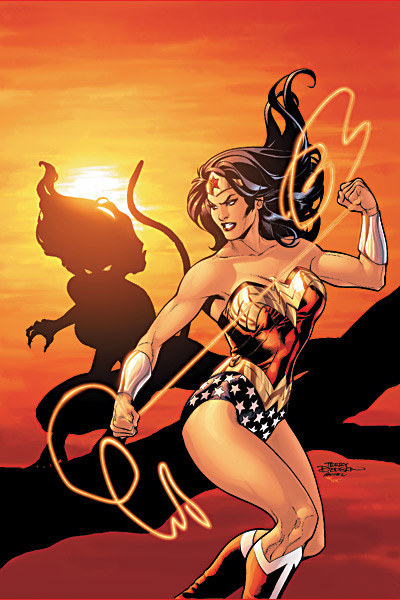
A 'we shall see' response is also provoked by the third issue of the new Wonder Woman relaunch, which is the first issue of the run that has the distinct feeling of groping.

We won't nickpick that this feeling starts with the cover itself (as you can see from the accompanying picture, the background - Cheetah and her feline servants hunched menacingly - was added after the fact, and lamentably so, since climbing trees is not among the many talents cheetahs possess) - instead, we'll concentrate on the issue itself, which is frantically nonstop in terms of plot and virtually featherweight in terms of sense or momentum.

In the progress towards the extremely un-surprising climax (the sorceress Circe deprives Agent Prince of ... her powers! Why, THAT plot-device hasn't been used since the early 90s, and before that the mid-'80s, and before that the late-'70s, and before that the mid-'60s ... if we do it often enough, the readers will always remember that FEMALE superheroes don't really DESERVE their powers and must constantly have them taken away and re-earned), we learn one thing above all: writer Allan Heinberg hasn't bothered to sit down at his coffee table and actually PLOT OUT what he wants to do with this title. We'll have to see what comes of it all ...

Luckily, no element of 'we shall see' attends the new Geoff Johns/Adam Kubert relaunch of Action Comics! This is epic stuff, despite its colossal flaws. Kubert's artwork is amazing, and Johns' writing walks the fine line between humanity and iconography.

The flaws creep in around the basic premise of the plot - a boy from Krypton, found by Superman and sought by the rest of the world (including a Bizarro-manipulating Lex Luthor), eventually taken in by Lois Lane and Clark Kent as their 'foster son' ... as Lois herself points out, everybody in the whole feckin world is going to NOTICE the coincidence. Somebody needs to tell Johns that pointing out this fact isn't the same thing as CONSIDERING it, as a writer should.

Still, the issue has one great exchange. When Clark and Lois are hanging around the Kent family farm debating what to do with the little super-boy, Johns gives this neat little bit of dialogue to Lois:

"Clark, people like Ma and Pa Kent were put on this earth to be good parents. We weren't. You're here to save it. And I'm here to find the truth in it." Great stuff, even if the issue's sentimental climax turns things around.

But the pearl of the pickings this time around was the latest issue of '52' - starting with the fantastic cover, certainly the best cover '52' will field this year (and it gets my nomination for best DC cover of year period).

The plot - half of it, anyway - revolves around how the trio of DC's oldest super-heroes, the original Green Lantern, the original Flash, and Wildcat, react to the new wave of Lex Luthor-sponsored young super-heroes. The tone is controlledly bittersweet, and the best part of it is, it's offset by the issue's other plotline, featuring a group of mad scientists. This other plotline is openly and joyously feckin hilarious.

My young friend Elmo (you'll know him by the errant Owl-like tufts of hair emanating at random hours and angles from the top of his head) speculated the other day that this new format - a weekly comic actually done well - might be the future of the genre. If so - and if the quality remains this good - that might be a very interesting future. We shall see.

Monday, November 27, 2006

penny press! The TLS!


With most literary reviews, the reader must take a firm hand. They tend to dawdle and meander, these literary reviews, and they sometimes run the most appalling stuff.

You must be wary, and cagey. You must pick and choose according to a sliding criteria of integers: do you recognize - and like - the reviewer? Are you interested in the subject? Are you in any way likely to actually read the book under review? It's a delicate, see-sawing procedure whose inherent tensions prevent it from yielding much in the way of enjoyment or enlightenment. Try, for instance, remembering the last time you were excited by something you read in the New York Times Book Review.

The TLS is an entirely different matter. It's so uniformly magisterial, so overwhelmingly authoritative so much of the time, that it prompts a very different response. The reader reposes in complete confidence, happy to absorb whatever each issue throws up for consideration. It's an altogether joyful little experience.

Take the November 10 issue, for instance. Heather Glen makes a very strong case for re-examining the novels of Elizabeth Gaskell - strong, but of course unconvincing, since Gaskell will remain obstinately second-tier no matter what anybody writes about her. Still, it was a strong effort, fun to read.

Allen Shawn reviews 'The Selected Correspondence of Aaron Copland' and sums up in words so clear they ought to be read to every young artist-type in the land:

Yet while these charming and circumspect letters do not dwell on intellectual matters and seldom betray any personal or artistic secrets, this is still a book that artists, in particular, should read. It shows very movingly that it is possible to be committed to what one is doing while being generous to others and a citizen of the world; that it is not necessary to be especially neurotic to be a great artist; that strong convictions need not preclude diplomatic civility; that it is important to produce important work and remain unpretentious.

To which we here at Stevereads say only Amen.

Then there's Alexander Urquhart's review of Jennifer Potter's "Strange Blooms," about that Jacobin gardener to the stars, John Tradescants. The book gets a very positive trot around the block; only one item caught our attention: Urquhart's referring to George Villiers, the Duke of Buckingham, as "James I's favorite and reputed lover."

That 'reputed' is charming enough to be a one-liner. Perhaps Urquhart hasn't felt compelled to ask around, but as it happens, whole boatloads of letters survive between the Villiers in question and the king in question. They file down that Victorian 'reputed' to a very fine 'the only thing lacking is Polaroids.' George Villiers was, like every other member of his family, fiercely ambitious (as one friend of the family remarked, a generation later, the Villiers didn't live who, taking a piss, didn't wish for a shit) - easily enough so to catch the eye of a king who was as queer as a two-headed cat.

Elsewhere, Dan Jacobson reminisces on the sixtieth anniversary of the Hotel Victoria fire, which he survived as a boy. It's a poignant piece, no moreso than at its conclusion, when Jacobson muses on a snapshot taken at the time of the fire - in which our writer appears, as quite a young boy. He writes:

This photograph had waited close on sixty years, virtually at the very site of the conflagration, or my niece to come across it To see myself in it - solitary, preoccupied, wholly unaware that I was being photographed, along with many others - struck me as almost uncanny. Of me as I am now, the young man in the photograph knows nothing. Of him as he was then, immersed in that moment and its random excitements, I have only fragmentary memories. If I could, I would like to tell him that since that morning I have not spent a night in a hotel, however grand or humble it might be, without immediately checking the route from my room to the nearest fire-escape. In return, he might perhaps tell me where I have gone wrong in recollecting the morning's events. Yet when I think of the differences between us in appearance and expectation, I feel it to be a mercy that neither of us will ever be able to exchange a single word with the other.

That has the beauty and the mordant insight vouchsafed to the very old ... I'm not sure the rest of us could resist the urge to say something across that divide.

Just as tempting to speak out about the issue's 'Freelance' piece by Michael Greenberg, all about the bibliophile's patron saint, Alberto Manguel, whose books about reading have the curious tendency to become books about reading first editions.

At one point Greenberg recalls attending a 'Live at the NYPL' with Manguel at which the old book-fan compared the Library of Alexandria to the World Wide Web ... 'one aspired to include everything, the other will include anything, without context, a constant present, which for Medieval scholars was a definition of hell' For readers, he pointed out, the computer is a technological step backwards, since it replaces the codex with the scroll. 'The time has come to refuse to buy from book chains or giant online outlets.'

So sayeth the prophet. Yeesh, what a load of goat crap.

The so-called book-purists who rail against chain bookstores and online outlets have historical precedent, but it's not the one they think it is: it's the monks who chained books to pulpits and condemned any commoner who wanted to read them.

Yes, by all means: let's all buy our books with exquisite care, from tiny local shops. Quirky, idiosyncratic shops, with unlimited inventory and a caring staff who remembers every book you've ever bought.

What's that you say? You live two hundred miles outside Wichita Falls? You love to read more than life itself, but the nearest bookstore is a Methodist Bible shop twenty miles away? Well! I guess that's tough luck for you! Better by far to pay full price for the latest Joel Osteen workbook (the insinuating lecture from the sales lady is on the house) than to take advantage of that enormous chain bookstore with well-lit shelves crammed with Sophocles, Hume, and Tanizaki. Better by far to settle for the latest comic books in the spinner rack of your 'downtown' Costco than to take advantage of ... well, the whole feckin world on offer at the nearest online outlet.

Stupid, stupid, stupid, this kind of book-snobbery. Alberto Manguel, for all that he writes books ostensibly aimed at all book-enthusiasts, has obviously forgotten what true adolescent book-yearning felt like. Instead, he's become (or always was) the nervous beadle from 'A Room of One's Own,' busily shooing the unworthy off the grass.

At least we can turn from such provincial idiocy to that grandest of all literary entertainments, when the TLS reviews a major new novel. The reviews of philosophy and history an all the various arcana of scholarship are always marvellously authoritative, but there's something extra thrilling about watching where that authority comes down on a work nobody needs to be a specialist to read.

When Norman Mailer or Thomas Pynchon (or, sniff, Gil Sorrentino...) comes out with a new book, the event somehow INVOLVES all us general readers. That makes a New York Times Book Review notice extra interesting - and it makes a TLS review something you skip ahead to and read first.

In this case, Stephen Abell reviews The Road, the new Cormac McCarthy novel. We here at Stevereads read the book at the (shrill? No! Say not shrill!) urging of our esteemed colleague The Mama Chan, and we consider it a spare, gorgeous, elegiac masterpiece - a flawed one, certainly, but a masterpiece nevertheless. So we held our collective breath when we saw the review, wondering if the TLS would somehow call us WRONG (talk about a clash of titans!).

Big sigh of relief. Abell turns out to be a fair and rigorous judge of prose - he writes that when McCarthy's "desire for poeticism is profitably channelled and controlled - as it is for the majority of 'The Road' - Cormac McCarthy shows that he is one of the greatest American writers alive."

The book is given the kind of close reading authors dream about receiving (and virtually never get from lesser organs, which tend to spend four-fifths of their allotted space regurgitating plot), and the verdict is almost entirely positive.

We can quibble with some of Abell's close readings. For instance, there's this:

There are moments in 'The Road' where the linear narrative breaks off for this sort of incomprehensible musing: 'he saw for a brief moment the absolute truth of the world. The cold relentless circling of the intestate earth. Darkness implacable. The blind dogs of the sun in their running ... Borrowed time and borrowed world and borrowed eyes with which to sorrow it.' We feel that 'intestate' has been used more for its weighty sound than any expansion in meaning, a feeling confirmed by the ponderous borrow/sorrow rhyme that brigns about the end of, but no real conclusion to, the passage.

We here at Stevereads disagree. 'Intestate' DOES expand the meaning, the legal term heightening the sense that the book's few characters are orphans, deprived of the patrimony they previously expected. And the borrow/sorrow rhyme is an artistic gamble, one we judge as successful.

Still, the titans largely agree, and so it was for the whole stretch of this issue. An issue much DELAYED in receiving due notice (another one is already on sale), because of our long, warm, wonderful Thanksgiving weekend spent at the cozy little Montauk hideaway overlooking the sea. With any luck, the frequency of our postings will quickly resume its customary frenetic pace! After all, a week without fresh Stevereads is ... well, it's like a little taste of nuclear winter! You've all endured it very bravely, but it's time your lives regained their sense of direction.

So: another great, thought-provoking issue of the TLS, and: Stevereads is back in business!

Monday, November 20, 2006

Penny press! Manly mags!


Our foray today into the he-manly latest issues of GQ and Esquire begins deep in the bi-valved heart of amiguity (or DOES it?), which is troublesome to those of us trained to think of ambiguity as the Eigth Deadly Sin.

Virtually every interesting article in the latest GQ (it's the 'Men of the Year' issue, with variant covers featuring a happy-looking Will Ferrell, a freakishly young-looking Leonardo DiCaprio, and a dour young man rather oddly named Jay-Z) is fraught with ambiguity - if not in its conception then certainly in its re-ception.

Take, for instance, Kevin Conley's article "A Few Good Medals," about some of the various high-valor decorations given to some of the men who served (or are still serving) in Iraq.

The strongest thing about Conley's piece is its descriptions of the various battles during which these men earned their commendations - you feel like you're there, in the dust and confusion.

And stories! The things these men not only lived through surmounted - well, even in these jaded times, it's the stuff of pure heroism.

Or is it? Take the story of Staff Sargeant Jerry Wolford, who earned a Silver Star in the Shiite town of Samawah. In 2003 Wolford was leading a platoon toward a bridge over the Euphrates when they spotted Iraqi Regulars on the other side. Wolford and his men opened fire, killing the men. So far, no ambiguity - in war, it's kill or be killed when you confront the enemy in plain sight.

Then comes this part:

"Everything happened quickly after that. Iraqi Regulars hidden in houses along the river started firing back, surprising a team of engineers who'd gotten ahead of the battalion. Wolford ran over to the spot were they'd hunkered down."

The article goes on to describe the fighting and heroism by which Wolford won his decoration, but we here at Stevereads stopped at that bit about Iraqi Regulars popping out of every house in the neighborhood. Regulars hidden with the knowledge and the help of the locals - in other words, an organized, locally-supported militia fighting well-armed and well-financed invaders sent by the world's foremost superpower.

We've debated the pros and cons of American military adventurism here in the past (well, Sam and I have - the rest of you being either too timid or too ill-informed to step up and join us ... or too lazy, let's not leave THAT one out) - and I'm sure we will again - but nevertheless: there's a deep current of ambiguity running underneath awarding a guy a medal for being the ruthless invader of a country that never did America the nation any harm. Nothing negates the valor of the specific battle - but there's a whole LOT of ambiguity informing whether or not that battle should ever have taken place.

(In case any of you are reading this in connection with my previous screed on properly-run military occupations, I'll share with you the results of a Google-search this morning: the town of Samawah still exists. It still has houses, roads, and inhabitants. The inhabitants are still considered to have rights, under the American occupation. If you're wondering how any of that differs from how a real military occupation would react to armed soldiers pouring out of civlian homes, just add a 'not' before each of those particulars)

Even when we move from international to domestic, the ambiguity remains. Take, for example, Lisa DePaulo's short, stupid interview with Al Gore (the short-form idiocy of the format is a stinging critique of what the powers that be at GQ consider the attention-span of their target audience).

Even through the haze of DiPaulo's (probably mandated) stupid questions, there blazes forth that curious 2006 phenomenon of The Other Al Gore.

I'm sure you're all familiar with the phenomenon. In conjunction with the gratifying success of 'An Inconvenient Truth' (the book and the movie), we've all seen him: The Other Al Gore, the smart, articulate guy who's not worried about clowning around in interviews, who's not only brainiac-style well-informed on a huge variety of subjects but who's openly passionate about a lot of them, who wants to teach about them, to change minds about them.

You know, the guy you'd have voted for in a heartbeat if he'd run for president in 2000. But instead, Al Gore ran, and The Other Al Gore stayed at home, and we got a president who speaks proudly about the fact that he doesn't even read the newspaper.

The Other Al Gore is exclamation-point excited about reprising his role as a disembodied head (even more likeable: he's actually unself-consciously dorky enough to USE the phrase 'reprising my role' when talking about a feckin disembodied head) on 'Futurama. He effortlessly mentions that Janis Joplin's great song 'Me and Bobby McGee' is in fact Kris Kristofferson's great song. He quotes from the Onion and makes iTunes mixes for the wife he's obviously still goo-gah in love with. He's sarcastic about President Bush but still respectful of the office.

So where, you ask, does the ambiguity come in?

Gore says it best himself, when commenting on the different perception people have of the Two Gores - the 'Inconvenient Truth' guy v.s. the campaign guy:

"I think one part of it is that in a campaign, there is an adversarial context. Your opposition is constantly painting negative caricatures."

Yes, they are. That's big-stakes politics, alas (although a bright young intern here at Stevereads points out that Massachusetts just elected its very first Black governor, who ran a landslide campaign WITHOUT resorting to slash-and-burn negative ads ... apparently, he even went so far as to tell his vicious Republican rival that she was better than the campaign she ran, which sounds almost Jed Bartlett in its high-mindedness ... ah, Boston! Someday, we'll get there!). And that's the ambiguous part!

Enough already with the 'I'm absolutely positively NOT running ... unless I run' line-dancing! Just in this one-page softball interview, Gore dances around the question twice, saying "Well, I don't plan to run. I don't plan to run. And I don't expect to run." But when asked if he's not ruling it out says "Uh ... no."

Think about what Karl Rove will do with this kind of Cinderella-to-the-ball coquettery. What possible reason can there be for this kind of theatrical hesitation, unless it's the very LAST thing the American voting public wants to hear: that Gore is AFRAID to declare until he's more sure of how the political winds will blow? This isn't a seminar on how distasteful he finds the mechanisms of presidential elections (although if the news from Boston is correct, there's already a successful blueprint in place for changing those mechanisms in the minds and hearts of the voters), it's a question of whether or not Gore feel CALLED ON. This epic-level hesitation hurts him whichever way the coin lands - either it's genuine and it's hugely distracting to his party, or it's poll-driven and, when characterized (or worse, revealed) as such, will hugely hurt his run.

The country's midterm elections already demonstrated that the living are trying to take back the government from the undead. Al Gore - especially The Other Al Gore - needs to either carry the standard or get out of the way. Until then, ambiguity reigns!

And then there's Devin Friedman's profile of Richard Ford, where the ambiguity arises mainly out of the fact that we here at Stevereads didn't particularly care for Ford's new book, "The Lay of the Land" but we kinda LIKE the guy who emerges from Friedman's beautifully-written piece. You have to like somebody who can say the quote that starts this off:

"'An airplane is forty tons of aluminum culvert, pressure-packed with highly volatile and unstable accelerants, entering a sky chock-full of other similar contraptions, piloted by guys with C averages from Purdue ... so it's stupid not to think it will seek its rightful home on earth at the first opportunity. Therefore today must be a good day to die.' If that's happiness, I guess you'd call it an ADULT happiness. And lots of people never have a go at it and wouldn't want to, because to them it doesn't look like happiness at all."

I like the quote (and needless to say, I agree with the concept of ADULT happiness - it's much rarer than the pabulum most people accept, but oh, it's so much sweeter), but I didn't like the book .... hence, more ambiguity...

But hands down, the NADIR of this issue's ambiguity centers on Tom Carson's review of Emilio Estevez' movie 'Bobby.' I've read the piece six times now, and I have NO IDEA WHATSOEVER whether or not Carson LIKED the movie. And it's not just me, I'll bet: my friend Locke is as smart, funny, and shrewd movie reviewer as ever strapped on a bag of Cool Ranch Doritos, and I defy even HIM to make sense of this hyperventilating ARIA of fence-sitting.

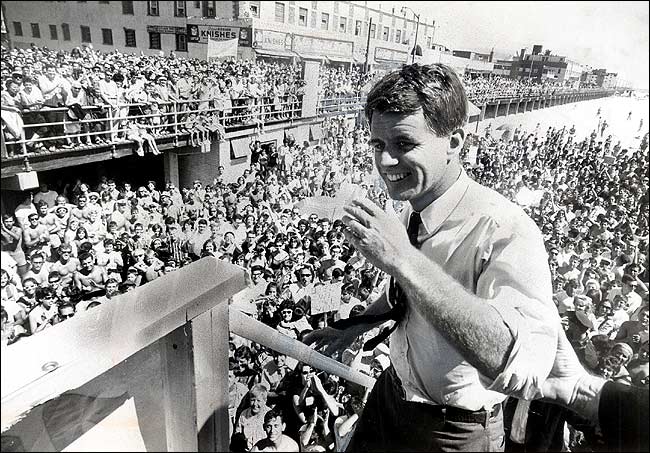
"Even though Estevez's labor of love isn't a good movie by any stretch of the imagination, I can think of worse tributes to Robert Kennedy."

"The script is a ring-around-the-rosary of cliches; there isn't one observation that seems to have grown out of lived experience."

"So sue me if I came out thinking naivete as ardent as Estevez's has its appeal. Sure, Oliver Stone can run rings around Estevez as a filmmaker, but give him fifty years and he wouldn't come up with a concept this purely touching."

"The movie is so oblivious to its own absurdities that watching all this schlock get wheeled out in good faith is kind of bewitching."

"Only a clod could dish it up with this kind of conviction, so let's give Estevez's ingenuous zeal its due. If his movie were any better, it wouldn't be nearly as expressive, and I'm not trying to be insulting."

Whew! Glad to know he's not trying to be insulting! Wish to Gawd I knew what he WAS trying to be, but I guess we'll just have to see the movie to tell!

(On a far more satisfying note, Carson is marvellously non-ambiguous in his sideline review of the UK-made 'Death of a President.' He calls it a 'repulsive piece of drivel' and makes a telling point: 'but then, these lucky Brits have no idea of what living through a real political assassination is like. Our history is a little different. You can't help wondering whether it's ever occurred to D.O.A.P.'s director, one Gabriel Range, that if American critics ended their reviews by urging the public to beat the shit out of him on sight, he wouldn't have a leg to stand on.')

Fortunately, there's no a scrap of ambiguity about the latest Esquire, because the entire issue is in this case merely the delivery device for one piece, one amazing, absolutely flooring piece.

Of course I'm referring to John Ridley's ground-scorching essay "The Manifesto of Ascendancy for the Modern American Nigger."

No amount of quoting will relieve any of you of your responsibility - you have to read this essay. It's smart, guardedly optimistic, and above all incandescently angry. It's easily the best essay I've read this year, and I'd be exceedingly interested in knowing what-all the rest of you make of it.

Penny Press! Chain stores and the Apocalypse!


Every issue of the Atlantic Monthly is a little like Christmas morning. You see the bounty spread before you in the table of contents, or blazoned on the cover, and the heart races. And like Christmas morning, what you end up unwrapping is almost always a mixed bag.

(ah, the glowing memory of the one and only Christmas where the bag WASN'T mixed ... that one and only time when everybody actually LISTENED to me and gave only gift certificates! Hardly any space under the tree, and I was in Heaven for months!)

Virginia Postrel turned in a very good piece "In Praise of Chain Stores," which of course had us here at Stevereads nodding in approval.

One of the experts Postrel quotes hits the nail on the head:

"[local anti-chain activists] want specialty retail that sells exactly what the chains sell - the same price the same fit, the same qualities, the same sizes, the same brands, even. You can show people pictures of a Pottery Barn with nothing but the name changed, and they'll love the store."

In other words, anti-chain store prejudice is born and kept alive by snobby Cantabrigians.

Chain stores plant themselves sometimes in the middle of feckin nowhere, offering a clean well-lighted space, shevles that are always well-stocked with a mind-staggering variety of items. They almost always attract to their staffs people who care about their particular specialization. Their size often allows them to offer discounts.

Listen carefully, boys and girls: ONLY in America could ANYBODY consider this a bad thing.

Don't get me wrong: we here at Stevereads are big fans of strong, knowing, well-stocked, idiosyncratic local shops. We're also big fans of Santa Claus and the Tooth Fairy.

OK, they're not quite urban legends. Everyplace has at least some places that 'you gotta see' - places that owe a large part of their 'gotta' status to the fact that you won't see them anywhere else.

That is a true fact. Here'a another: in the last twenty years, America has undergone a gigantic REAL ESTATE BOOM. This boom, ENTIRELY separate from what chain stores do or don't do, what they are or aren't, has driven property rates through the ceiling. Independent of ANYTHING chain stores do or don't do, these property rates have driven many small, idiosyncratic shops out of business. The ONLY thing chain stores did was take advantage of their more stable financial footing to PAY those hugely swollen rents. That's it. That's all. The only thing they did 'wrong' was exactly what all those little 'independent' shops would have done if they could have. The hypocrisy leaves salt-clogs in the mouth.

Alas, those clogs stay firmly in place during Mona Simpson's fawning piece about Alice Munro's recent elevation to the celestial ranks of Everyman's Library.

As some of you may know, Munro is one of our bete noires here at Stevereads. Not only is she completely talentless in exactly the same way a tape recorder is completely talentless, but she's never written a 30 page short story that didn't dress out about about 170 pages of turgid, mind-numbing blandness.

The subtitle of Simpson's puff-piece is 'the living writer most likely to be read in a hundred years,' and I realize Simpson might not have had a hand in that line, but still: what a bleak future it hints at, if they're still reading Alice Munro in a hundred years! (the story she wrote last February, about two Canadian sisters, Esther and Florence, arguing about the level of their shared car's brake fluid, is, as far as I know, still ongoing)

A hundred years from now? Surely no eco-apocalypse scenario floated by the most radical environmental fringe-group is worse than that? Surely your children's children deserve better than that? Munro has built her entire 110-year career on banking that the general reading public doesn't understand - or more properly doesn't care - that there's a world of difference between simple fluency in English and actual TALENT in writing. Can it be that the progeny of a hundred years hence won't be able to tell the difference? We here at Stevereads certainly hope not! We have young writer-friends who are counting on earning royalities round about then.

Fortunately, there's always Cristina Nehring, who can be relied upon to turn in a quick, smart, snarky review no matter what.

Here she reviews a book called 'Mating in Captivity - Reconciling the Erotic and the Domestic' by Esther Perel ... and she clearly revels in her intended prey:

"Perel practices couples therapy in New York, and her book's organizing principle emerge in a series of clinical vignette. A typical one might go like this: On spunky young couple has it all. The adore each other. They have wonderful times, wonderful families, spectacular careers. But they are 'in despair over what's happening to them.' "We are terrified," they confess. Why? Because their sex together is good, dear reader, but it it is not GREAT.
'Incalculable woe. Part of us wonders if Perel might best advise such couples to GET A LIFE - i.e., CARE ABOUT SOMETHING MORE IMPORTANT. Go help the homeless or the victims of war, and let your libido rebound on its own time. But the advice Perel profers her 'distressed' clients is not to help others; it is to destroy themselves. Do you, she asks them, express physical affection? 'Do you cuddle? .... Do you touch each other?' Yes, they say, in unison. Well, annouces the doctor, 'it's got to stop.' She gives them an assignment: Stop being nice to each other. Stop kissing. Stop hugging. It is sapping your sexual energy. Treat each other like trash, and you might notice a discrete rise in sexual tension.' Or just tension in general, one is tempted to add. 'About a month into it,' he says, 'I wanted nothing more to do with her.' Dr. Perel considers this plan a success. 'I knew I was onto something,' she intones."

This is odious stuff, and just when I thought I'd have to be the one to point this out, Nehring did it for me, in terms so clear and beautiful that I couldn't improve on them in any way. In fact, her words might stand as an motto for this entire blessed site. Just listen:

"It's easy to make fun of this sort of thing - and it's important to do so."

Let's hear that again, for the benefit of those out there who might be laboring under the impression that we here at Stevereads have always been ISOLATED gadflies:

"It's easy to make fun of this sort of thing - and it's important to do so."

Alas, there's plenty to make fun of in this issue, and nothing moreso than the centerpiece of the thing, the 100 most influential Americans 'They Made America' feature.

The thing was ripped from the pages of Cosmo - finding it in the Atlantic was both jarring and infuriating.

The one-sentence summaries of our worthies (an irritating number of whom aren't in fact American - allusions to the melting pot are all well and good, but what? There weren't one hundred people BORN here worthy of the list?) are puerile:

"Lewis and Clark - they went west to explore, and millions followed in their wake"

"Sam Walton - He promised us 'ever day low prices,' and we took him up on the offer"

"Elvis Presley - The king of rock and roll. Enough said."

Ugh.

In the Atlantic, of all places .... ugh.

Difficult to know what the purpose of this is, given how dumbed down it all is - the accompanying article about what exactly 'influential' is could go under a card-catalogue definition of useless, and the promo-blurb mini-summaries are better suited to Teen Beat than the country's best periodical ('Eli Whitney - his cotton gin harvested OUR HEARTS!!! OMG!!!)

As it is, the piece is two-parts hagiography and one-part misleading (you rock 'n' roll fans among my loyal followers, take a deep breath and ask yourself this: what INFLUENCE, in any way, has Elvis Presley had on ANYTHING, from the last twenty years of his career until now?), best forgotten entirely.

Unfortunately, this piece isn't the only deplorable thing in this issue, and one of those such things is very, very hard to swallow. As some of you know, we here at Stevereads consider the Atlantic's book critic Ben Schwartz to be the finest book critic currently working in English. So you can imagine how it pains us to point out that his 'Books of the Year' feature in this issue was hip-deep in sheep-dip.

He recommends these things:

Twilight of the Superheroes by Deborah Eisenberg

The Secret River by Kate Grenville

All Aunt Hagar's Children by Edward Jones

After This by Alice McDermott

The Accidental by Ali Smith

Framing the Early Middle Ages by Chris Wickham

We don't know exactly WHERE this crazy list comes from, but we feel certain it DIDN'T come from pure, clean thought. Perhaps payola was involved: we've all fallen behind on those lawnmower payments. Whatever the reasons, this list most certainly does NOT represent the best books of 2006. We here at Stevereads have read them all, and only the history, the last of them, is anything approaching GOOD, let alone great.

The rest are grasping, psuedo-intellectual hackwork, the type of prose most of my young friends currently writing would be embarrassed to see under their name even after a typical night's informal free-for-all. We can only hope Schwarz will give us all a longer, more discriminating list in the one issue he has left to do so before the year ends.

Our survey of the issue ends on a high note, however, albeit a grim one. Once again, William Langewiesche (Bill Lang) has turned in a piece of prose so well-written it's as thrilling as it is compelling.

The downside is that the piece is about how relatively easy it is to buy all the componants of a nuclear bomb in this topsy-turvy world. Wonderful prose or not, if you're not hiding under your desk by the time you finish reading this essay, you've got some kind of nuclear death-wish.

The ONLY conclusion anybody could possibly draw from all Lang's reportage is that it's a feckin MIRACLE some nutjob or 'rogue state' hasn't set off a nuclear bomb on American soil. The article is titled 'How to Get a Nuclear Bomb,' but it might just as well have been titled 'When, Not If.'

Which is depressing mainly because in a mutant-ravaged post-apocalyptic wasteland, there would be no Stevereads. Surely that's incentive enough to bring the wayward world to its senses?

Friday, November 17, 2006

books! yet another grab-bag of goodies!


Due to the vast power we wield here at stevereads, our palatial offices are inundated with advance copies of all manner of forthcoming books. Of course we wish to look kindly on all these humble supplicants, but it isn't possible. They are too many, and, let's be frank, most of them are crap on a stick, unworthy of anyone's time or attention.

Even the good titles are too numerous to read, much less recommend - amd there's also the undeniable fact that some of the un-worthy titles are still perforce note-worthy, for their reach, for their subject, even for their particular failure.

It's a huge burden, and the only thing that allows us to shoulder it is our own absolute infallibility. Without that, we scarcely know how we'd muddle through.

Nevertheless, we DO muddle through! It's akin to a sacred duty, blazing the trail and sending back reliable dispatches for those who read slower than I do (which is everybody).

Of course, some of the noteworthy forthcomings are more problematic than others, even from a personal view. One such title is Elliot Perlman's "Reasons I Won't Be Coming," which comes out in paperback shortly.

Elliot was much-praised (and rightly so) for his novel "Seven Types of Ambiguity." This book is a collection of short stories, all of them strong, one or two of them nothing short of moving.

The conflict comes in around the edges because Elliot is currently mining the same white-suburband-privileged-youth market that three of my young friends are attempting to mine. So far, none of them has met with success in terms of a book contract (although all three have succeeded in terms of competency, and one of the three has achieved some scenes of genuine beauty), and that fact makes LIKING Elliot's books feel a trifle traitorous. Still, these are good stories, well worth your time.

Less worthwhile is Jeremy Black's new book "George III America's Last King" - Black is a ploddingly competent historian, but he knows nothing whatsoever about fluid storytelling and never has. King George III is a fascinating historical figure who ruled for a very long time and of course saw the parting of the American colonies from the British empire. His story has been undertaken many times, from many angles, but this particular undertaking fails on almost all counts. The writing is mediocre at best, and the research has large and curious gaps (almost like SOMEBODY lost a research assistant two-thirds of the way through).

There are good biographies of George III out there - although no great ones - but this isn't one of them. When a superb one eventually comes, you'll be sure to read about it here at stevereads. Until then, best to skim this volume on your local Barnes & Noble tables and move on. I absolve you of a guily conscience.

And speaking of guilty pleasures! There's a new book called 'Voyages of the Imagination,' in which editor Jeff Ayers presides over a staff who've devoted their time and energy to ... well, to the unthinkable.

They've read and summarized every single Star Trek novel ever written. Think about that last sentence. Every Star Trek novel ever written.

This isn't an inherently unbelievable goal. Your humble editor has, after all, read every single Star Trek novel that's ever been published (and, back in the old fanzine days, quite a few that weren't published) ... read them with care and attention, turning down pages, piecing it all together with far, far more thought than the subject matter deserves.

But we hardly expect anybody else to have done so, and the knowledge that somebody HAS prompts only a curious strain of pity.

Especially since this volume - undoubtedly the only one of its kind that'll ever exist - criminally softballs things. NONE of the near-innumerable books under examination here is given any kind of critical appraisal - understandably, since the last thing Paramount wants to authorize in this, Star Trek's 40th anniversary, is a cold-minded review of how loudly most Star Trek fiction in the last 30 years has SUCKED WAD. That's understandable on the studio's part, but still ... surely a relatively benign rating system could have been set up? A scale of one to five tribbles would surely have offended nobody, but it might have served as a much-needed guide for the wary reader.

And yet, some of the best Star Trek fiction is duly honored here, such as Sondra Marshak & Myrna Culbreath's 'Star Trek the New Voyages' and their wonderful little novels 'The Price of the Phoenix' and 'The Fate of the Phoenix' (their ill-starred novel 'Triangle' is also well worth seeking out and devouring), all big sentimental favorites here at Stevereads. Also there's Alan Dean Foster's adaptation of all the cartoon episodes; most of these episodes were atrocious - and all of them were only 30 minutes long - but Foster lavishes inordinate amounts of care fleshing them out, with results that get more rewarding as his series progresses.

No, 'Voyages of the Imagination' is a bit of a disappointment, although even now, in its gelded state, it's a prodigious trek down memory lane and deserves a place on the shelf right next to the Star Trek Encylopedia. For a book-by-book critical rundown of every Star Trek novel ever written (in how many novels has Doctor M'Benga gone crazy and become the villain? How many different novels have ice-queen T'Pring trying to bring down the Federation just to get Spock's attention? How many different origins have been given for the enigmatic Number One?), you're all just going to have to wait until Stevereads gets around to doing it.

The last item under examination here is by far the sweetest: John Mortimer's new book "Rumpole and the Reign of Terror."

Mortimer is very old (we don't have the exact number at our fingertips, but he's got to be pushing seventy), and he's known for decades that he's succeeded in one of the rarest tasks of any author: he's created an immortal character. In most people, this would create a certain tendency to rest on one's laurels.

Not so Mortimer. His latest Rumpole book (a novel rather than the more usual collection of short stories) is one of the strongest stories he's ever told, every bit as trenchant and hilarious as the earliest stories were, decades ago - maybe even a bit moreso.

In this latest book, battered but unbowed Old Bailey hack Horace Rumpole defends a Pakistani doctor who's been accused by the Homeland Security drum-bangers of being an al-Qaeda operative. As readers of the series well know, Rumpole never pleads guilty - so we're off to the races.

I confess, I started the book with a bit of trepidation. One of the sweetest pleasures of entering the Rumpole universe is how TIMELESS it is: the chambers of Number 3 Equity Court will always be overcrowded to the point of chaos; Chateau Thames Embankment will always flow at Pomeroy's wine bar; Judge Graves ('my hearing is exceptionally keen'), Judge Bullingham ('Mr. Rumpole, that was an outrageous thing to say'), and Judge Oliphant ('Use your common sense') will always headline Rumpole's courtroom rogues gallery; She Who Must Be Obeyed will always loom over the flat in the Gloucester Road like Attila the Hun in sensible shoes.

I worried that the introduction of 'relevant' elements - al Qaeda and homeland security - would burst that bubble, with negative effects (surely I'm not the only one who wishes Watson had never moved out of 221b Baker Street, much less that an aged Holmes had ever felt 'an east wind' blowing).

I needn't have worried, and the relief was only deepened by the quiet perfection of it all. Who better than Rumpole, I quickly realized? Who better to stand up in a court of law in his dirty wig and soiled waistcoat and make a jury by turns laugh and rage at the silly, paranoid fascism of the times?

"Rumpole and the Reign of Terror" is a wonderful book and a deceptively easy read. As with all Rumpole books, absolutely no knowledge of the previous volumes is necessary - so here's an hearty encouragement for all of you, fans and newcomers alike! This little book won't disappoint.

And there we have it for now, yet another romp through book-land! More to come, as always ...