Showing posts with label Wonder Woman. Show all posts

Monday, October 29, 2007

Comics!


Jimmy Steranko stopped by our palatial offices here at Stevereads the other day, and we shot the comic shat over overbrewed coffee. As is his style, he quickly got down to brass tacks:

“Dammit, Stevey, why ain’t ya reviewin’ comics no more? Ya know dad blamed well yers was the only voice a’ truth on th’ whole dad-blamed subject, an’ ya dad-blamed know it!”

To which we replied, ‘Jimmy, why in the Hell are you talking like a ten-penny San Antonio cowpoke?’

But we got his point: since we here at Stevereads have stopped reviewing comics, there’s been a gaping void in the whole comics-reviewing worldframe, a voice, an impartial and highly entertaining voice, something that’s been conspicuously missing since we here at Stevereads stopped cataloging every single screwup Marvel Comics makes from week to week.

It made us nostalgic for the whole scene, so we flew out to Boston’s wonderful, jam-packed comics destination, Comicopia, and picked up a couple of things.

A couple, because the entirety of the Marvel Universe can still be safely ignored (even the two-issue-old and already-stalled Thor relaunch, despite its magnificent artwork, is complicit in the evil plot-foundation of the whole continuity – nothing but the wholesale revocation of that premise can save the franchise, and since that’s not likely anytime soon, we can comfortably ignore Marvel in favor of DC, which is a far bigger and more interesting universe anyway, so no harm done).

So we can concentrate on two issues, one bad (hey, even DC isn’t perfect) and one good.

The bad issue is the latest Justice League of America, a bad issue of a bad run of a badly-conceived revamp. The problem with the revamp in general is that it shouldn’t have happened in the first place – the previous incarnation of the title wasn’t broken, it didn’t need fixing. You take the Big Seven – Superman, Batman, Wonder Woman, the Flash, Green Lantern, Aquaman, and the Martian Manhunter (personally, we here at Stevereads would change that fan-honored roster, bumping off the impossibly derivative Martian Manhunter in favor of Black Canary, who’s always been a great character and who’s been handled better in the last ten years than ever in her sixty year history), and you put them through their paces in both intimate and epic stories. You explore endlessly the interplay of their personalities, but you don’t add members (except for honorary memberships handed out to third-stringers and sick children), and you don’t subtract members, and you don’t have anybody act out of character, not egregiously so, in any case.

That formula was good, well, forever – there was no reason to change it. But if you felt you had to change it, there would still never be any reason imaginable to involve such embarrassingly fourth-rate character ideas as Vixen (she can mimic animal powers! Rwaaarwr!) or to involve the Red Tornado, whose only superpower is being disassembled by every single bad guy who’s ever even looked at him funny.

The new incarnation of the title makes these and innumerable other mistakes, most signally including boneheaded shadow-versions of the iconic central characters. The storyline here is the rebuilding of the Injustice League by Lex Luthor, and in the initial issue Wonder Woman is defeated and taken captive by Doctor Light, the Cheetah, and Killer Frost (Hawkgirl only barely escapes the same fate, but it doesn’t matter – she’s captured about five minutes later, probably by the Dominos pizza delivery guy) – which is the equivalent of Superman being beaten by Iceman, Tigra, and Dazzler, and which should have been the first indication that writer Dwayne McDuffie was going to use the oldest gimmick in the book to make his villains look extra-badass: pit them against shadow-versions of the heroes. In this way the entire team is taken hostage except Superman and Black Lightning, and that’s where things stand when issue #14 opens.

At that opening, our heroes are being taunted by Lex Luthor, who shows them videos of their helpless teammates being tortured, and who admits that the reason he’s doing this is to tick off Superman, to induce him to stop thinking clearly and just act out of rage. After making these taunts, Luthor teleports back to the secret lair of the Injustice League and intones that if he knows Superman, they won’t have to wait long for him to come crashing through the ceiling. But when Superman a bit later does exactly that (having allowed himself, despite clear warning to the contrary, to become ticked off and stop thinking clearly), Luthor is totally surprised and unprepared, and McDuffie doesn’t seem to notice or care about the contradiction. Instead, he’s busy having Superman commit murder.

Which is what happens if, as in this issue, Superman grabs up the power-absorbing Parasite at super-speed and hurls him into the sky before he’s had a chance to absorb anybody’s powers – and which raises the question of why Superman didn’t just vaporize his head via heat vision from a safe distance. Not that this precautionary manslaughter matters – Superman and Black Lightning are quickly and easily dispatched by Cheetah, Poison Ivy, and an elderly UPS guy, setting up the conclusion of this farce next issue, when, we here at Stevereads confidently predict, the League, completely helpless and totally at the mercy of their worst enemies, will manage by a fluke to get the upper hand and save the day, which in this case translates merely into saving their own incompetent asses.

Fortunately, the fact that a major flagship title like Justice League is managing to suck so bad issue after issue is a bizarre rarity at DC, where most of the best titles are being done with skill and very visible enthusiasm every month. Take the newly-revived relaunch of the venerable title The Brave and the Bold. It’s seven issues strong and has been consistently fantastic.

Of course, a large part of this is due to the otherworldly-great artwork of George Perez, here back from his 31st official retirement from drawing comics. His work is so inhumanly detailed, so kinetically gripping, that it can effortlessly carry even a lame story.

And this story is a little on the lame side, hinging on magic possession and centering on the fourth-rate villain Doctor Alchemy, who has managed to place a post-hypnotic suggestion in Power Girl’s mind that, when triggered, will compel her to kill Superman. The issue opens with Wonder Woman and Power Girl in battle together against a horde of killer mummies, and in the aftermath of this fight, while Power Girl is handing Wonder Woman her lasso of truth, she blurts out the buried compulsion, until then unaware that she’d even been carrying it around in her unconscious mind. Of course Power Girl is furious at this violation and wants to charge off and pulverize whoever’s responsible, and when Wonder Woman advises caution and planning, the two almost come to blows (and they do fight later, twice, because that’s what characters in team-up titles do, and the fights are inconclusive, which is probably just as well – after all, despite her retro codename, Power Girl is a full-grown adult, as close to being Superwoman as the DC universe comes; it only makes sense that she’d be able to hold her own against Wonder Woman).

Eventually, they find Doctor Alchemy and foil his plan and save Superman in is Fortress of Solitude. The issue’s ending is quick and easy, its spirit is resolutely upbeat, the characters stay in character, and no violence is done to anybody’s continuity. Once upon a time, ALL comics were like this (only very seldom drawn this well), and there was a reason for that: it works. #7 of Brave and Bold left us hungry for #8.

But alas, despite Jimmy Steranko’s pleading, it’s unlikely we here at Stevereads will be reviewing that or any other issue … there are simply too many demands on our time. Luckily, there are new voices to be heard, new shoulders to take up the burden. We here at Stevereads are happy to recommend one such new voice, that of our colleague Gianni, who is now holding court on all things comics over at The Latest Issue. Give it a look (or, as Jimmy would say, a look-see) and be sure to leave plenty of comments!

Saturday, April 21, 2007

Comics! 52, Wonder Woman, and screwing up!


Well, it was only a matter of time before we here at Stevereads were disappointed by more than one DC comic at a time. The company has lately been on an unprecedented roll, and such things always come to an end, or at least falter and fumble. Such is the case with the latest batch of comics purloined by Elmo from Pepito while he was sleeping.

It's not all bad news, of course. The Judd Winick/Scott McDaniel run on Green Arrow is still unflaggingly fantastic, for instance. Winick is so good at dialogue that the requisite action sequences - though wonderfully rendered, of course - feel positively redundant. Oh, make no mistake, there's a plot going on here - but even so, the prospect of Winick writing the chemistry between Green Arrow and Black Canary, who guest-stars next month, is mouth-watering in and of itself.

Same thing with the latest Green Lantern Corps, written by Dave Gibbons and drawn by Patrick Gleason - this title is as epic as it gets, convincingly so, driven by gigantic cosmic plotlines and delightfully rendered personalities. Gibbons has crafted an enormous plotline that fits the cosmic nature of his title perfectly.

But it's slim pickings elsewhere. The ongoing 'Trials of Shazam' title continues to be incomprehensible; Captain Marvel is the wizard Shazam? Captain Marvel Junior is a newer, skinnier Captain Marvel? No, no, no .... these old Fawcett characters aren't meant for any kind of radical change. And even if you DO subject them to radical change, you have to plan it better than our present writer - none other than the very same Judd Winick - has bothered to do. It CAN be done (just look at the huge improvements made to other Fawcett characters! The renovation of the Question over in '52' has been nothing but sure-footed, and what better improvement to the character of Blue Beetle could be conceived than a bullet through the head?), but it's not being done here.

Likewise the affairs over in Geoff Johns' Teen Titans, where Al Barrionuevo's pencils are so violently incoherent that Johns' writing can't do much more than offer a guided tour through a Kandinsky print.

So too the concluding chapter of Brad Meltzer's first arc on 'Justice League of America,' a decided epilogue of a thing in which we see our team first fully assembled, amidst much conversation, virtually none of stands in character (same goes for the artwork, in which every single person is of the exact same build and height, despite any sensible person's awareness that, of course, Wonder Woman is taller than, say, Green Lantern ... or that Superman is taller than, say, Speedy - now called Red Arrow).

Still, these things are comparatively minor compared to the grave missteps happening elsewhere in the DC lineup.

For instance, the latest '52.' The ball it dropped a couple of issues ago is here spiked, deflated, and ripped to leathery shreds.

The problem is Black Adam, of course. A couple of issue's ago he was captured by the mad scientists on Oolong Island, including the Marvel family arch-villain Dr. Sivana, who's been busy torturing Black Adam ever since. In this issue we see him clamped to a table being electro-shocked while Sivana gathers up his various devices, saying he's 'bored' with torturing Black Adam.

Sivana is exercising the better part of valor, because Oolong Island is being taken by the Justice Society. Just as he's leaving, he's snatched into the air by Atom-Smasher (or whatever he's called this week), who forces him to divulge Black Adam's location.

Which might not seem like a problem, but oh! It is! Not only is it completely illogical that Atom-Smasher wouldn't, you know, HOLD ON to Sivana one he caught him. No, the real problem runs much deeper: nothing should have happened to Black Adam in the first place.

DC has a limited roster of class-A powerhouses, after all. There are all sorts of characters in the upper echelon - Power Girl, Mary Marvel and Captain Marvel Junior, Grace over in Outsiders, Supergirl, Martian Manhunter, etc. But the class-A's have always been fairly limited; these are the characters whose sheer amount of physical power obliges the writer to re-work the normal storylines. Normal storylines like 'character gets captured by bad guys and has to be rescued by his friend.'

The list isn't long. Superman sits at the top of it, of course. Wonder Woman (when she's portrayed well, which we'll get to - hoo-hoooooooo, will we get to it). Captain Marvel. Darkseid. Alan Scott (for those of you holding out for one of the leotardy Green Lanterns, we here at Stevereads have only one word: oh please). Bizarro. Solomon Grundy (PRIOR to his idiotically wasted recent turn in Justice League). And, for better or worse, Black Adam.

Black Adam, who's therefore immeasurably strong, fast, and invulnerable. Meaning, you're going to have to do better than ordinary-looking metal shackles to hold him while you TORTURE him for DAYS. Meaning, it isn't possible for such a plotline to happen in the first place. Power Girl, yes. Martian Manhunter, yes. But not Black Adam, who's not only invulnerable (and therefore, you know, invulnerable) but also strong enough to make any kind of simple metal shackle a little silly.

What happened was the writers of '52' lost their nerve. They created a perfectly compelling scenario: what would happen if a class-A character were driven over the edge (note: NOT driven insane)? What would happen, in other words, if somebody killed Lois Lane?

If such a thing DID happen, it's a lock-solid certainty that Superman WOULDN'T a) be captured, b) be tortured for DAYS OFF CAMERA, and c) need to be helplessly rescued by other people. Not because he's Superman, but because he's class A - he represents simply too much power for such plotlines to make any sense. The writers of '52' had a chance to explore what would happen to the DC continuity if a class-A character went off the rails - they came close, but then they drew back.

Black Adam's sworn mission is to kill the 'people responsible' for the death of his wife and family. OK, fine - but the people responsible are the mad scientists who created the creatures who did those dastardly deeds. That is, the scientists on Oolong Island. Nobody else. And yet, at the end of this current issue of '52,' there Black Adam is, portentiously intoning 'They wanted a war - I'm going to give it to them.'

Given the events of this particular issue, the only allowable 'them' here would be the Chinese government, which covertly sponsored one of those evil scientists. That's tenuous - the scientists worked together, after all - but even if we accept it, why would Black Adam? He was being helplessly tortured while the JSA was discovering the link between China and Oolong Island - his only legitimate target would still be the scientists themselves, presumably starting with the one Atom-Smasher let go.

So: the next issue of '52' had better feature Black Adam squaring off against the Justice Society as they try to stop him from killing all the evil scientists they've captured.

Eddy Barrows' artwork, however, remains superb.

But hoo-boy, if this issue stumbled on the problem of handling an A-list character, the latest issue of Wonder Woman doesn't just stumble - it falls flat on its face and slides all the way down the hillside on its boobs.

You'll have seen the little news blurbs - Wonder Woman is currently being written by bestselling author Jodi Picoult. We here at Stevereads don't wish to generalize, but nevertheless: every single time a bestselling author takes over the writing chores on a comic book, they suck at it with an ironclad, forge-bellows level of suckery.

The reason is probably easy to figure: they think they're slumming, so they bring the middlingest of their game to the task, confident that it won't show. As any long-time comics fan could tell them if they bothered to ask, it shows. Oh, how it shows.

Not that Wonder Woman has ever been an easy job. Only comparatively recently has DC editorial policy seemed to give her the credit that's been due her for so long; only comparatively recently has she been consistently portrayed as entirely A-list, Superman's equal in sheer power (we here at Stevereads have a pet theory on the subject: we think the process was sped up by the overwhelmingly favorable response garnered by the 'Justice League' animated series, which gave its viewers a gloriously badass version of Wonder Woman - culminating in eight shiningly magnificent minutes in the second season of 'Justice League Unlimited' - eight minutes every fan of the character should waste no time in Youtubing).

Alas, what DC editorial policy giveth, Jodi Picoult taketh away. Her Wonder Woman simpers with chickchat, brims with bromides, and worst of all, is a weak-ass little girlscout who allows herself to be taken captive by the US government and callously tortured whenever she opens her uppity mouth to her male captors. Again, the easiest way to reveal the utter poverty of the storyline is to picture any writer writing anything even remotely similar about Superman.

Superman who, as a character, has been around the longest (with all due respect to the Shadow and Doc Savage), the one who started it all. For seventy years, Superman writers have had to test their inventiveness AGAINST the granite cliffside of his level of power. Ditto, come to think of it, for Captain Marvel writers down through the decades.

Not so Wonder Woman's writers, who, when faced with a thorny plot-challenge, have overwhelmingly chosen to simply dial down her power-level (or worse, dumb her down intellectually). A present-day comics reader would like to think such days were long gone, but it turns out that in Jodi Picoult, the '40s live on.

Fortunately, slumming, showboating bestselling authors never hang around for long. We can only hope that in the two or three issues remaining to her, Picoult doesn't a) contrive to permanently remove Wonder Woman's powers (so that she can for the eight hundredth time learn 'proportion,' 'balance,' or 'humanity') b) contrive an entirely new origin story for the character (aliens? mole people? clandestine MEN?) or c) KILL the character, probably at the hands of a gun-wielding lowlife.

Then she'll be gone, and some professional comic-writer will step in and take over, and with any luck, we'll all get back to a Wonder Woman who's as powerful as Superman or Captain Marvel, a character who's grappling with her role in Man's World, her diplomatic duties, her status as an ambassador of peace versus her status as a costumed crime-fighter.

Until then, it's this stupid, ineffectual little debutante in a tiara. In the meantime, at least Brad Meltzer's (gasp - another bestselling author) Wonder Woman over in Justice League isn't (yet) embarrassing herself all over every issue. Yeesh, but a sister deserves better.

Wednesday, February 28, 2007

Comics! the end of the world as we know it!


A banner week in comics! Everything from little tidbits to continuity-shaking mega-events was on hand at the Android's Dungeon. The mouth-breathing virgins at that venerable establishment were all a-twitter over it, in much the same way the rest of us start heart-afluttering when Hippolyta strides into the room (we suspect Hippolyta herself would never under any circumstances stride into the Android's Dungeon, so we'll never see the two worlds meet, alas).

Starting out on the tidbit side would be the latest issue of Conan, a rollicking good time with magnificent artwork and a glowering Cimmerian who's always perfectly in character. Robert E. Howard would very likely have been irked beyond measure by the legendary rendition of his character made by Roy Thomas and John Buscema, but he'd have flat-out LOVED this new run, which bids fair to being the best adaptation of the character yet done in any medium (things are equally good over in Red Sonja, in case anybody's interested).

Also on the tidbitty side is the first issue of 'Legion of Monsters' - we here at Stevereads know nothing about this thing, having encountered it by chance, but half of this particular issue deals with the retro Marvel horror character Werewolf by Night.

Only this is a Werewolf by Night for the Midnighter generation - he's no longer a victim as he was in the '70s. No, he not only controls his transformations but revels in them. In this issue (drawn by Gred Land, whose weirdly photographic work we confess we're liking more and more), our hero saves a comely young female werewolf from her superstitious townspeople, and even though it's only eight pages or so, you want more when it ends. Half the issue is taken up with a rather by-the-numbers Frankenstein's monster story, but we here at Stevereads call for a monthly Werewolf by Night title, drawn by Land and while we're at it, written by this issue's scribe Mike Carey.

Moving out of tidbit range, we find the lastest issue of The Amazing Spider-Man, written with unusual delicacy by J. Michael Straczynski and drawn with career-high skill by Ron Garney.

The story so far: Spider-Man has broken from Iron Man's fascistic ranks and taken his wife Mary Jane and his Aunt May into Motel 6 hiding while he figures things out. Of course since his identity is public his movements have been tracked - although in this case rather improbably only by the incarcerated Kingpin (not the government, which presumably can afford more tracking gadgets than are available at the prison commissary). Kingpin has put out a hit on Peter and is family, so half the issue shows Mary Jane and Aunt May in an assassin's crosshairs.

In the meantime, Straczynski is presented with the unenviable task of needing to tell his story without revealing any of the dramatic revelations over in the concluding issue of Civil War.

He pulls it off wonderfully. Nothing in this issue feels forced or avoiding, especially the Daily Bugle newsroom scene that should have been the weakest in the issue. The neglected central figure in this whole Civil War storyline is J. Jonah Jameson, and he doesn't get the moment he deserves in this issue, but the sequence is very strong anyway, as is the rest of the issue.

'The rest of the issue' boils down to one thing and one thing only: when Peter Parker gets back to his Motel 6 to comfort Mary Jane and Aunt May, his spider-sense tells him something is wrong. He lunges to save Mary Jane and succeeds, only to realize that Aunt May has been shot.

This is a watered-down version of what should have happened - clearly, the whole Civil War storyline SHOULD have huge personal consequences for everyone involved. Identities are known; dependents are known - it shouldn't just be the Kingpin who's making hay off all this.

Nevertheless, it's Aunt May who gets shot this time around. That specific thing has never happened to the venerable lady before, and although Spider-Man #200 upped the ante for Aunt May peril, this is the logical extension of that.

This issue ends with Aunt May gutshot - if she's to live, she'll need extensive immediate medical attention. The writers of Civil War have made it completely impossible for Peter Parker to GET her that aid, without being promptly hauled off to jail. We'll see how - or if - they resolve it in the next issue.

Fortunately, all is not lost at Marvel. As will almost certainly be the pattern for the next few years, Marvel gets to tell its GOOD stories only in alternate places - in the Ultimate continuity, or, in the case of the 'Illuminati' mini-series, the past.

The second issue of 'Illuminati' is a potent little delight. The premise, as all of you will no doubt remember, is this: the movers and the shakers of the Marvel universe (minus the Black Panther, Doctor Doom, and Magneto, much to the detriment of the idea) get together regularly as a sort of Ex-Com board meeting. Our cast is Reed Richards, leader of the Fantastic Four, Iron Man of the Avengers, Prince Namor of Atlantis, Professor Xavier, leader of the X-Men, Doctor Strange, Master of the Mystic Arts, and Black Bolt, king of the Inhumans. Namor is the closest we come to any kind of partisan bickering, although writer Brian Michael Bendis does a wonderful job of it (a wonderful job that SHOULD be ongoing in monthly titles for HALF of these characters ... how shameful is it for Marvel that they have no ongoing title for the Sub-Mariner, Doctor Strange, OR the Inhumans? DC is thinking about giving an ongoing title to Ibis the Frickin Invincible, but Prince Namor goes a-begging?).

In this issue Reed Richards shares with his fellow Ex-Com members his quest to find all the gems of power that outfit the Infinity Gauntlet, the better to make sure they never fall into the wrong hands. Bendis does a curiously un-subtle job of making the point that ANYBODY'S hands would be the wrong ones for that amount of power, and that's not his only failing so far - true, his Reed Richards and his Iron Man are note-perfect, but he clearly has no idea what to do with either Doctor Strange or Black Bolt (about whom it's not even made clear the question of language - without Black Bolt's interpreter present, has any roster of hand-gestures been agreed upon? Does anybody know what he's trying to say, ever?), and his Professor X is a curiously tentative figure.

Still, Jim Cheung's artwork is fantastic as always, and apart from the Doctor Strange mini-series currently underway, this is the best book Marvel's currently publishing.

Over at DC, the sheer number of really, really good titles is, well, a little embarrassing. Those of us who've been reading comics a long time remember vividly an extended stretch - a very extended stretch - in which Marvel comics were almost uniformly good and DC comics were almost uniformly bad. Times change, it seems.

There's the first issue of the 'Brave and Bold' relaunch, for instance, featuring the positively last appearance of that perennial retiree, George Perez. His artwork here is as legendarily, even weirdly detailed as always, illuminating this inaugural team-up between Hal Jordan and Batman.

Alas, Mark Waid's writing ain't quite so legendary. The main problem with an otherwise nifty issue is that (excepting one wonderful scene with our two heroes gambling in Vegas) everybody in it SOUNDS exactly the same, most certainly including scrappy working-poor test pilot Hal Jordan and aristocratic Bruce Wayne. But the artwork is the selling point here in any case, and Perez as usual doesn't disappoint.

Also from DC is the latest issue of Wonder Woman, written by Allen Heinberg and drawn with superb artistry by Terry Dodson. After three issues of Diana Prince-style futzing around, this is the issue where the one true Wonder Woman finally returns, and for all his tendency to nod and wander, Heinberg handles the moment wonderfully. Oh, don't mistake: this still isn't good enough, not by a long mark. The whole premise of '52' and like titles is that for an entire year the DC universe went without the three titans at its top: Superman, Batman, and Wonder Woman. The journeys each of these three underwent in that year should by rights be the stuff of comics legend, and yet they've been uniformly botched, leached of the epic significance they might have had. But at least as of the next issue of Wonder Woman, the whole question will be behind us, and we'll be free to concentrate on the traditional character again.

And speaking of traditional characters, the current run on Green Arrow continues to be the gold standard by which the character will be measured. Writer Judd Winick and epochal artist Scott McDaniel continue to give us the best rendition of Green Arrow yet made.
The current issue guest-stars Batman, which is both enjoyable and taunting (as some of you may know, we here at Stevereads stand by our conviction that McDaniel could be the greatest Batman artist of all time), and the dialogue is winningly sharp - the villains who draw our two heroes into separate conflicts refreshingly admit outright that they never expected to actually WIN against two of DC's A-list heavyweights. This is definitive work.

As is the current run on Robin, surely the best that character has ever received (apart, that is, from his occasional appearances in the old Scott McDaniel run on Nightwing). In this latest issue, all Tim Drake wants to do is successfully go out on a date with a beautiful girl, and his evening keeps getting interrupted by Batman and the super-villain of the week. It's funny stuff, rendered just so by Adam Beechen's expert writing. This 50-year-old character has never been in better hands.

But none of this really matters, not this week, not in the shadow of the most important - in every neutral reading of that word - comic of the year. No, Marvel's Civil War #7 must command any comic-book discussion this week, no matter what our mighty Hippolyta says.

And true to form, it's an unmitigated disaster. The entirety of Marvel's Civil War storyline has been one long exercise of poor judgement, a What If story cranked up on black market steroids. Any hope that the fascists-v.s.-freedom fighters plotline could be resolved with any degree of coherence, let alone satisfaction, has been dwindling for months, to the point where the main motivation for reading issue #7 was to see just how big a frickin train wreck it would be.

The answer? Pretty damn big. The bulk of the issue is devoted to the gigantic battle between Captain America's forces and the fascist, gulag-operating forces of Iron Man. This battle rages back and forth - Hercules uses the fake Thor's fake hammer to crush the fake' Thor's fake head, Prince Namor and a bunch of Atlantean warriors join the fray on Cap's side for absolutely no reason whatsoever, the Vision disrupts Iron Man's armor (a trick he must have picked up from Kitty Pryde, but nevermind), and just when it looks like Captain America's side might be winning, a group of oridary working joes tackles him for absolutely no reason whatsoever. This causes Cap, for absolutely no reason whatsoever, to SURRENDER and order his troops to stand down. The issue ends with him in jail, the gulag in full operation, and Tony Stark in charge.

In other words, the bad guys win.

Somewhere out there, Stan Lee is spinning in his grave.

And the worst part of it all is that this isn't the Ultimate continuity ... it ISN'T some What If hypothetical. This IS the Marvel Universe now. A universe in which the government not only controls the superheroes (doling out assignments, hiring and firing, cutting a weekly paycheck) but jails anybody who doesn't play along. A universe in which Venom and Bullseye work for he government and Captain America is in jail.

Howls of contempt for this conclusion have echoed from one end of the Stevereads intern-pool to the other, and rightly so. The combination of how terrible this whole Civil War storyline was handled and how title-by-title strong DC currently is has actually created the temptation to ignore Marvel comics altogether. We'll see what next week brings.

Tuesday, November 28, 2006

Comics! 52 and Action!


After waiting patiently for my archnemesis Pepito to fall asleep (which he eventually did, clutching his ragged Ricky Martin plush doll close to his heart, as always), I crept into his lean-to and snatched up a small selection of the latest comics to read and tell you all about.

(the sequel, the somehow getting them back into Pepito's lean-to without arousing suspiciion, is a trickier matter, but we'll manage it somehow)

The item on the top of the pile aroused some considerable misgivings - it was the second issue of 'Fantastic Four - The End,' and the misgivings came from our awareness that our freakish young friend Elmo seemed to LIKE the first issue.

So we read the second issue with more care, attenae attuned for the WORTH of the thing.

The first worth leaps off the page: this is some of Alan Davis' greatest artwork almost impossibly rich in detail and compositional excellence.

Beyond that, well ... there's always been a certain charm in 'imaginary' stories - plots set outside the normal continuity, where readers get to conjure on might-have-beens.

This present story is set in the future, on an Earth that's become a paradise since all the mutie-scum were eliminated (or not all ... you just KNOW how this thing is going to climax ... and if you don't, let me give you a hint: his code-name starts with 'W'), and it's got lots of interesting stuff in it. It doesn't yet exercise our passion here at Stevereads, but there are four issues left. We shall see ...

A 'we shall see' response is also provoked by the third issue of the new Wonder Woman relaunch, which is the first issue of the run that has the distinct feeling of groping.

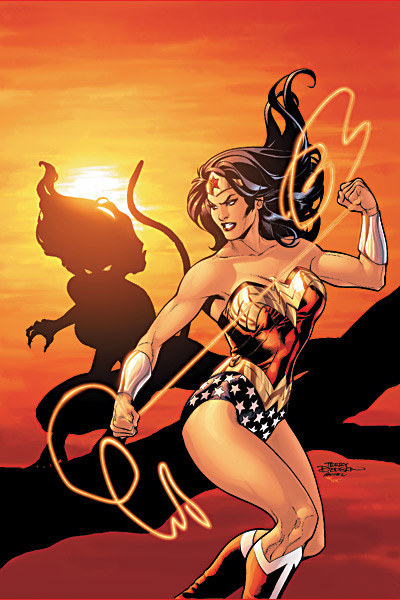
We won't nickpick that this feeling starts with the cover itself (as you can see from the accompanying picture, the background - Cheetah and her feline servants hunched menacingly - was added after the fact, and lamentably so, since climbing trees is not among the many talents cheetahs possess) - instead, we'll concentrate on the issue itself, which is frantically nonstop in terms of plot and virtually featherweight in terms of sense or momentum.

In the progress towards the extremely un-surprising climax (the sorceress Circe deprives Agent Prince of ... her powers! Why, THAT plot-device hasn't been used since the early 90s, and before that the mid-'80s, and before that the late-'70s, and before that the mid-'60s ... if we do it often enough, the readers will always remember that FEMALE superheroes don't really DESERVE their powers and must constantly have them taken away and re-earned), we learn one thing above all: writer Allan Heinberg hasn't bothered to sit down at his coffee table and actually PLOT OUT what he wants to do with this title. We'll have to see what comes of it all ...

Luckily, no element of 'we shall see' attends the new Geoff Johns/Adam Kubert relaunch of Action Comics! This is epic stuff, despite its colossal flaws. Kubert's artwork is amazing, and Johns' writing walks the fine line between humanity and iconography.

The flaws creep in around the basic premise of the plot - a boy from Krypton, found by Superman and sought by the rest of the world (including a Bizarro-manipulating Lex Luthor), eventually taken in by Lois Lane and Clark Kent as their 'foster son' ... as Lois herself points out, everybody in the whole feckin world is going to NOTICE the coincidence. Somebody needs to tell Johns that pointing out this fact isn't the same thing as CONSIDERING it, as a writer should.

Still, the issue has one great exchange. When Clark and Lois are hanging around the Kent family farm debating what to do with the little super-boy, Johns gives this neat little bit of dialogue to Lois:

"Clark, people like Ma and Pa Kent were put on this earth to be good parents. We weren't. You're here to save it. And I'm here to find the truth in it." Great stuff, even if the issue's sentimental climax turns things around.

But the pearl of the pickings this time around was the latest issue of '52' - starting with the fantastic cover, certainly the best cover '52' will field this year (and it gets my nomination for best DC cover of year period).

The plot - half of it, anyway - revolves around how the trio of DC's oldest super-heroes, the original Green Lantern, the original Flash, and Wildcat, react to the new wave of Lex Luthor-sponsored young super-heroes. The tone is controlledly bittersweet, and the best part of it is, it's offset by the issue's other plotline, featuring a group of mad scientists. This other plotline is openly and joyously feckin hilarious.

My young friend Elmo (you'll know him by the errant Owl-like tufts of hair emanating at random hours and angles from the top of his head) speculated the other day that this new format - a weekly comic actually done well - might be the future of the genre. If so - and if the quality remains this good - that might be a very interesting future. We shall see.