Showing posts with label civil war. Show all posts

Monday, July 20, 2009

A Separate Country!


Our book today is Robert Hicks' forthcoming A Separate Country, which turns on the literary conceit of a secret second memoir written by ill-starred Confederate general John Bell Hood.

If you'd have asked me last week to name the least promising American Civil War figure to act as the dramatic fulcrum for a work of historical fiction, John Bell Hood would have been at or near the top of such a list. The man was a morose, egotistical wet blanket at the best of times - Robert E. Lee once wrote that he was courageous on the battlefield and careless off it, and as usual with that old Sphinx, what he doesn't say is as resonant as what he does, namely that Hood was also courageous off the battlefield and careless on it. Leave it to one traitor to fully understand another.

Only if anything, Hood was more of a traitor than Lee. Lee at least could style himself a patriot to his home 'country' of Virginia - Hood didn't like the fact that his native Kentucky wasn't in armed rebellion against the Union, so he went shopping around for a rebel state that would adopt him. And his career in the Civil War was a long litany of blunders and vicious, callous mishandling of the men under his command, most famously at the Battle of Franklin, where he sent his troops out marching into enemy fire with no protection at all and reaped the inevitable wholesale slaughter with what could only be interpreted as grim satisfaction.


Such creatures don't exactly lend themselves to the central heroic role of a historical romance, and Hicks (author of the very, very good Widow of the South) surely knows that better than anybody, which is where the second book by Hood comes in - that's a great little idea, familiar from countless other historical novels, but no less serviceable for all that. In the second memoir's pages, Hicks gets to craft a Hood who's every bit as prickly, self-righteous, and dim as the historical Hood, but then charge that historical template with all sorts of sympathetic strata. It's blatantly manipulative, and it shouldn't work.

But it does. It really works. A Separate Country isn't just Hicks' best book to date - it's also one of the best historical novels I've read so far in 2009 and one of the best American historical novels ever written.

The book opens after the war, with a sick Hood (he died of yellow fever in New Orleans, after first watching his beloved wife Anna Marie die of the same disease) summoning our narrator Eli Griffin to his bedside and charging him to find this secret memoir, have it assessed, and see to its fate. Griffin is a marvelously drawn character from the very first page, and he's no friend of Hood's, having once tried to kill him. Hood, Griffin remarks, is "the first man I had ever seen a mockingbird actually mock," but he's under obligation to the old soldier, not to mention being touched by the tragic, tender family life he sees in disarray all around the man. Hood confesses to a deep, blinding love for his wife and his family (he refers to them as "a separate country," hence the book's title - although the phrase also acquires a second meaning as the book goes on, a devastating one), and his second, secret book is full of that love disingenuously described, a fact caustically brought to Griffin's attention once he allows the manuscript to be read by others:

"Why, Mr. Eli Griffin, why would Hood think anyone would be interested in reading this thing?" He let it flap over in his hand, and some of the pages wavered in the heat coming up out of the cookstove. Of course he would burn it, I thought.

"Dunno."

"He writes as if he was the first man to love a woman."

"Yes."

"But perhaps that is true. We are always the first men to fall in love, no? No one else knows how it feels, not like we do. And when you have lived most of your life hard and grim and merciless, when you have finally fallen in love it must, must, be unlike anything else on this earth, unlike anything anyone else knows. Otherwise love carries the despair of all that you have misunderstood in the world and all that you have failed to see. Too painful, it's much better to think that it is one of a kind."


The most amazing thing about A Separate Country is the way Hicks mixes this unabashedly open, romantic side of Hood with the callous butcher of the historical record. In a less skilled writer's hands, the Hood who narrates his own story in the memoirs that constitute the bulk of this book would stand revealed as secretly compassionate, but no! No, this is the Hood all Civil War buffs know quite well:

There was a hospital at Franklin, where the hundreds died. Several of them, actually. They hadn't been hospitals before I rode my army up into that town, but for weeks afterward those houses and mansions and churches were the refuge of the maimed and the hopeless, my casualties, the men who's names we'd have to strike from the rolls. Their absence would be my handicap, my burden. When I walked through the Methodist church that cold day in November 1864, I was angry. Not at myself, never that, but at them. Them in their neat rows of improvised cots. Blood and piss ran between the floorboards, there were men who would never wake up from their slack-jawed sleep, there was a man missing his tongue and bottom jaw who flapped the sagging skin of his bottom lip at me.

I studied their faces for signs of malingering. I poked men at their wounds to ascertain the degree of their pain. The church-women gaped at me and finally, tired of my harassment of their charges, took to rattling the bedpans against the bed frames in protest. Had they been my troops I would have had them locked up. Instead I left, disgusted. How had they let this happen to them, I remember thinking of the men in that hospital room. Why did they let it happen?


That ramrod, repellent Hood is humanized somewhat by the end of his book and Hicks', but not as much as you'd expect, and the reason is the same saving grace that animated Widow of the South: Hicks has a fundamental respect for his readers' intelligence. That kind of respect - the trust it implies - is extremely rare in writers of historical fiction; they've done all the research, after all, and they severely doubt you can follow along unless they spell it all out for you. The triumph of A Separate Country is that Hicks trusts you to follow along on your own, without him hovering over your every reaction. He even dares to trust that most of you have at one point or another in your life fallen hopelessly in love - and if you have, that plot-strand of this book will have you nodding in fervent agreement. So: not only a winning historical novel starring, of all people, John Bell Hood, but a touching love story starring John Bell Hood. Can a J. Edgar Hoover cookbook be far behind?

A Separate Country comes out in hardcover in September. I don't usually advocate the purchase of such murderously expensive books, but two months is time enough to save up, and this is an author who actually deserves your money. Alternately, you could go to your local library, create a waiting list for the book, and put your name at the top of that list. And of course there's the tried-and-true Stevereads approach: if my review here intrigues you, I'd be happy to acquire a copy of the book for you myself and send it along.

The important thing is that Hicks has written a quiet little masterpiece (I've only scratched its surface here), a fictive highlight of 2009, and you shouldn't miss it. In two or three years, I predict, this author is going to write a massive Civil War epic and gain wide-stage immortality for it (there'll be comparisons with War and Peace, mark my words) - but he's doing deeply invigorating work right now, and his best stuff yet comes out in September.

Saturday, December 27, 2008

The Ways of War in the Penny Press!


Our last look at the Penny Press in 2008 features two accounts of the shot and fray of war - and some of the perils attendant in writing about it!

In the 18 December London Review of Books, Thomas Laqueur turns in a long and extremely thoughtful review of Drew Gilpin Faust's This Republic of Sorrow and Mark Neely's The Civil War and the Limits of Destruction. Faust's book he loves ("a spectacularly good book," which sounds a little like a contradiction), and Neely's book frustrates him with its central tenet that the American Civil War was neither so bloody nor so destructive as 150 years of historians have rejoiced in saying it was.


I thought Faust's universally-praised book was almost hysterically overwrought, and I thought Neely's book was simply dull - you would never read a long, detailed exegesis of either one of them on Stevereads (much less Open Letters). But Laqueur is always worth reading, even when I don't agree that his subjects are worth reviewing. In this case I think he might be a little too hard on Neely, taking him to task for relativizing what he never meant to belittle. For instance, Laqueur has little patience with Neely's subtraction from the overall mortality of the Civil War the many thousands of deaths from infection and disease, although it's hard not to agree with a reviewer when he's making his points so calmly and eloquently:

The 225,000 Union and 194,000 Confederate soldiers who died from disease were just as dead as their comrades. They too left survivors bereft; they too filled graves, probably in disproportionate numbers because their bodies were more easily identified and recovered. More important, death from disease or exposure is not an act of God but a real consequence of the violence of war. It would be very odd to exclude those who died of cold and hunger in Napoleon's or Hitler's Russian campaigns if one were trying to quantify their human cost.

Likewise, over in the 12 December TLS, W. V. Harris reviews two volumes in the Cambridge History of Greek and Roman Warfare series - Volume One, on Greece and the Rise of Rome, and Volume Two, on Rome from the Late Republic to the Late Empire. Here, also, there's disparity and a little literary bloodletting (this being the TLS, the latter is significantly less delicate than in other review organs).

Some of Harris' observations are a little wobbly, as in his lengthiest digression:

At the Battle of Pydna, for instance, the commander Aemilius Paullus is said to have thrown a precious Roman standard in among the Macedonian enemy, which in effect obliged the legionaries under Paullus' command to drive the enemy back in order to retrieve it. .... Unimaginable in a modern army, this sort of behaviour was apparently quite common in Republican Rome.

Not so common: military commanders who tried such melodramatic stunts risked a great deal, and certainly a general as experienced as this particular Aemilius Paullus never actually did it. But I'd argue that it isn't so unthinkable in a modern army, or at least its modern equivalent isn't. And that equivalent wouldn't be 'throwing a standard in among the enemy, thereby forcing your men to more greatly endanger themselves to retrieve it' but rather 'imitating Alexander the Great' - who pulled that stunt (and the much riskier one of the personally leaping into the press of his enemies himself, thereby forcing his men to rescue not just the standard but the standard-bearer) quite often. And if we generalize that to 'imitate the great stories of what battlefield courage is supposed to be,' the thing becomes easily imaginable, even in modern-moment Iraq.


But that's a quibble, and it shouldn't keep us from Harris' own bloodletting, this time in the form of a classic lightning-quick TLS knife-thrust. He's running down the various merits of some of the Roman volume's better essays when the knife suddenly goes in:

At the other extreme is a chapter on Rome's early international relations marked by quite breathtaking vapidity.

Eeep. Perhaps fortunately for all involved, the writer of that chapter isn't named. The morbidly curious will have to Google it on their own.

These two forays into military history and the reviewing of military history form our last look at the Penny Press in 2008. It hasn't exactly been a banner year for periodical reading. Harper's has been almost relentlessly inconsequential; GQ and Esquire have amped up their gadget-and-g-spot coverage, at the expense of anything else (ditto Men's Journal and Outside); Vanity Fair has become thinner and slighter; The New Republic has become shriller; The New York Review of Books has become almost distractingly more political; worst of all, The Atlantic's move and recent redesign have combined seriously to undercut its intellectual heft.

Fortunately, the mighty TLS remains the same. And Open Letters keeps getting better and better. So there's hope, in the Penny Press.

Sunday, March 11, 2007

Comics! The King is dead, and all that!


The thing you have to understand about today's comics, the thing that trumps everything else, is how goddam GOOD they are, almost universally across the board. And by 'good' we here at Stevereads mean 'written for adults' - in the very best way that can be meant. Not 'adult fanboys,' but actual card-carrying adults. Dramatic storytelling. Expert pacing. On-spot characterization. And artwork that's better than it ever has been.

The latest batch of comics Elmo stole from my archnemesis Pepito illustrates this fact handily enough. Every title in the pile, each individual one, is pound for pound better than most of the issues in each title's history.

Even devil's advocate - Brad Meltzer's current incarnation of the Justice League is undoubtedly a failure; the pacing is all wrong, the narrative flow is an unmitigated disaster; you'd need an abacus to count all the missed chances, dramatically speaking.

This should be everything, keep in mind: a newly-intelligent Solomon Grundy manipulating Amazo to destroy a fledgling Justice League - that's grade-A stuff, mythic stuff. And even in devil's advocate, even on a title that's a failure, there's a degree of intelligence and energy in the storytelling that if nothing else give hope of better days ahead.

(Even so, we had to laugh at the scene where an enraged Vixen dive-bombs Amazo from high overhead, accelerating to 217 miles per hour; right before impact, she whispers 'triceratops,' so I guess we're supposed to think she's manifesting the weight and power of a triceratops in order to hit Amazo that much harder ... and she does, oh-so-coolly ripping him in two. Somebody should get a memo to Meltzer right away on what would REALLY happen if she hit a solid target at 217 mph with 9000 pounds of mass behind her. We won't spoil the surprise here at Stevereads, but you should all be thinking not of lame-ass third-tier superheroes but of Seaworld ... where the first three rows WILL GET WET!)

But devil's advocate isn't necessary for most of this batch. Jeff Smith, for instance, is always a delight, and the second issue of his Shazam! mini-series is full of good stuff - from a Doctor Sivana unabashedly modelled on Dick Cheney to a version of talking-tiger Mr. Tawny that actually manages to be cool (of course, if anybody can make a talking cat cool, it's Jeff Smith). The only qualm-causing aspect of the issue is Smith's revamp of Mary Marvel - getting her powers as per usual, but staying a little five-year-old girl. To say the least, the effect is creepy - so we're earnestly hoping the powers that be at DC don't take it into their heads to make Smith's mini-series in any way part of normal continuity.

Still, Smith's artwork and writing are so clean, so much fun - we earnestly wish he'd consider doing a comic book version of Lil' Abner. He'd be perfect for it.

Then there's the latest issue of Detective Comics, featuring quick, intelligent writing by Stuart Moore and highly detailed artwork by Andy Clarke, artwork that takes a little while to catch up to you. There's nothing remotely earth-shaking in the issue - standard Batman-and-Robin-vs-bad guy stuff, but considering how many titles at Marvel and DC are in the midst of reality-redefining catastrophies, that's something of a blessing.

Did somebody mention reality-redefining catastrophies? Well of course that's the heart and soul of DC's '52,' and after a sucky issue last week, this week rebounds incredibly, packing all the pathos, drama, and ass-kicking of an old-fashioned Lee/Kirby multi-issue epic into a mere 25 pages. We here at Stevereads have in previous entries praised the creation of heavy-hitting new characters like Isis and Osiris - well, we should have spared ourselves the trouble, since they both get offed in this issue (she's napalmed and he's EATEN ... hee). But we're not complaining, because in the process the powers that be at DC are transforming Black Adam into something remarkable. We thank whatever gods may be that he (and Renee Montoya) are turning out to be the real stars of '52,' not the much-hyped and thoroughly ridiculous lesbian Batwoman (and where's the press attention for the latest issue of Outsiders, which featured lesbian action so graphically depicted I wanted to shield Elmo's eyes?).

Discerning eyes will have noticed that all the successes so far are from DC, and there's a good reason for that: Marvel is currently experiencing a downward-spiral of suckitude unseen since the launch of the New Universe, many moons ago, and nothing seems to be able to stop the tailspin.

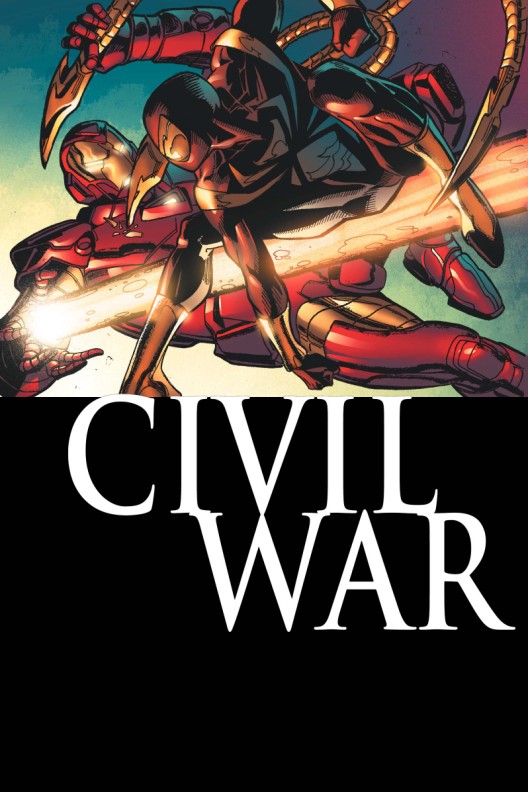
Not even something as well-done and sweet at the 45th anniversary issue of the Fantastic Four, which did have its moments (like the charming tone of Ben Grimm's dealings with little Franklin and Val, or Sue matter-of-factly referring to Ben as the heart and soul of the team, or Doctor Doom - of all people - pointing out the evils Reed Richards committed during the Civil War). But nothing write Dwayne McDuffie can do gets around the fact that the FF split up and fought AGAINST each other in Civil War (a point worth repeating, no? During the climactic battle of Civil War #7, Reed Richards is there to beat and LOCK UP his wife and her brother). The issue's main story ends with Reed and Sue leaving the team to 'work on their marriage,' but it can only turn a blind eye toward all the open cans of worms left over from Civil War.

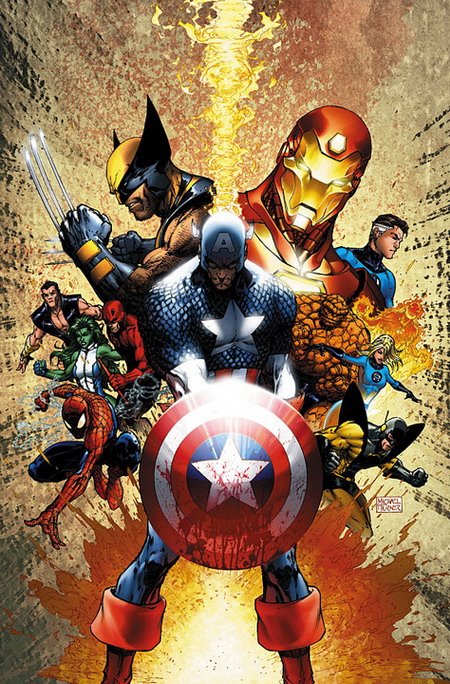
The main one of these is the fact that Civil War tore Marvel's community of superheroes in half, and it LEFT things that way - sign up or get locked up in the Phantom Zone, period. Not a dream. Not a hoax. Not an imaginary story. The basic state of affairs now in Marvel Comcics is a fascist dictatorship - that kinda makes it hard to go back to telling ordinary superhero stories about Mole Man attacking Manhattan.

Which makes the first issue of Brian Michael Bendis' 'the Initiative' launch of the Avengers all the more ironic, since in it, Mole Man DOES attack Manhattan, and a newly-minted team of Avengers spring into action to fight the menace.

You can't help but trip over problems, right from the first page, when the Wasp asks 'Am I to assume a training exercise to see how we work together is completely out of the question?'

She gets a smug response, and a very large amount of property damage ensues - exactly the kind of thing the Registration Act was designed to prevent.

The battle itself isn't all that interesting, except for the fantastic artwork of Frank Cho. No, the issue's only real point of interest is the sequence of scenes in which Tony Stark and Carol Danvers, standing before a cool wall-display of every 'right-thinking' superhero currently in play. Like a couple of mouth-breathing virginal fanboys (pause here while Hippolyta deadpans 'is there any other kind?'), they set out to assemble 'the greatest roster ever.'

Cue the irony here, since the roster arrived at is the single worst one since the dark days of the Forgotten One and Doctor Druid.

Iron Man, of course, and the Wasp, and the always-pleasing presence of the Black Widow (the Steve Epting-pencilled stretch where she led the team stands as one of the best runs on the title). But after that, things start to fall apart - Ms. Marvel is OK, but the perennially-boring Wonder Man is here straight out of the 80s, right down to the inability to fly and the Reagan-era tracksuit. Add to that the only superhero in the Marvel lineup MORE boring than Wonder Man - the Sentry, as dumb and derivative a character as anybody's dreamt up in quite some time. Super-strength, vague energy-powers ... whatever! Yech. And that pales beside the final member, the Greek god Ares, who for the last 30 years has been one of Thor's super-villains. He cares nothing for mortal life, and he carries an enormous axe - but hey, at least he registered.

Still, the discussions are interesting. Carol Danvers asks the question Avengers (indeed, super-team) fans have always asked: why not just assemble a team of powerhouses? At one point Carol declares that the Wasp was the best Avenger, and at another point Stark says the same of Thor. Neither nominates Captain America, and the reader can't help but notice the reason why: because Carol and Stark are both victorious Nazis, and Cap is off in a gulag somewhere. It couldn't matter less whether or not our team stops Mole Man: it's bad guy v.s. bad guy.

The whole thing is made all the more depressing by Bendis' comments in the letters page (you almost expect disagreeable parts of each letter in the future to be blacked out). He promises a big surge of super-villains in upcoming weeks, and he writes "Now that we know who the heroes are, we will set up for the villains."

Some of us - especially those of us who maintain that there's no second, subversive meaning behind all this Civil War nonsense - aren't quite so certain we now 'know' who the heroes are, but it's instructive to know that Bendis doesn't have that problem.

But then, none of this touches on the week's comic that everybody's most likely to have heard about, right? Talk about press attention: in the latest issue of Captain America, a handcuffed Steve Rogers is heart-shot by a hypnotized Sharon Carter. See the news on your local evening broadcast.

There are at least eight different ways this could be reversed, but we here at Stevereads think not. Given the current fascistic atmosphere at Marvel, we think the Steve Rogers Captain America might very well be dead, the identity to be replaced by ... well, what the Hell difference does it make WHAT replaces him? The whole foundation of the Marvel universe is now rotten beyond recall, except by some kind of total rewrite. Which would be - will be - boring and time-consuming and utterly manipulative.

It's a sad state of affairs, but at least we still have DC, surfing an almost unprecedented high.

Wednesday, February 28, 2007

Comics! the end of the world as we know it!


A banner week in comics! Everything from little tidbits to continuity-shaking mega-events was on hand at the Android's Dungeon. The mouth-breathing virgins at that venerable establishment were all a-twitter over it, in much the same way the rest of us start heart-afluttering when Hippolyta strides into the room (we suspect Hippolyta herself would never under any circumstances stride into the Android's Dungeon, so we'll never see the two worlds meet, alas).

Starting out on the tidbit side would be the latest issue of Conan, a rollicking good time with magnificent artwork and a glowering Cimmerian who's always perfectly in character. Robert E. Howard would very likely have been irked beyond measure by the legendary rendition of his character made by Roy Thomas and John Buscema, but he'd have flat-out LOVED this new run, which bids fair to being the best adaptation of the character yet done in any medium (things are equally good over in Red Sonja, in case anybody's interested).

Also on the tidbitty side is the first issue of 'Legion of Monsters' - we here at Stevereads know nothing about this thing, having encountered it by chance, but half of this particular issue deals with the retro Marvel horror character Werewolf by Night.

Only this is a Werewolf by Night for the Midnighter generation - he's no longer a victim as he was in the '70s. No, he not only controls his transformations but revels in them. In this issue (drawn by Gred Land, whose weirdly photographic work we confess we're liking more and more), our hero saves a comely young female werewolf from her superstitious townspeople, and even though it's only eight pages or so, you want more when it ends. Half the issue is taken up with a rather by-the-numbers Frankenstein's monster story, but we here at Stevereads call for a monthly Werewolf by Night title, drawn by Land and while we're at it, written by this issue's scribe Mike Carey.

Moving out of tidbit range, we find the lastest issue of The Amazing Spider-Man, written with unusual delicacy by J. Michael Straczynski and drawn with career-high skill by Ron Garney.

The story so far: Spider-Man has broken from Iron Man's fascistic ranks and taken his wife Mary Jane and his Aunt May into Motel 6 hiding while he figures things out. Of course since his identity is public his movements have been tracked - although in this case rather improbably only by the incarcerated Kingpin (not the government, which presumably can afford more tracking gadgets than are available at the prison commissary). Kingpin has put out a hit on Peter and is family, so half the issue shows Mary Jane and Aunt May in an assassin's crosshairs.

In the meantime, Straczynski is presented with the unenviable task of needing to tell his story without revealing any of the dramatic revelations over in the concluding issue of Civil War.

He pulls it off wonderfully. Nothing in this issue feels forced or avoiding, especially the Daily Bugle newsroom scene that should have been the weakest in the issue. The neglected central figure in this whole Civil War storyline is J. Jonah Jameson, and he doesn't get the moment he deserves in this issue, but the sequence is very strong anyway, as is the rest of the issue.

'The rest of the issue' boils down to one thing and one thing only: when Peter Parker gets back to his Motel 6 to comfort Mary Jane and Aunt May, his spider-sense tells him something is wrong. He lunges to save Mary Jane and succeeds, only to realize that Aunt May has been shot.

This is a watered-down version of what should have happened - clearly, the whole Civil War storyline SHOULD have huge personal consequences for everyone involved. Identities are known; dependents are known - it shouldn't just be the Kingpin who's making hay off all this.

Nevertheless, it's Aunt May who gets shot this time around. That specific thing has never happened to the venerable lady before, and although Spider-Man #200 upped the ante for Aunt May peril, this is the logical extension of that.

This issue ends with Aunt May gutshot - if she's to live, she'll need extensive immediate medical attention. The writers of Civil War have made it completely impossible for Peter Parker to GET her that aid, without being promptly hauled off to jail. We'll see how - or if - they resolve it in the next issue.

Fortunately, all is not lost at Marvel. As will almost certainly be the pattern for the next few years, Marvel gets to tell its GOOD stories only in alternate places - in the Ultimate continuity, or, in the case of the 'Illuminati' mini-series, the past.

The second issue of 'Illuminati' is a potent little delight. The premise, as all of you will no doubt remember, is this: the movers and the shakers of the Marvel universe (minus the Black Panther, Doctor Doom, and Magneto, much to the detriment of the idea) get together regularly as a sort of Ex-Com board meeting. Our cast is Reed Richards, leader of the Fantastic Four, Iron Man of the Avengers, Prince Namor of Atlantis, Professor Xavier, leader of the X-Men, Doctor Strange, Master of the Mystic Arts, and Black Bolt, king of the Inhumans. Namor is the closest we come to any kind of partisan bickering, although writer Brian Michael Bendis does a wonderful job of it (a wonderful job that SHOULD be ongoing in monthly titles for HALF of these characters ... how shameful is it for Marvel that they have no ongoing title for the Sub-Mariner, Doctor Strange, OR the Inhumans? DC is thinking about giving an ongoing title to Ibis the Frickin Invincible, but Prince Namor goes a-begging?).

In this issue Reed Richards shares with his fellow Ex-Com members his quest to find all the gems of power that outfit the Infinity Gauntlet, the better to make sure they never fall into the wrong hands. Bendis does a curiously un-subtle job of making the point that ANYBODY'S hands would be the wrong ones for that amount of power, and that's not his only failing so far - true, his Reed Richards and his Iron Man are note-perfect, but he clearly has no idea what to do with either Doctor Strange or Black Bolt (about whom it's not even made clear the question of language - without Black Bolt's interpreter present, has any roster of hand-gestures been agreed upon? Does anybody know what he's trying to say, ever?), and his Professor X is a curiously tentative figure.

Still, Jim Cheung's artwork is fantastic as always, and apart from the Doctor Strange mini-series currently underway, this is the best book Marvel's currently publishing.

Over at DC, the sheer number of really, really good titles is, well, a little embarrassing. Those of us who've been reading comics a long time remember vividly an extended stretch - a very extended stretch - in which Marvel comics were almost uniformly good and DC comics were almost uniformly bad. Times change, it seems.

There's the first issue of the 'Brave and Bold' relaunch, for instance, featuring the positively last appearance of that perennial retiree, George Perez. His artwork here is as legendarily, even weirdly detailed as always, illuminating this inaugural team-up between Hal Jordan and Batman.

Alas, Mark Waid's writing ain't quite so legendary. The main problem with an otherwise nifty issue is that (excepting one wonderful scene with our two heroes gambling in Vegas) everybody in it SOUNDS exactly the same, most certainly including scrappy working-poor test pilot Hal Jordan and aristocratic Bruce Wayne. But the artwork is the selling point here in any case, and Perez as usual doesn't disappoint.

Also from DC is the latest issue of Wonder Woman, written by Allen Heinberg and drawn with superb artistry by Terry Dodson. After three issues of Diana Prince-style futzing around, this is the issue where the one true Wonder Woman finally returns, and for all his tendency to nod and wander, Heinberg handles the moment wonderfully. Oh, don't mistake: this still isn't good enough, not by a long mark. The whole premise of '52' and like titles is that for an entire year the DC universe went without the three titans at its top: Superman, Batman, and Wonder Woman. The journeys each of these three underwent in that year should by rights be the stuff of comics legend, and yet they've been uniformly botched, leached of the epic significance they might have had. But at least as of the next issue of Wonder Woman, the whole question will be behind us, and we'll be free to concentrate on the traditional character again.

And speaking of traditional characters, the current run on Green Arrow continues to be the gold standard by which the character will be measured. Writer Judd Winick and epochal artist Scott McDaniel continue to give us the best rendition of Green Arrow yet made.
The current issue guest-stars Batman, which is both enjoyable and taunting (as some of you may know, we here at Stevereads stand by our conviction that McDaniel could be the greatest Batman artist of all time), and the dialogue is winningly sharp - the villains who draw our two heroes into separate conflicts refreshingly admit outright that they never expected to actually WIN against two of DC's A-list heavyweights. This is definitive work.

As is the current run on Robin, surely the best that character has ever received (apart, that is, from his occasional appearances in the old Scott McDaniel run on Nightwing). In this latest issue, all Tim Drake wants to do is successfully go out on a date with a beautiful girl, and his evening keeps getting interrupted by Batman and the super-villain of the week. It's funny stuff, rendered just so by Adam Beechen's expert writing. This 50-year-old character has never been in better hands.

But none of this really matters, not this week, not in the shadow of the most important - in every neutral reading of that word - comic of the year. No, Marvel's Civil War #7 must command any comic-book discussion this week, no matter what our mighty Hippolyta says.

And true to form, it's an unmitigated disaster. The entirety of Marvel's Civil War storyline has been one long exercise of poor judgement, a What If story cranked up on black market steroids. Any hope that the fascists-v.s.-freedom fighters plotline could be resolved with any degree of coherence, let alone satisfaction, has been dwindling for months, to the point where the main motivation for reading issue #7 was to see just how big a frickin train wreck it would be.

The answer? Pretty damn big. The bulk of the issue is devoted to the gigantic battle between Captain America's forces and the fascist, gulag-operating forces of Iron Man. This battle rages back and forth - Hercules uses the fake Thor's fake hammer to crush the fake' Thor's fake head, Prince Namor and a bunch of Atlantean warriors join the fray on Cap's side for absolutely no reason whatsoever, the Vision disrupts Iron Man's armor (a trick he must have picked up from Kitty Pryde, but nevermind), and just when it looks like Captain America's side might be winning, a group of oridary working joes tackles him for absolutely no reason whatsoever. This causes Cap, for absolutely no reason whatsoever, to SURRENDER and order his troops to stand down. The issue ends with him in jail, the gulag in full operation, and Tony Stark in charge.

In other words, the bad guys win.

Somewhere out there, Stan Lee is spinning in his grave.

And the worst part of it all is that this isn't the Ultimate continuity ... it ISN'T some What If hypothetical. This IS the Marvel Universe now. A universe in which the government not only controls the superheroes (doling out assignments, hiring and firing, cutting a weekly paycheck) but jails anybody who doesn't play along. A universe in which Venom and Bullseye work for he government and Captain America is in jail.

Howls of contempt for this conclusion have echoed from one end of the Stevereads intern-pool to the other, and rightly so. The combination of how terrible this whole Civil War storyline was handled and how title-by-title strong DC currently is has actually created the temptation to ignore Marvel comics altogether. We'll see what next week brings.

Wednesday, January 10, 2007

More comics! To heal the rift!


It was a rainy day here in Palo Alto, and we wandered into the Android's Dungeon looking to be amused. As a result, we walked out with a small batch of comics bought with our own ducats, not borrowed from Elmo or filched from my arch-nemesis Pepito.

A winning batch of comics! On the strength of its Civil War tie-in cred alone, I stooped to buying an ... ick ... Punisher title: 'Punisher War Journal.' And boy! Am I glad I did! The luminous scripting by Matt Fraction and the incredible artwork by Ariel Olivetti, the combination, is just stunning (stunning enough to insure that I go back and buy the first issue of 'Punisher War Journal' and every subsequent one that features this pair) but also perfectly distinct: at no point did I feel like I was reading any other comic on the market.

The plot of course revolves around where the Punisher fits in with the overall Civil War storyline - specifically, whether or not Captain America can trust the most notorious and ruthless vigilante in the Marvel Universe.

The best thing about Fraction's writing is that he can write dialogue for these two men - the polar opposites of the Marvel Universe - in which both are completely in character.

My favorite part of the issue was the way Fraction consistently portrays a Frank Castle who knows that Captain America is every bit as tough and brave as he is, but who's somehow managed to hold on to all the higher intangibles he himself believes he can't afford.

I have only one question about the issue, one point I liked but didn't derive. At one point, a gigantic retired S.H.I.E.L.D. agent says something to himself as a kind of private mantra: "Whatever he commands along the way ... we must without recalcitrance obey." I confess, I can't place the quotation - I wonder even if Fraction invented it. It has the ring of dependency-prose, but I kind of like it nonetheless: any of you out there recognize it?

The second issue we bought on that rainy afternoon was the latest issue of Spider-Man, with wonderful scripting by J. Michael Straczynski and fantastic artwork by Ron Garney (he gets better and better with every issue, but he's not at all right for Spider-Man ... but I can't quite figure out where he WOULD be perfect - any thoughts? Not a team book, certainly, but still ... the perfect match eludes me...).

The centerpiece of this issue is the rooftop heart-to-heart between Captain America and Spider-Man. Naturally, having defected from the government's fold, Spider-Man is looking for some consolation from the man running the opposition. Cue a standard-issue Captain America set-piece, but despite Spider-Man's wonderfully delineated awestruck reaction ("Can I, like, carry your book to school? For the rest of my life?"), this is like no Captain America set-piece ever written.

He recalls a passage from Mark Twain, about what constitutes 'the country' - it's a long passage, and I couldn't help but be grateful for its quotation, since, for very different reasons, I've always treasured it too (it was the favorite of a friend of mine, a long time ago). It's a call for individual responsibility, and it ends with this:

"If you alone of all the nation shall decide one way, and that way be the right way according to your convictions of the right, you have done your duty by yourself and by your country. Hold up your head, you have nothing to be ashamed of."

Cap finishes and then adds this on his own: "Doesn't matter what the press says, doesn't matter what the politicians or the mob say. Doesn't matter if the whole country decides that something wrong is something right. When the mob and the press and the whole world tell you to move, your job is to plant yourself like a tree beside the river of truth, and tell the whole world ... no, you move."

This is something new, a Captain America who basically equates politicians with the mob, a Captain America who disavows duty to elected officials, presumably including the President, a Captain America, in other words, who no longer espouses patriotism in any of the ways it's been previously understood.

I submit that this is a Captain America set-piece specifically tailored for the age of W.

This isn't just a speech Captain America gives when Reed Richards and Iron Man are spearheading a Registration Act with which he disagrees - this is a speech Captain America makes when his writers feel their own participation in the democracy of their birth has been violated - violated not by the other guys being in power, darn them, not by lawful legislation with which they whole-heartedly disagree, but ... well, by EVIL being done in their name.

I'm not completely sure that isn't what the entire Civil War storyline is and has always been about: the particular tension felt by all thinking Americans living under the unelected rule of a crude, stupid man who maintains without irony that he receives governmental instructions from God. The country awoke one morning and found that the Supreme Court had awarded the presidency to this man (by a majority composed entirely of justices who owed their appointments to Republicans), and ever since there's been a schism, a rent in the psyche of the country.

Certainly the ur-text of this little theory of mine would have to be the Civil War mini-series itself, and the latest issue is a textbook case.

My twitchy, hyper-intelligent young friend Elmo scalded this issue, saying he's eager for the NEXT issue so the whole thing can be over and we can wait ten years for 'some smart writer to undo it all,' and I can see his point of view.

Because this is more and more looking like a mistake, this entire plotline. And it's a mistake because it can't GO anywhere good. That wouldn't be a problem in a novel - novels thrive on such plotlines - but comics are all about GOING somewhere ... the Avengers, the Fantastic Four, these aren't limited mini-series featuring new characters.

You can see the incredible appeal of the initial idea. Super-heroes fight super-villains in downtown Manhattan, doing massive amounts of property damage before the heroes win - what if the government decided to crack down on the whole business? Demand that super-heroes register, etc? (that step right there is where W. comes in - that the government would force you to register, and that it would incarcerate you if you refused AND say it was because you weren't being patriotic ... ). Easily understandable that a bunch of writers would think the idea had enormous potential and want to leap at it.

But this is starting to look like a story that shouldn't have been told. Stan Lee and Jack Kirby knew that such stories existed, of course: they flirted with the mother of 'em all - what if our heroes are faced with a foe who's simply too powerful for them to beat? Stan and Jack did it with Galactus and treated us to three issues of the Fantastic Four getting protractedly, indisputably beat.

But then they hauled out the Ultimate Nullifier (if ever a plot device were more aptly named...), a thingamagig even Galactus feared, and he packed his bags and left town.

Back then, we all concentrated on how NEATO the concept of an 'ultimate nullifier' was - but today's comic audience rightfully demands more. Any variation of a deus ex machina for this Civil War storyline will, I think, be met with pitchforks and torches.

For the longest time, I assumed the ultimate nullifier in this case would be Doctor Strange. But there he is in this latest issue, vowing (to his close personal friend the Watcher - when did THAT happen?) to stay above it all. The only other possibility for a solution (because the storyline obviously NEEDS a solution, not a conclusion - the Marvel universe can't go on if half its heroes, including Captain America, are hunted fugitives) that's arisen so far is in the latest issue of 'Frontline,' where ace reporter Ben Urich says he's figured out the 'real reason' for the Civil War. We'll see what that turns out to be.

In the meantime, those of us who DO expect more complexity from our comic-stories will have to cross our fingers that in a month's time we don't encounter a dream, a hoax, or an imaginary story ...

Thursday, October 05, 2006

comics! Civil War escalates!


My nemesis Pepito, in his blind and stumbling way, sometimes picks some comics that are actually good. This week, the haul that ever-vigilant Elmo yoinked from Pepito's room while its occupant was off dirty dancing at the Kit Kat Club was mostly well-done.

True, there was the usual proportion of crap so characteristic of Pepito: there's still swill like 'Supergirl and the Legion of Super-Heroes' (when, oh when, will the plug be pulled on this, the VERY WORST incarnation of the Legion that's EVER EXISTED?) and 'Secret Six' (yeesh - of all the lame-ass concepts for a super-team book... made all the worse to see by this issue's guest-star, the Doom Patrol, one of the BEST concepts for a super-team book, but without a book of their own these sixty or seventy years) ... and Pepito also bought 'Ultimates,' about which I've already said all I'll be saying.

But the rest of it - from a very good, surprisingly good issue of 'Daredevil' to yet another winning issue of 'Blue Beetle' (the title is in direct violation Steve Peeve #114-50/c: established comics characters being replaced by second-grade recruits chosen for their gender or ethnicity - it's a sign of the worst corporate craven irresponsibility), an issue that includes a classic riff on the oft-used 'newbie meets Batman' motif:

Blue Beetle: I can tell my parents I helped the Batman

Batman: say Superman

Blue Beetle: Huh?

Batman: Trust me. Tell them it was Superman. Everybody likes him.

Blue Beetle: Doesn't anybody like YOU?

Batman: They're not supposed to.

Hee

Quite a few other DC titles had similarly good parts. In 'The Trials of Shazam' poor crippled Freddie Freeman goes to visit Mary Batson in the hospital. As you may recall from last time, Freddie lost his superpowers during battle with some super-demons, and Mary lost her powers while battling a harpy far, far above Puerto Vallarta. Because comics is still a boys' world, Mary ended up comatose and paralyzed in a hospital room, while Freddie ended up with a soul patch and a hot black girlfriend. Sigh.

At one point in his bedside recriminations, Freddie says the word Shazam' and WAMMO! He's lightning-bolted to the rock of eternity to have an audience with the new Wizard thereof, the former Captain Marvel. Freddie is probably too stunned to ask where the heck his CRUTCH is, even though it's clearly shown getting zapped right along with him. But stunned or no, you'd think it would occur to him to ask where his LIMP is.

In any case, the new Wizard informs him that he'll no longer be Captain Marvel Junior, at which point Freddie had to be thinking "Yes! No longer will I be the only superhero who can't say his own name without losing his powers." The new Wizard informs him that if he survives his upcoming trials, he'll be known as .... Shazam! At which point Freddie had to be thinking "D'oh! I STILL won't be able to say my own name!"

But it seems he'll have lots of company even so - the new Wizard informs Freddie that ALL the Marvels will be reborn - and sure enough, on the panels behind him we see the disastrous, embarrassing rest of the Marvel extended family, including Uncle Dudley (guess the old pederast will actually have super-powers now, instead of only pretending to). We'll have to see if Judd Winick can make it work.

The latest issue of "52" and the latest "Teen Titans" neatly dovetail, since in the former we first meet the characters who are so scattered and embittered in the latter. '52' has great panel breakdowns by Keith Giffen and wonderful pencils by Joe Bennett, and 'Teen Titans' features the increasingly-annoying artwork of Tony Daniel. Both issues kept things moving along fairly briskly, although the writers really should make an effort to, you know, actually TALK with each other. In 'Teen Titans' Zatara (Zatanna's cousin, possessing her same backwards-magic powers) tells his erstwhile teammates that his powers only work on things, not people. But in '52' he's stopped right in the middle of backwards-ordering Blockbuster to 'freeze' ... and while we're on the subject, shouldn't the writers make it clear that this restriction certainly DOESN'T apply to Zatanna herself? Because if it did, I can think of a couple of fairly big DC storylines in the last two years that wouldn't have happened ...

The other two DC picks I enjoyed mostly for their artwork: Scott McDaniel doing great work on an Hourman issue of 'JSA Classified' and Andy Kubert doing great work on Batman. The Hourman story is fairly standard, but kudos to Grant Morrison for his sparkling dialogue in 'Batman.'

But the top honors for the week go to Marvel's latest batch of 'Civil War' tie-ins - despite all my problems with it, this storyline is turning in consistently involving issues. We have three this time around:

Frontline #6 - this title is still annoying me with its multiple-storylines, but that annoyance is lessened when a couple of the storylines are really good. The Ben Urich strand in this current issue makes for very good reading (although again, the people involved really ought to talk to each other about what they're doing ... this issue shows Thor killing Goliath by blasting his head with lightning, when the latest issue of Civil War itself shows - in graphic detail - Goliath getting lightninged straight through the heart). And the issue's shocker is Speedball getting shot (the artist re-creates the famous photo of Oswald getting shot) - he's on his way to testify to Congress about his innocence, having had his safety personally guaranteed by Reed Richards. This was interesting reading but incredibly depressing, since the Oswald invocation is SURELY meant to throw suspicion on Reed Richards ... call me naive, but I just don't want Mr. Fantastic to be secretly orchestrating the execution of pesky jailbirds. Iron Man going all villainy I can barely stomach, but not that ...

Captain America #22 - Finally, Cap hashes out his position with Sharon Carter in this issue. They toss around quotes from Thomas Paine and Ben Franklin, and there's some very good lines, like when Sharon asks 'If Captain America doesn't follow the law, who does?' or when Cap points out that America isn't a country founded on law - it's a country founded on the breaking of a law, an unjust law. But as impressive as all of this is, what impressed me the most is that Cap and Sharon waited to have this deep philosophical debate until AFTER THE BOOM-BOOM ... they're getting out of bed and getting dressed when the political science fur starts to fly. Grown ups! They keep their priorities straight!

Amazing Spider-man #535 - Well, this is the issue I've been waiting for: the defection of Spider-Man from the cause of fascism, Peter Parker's realization that he's made a horrible mistake supporting the Registration Act and all the subsequent measures Tony Stark has enacted.

Ron Garney's artwork is once again the best he's ever done, but it's J. Michael Straczynski's writing that's the star of the show. This is the issue that finally confronts several major parts of the whole Civil War storyline, and above everything else, it cements Iron Man's role as the main villain of the piece.

Peter Parker insists on inspecting the gigantic Negative Zone jail Tony Stark and Reed Richards have devised to house all the super-beings who refuse to fall into line with the Registration Act. After the tour, Iron Man says. "So if you had notions of some kind of inhumane gulag, or a dark, dank prison dripping sludge and human misery, you were mistaken." Peter replies that he supposes the place is alright as an interim solution, whereupon Iron Man brings him up short: "This isn't temporary, Peter. This isn't interim. This is permanent. Get with the program." And when Peter is naturally shocked, Straczynski puts even more first-rate dialogue in Iron Man's mouth: "You can't put an atomic bomb on probation! You can't put somebody who flies under house arrest! It's real simple, Peter: they either sign up, or they stay here until they do sign up! And if they never sign up then they stay here for the rest of their natural lives! Do you get it, Peter? Do you get it now?" To which Peter replies "Take off the helmet. And tell me that again when I can see your face." And then for the first time we get a glimpse of the Tony Stark old Iron Man fans would actually recognize: "Do you think I like this, Peter? Do you think I worked my whole life to become someone's jailer? I hate this, Peter. I hate every minute of it. I hate everything about it. I haven't had a good night's sleep in weeks. But we have no choice. We have to follow the law ..."

So there it all is, out in the open, and the next thing we know, Peter is waking Mary Jane and Aunt May in the middle of the night, trying to slip them off the premises before anybody notices. The issue ends with Iron Man exploding through a wall and tackling Spider-Man - although what kind of a fight it could possibly be, considering the fact that Iron Man built the suit Spider-Man is currently wearing and almost certainly retains some kind of electronic control over it - remains to be seen.

But in the meantime, kudos to Straczynski for turning in the single best Civil War issue to date .... always knew he had it in him!

Friday, September 22, 2006

comics! Send in the clones!

Only two comics in the bin this week, but both of note: Civil War #4 and the launch of a new X-Men mini-series.

First things first: Civil War.

Well, at least I can breathe a small sigh of relief: the Thor who appeared so dramatically at the end of the last issue (about a year ago) turns out not to be the REAL Thor. He's a CLONE Thor with a mechanical hammer. So my favorite Marvel character is still MIA, not buddying up with the fascists to char-broil Captain America. Thank Heaven for small favors.

And the writing, pacing, and artwork in the issue are all their usual superlative. So that's good.

You can sense I'm leading up to some 'buts' here, can't you?

OK, let's take them from the small to the large:

Small: Even under the sooper-dooper best of conditions, a Thor clone would only possess physical attributes the original Thor possessed. And as all you long-term geeks out there know, controlling the weather isn't one of those attributes - Thor can't do it biologically, he does it through power granted him by Odin. Still, Reed Richards COULD have rigged some weather-warping technology into the fake hammer, so I let it go.

Small: But even so! Just how fast was this replacement Thor-clone grown? In the timeline of Civil War, it can't have been more than a month since sides were declared - that doesn't seem like enough time to grow an adult clone, teach it everything it needs to know (it calls Dagger by name, for instance), and get it a Thor costume that fits properly.

Which brings up a question every bit as creepy as the whole Iron Man-putting-spy-sensors-in-Spidey's-underwear question from last issue: how long has a Thor-clone been growing? We're told that Tony Stark gathered a lock of Thor's hair after the FIRST MEETING of the Avengers, and absolutely NOBODY is bothered by that. Even though it means that Iron Man is not only a crazy sumbitch super-villain but always has been.

(super-geeky side-note: hair that just falls off your head and winds up in the couch cushions is useless for cloning - it needs to be YANKED off to contain any DNA ... but hey, since cloning a supernatural being from another freakin dimension should be impossible anyway, what's a few follicles among friends?)

Small: Iron Man tells the 'tough old bird' Captain America that the high frequency blast he just used usually puts the human brain in 'shutdown' ... but only ten panels later, none of its victims (including Daredevil, whose head should probably have popped right off) seem to be shut down.

Small: why is it that even after four issues (and countless tie-in issues) we're still not seeing clearly who-all is in Captain America's resistance army? It blunts the drama a bit, still not knowing the sides.

Large: So the Thor-clone kills Bill Foster, blows a hole in his chest, and ... Iron Man still has ANYBODY on his side? Peter Parker says everybody's "a little freaked out" by it, like it was somebody showing up with a tattoo? What the eff?

And of course Large: that final panel. The government recruiting not just foreign nationals (like Radioactive Man) but actual psychopaths - Taskmaster, Venom ... Bullseye. Riiiight. This has its requisite shock-value, but, to use a favorite comic-geek refrain, it would NEVER happen. Millar's storyline is forcing our well-known and long-established heroes to be not only morally bankrupt but downright stupid. It strains the seams of an already head-scratching plotline.

Of course the issue's other big storyline is Sue Richards leaving her husband to join the opposition ... a storyline that has great potential, since that's just the kind of rifts we should be seeing more of. We'll see what comes of it (although, back in the category of Small, I should point out that although Sue in her note to Reed mentions the fish dinner they had that evening, the panel clearly shows her eating steak).

The new X-men mini-series was a much simpler affair: 'First Class,' a kind of re-introduction to Professor Xavier's original class of students, rendered all the more nostalgic for me since I remember clearly buying the FIRST version of this story, about forty years ago. I conjured with its possibilities back then, just like I did with this issue.

It's a simple, day-glow thing, with wholesome homilies and no angst whatsoever, a welcome ray of sunlight in the X-world (over in Uncanny X-men, I'm pretty sure somebody gets gutted this week, and over in Astonishing X-Men, a character gets shot multiple times in the back, and last week in Ultimate X-Men somebody got all the skin on his body burned off ... so you might be able to see what I'm getting at here).

Reading this issue, I naturally started comparing it to that Lee and Kirby first issue of decades ago. I had one person at the time to talk comics with (boy, has THAT changed), and we pointed out how Kirby's artwork seemed crowded and rushed, how Stan Lee's writing - though jam-packed with new ideas - didn't seem nearly so spontaneous or funny as in other titles.

Thinking back on it now, I whole-heartedly agree with myself! X-Men #1 was a decidedly second-rate effort, engaging to me mainly because of the new idea of a SCHOOL of super-heroes.

'X-Men: First Class' is, when you dispense with nostalgia, in every way a superior thing. The artwork isn't anything like Kirby's, but then, KIRBY's artwork in X-Men #1 wasn't much like Kirby's. And the writing is hugely better - smart, funny, and fast-paced.

The culprit, I think, is TV. When X-Men #1 came out, the average house in middle-class America had exactly one TV, and it was a great ponderous thing that showed mostly news and half-hour serials long on action and devoid of character-development.

In the intervening decades, whole generations of kids (and comic book creators) have been raised to think in terms of the hour-long dramas that eventually took root in the industry. I'm sure this issue's writer, Jeff Parker, felt it only natural, the whole concept of an issue in which we not only get good action sequences and an interesting antagonist but also sharp characterization, all pulled together neatly by page 22.

Lee and Kirby paved the way, yes indeed, but it's 'Star Trek' and 'Buffy' that gave us the comics we have today. 'Nuff said!

And next week, if all goes well? ULTIMATES!